


About this worksheet
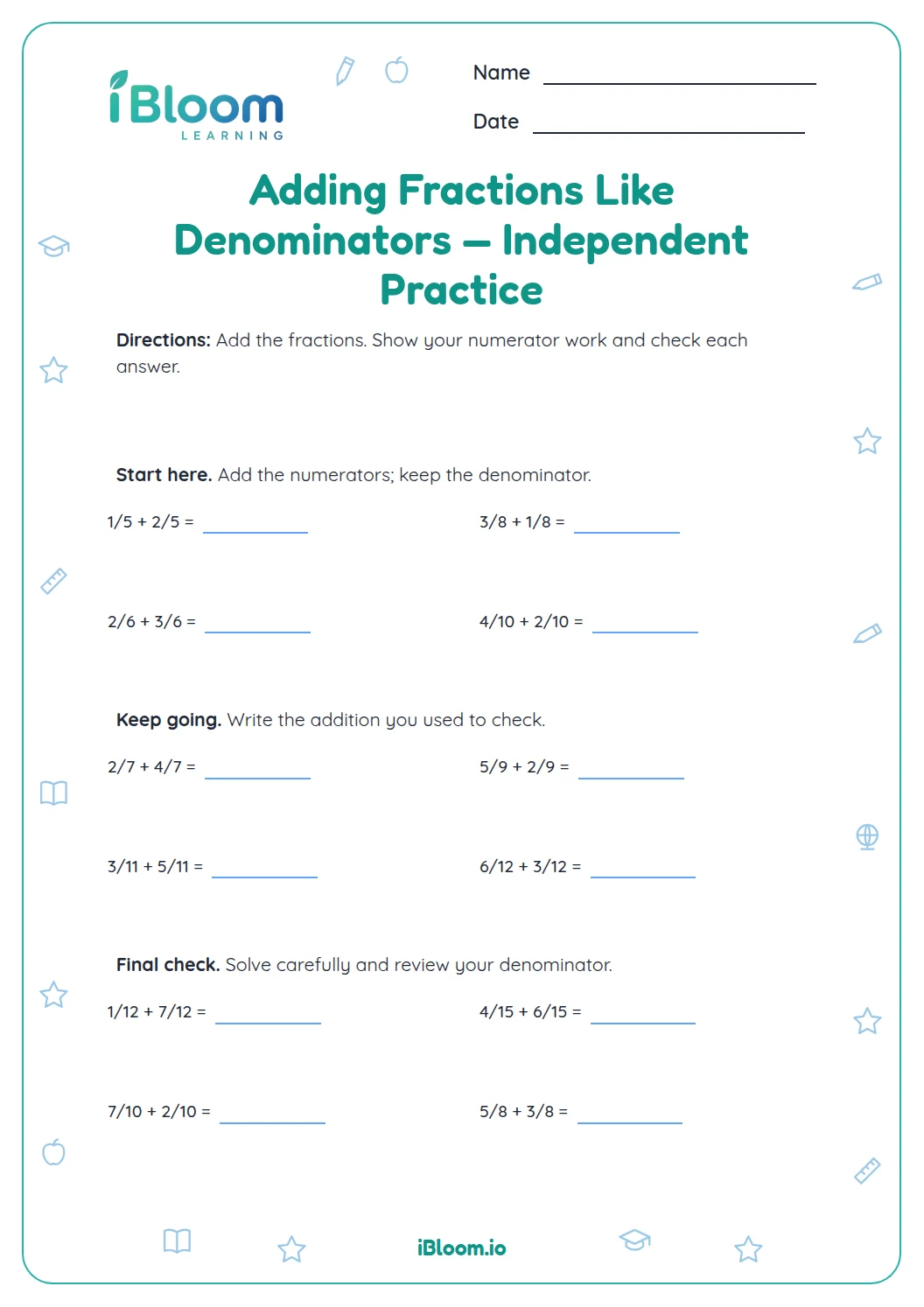
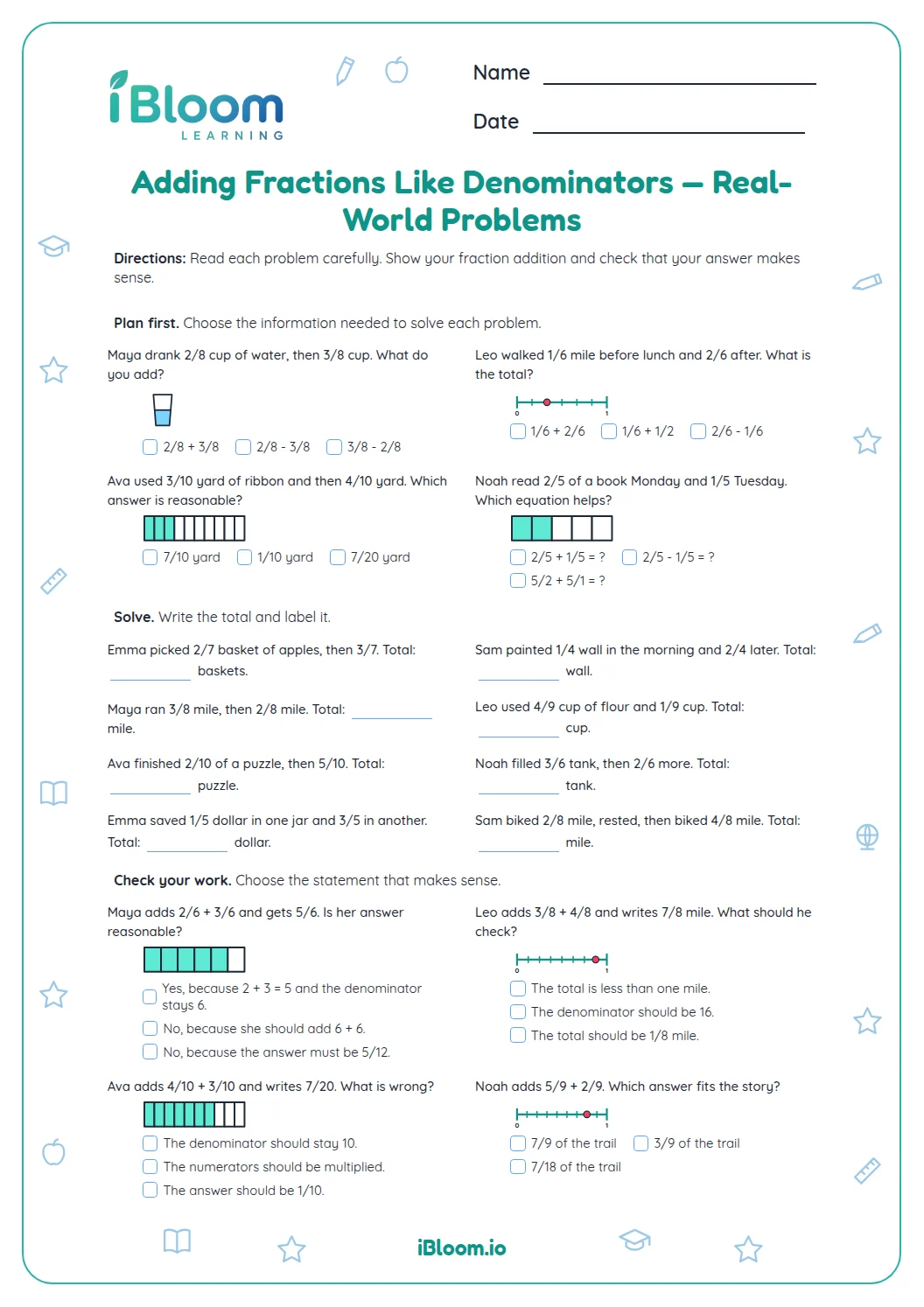
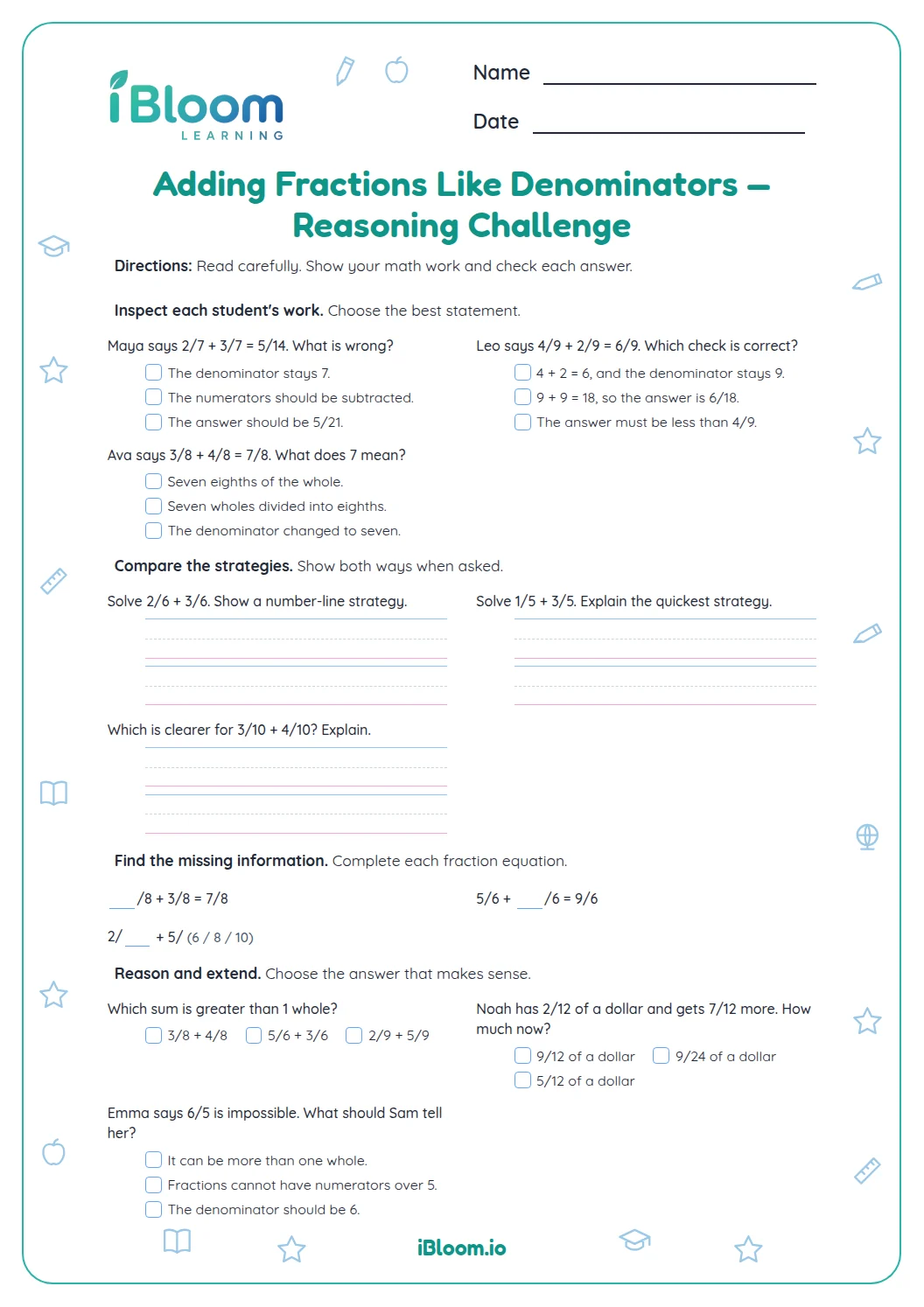
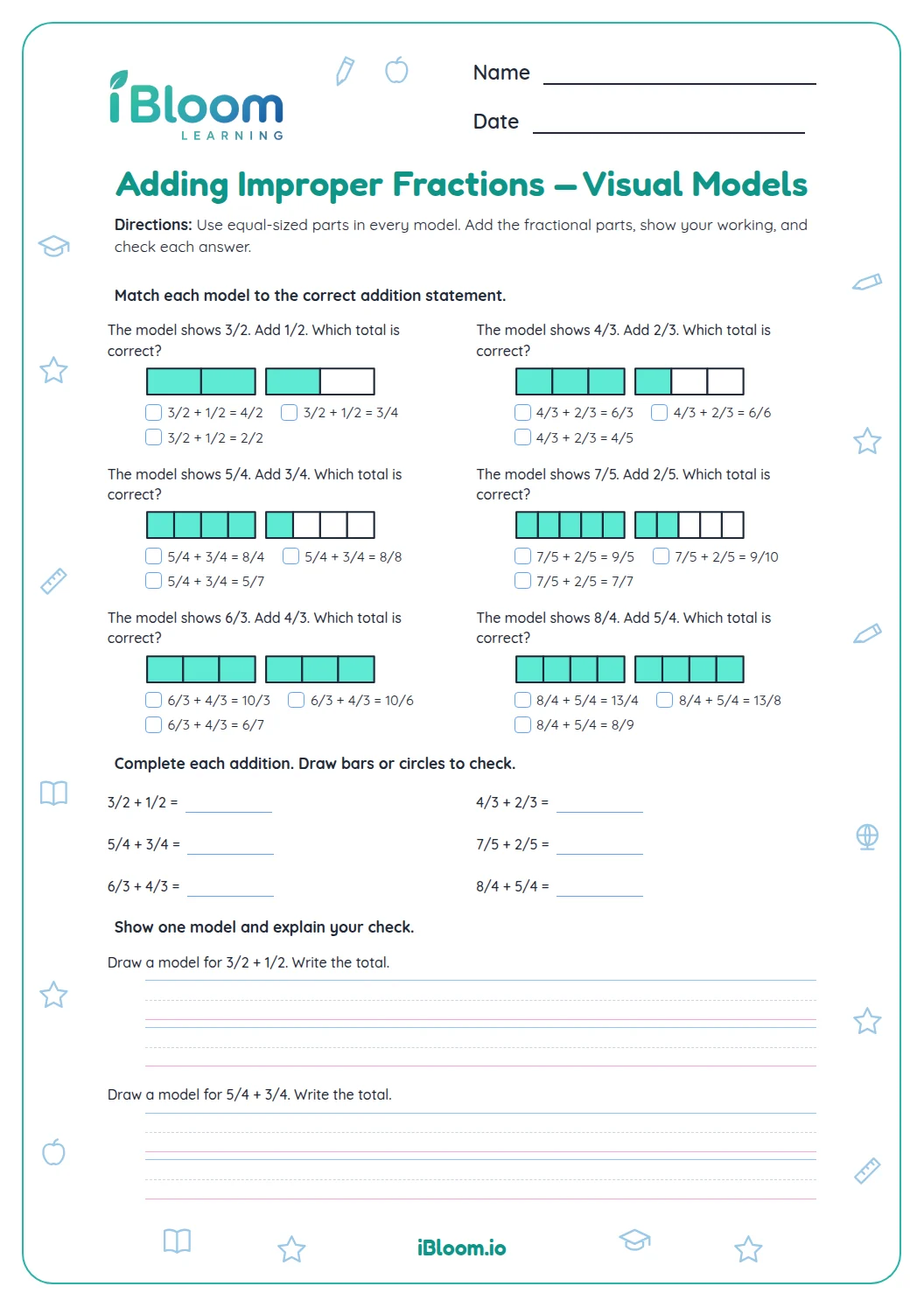
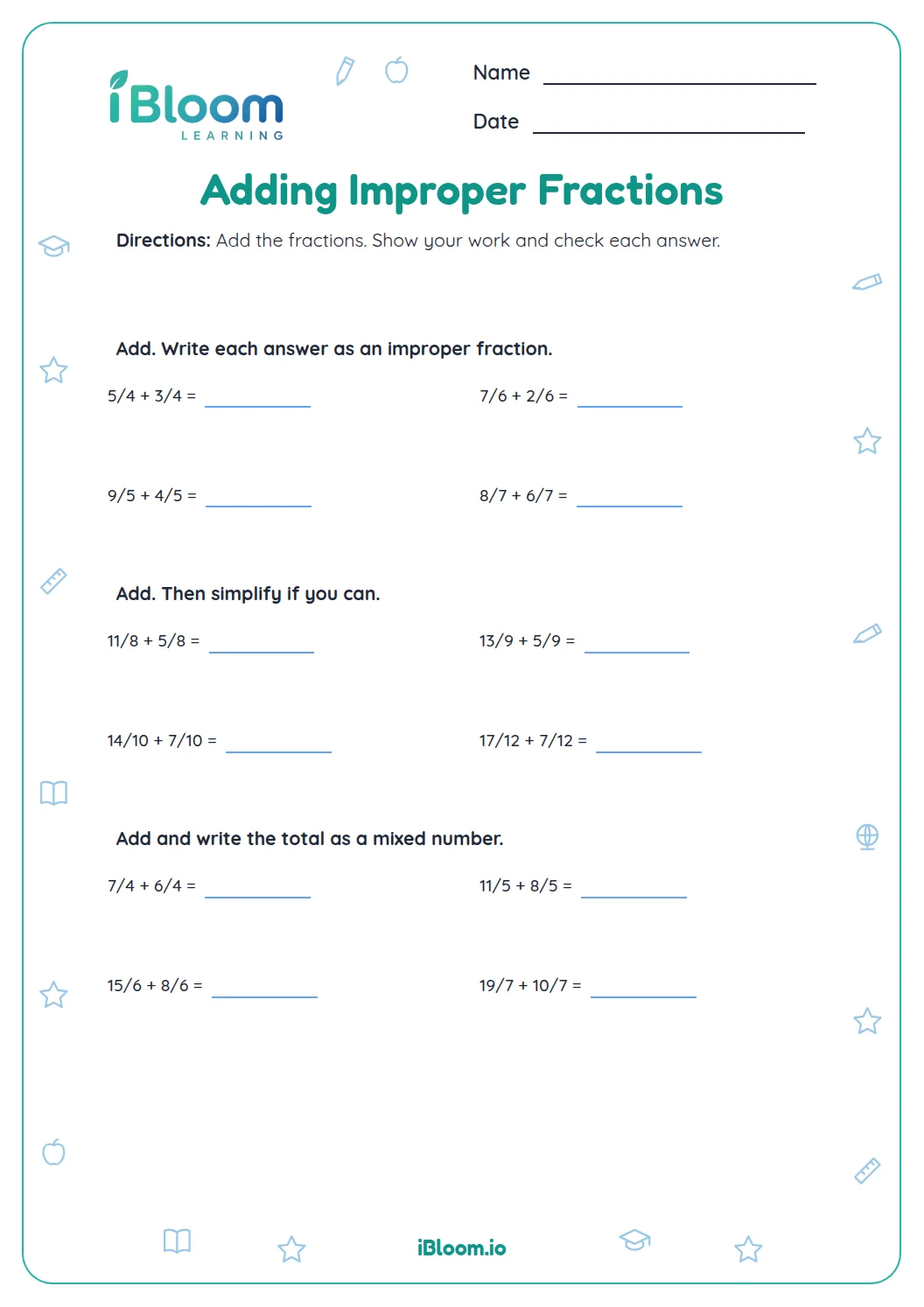
This printable introduces addition of fractions with like denominators through shaded bar, circle, and square models. Children connect a model to an addition sentence, solve sums with denominators from 3 to 8, then apply the same idea in short stories. The sheet has 14 questions in three parts and a separate answer key.
How does a model show fraction addition?
When fractions have the same denominator, the parts are the same size. Add the numerators to count all the parts, and keep the denominator because the whole is still divided the same way.
Question 1 starts with 2/4 and adds 1/4. Two fourths plus one fourth is three fourths.
- 1Start with 2/4.
- 2Join 1/4 more.
- 32 + 1 = 3 fourths, so 2/4 + 1/4 = 3/4.
How can you check a like-denominator sum?
Keep the unit fraction size fixed. For 3/8 + 2/8, count five eighths in all, so the sum is 5/8. The denominator stays 8 because both addends name eighths.
What practice is included?
Fourteen questions move from shaded models to number sentences and short stories. Model questions connect a starting fraction to addition; later items ask children to compute totals directly.
- Part A: connect a fraction model to addition
- Part B: add like-denominator fractions
- Part C: apply addition in short stories
How can an adult guide this practice?
- 1Read the denominator to name the size of each part.
- 2Count the numerator parts in both addends.
- 3Add those part counts and keep the shared denominator.
- 4Check whether the total is less than, equal to, or greater than one whole.
- 5In stories, include the unit in the answer.
Common fraction mistakes and fixes
The mistake
Adding the denominators too.
The fix
Keep the denominator because both addends count the same-sized parts.
The mistake
Adding numerators but changing the part size.
The fix
Say the unit fraction aloud; fifths stay fifths in the total.
The mistake
Leaving off the story unit.
The fix
Reread the question and include miles, yards, or the described fraction of a whole.
What to practice next
Make more practice
Further reading
Questions parents and teachers ask
What stays the same when adding fractions with like denominators?
The denominator stays the same because it names the size of each part. Add the numerators to count how many same-sized parts there are altogether. This page practices that method with models, equations, and two short stories. Families can use the key after the child has explained the numerator and denominator.
How do you add 2/4 and 1/4?
There are two fourths and one more fourth, making three fourths, so the sum is 3/4. The first model question shows 2/4 and asks children to choose the equation that adds 1/4. The key marks 3/4 as correct. Families can use the key after the child has explained the numerator and denominator.
Can a sum be 4/4?
Yes. Four fourths make one whole, so 3/4 + 1/4 = 4/4. One of the worksheet questions asks children to complete that sum, and the answer key keeps the result in fourths. Families can use the key after the child has explained the numerator and denominator.
Why do the models use equal parts?
The parts must be the same size before they can be joined and counted. Like denominators name equal-sized parts, such as eighths. The shaded models make those equal parts visible before children solve sums on their own. Families can use the key after the child has explained the numerator and denominator.
What does the word “in all” signal in a story problem?
“In all” asks for a total, so addition fits the story. The child adds the numerators when the denominators match, then includes the unit named in the question, such as miles. Families can use the key after the child has explained the numerator and denominator.