



About this worksheet
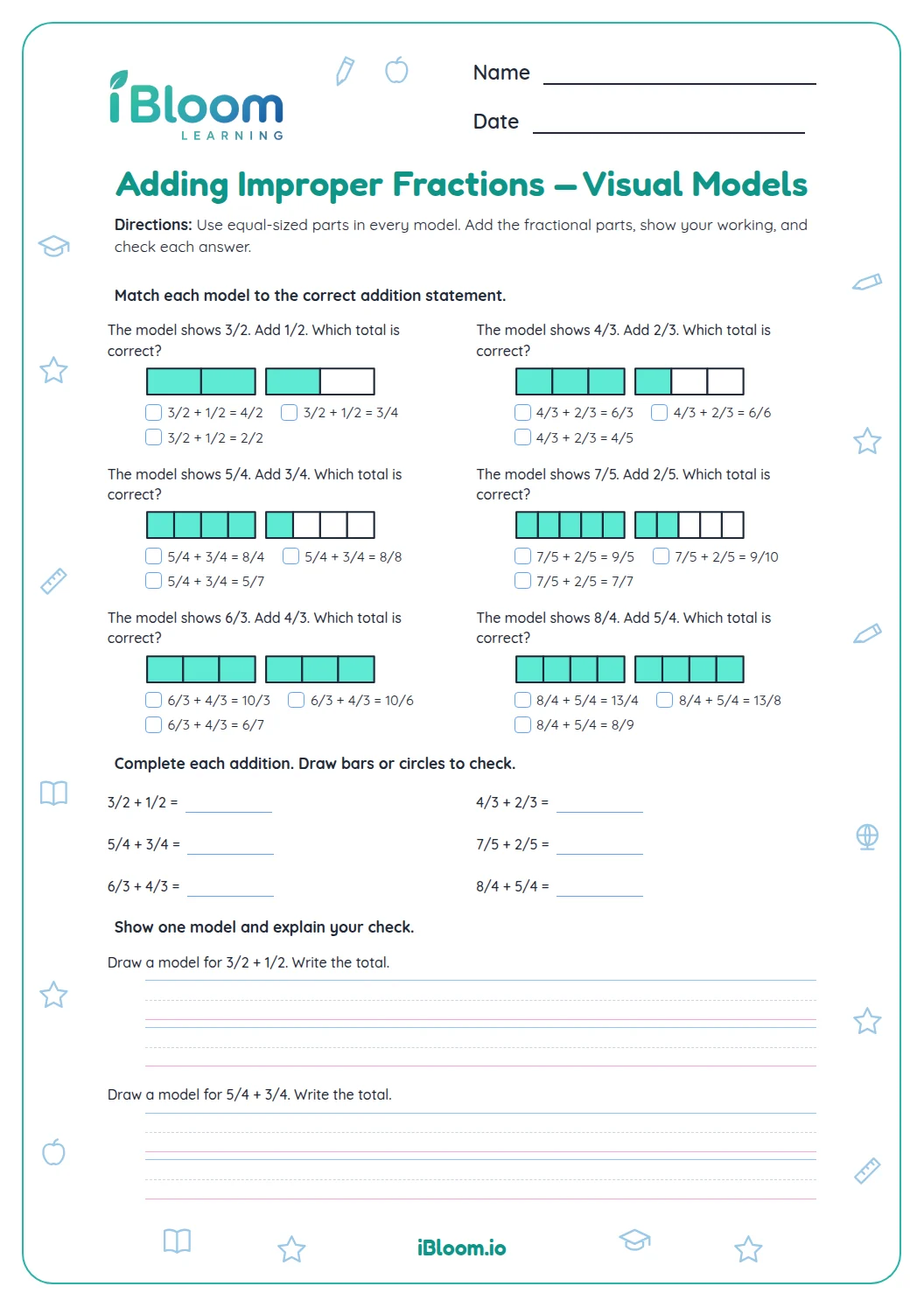
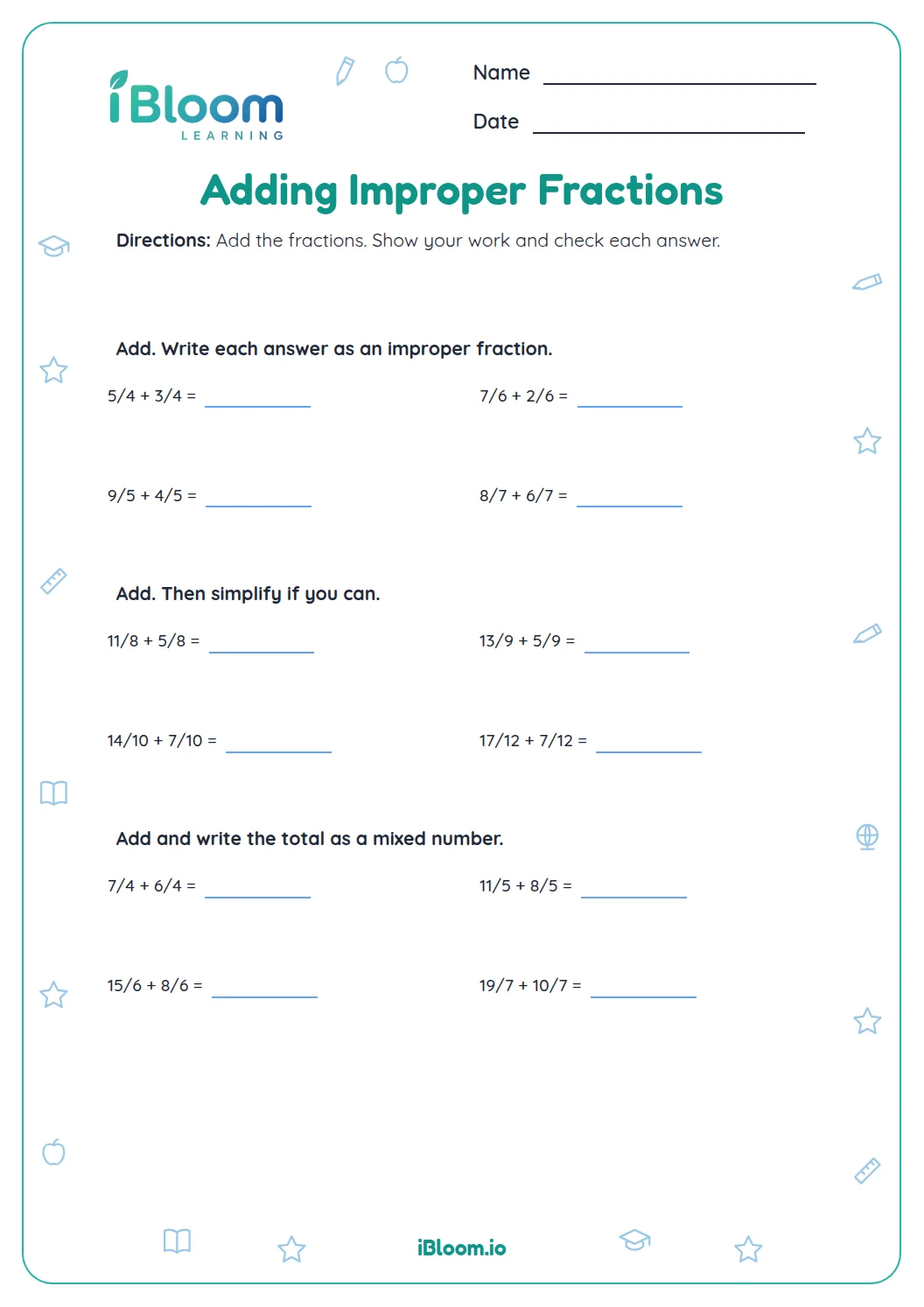
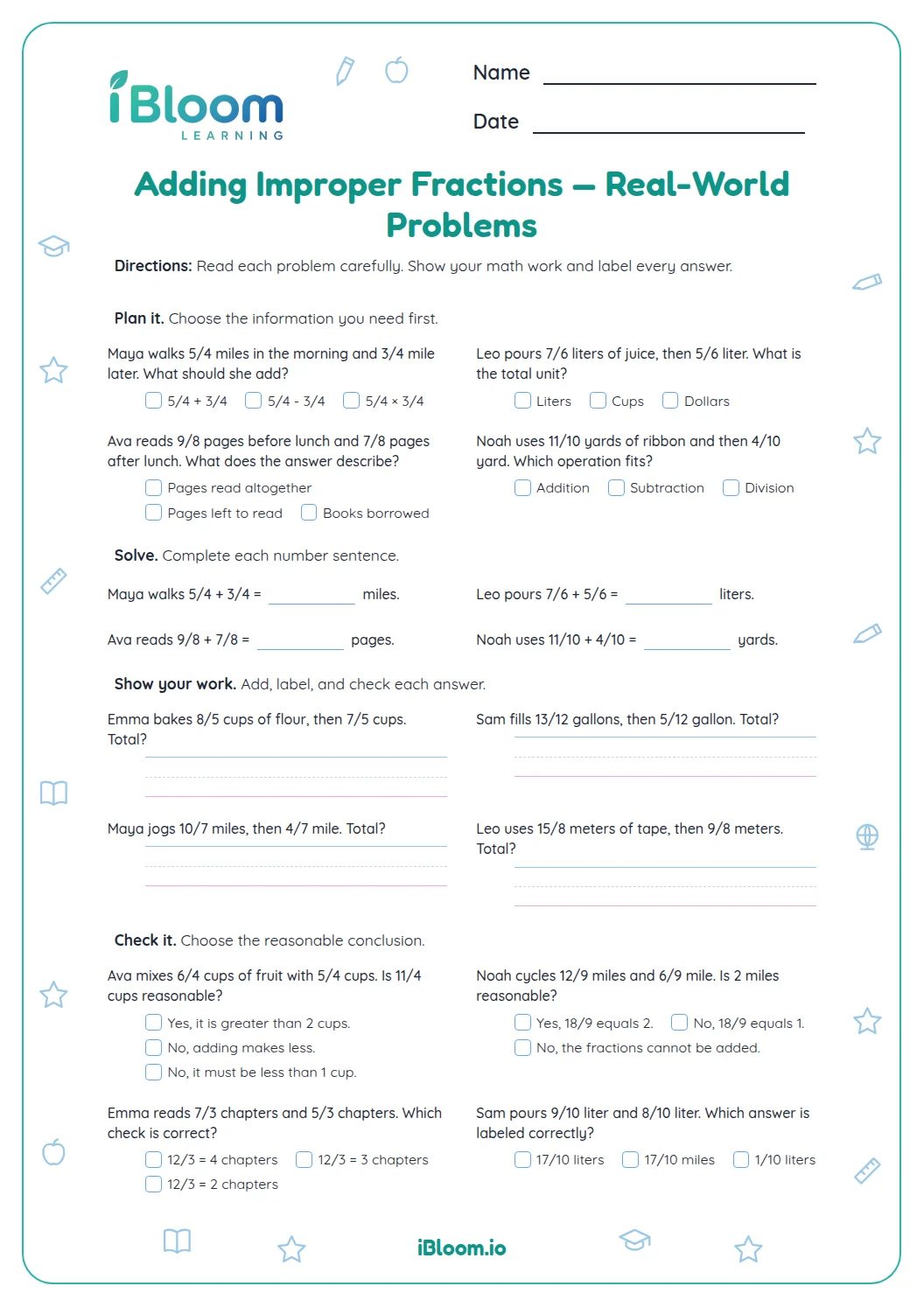
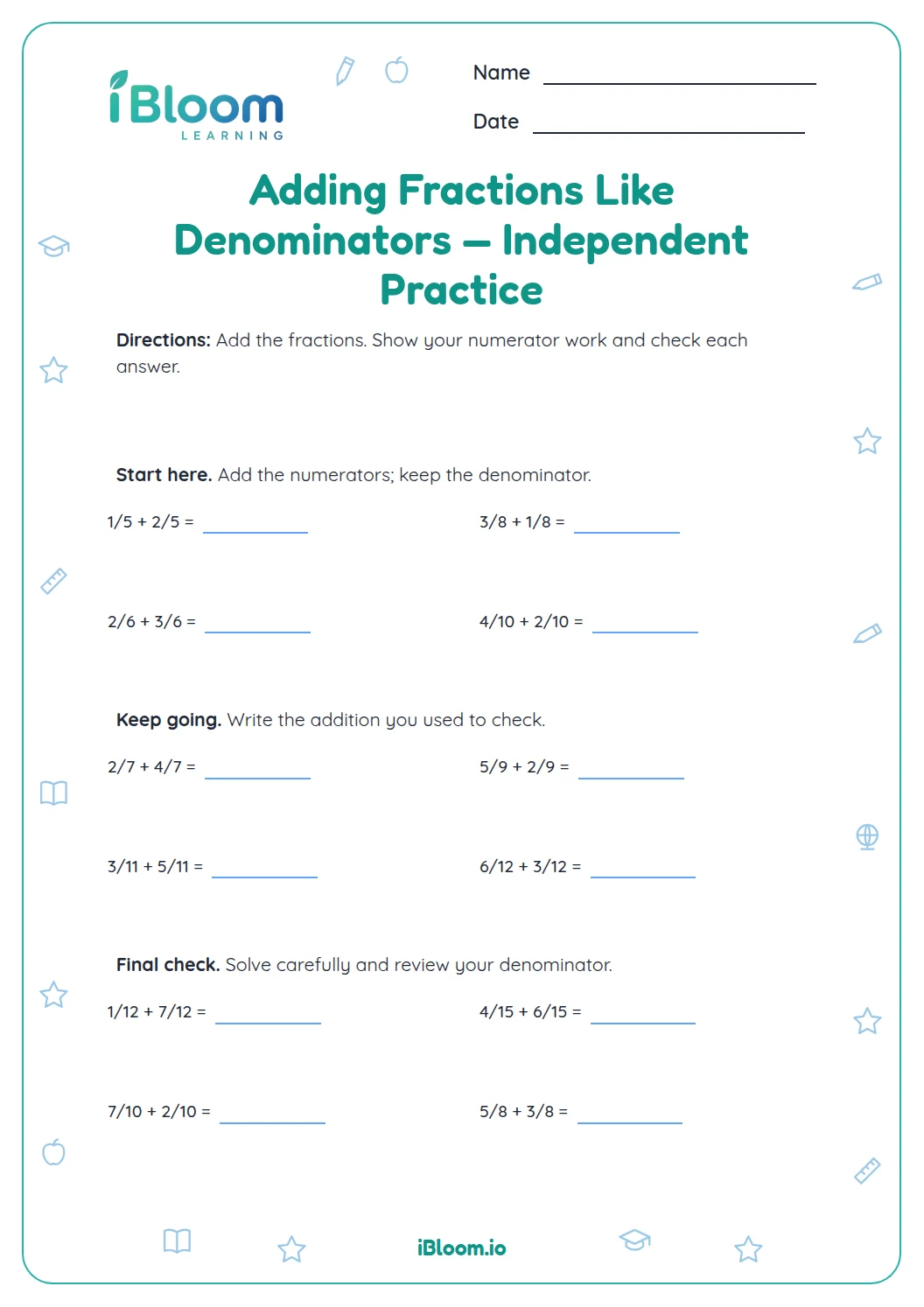
This printable worksheet gives Grade 3 students 15 questions on adding improper fractions with like denominators. Students add the numerators, retain the denominator, and rename totals as mixed numbers when needed. The final part asks for the closest whole number. Denominators are thirds, fourths, sixths, and eighths, and a separate answer key is included. The skill aligns with Common Core 4.NF.B.3.c.
Aligned to 4.NF.B.3.c
How do like-denominator fractions add?
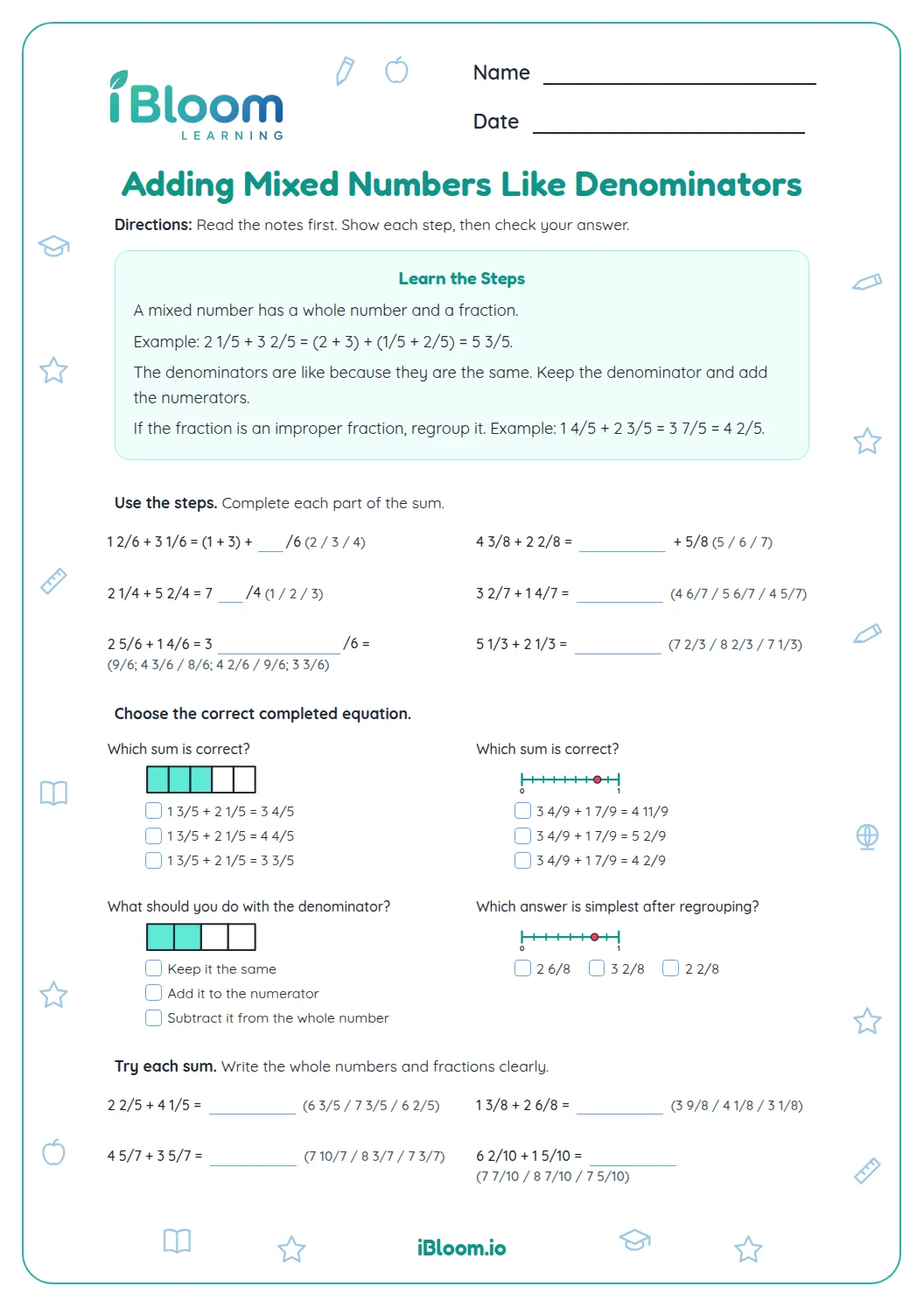
Keep the denominator because the parts have the same size. Add the numerators, then combine the fraction sum with the whole numbers. For 5/4 + 4/4, keep fourths and add 5 + 4 to make 9/4. Since 8/4 is 2 wholes, 9/4 is 2 1/4.
- 15/4 + 4/4 = 2 1/4
- 2Add the whole-number parts and fraction parts separately, then combine.
When should students regroup?
When the numerator total equals or exceeds the denominator, trade a complete group for a whole. Keep any remaining fractional parts in the final answer. A quick check is to confirm that the fractional part left over is smaller than one whole.
What is included in the practice?
The 15 number sentences are grouped into three parts: direct addition, regrouping, and a final independent set. Each expression shows both addends and uses a like denominator.
How to use this worksheet
- 1Add the numerators because the denominators match.
- 2Keep the common denominator.
- 3Rename each complete group as one whole.
- 4Write the answer as an improper fraction or mixed number.
- 5For the final questions, choose the closest whole number.
Common mistakes and quick fixes
The mistake
Adding unlike place values or pieces without naming their unit.
The fix
Say the unit or denominator aloud as you combine the values.
The mistake
Stopping when the fractional parts make one or more wholes.
The fix
Trade each complete set of parts for a whole and include it in the total.
The mistake
Copying an answer before checking every addend.
The fix
Read each addend again and check the total with the model or a second calculation.
Common Core alignment
This worksheet practices the fraction addition described in the standard below.
Add fractions or mixed numbers with like denominators and regroup when needed.
On this sheet: Students add fractions with like denominators and regroup fractional parts into wholes.
Show the official wordingHide the official wording
Add and subtract mixed numbers with like denominators, e.g., by replacing each mixed number with an equivalent fraction, and/or by using properties of operations and the relationship between addition and subtraction.
What to practice next
Make more practice
Further reading
Questions parents and teachers ask
What skill does this adding improper fractions page practice?
The worksheet practices adding improper fractions with 15 printed questions. Students work through direct examples, regrouping or reasoning tasks, and a final set of mixed problems. The answer key is separate, so students can complete the page before checking each total.
How do students solve 7/8 + 8/8?
They keep the like denominators and add the numerators, then regroup if the fractional sum makes a whole. For this example, the total is 1 7/8. The worked method is: add the whole numbers and numerators separately, then regroup a full set of parts as one whole. The final form names both the whole-number part and any fraction left over.
Does the worksheet include an answer key?
Yes. The printable includes a separate answer key with the result for each question. Use it after the student has finished a section, then ask them to point to the addend or regrouping step that explains any corrected answer.
What does regrouping mean in fraction addition?
Regrouping means trading a complete set of equal fractional parts for one whole. For example, 6/6 is one whole and 8/8 is one whole. Students add the fractional parts first, trade each complete set, and combine those wholes with the original whole-number parts.
Which denominators appear on the page?
The problems use like denominators of thirds, fourths, sixths, and eighths. Students can add the numerators directly because the parts have the same size. When the numerator total reaches the denominator, they rename that group as a whole before recording the final mixed number.