






About this worksheet
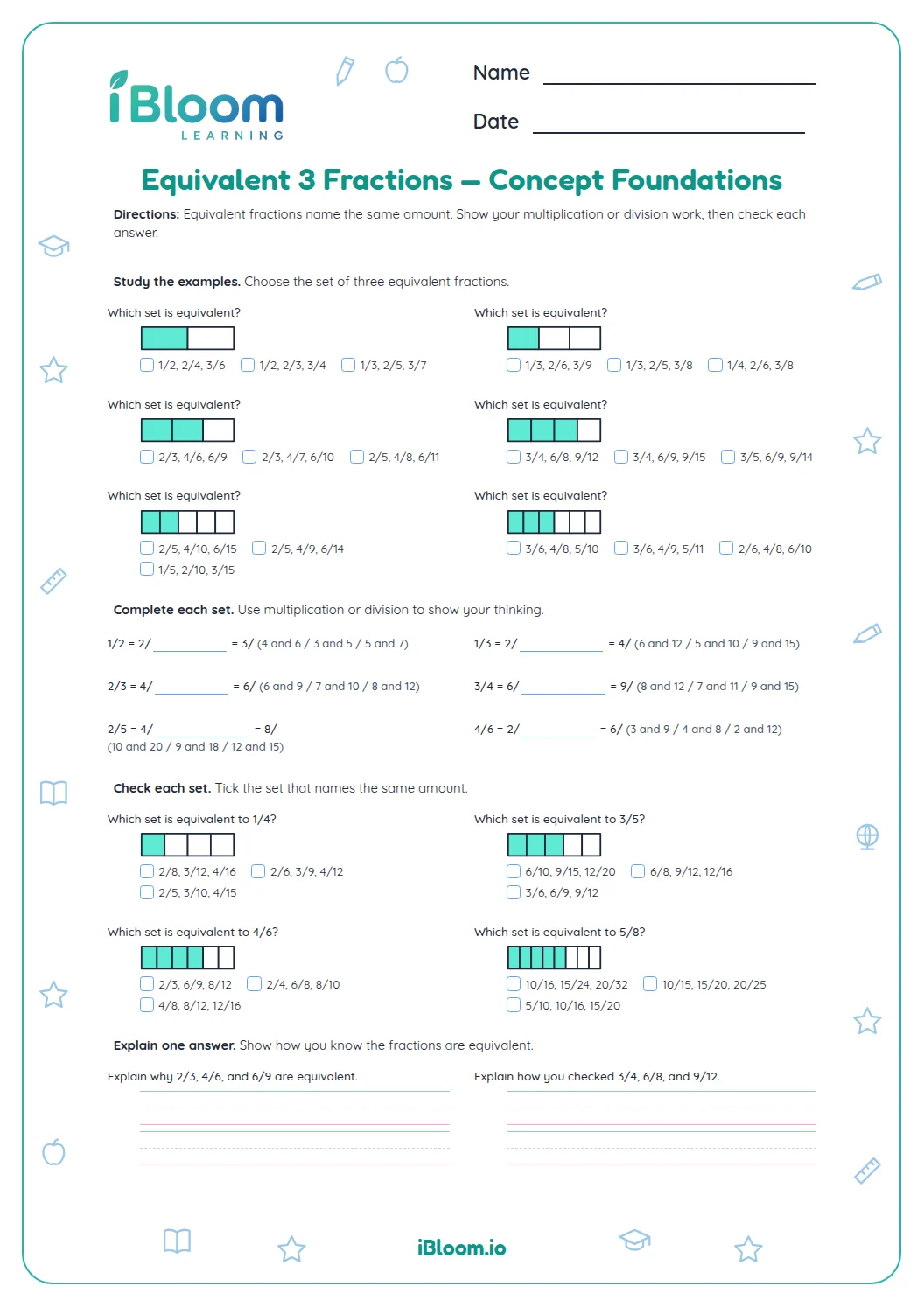
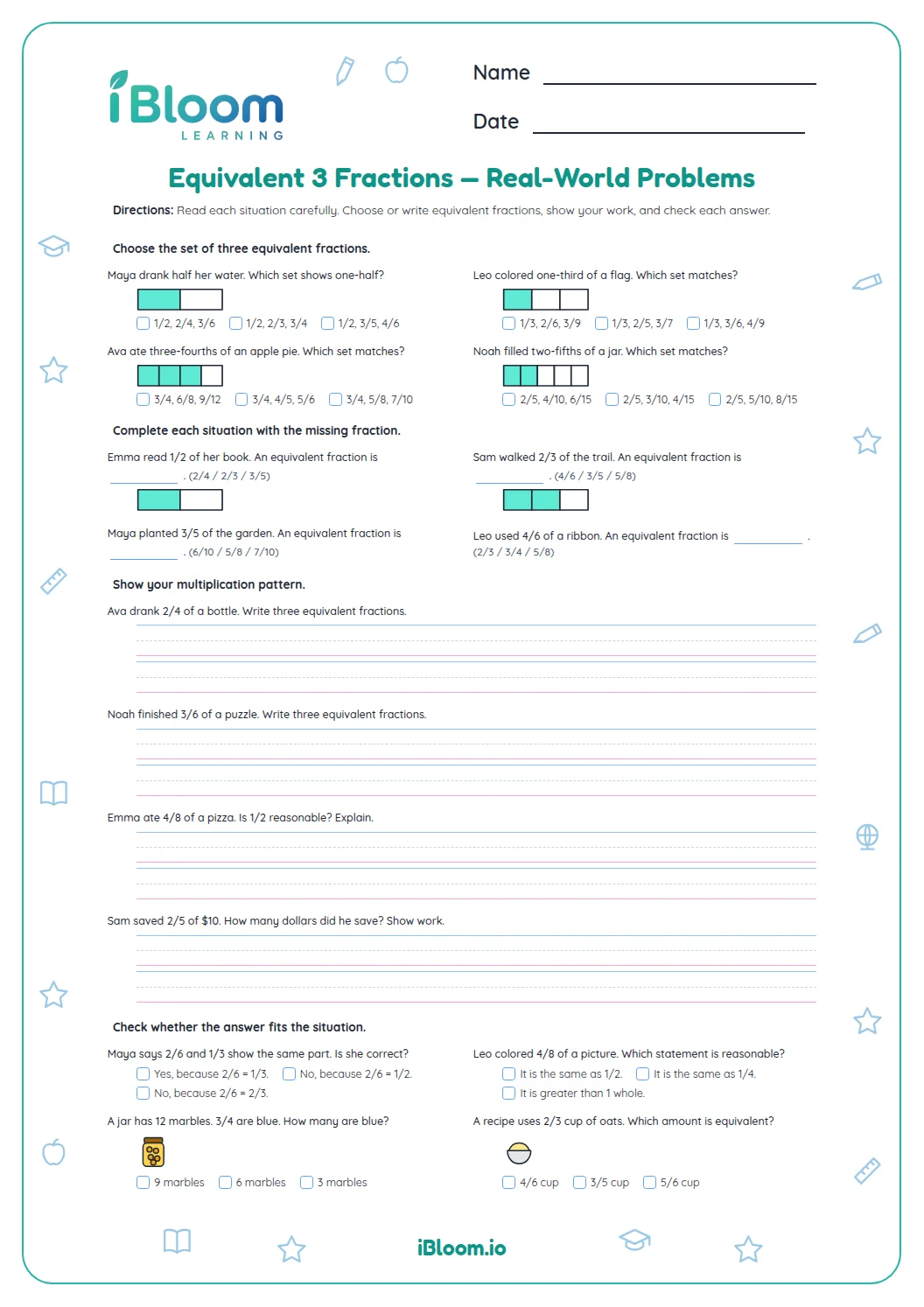
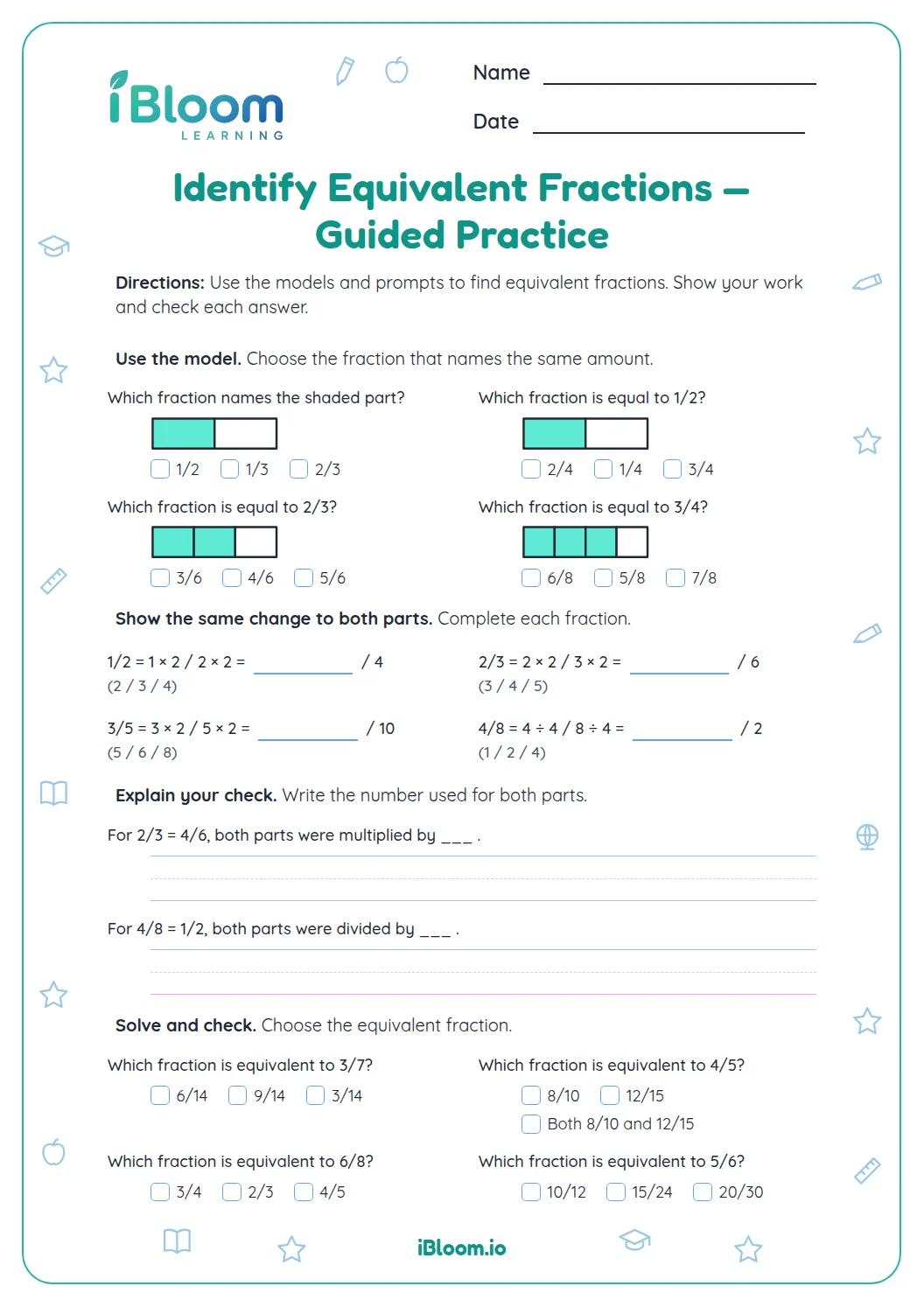
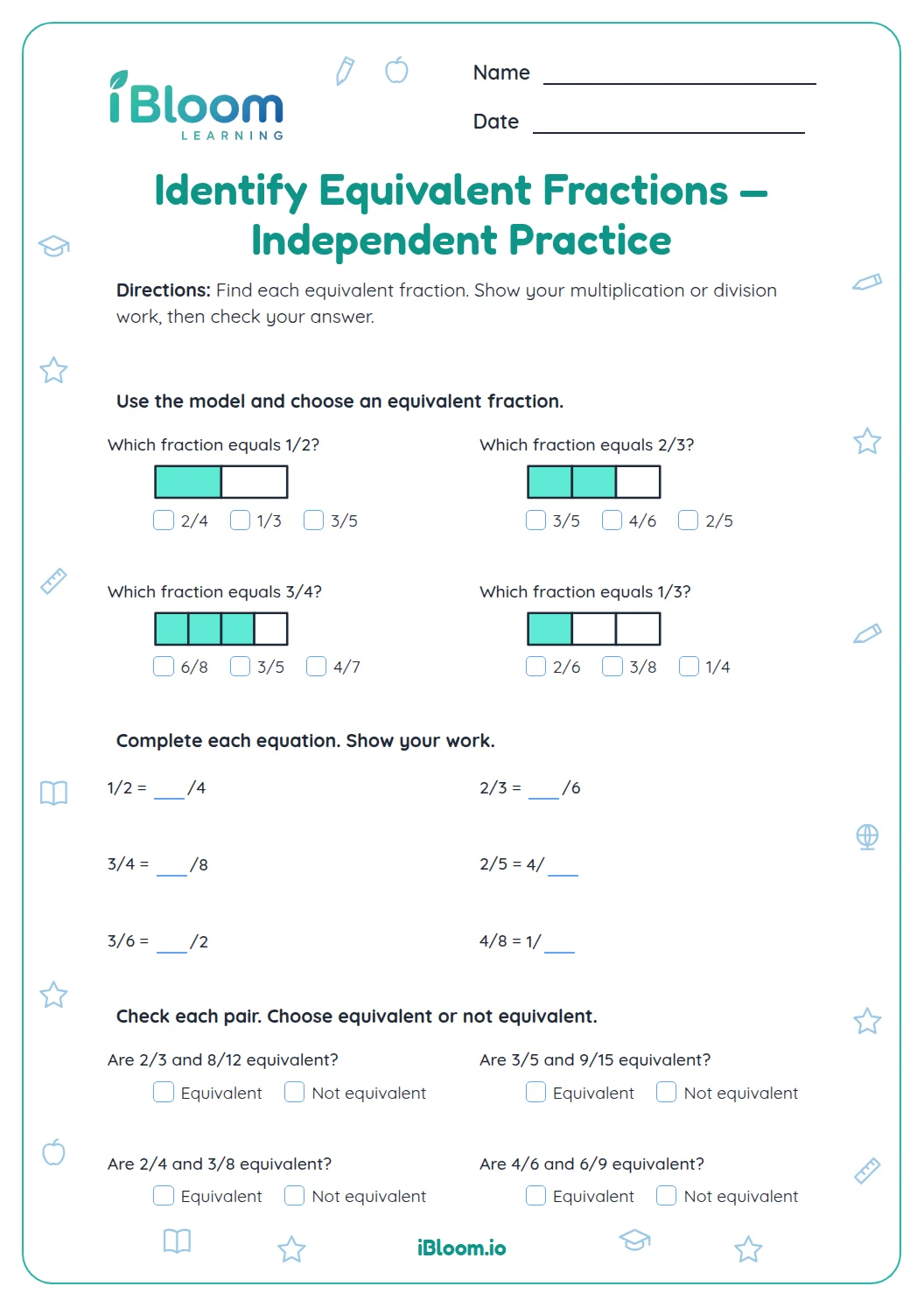
This printable gives Grade 3 learners 14 guided questions about equivalent fractions. The first part has separate blanks for each missing numerator in a three-fraction chain; later questions ask learners to choose equivalent values, complete a missing numerator or denominator, and read two shaded models. A separate answer key supports checking each response.
How can you make an equivalent fraction?
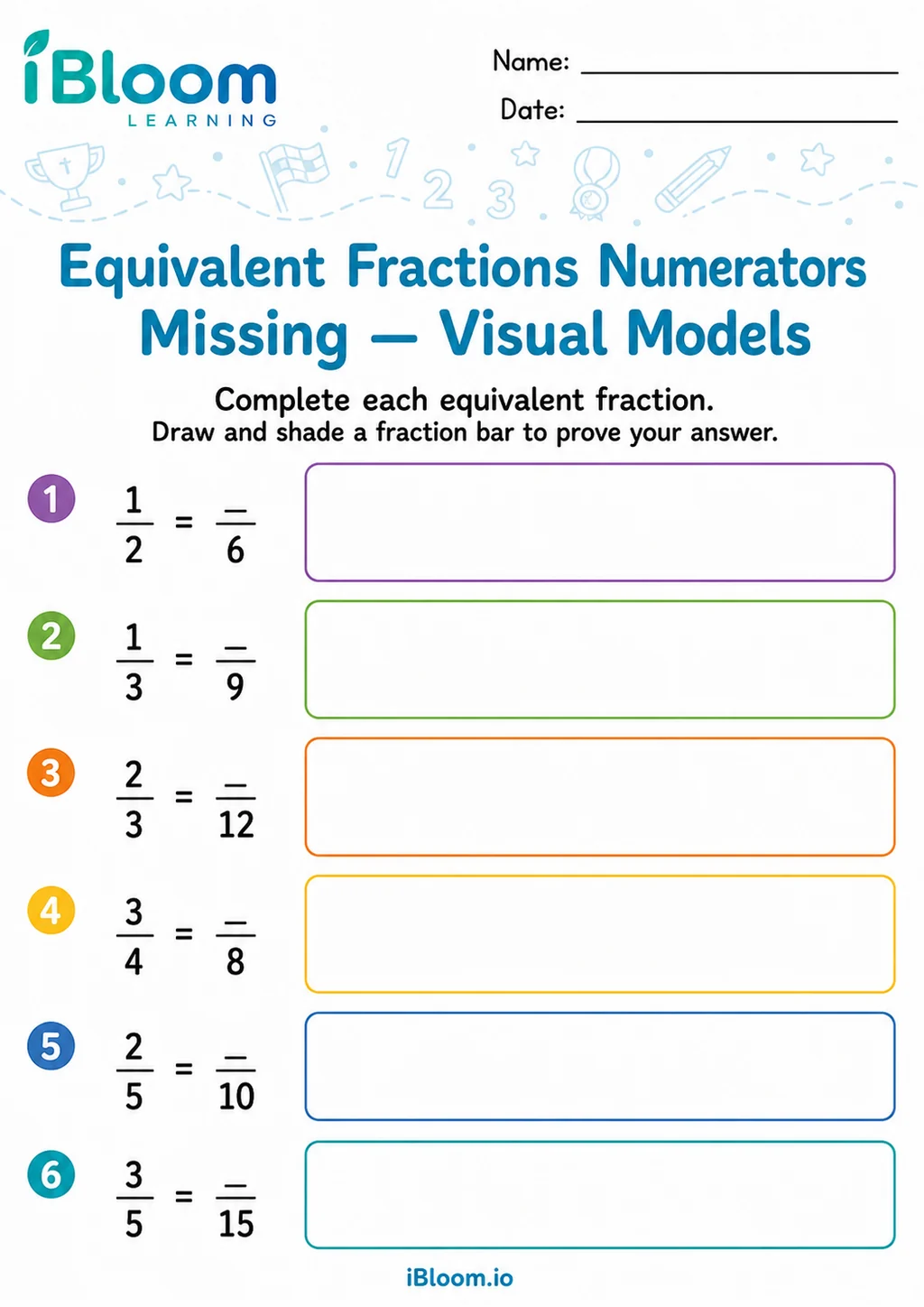
Multiply or divide the numerator and denominator by the same nonzero number. For question 1, multiply both parts of 1/2 by 2 to get 2/4; multiply both by 4 to get 4/8.
- 11/2 = 2/4
- 21/2 = 4/8
- 3Both fractions name one half.
How can a model show equal fractions?
Count the shaded parts and the total equal parts. In question 11, four of eight parts are shaded, which is half of the strip, so the fraction in simplest form is 1/2.
What is included in the practice?
There are 14 questions in three parts: fraction chains, missing values and choices, and model-based equivalence. The key lists one response per question.
How to use this worksheet
- 1Read the starting fraction and the target denominator.
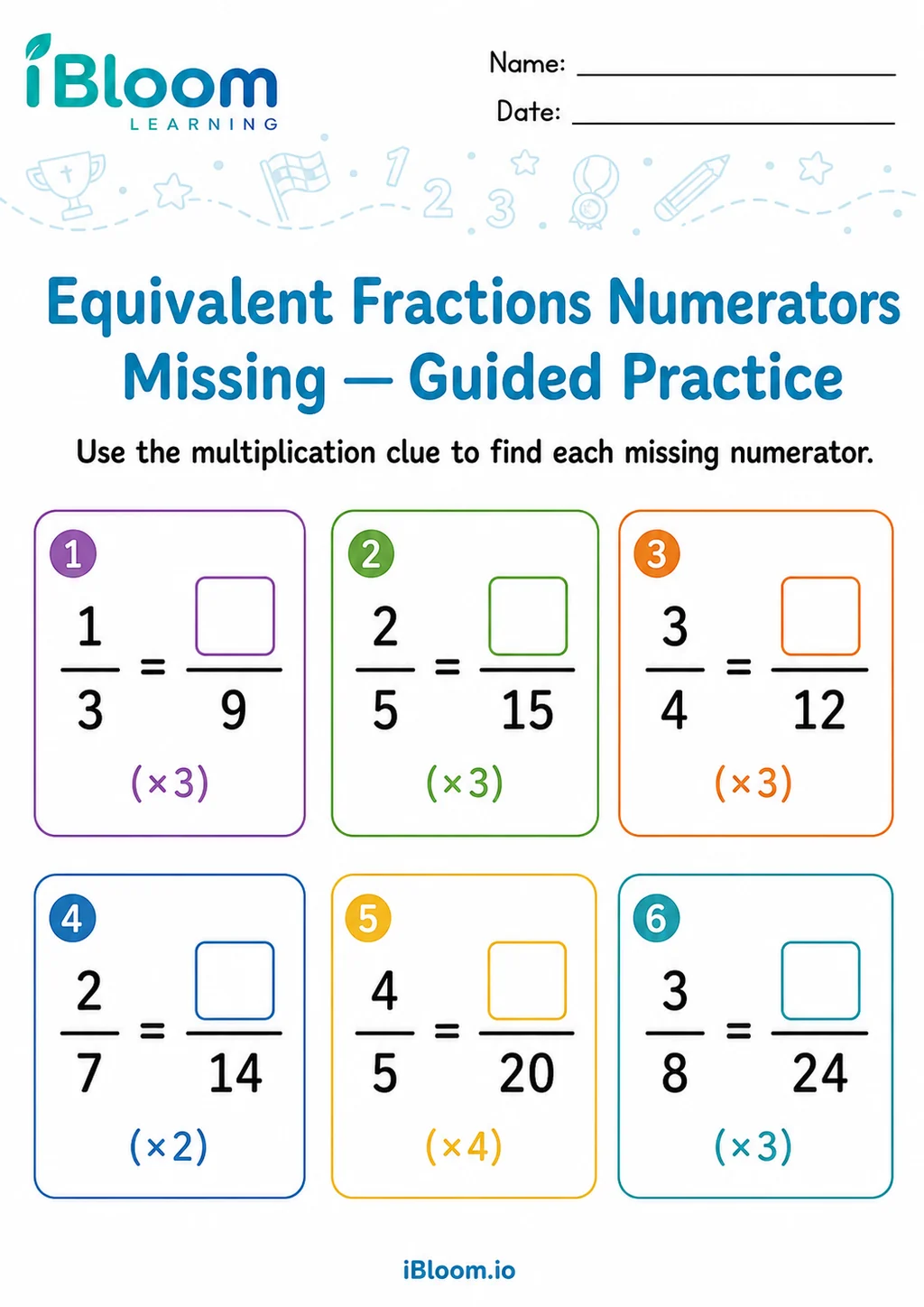
- 2Ask what factor changes the denominator.
- 3Multiply the numerator by that same factor.
- 4For a model, count shaded parts and total equal parts.
- 5Check by simplifying both fractions or comparing their models.
Common mistakes and quick fixes
The mistake
Changing only the denominator.
The fix
Use the same multiplier on numerator and denominator.
The mistake
Multiplying by different factors in a chain.
The fix
Compare each new numerator and denominator with the starting fraction.
The mistake
Counting unshaded parts as shaded.
The fix
Count only the filled sections, then count all equal sections.
What to practice next
Make more practice
Further reading
Questions parents and teachers ask
How many blanks are in each fraction chain?
Each chain has two distinct numerator blanks, one for each equivalent fraction. The answer key lists the two numerators in order, matching the two spaces printed in every chain on the student page. There are no combined blanks: each answer has its own printed space.
What does equivalent mean?
Equivalent fractions have the same value even when they use different numbers. For example, 1/2, 2/4, and 4/8 all name the same amount because the numerator and denominator are multiplied by the same factor. The worksheet uses that relationship in fraction chains and in shaded-part models.
How do you find a missing numerator?
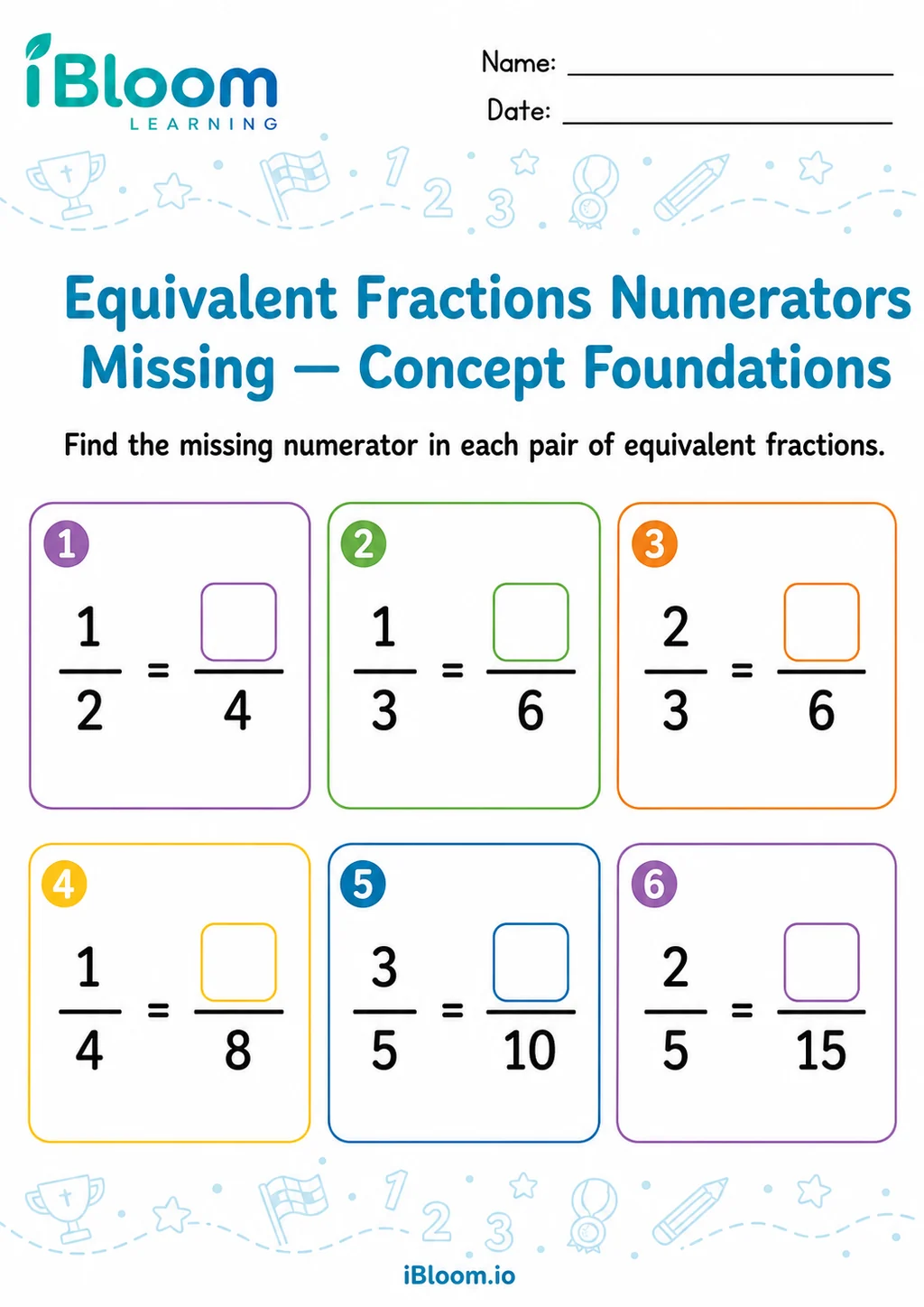
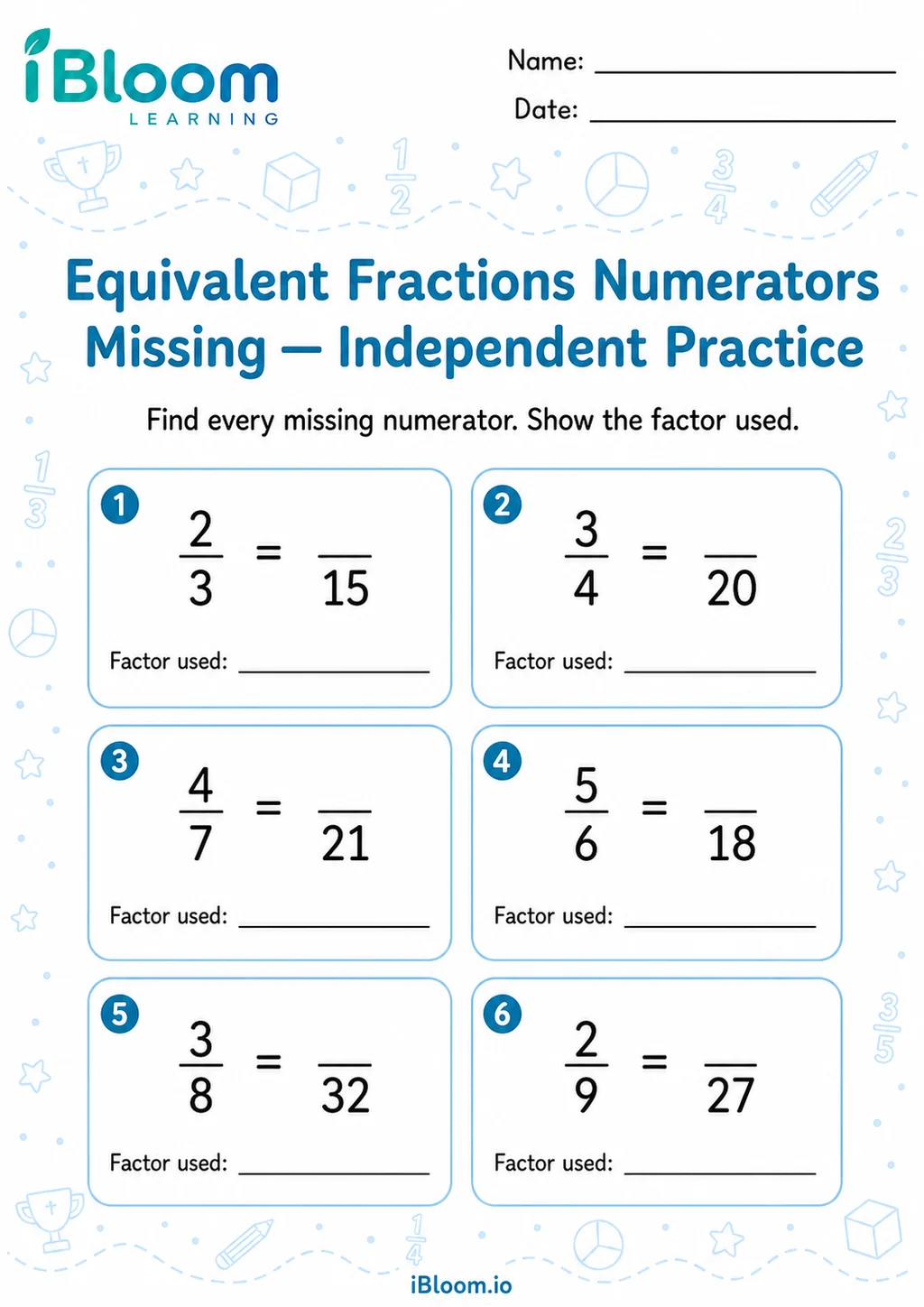
Find the factor that changes the denominator, then multiply the numerator by that same factor. In 1/3 = ___/6, the denominator doubles, so the numerator doubles too and the missing value is 2. This keeps the parts of the fraction in the same ratio.
Are there picture models?
Yes. Two questions show equal-part fraction models. Children count the shaded pieces and compare the amount with an equivalent fraction named in the prompt. The diagrams provide the actual values needed to answer. Children can use the pictures to verify that the two names represent the same part of a whole.
Is an answer key included?
Yes. The separate key gives each missing value and selected fraction so a child or adult can check all 14 questions. For a chain, the two key values follow the same order as the blanks. The key follows the question order and uses the student page’s separate answer spaces.