







About this worksheet
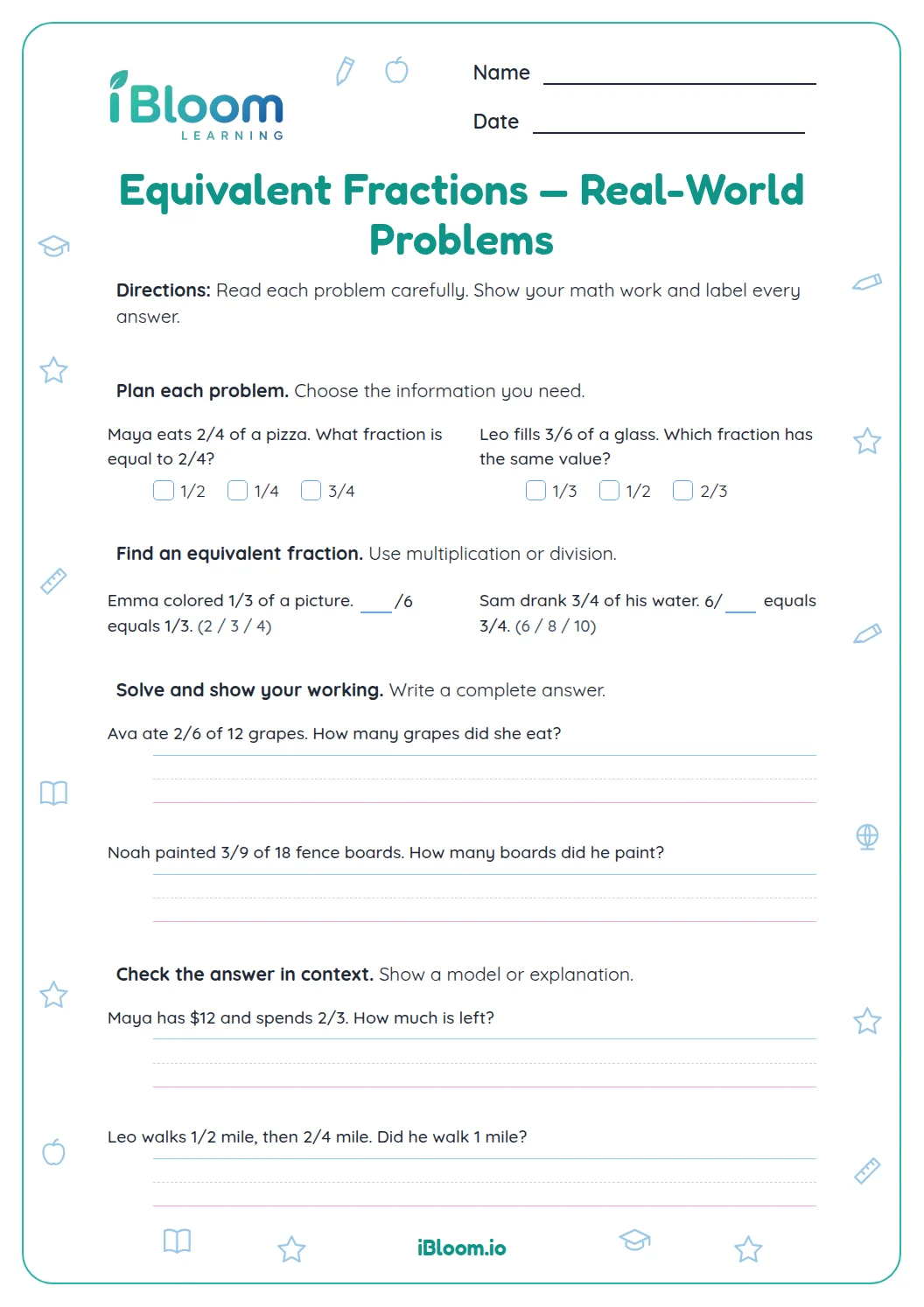
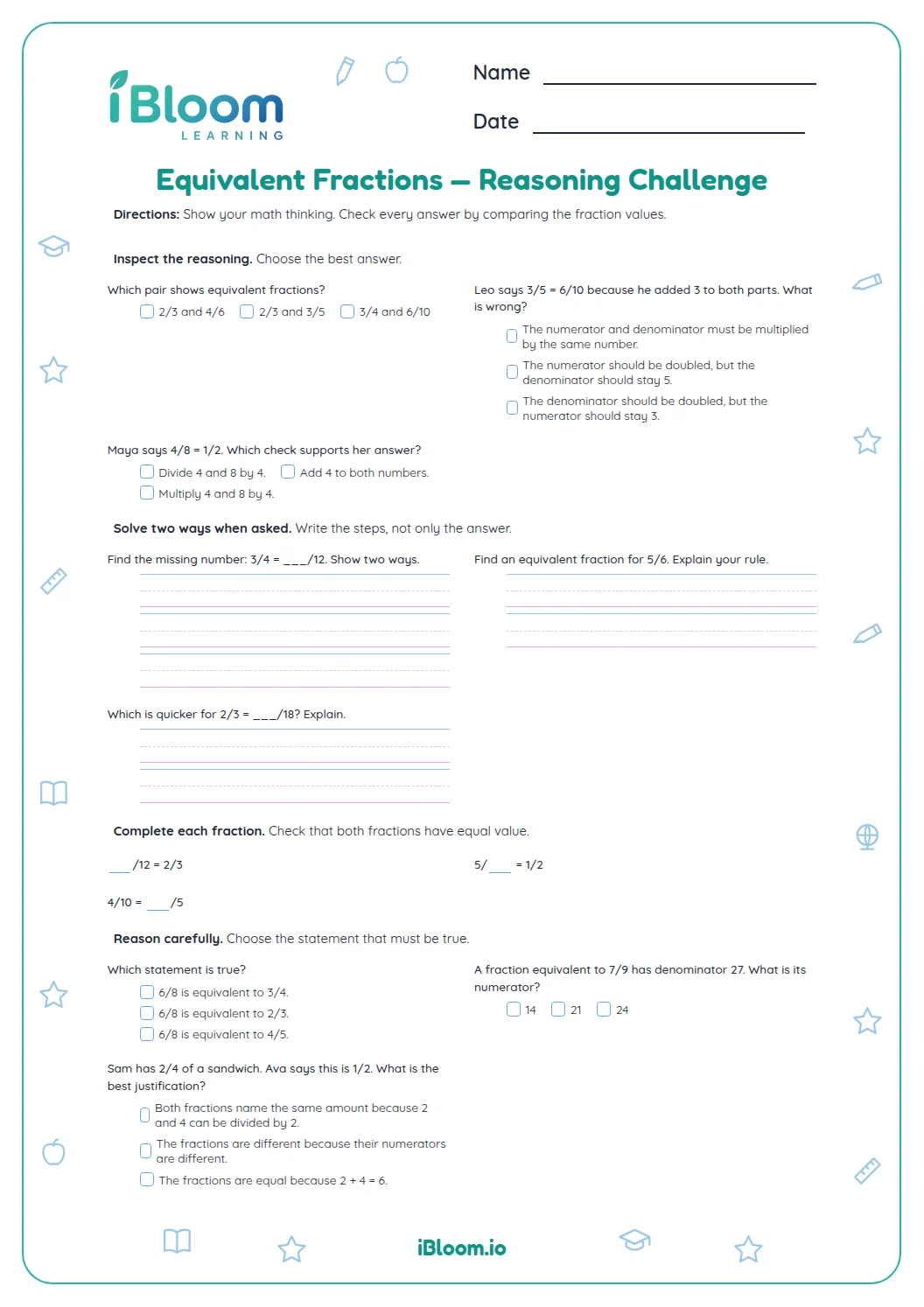
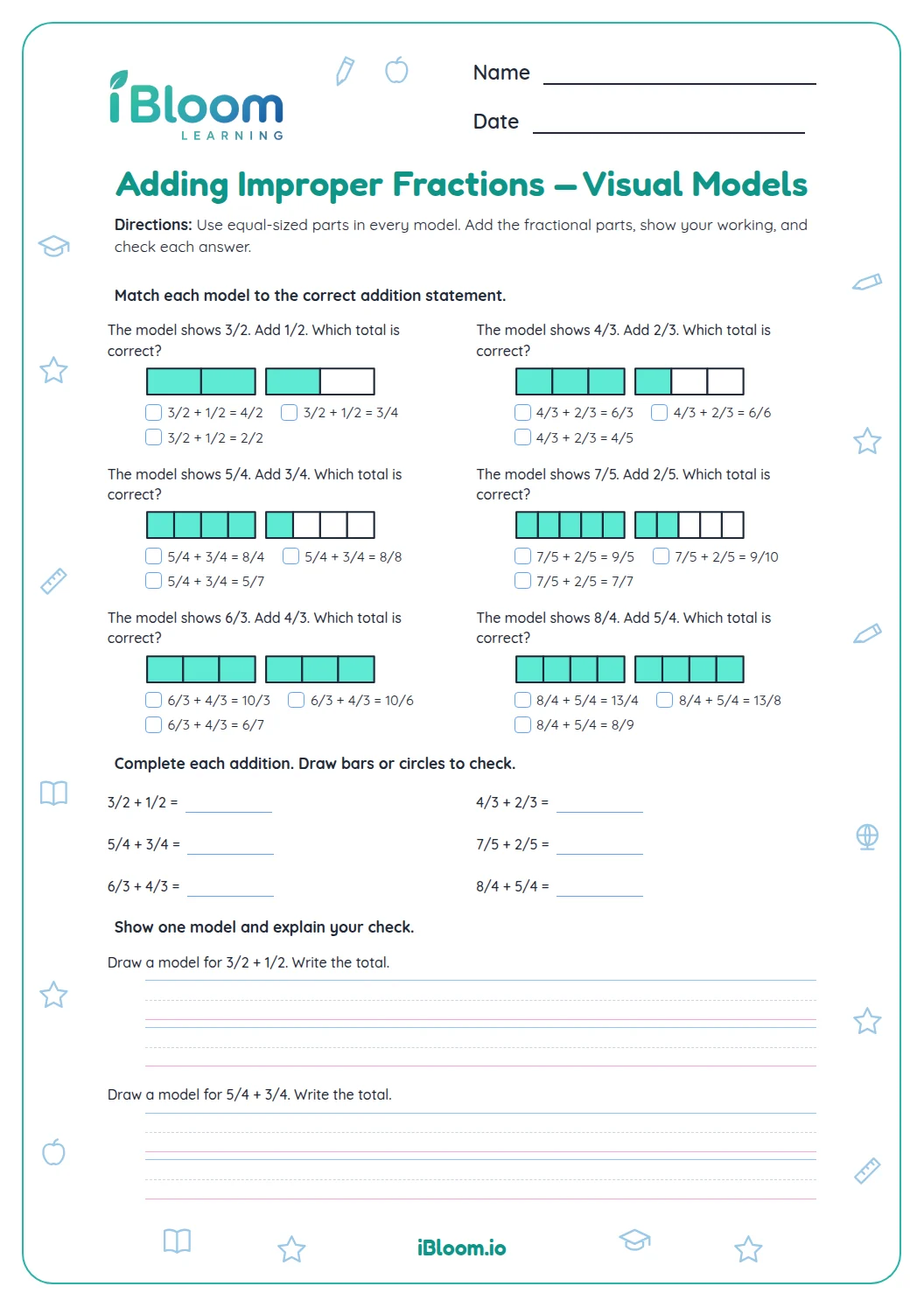
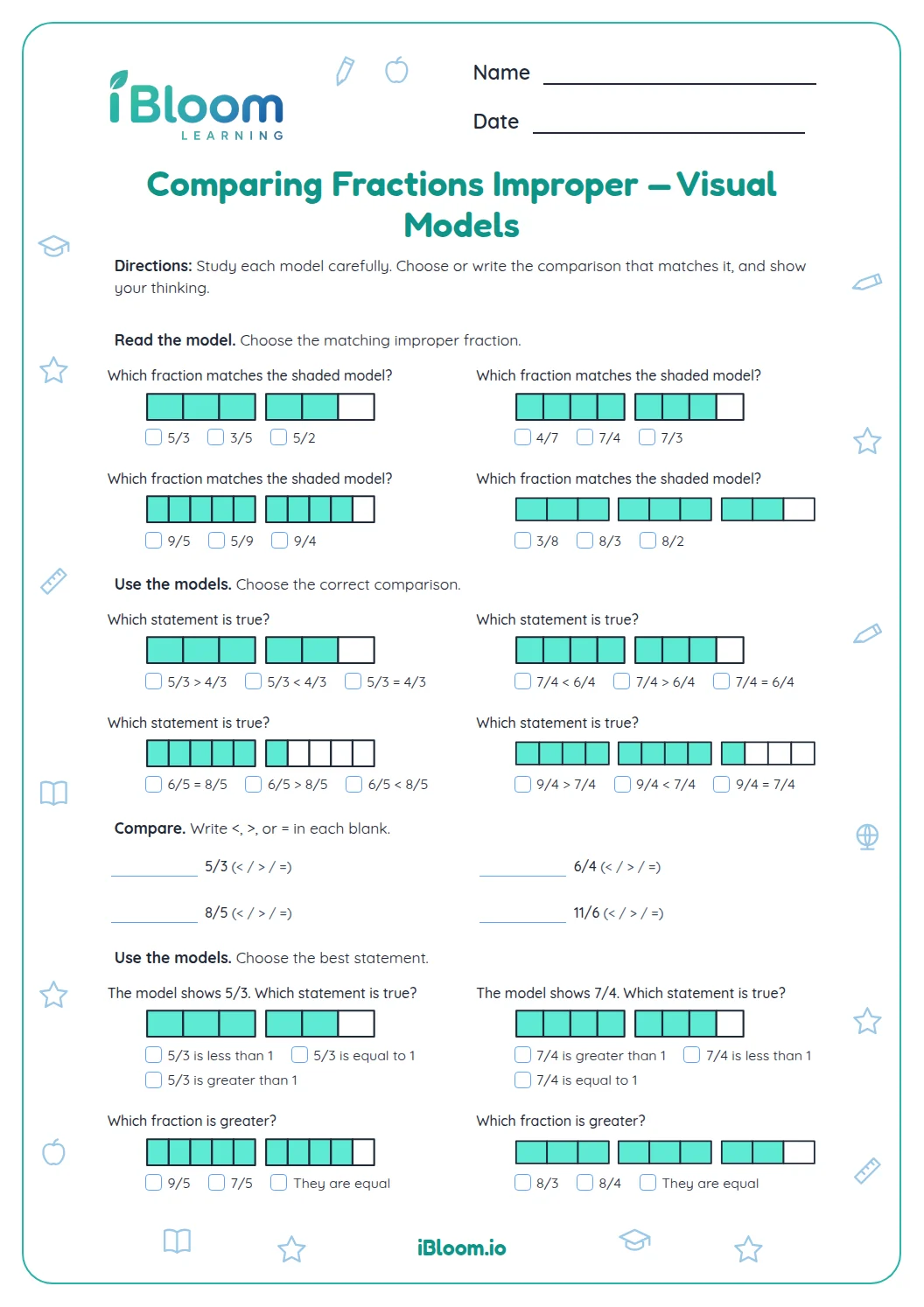
This Grade 3 visual-model worksheet helps children see equivalent fractions rather than memorize a rule alone. Four shaded bars or circles show the same whole split in different ways; the remaining questions connect those pictures to fraction names, missing numerators and equivalence checks. It includes 15 questions and a separate key.
How can two fractions name the same amount?
Equivalent fractions can partition the same whole into different numbers of equal pieces while covering the same amount. For instance, one half of a circle and two fourths of a circle fill the same area. In question 5, 1/2 = 2/4.
- 11/2 = ___/4
- 2A half is the same amount as two fourths.
- 3So the missing numerator is 2.
How do the visual models connect to number sentences?
Count the shaded parts and total equal parts in each model. Then compare amounts, not just the numerals. The later questions ask children to use that idea to decide if a pair is equivalent or complete a fraction equation.
How to work through the fraction models
- 1Check that both models represent one whole of the same size.
- 2Count shaded parts for the numerator and all equal parts for the denominator.
- 3Compare how much is shaded, not whether the numerators match.
- 4For a missing numerator, ask how many equal parts cover the same amount.
- 5Check an equivalence by shading or by grouping equal pieces.
Common fraction mistakes and quick fixes
The mistake
Changing only the denominator and assuming the amount stays equal.
The fix
If the whole is split into more pieces, the numerator must increase in the same proportion to cover the same area.
The mistake
Thinking 2/4 is larger than 1/2 because 2 is larger than 1.
The fix
Compare the shaded portions of equal-sized wholes; both fill one half.
The mistake
Counting unshaded pieces as the numerator.
The fix
The numerator counts shaded pieces; the denominator counts all equal pieces.
What to practice next
Make more practice
Further reading
Questions parents and teachers ask
What does equivalent mean?
Equivalent fractions name the same amount, even when their numerators and denominators differ. The models show this by shading equal portions of the same-sized whole. For example, 1/2 and 2/4 both cover half of one whole. Have the student name the total equal parts first, then the selected parts, and connect each count to its place in the fraction.
How do I find the missing number in 2/3 = ___/6?
Think of each third as two sixths. Two thirds therefore covers four sixths, so the missing numerator is 4. The models help show that the shaded amount stays the same while each original part is split into smaller equal parts. Have the student name the total equal parts first, then the selected parts, and connect each count
Why must the wholes be the same size?
A fraction describes a portion of one whole. Comparing shaded areas is fair only when the wholes have the same size. The worksheet models use a single whole each, so students can compare the portions directly. Have the student name the total equal parts first, then the selected parts, and connect each count to its place in the fraction.
Can equivalent fractions have different denominators?
Yes. The denominator tells how many equal pieces make the whole, and the same amount can be divided into more or fewer pieces. One half, two fourths and three sixths are different fraction names for the same amount. Have the student name the total equal parts first, then the selected parts, and connect each count to its
What is included in the answer key?
The key lists each fraction shown, the missing numerators, equivalence choices and the final written fraction. Ask students to point to the matching shaded amount when checking a response so the numbers stay connected to the visual idea. Have the student name the total equal parts first, then the selected parts, and connect each count to its