




About this worksheet
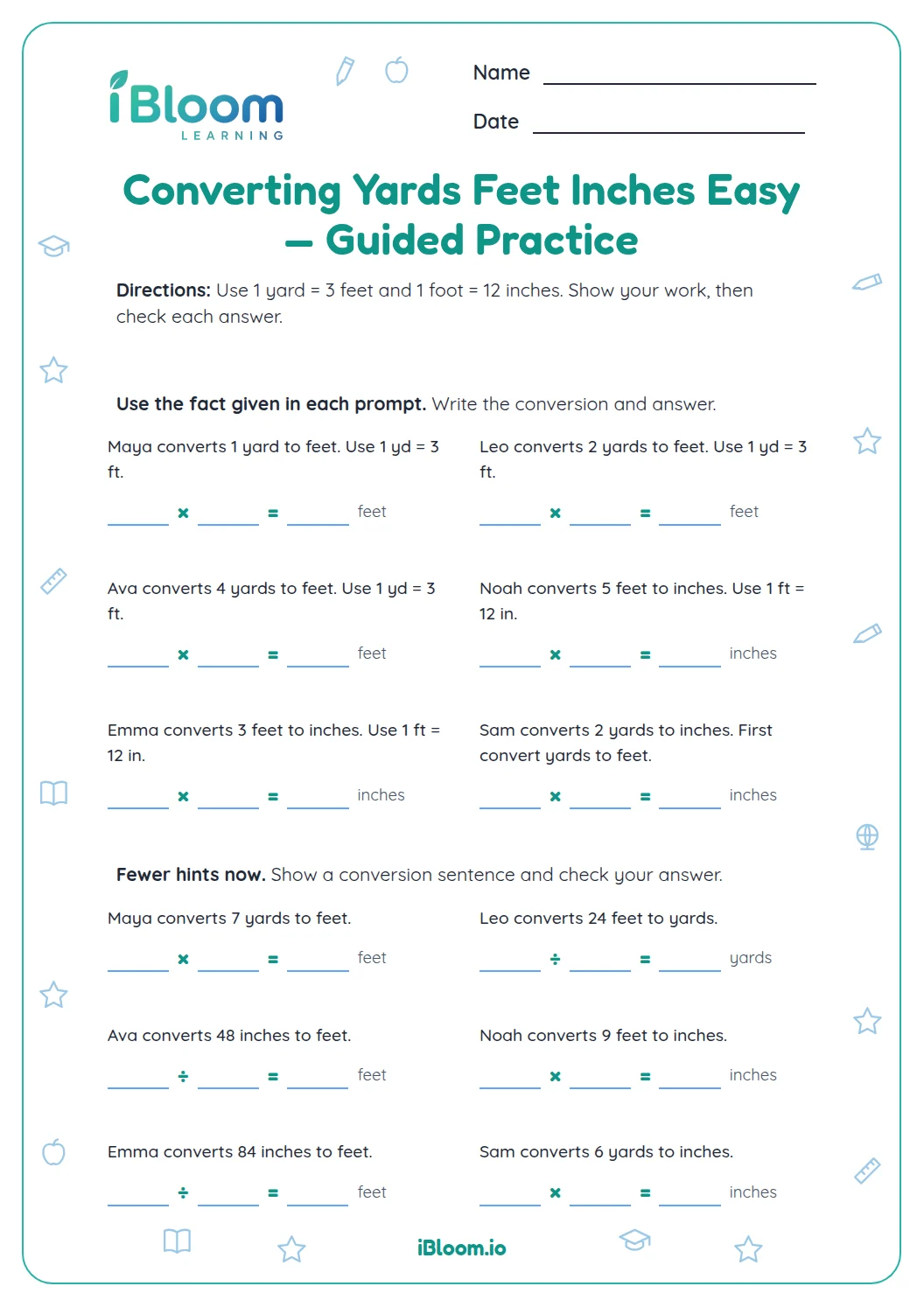
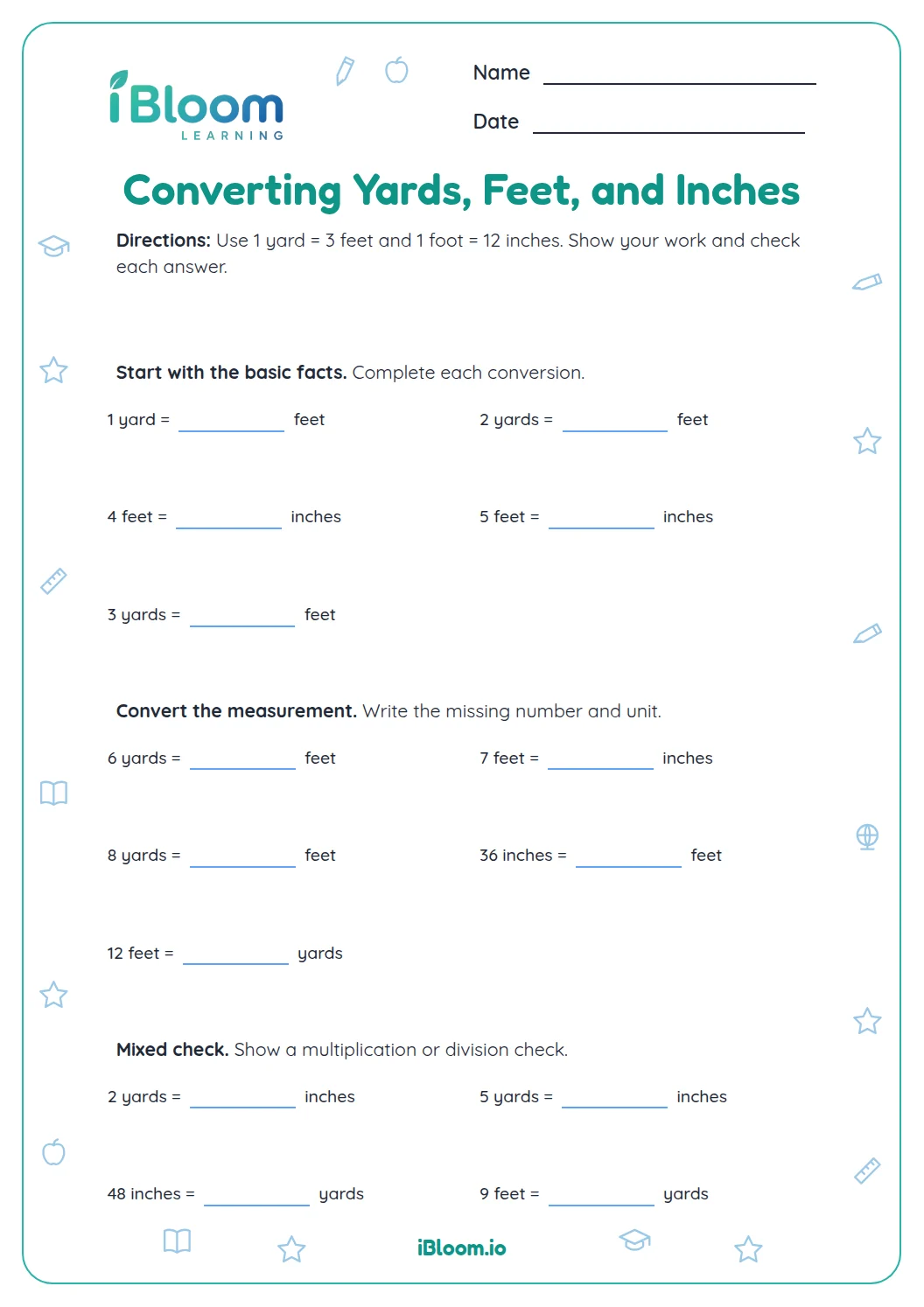
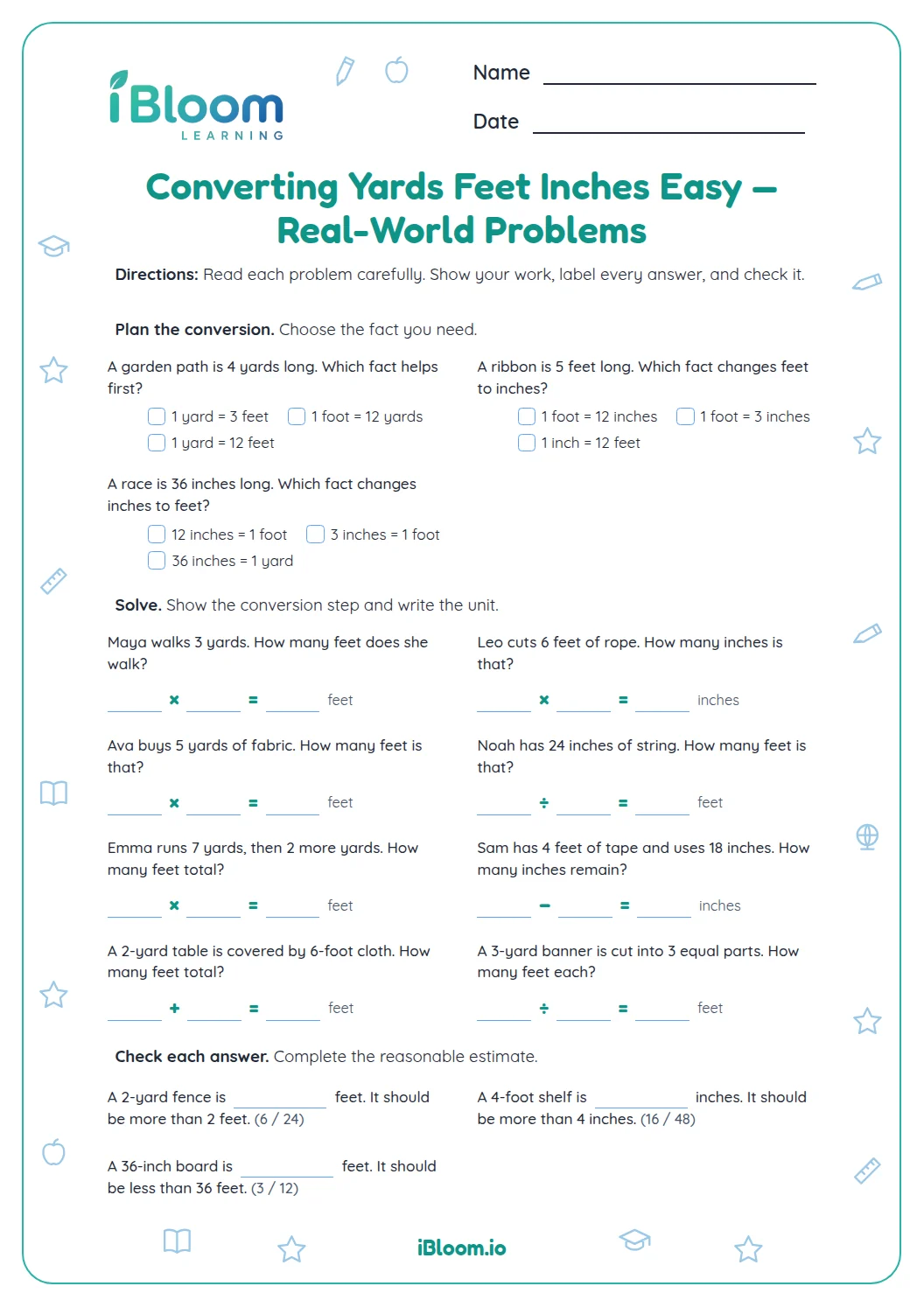
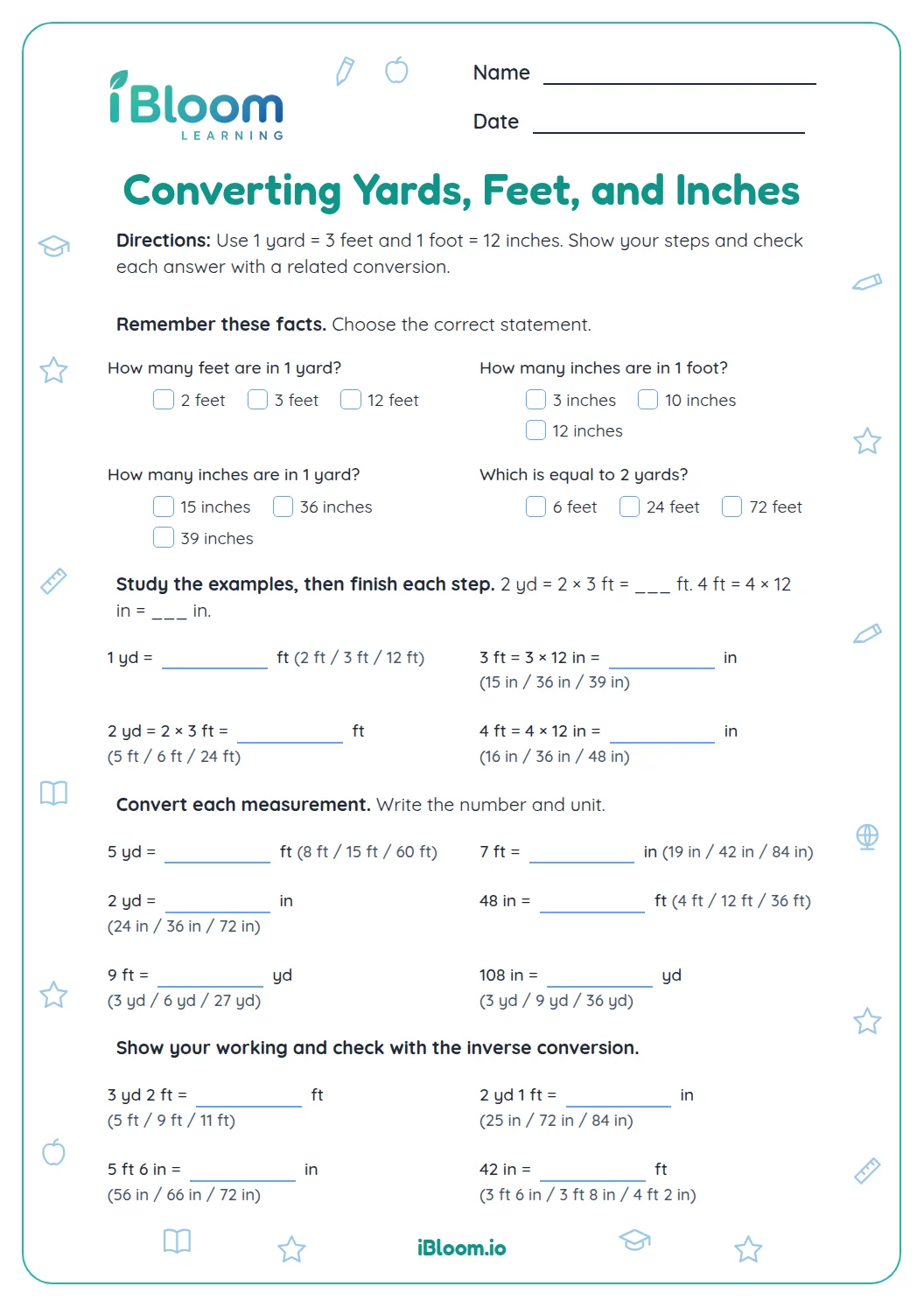
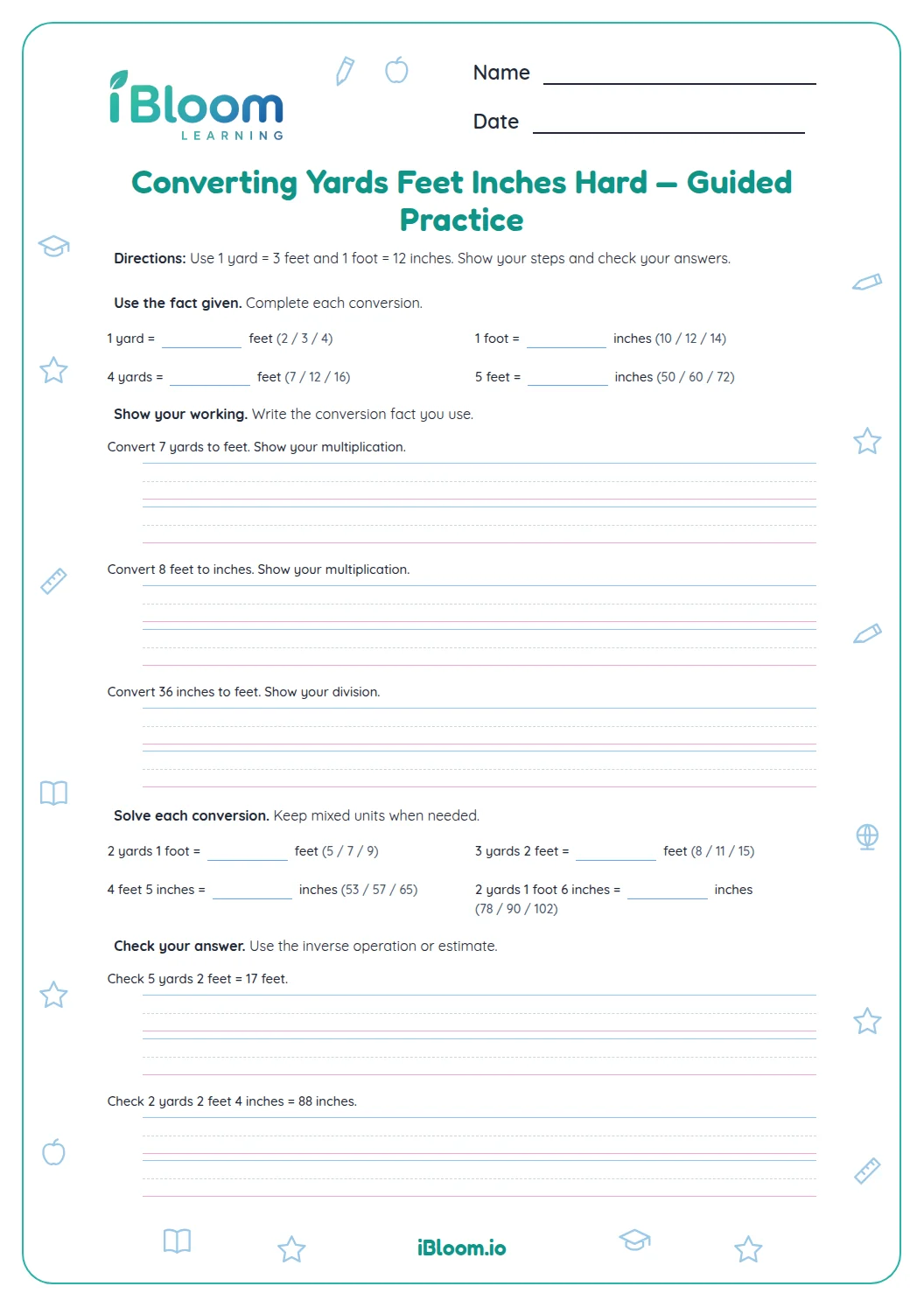
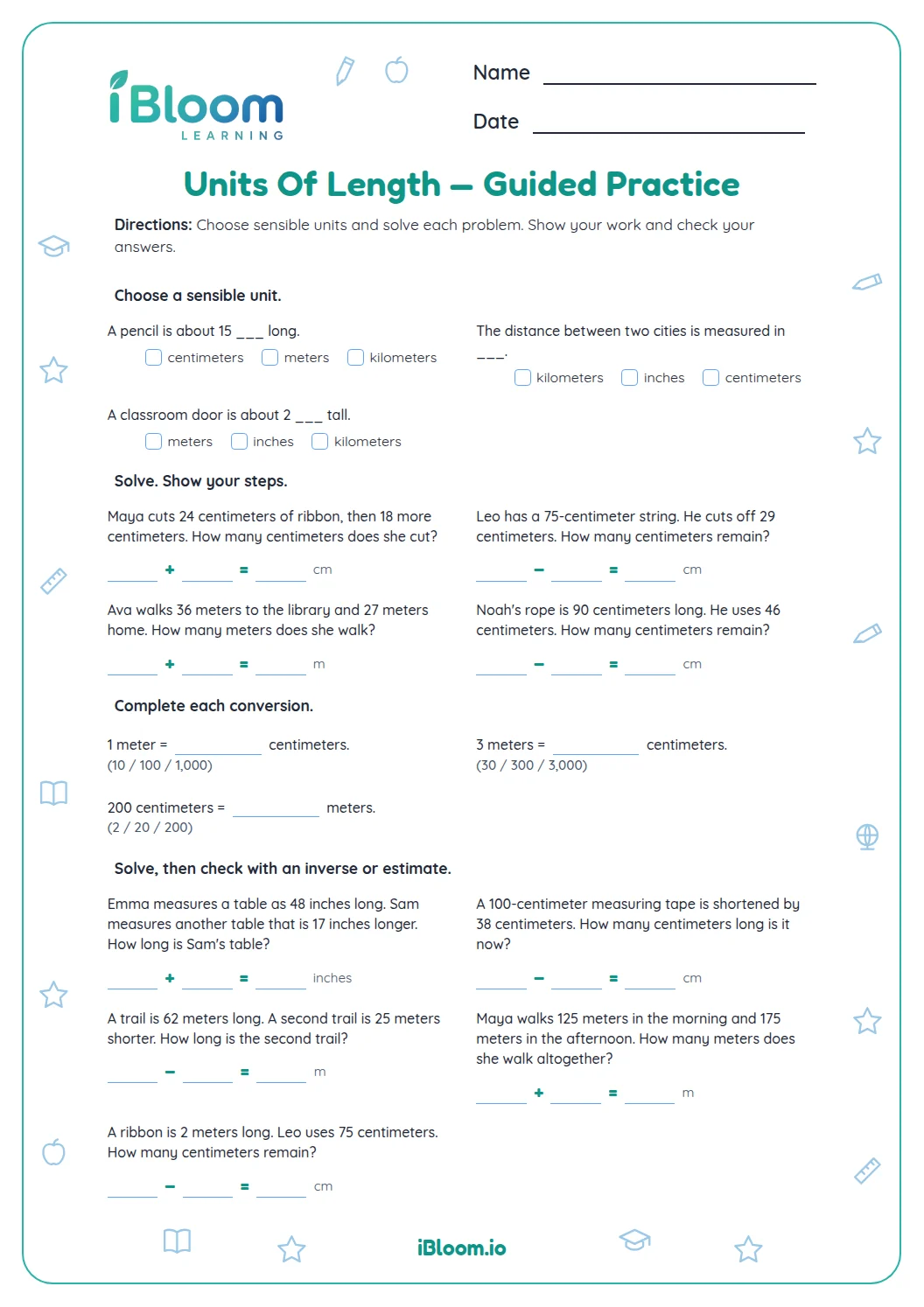
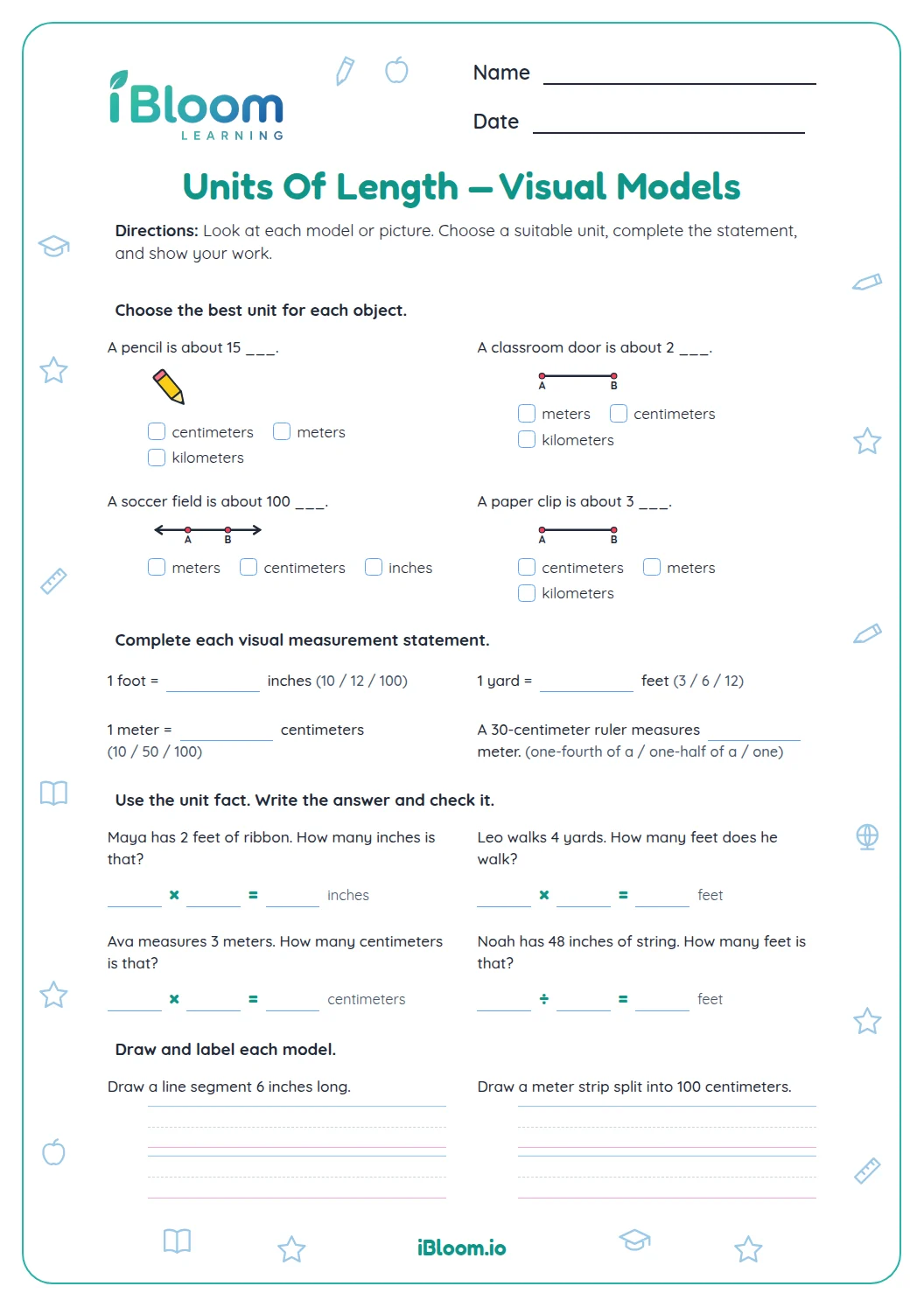
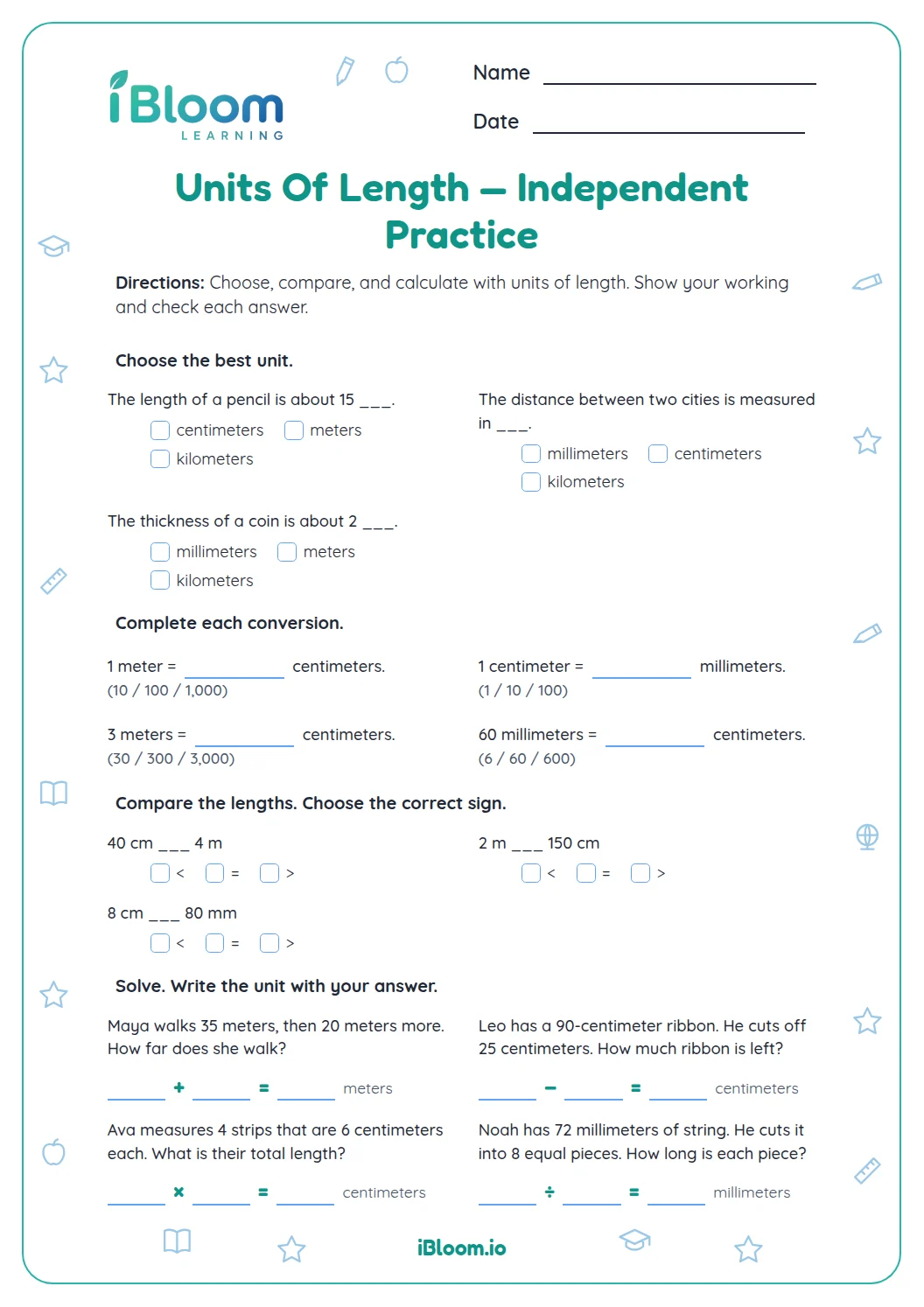
This Grade 3 concept-foundations worksheet gives 16 questions about converting yards, feet, and inches. Students begin with the two unit facts, practice conversions in both directions, and apply them to a hose, table, ribbon, and scarf. The answer key is separate. Number-sentence blanks are keyed with just the missing number, while story answers include the requested unit.
Aligned to 4.MD.A.1
How are yards, feet, and inches related?
One yard equals 3 feet, and one foot equals 12 inches. These two facts let you convert in steps: yards to feet, then feet to inches. Question 4 uses 3 feet; multiplying 3 by 12 gives 36 inches.
- 13 feet × 12 inches per foot
- 23 × 12 = 36
- 33 feet = 36 inches
When should you multiply or divide?
Going from a larger unit to a smaller unit makes a larger number, so multiply. Going from inches to feet or feet to yards combines smaller units into larger ones, so divide by 12 or 3.
Where do the conversion facts help?
The last part uses the same facts in familiar length situations. Identify the starting unit and target unit, then choose the conversion factor that connects them.
How to use this worksheet
- 1Write the unit relationship you need: 1 yard = 3 feet or 1 foot = 12 inches.
- 2Check whether the target unit is smaller or larger.
- 3Multiply when converting to a smaller unit.
- 4Divide when converting to a larger unit.
- 5Write the requested unit in a word answer.
- 6Estimate whether the result should be more or fewer units.
Common mistakes and quick fixes
The mistake
Using 12 inches in one yard.
The fix
Convert yards to feet first: 1 yard is 3 feet, or 36 inches.
The mistake
Dividing when changing feet to inches.
The fix
Inches are smaller, so multiply feet by 12.
The mistake
Multiplying inches when changing to feet.
The fix
Feet are larger, so divide the inches by 12.
Common Core alignment
This worksheet practices customary measurement conversions and related problem solving.
Use unit relationships to express lengths in smaller or larger units.
On this sheet: Students use customary length-unit relationships in conversion problems.
Show the official wordingHide the official wording
Know relative sizes of measurement units within one system of units including km, m, cm; kg, g; lb., oz.; l, ml; hr, min, sec. Within a single system of measurement, express measurements in a larger unit in terms of a smaller unit. Record measurement equivalents in a two-column table. For example, know that 1 ft is 12 times as long as 1 in. Express the length of a 4 ft snake as 48 in. Generate a conversion table for feet and inches listing the number pairs (1, 12), (2, 24), (3, 36), ...
What to practice next
Make more practice
Further reading
Questions parents and teachers ask
How many feet are in a yard?
There are 3 feet in 1 yard. Multiply the number of yards by 3 to find feet; for example, 4 yards equals 12 feet in question 13. Multiplication is the right direction because a foot is smaller than a yard, so more feet are needed to describe the same length.
How many inches are in a foot?
There are 12 inches in 1 foot. To change feet into inches, multiply by 12; to change inches into feet, divide by 12. For example, 3 feet is 36 inches, and 24 inches is 2 feet. These inverse operations help check that both measurements describe the same length.
How do you convert yards to inches?
First change yards to feet using 3 feet per yard, then change feet to inches using 12 inches per foot. One yard is 3 × 12, or 36 inches. For the 2-yard scarf in question 16, 2 × 36 = 72 inches.
Why does the number get bigger when converting to inches?
An inch is smaller than a foot or yard, so the same length contains more inches. For example, 3 feet and 36 inches describe the same length, but the count is larger in inches. Each foot contains 12 inches, so the same length needs a larger count when measured with the smaller unit.
What is included in the answer key?
The separate key lists answers for all 16 items. For instance, it shows the hose as 12 feet because 4 yards contains 12 feet. Number-only blanks have a number in the key; story questions include the target unit so the student can see the complete measurement.