




About this worksheet
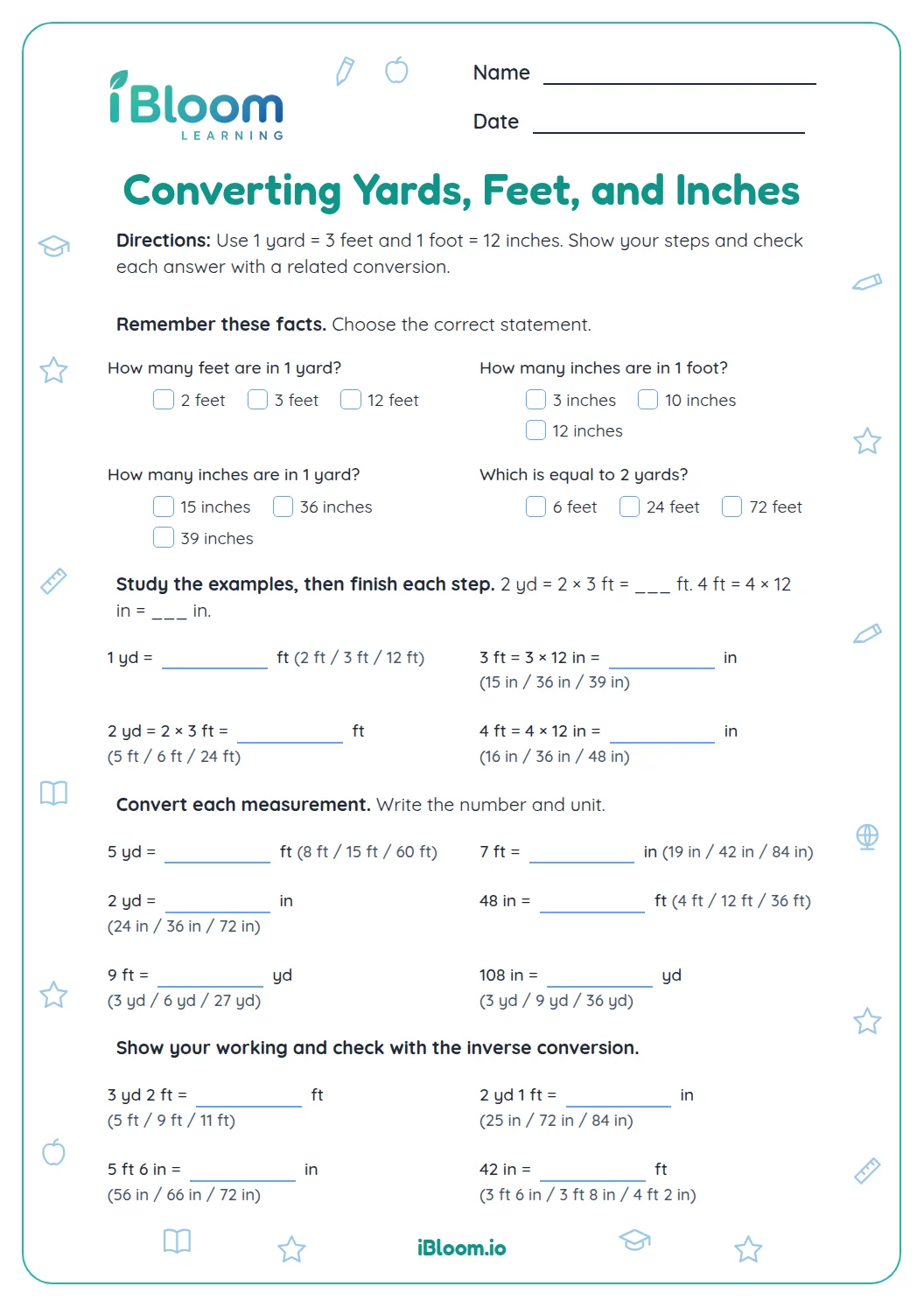
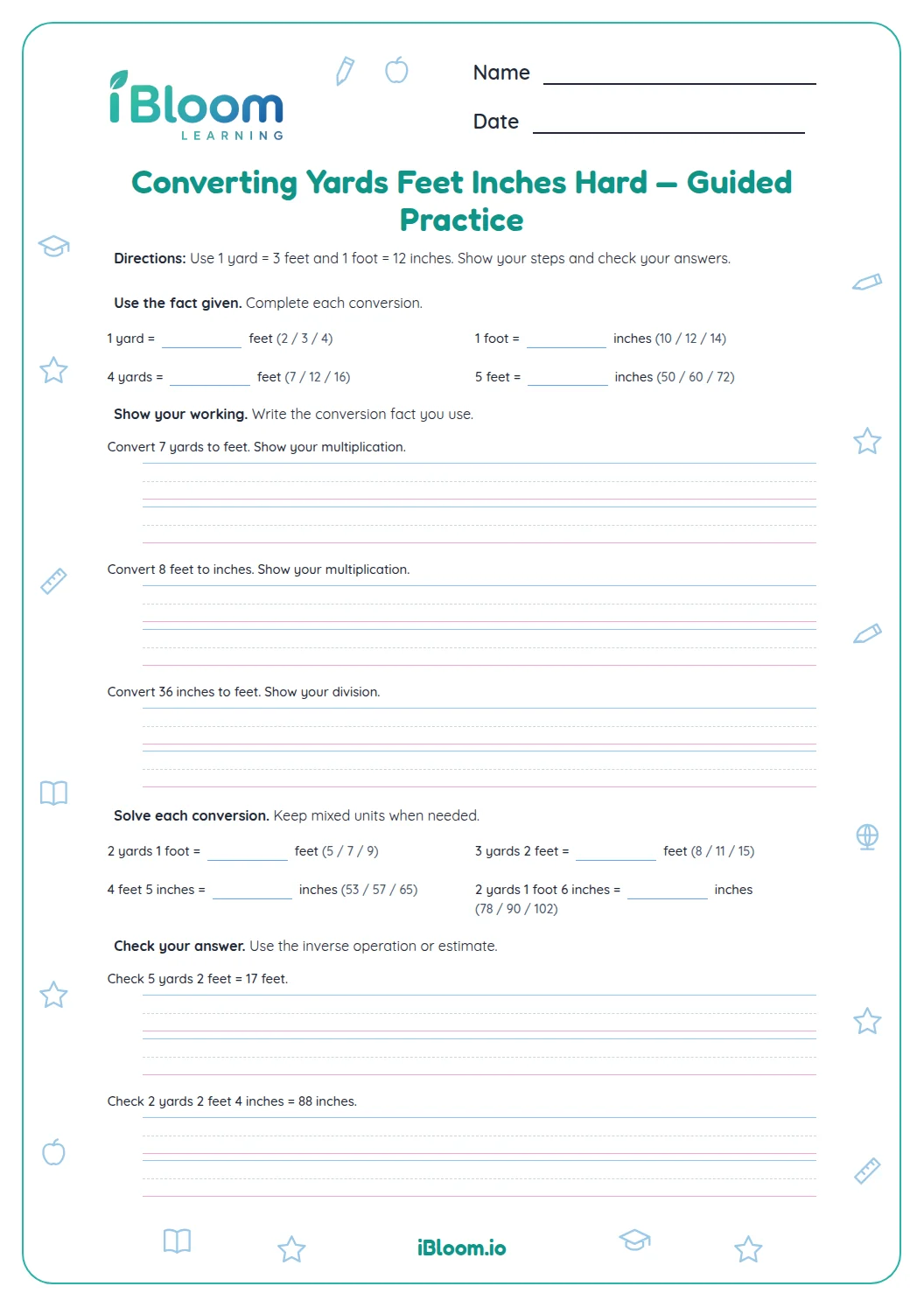
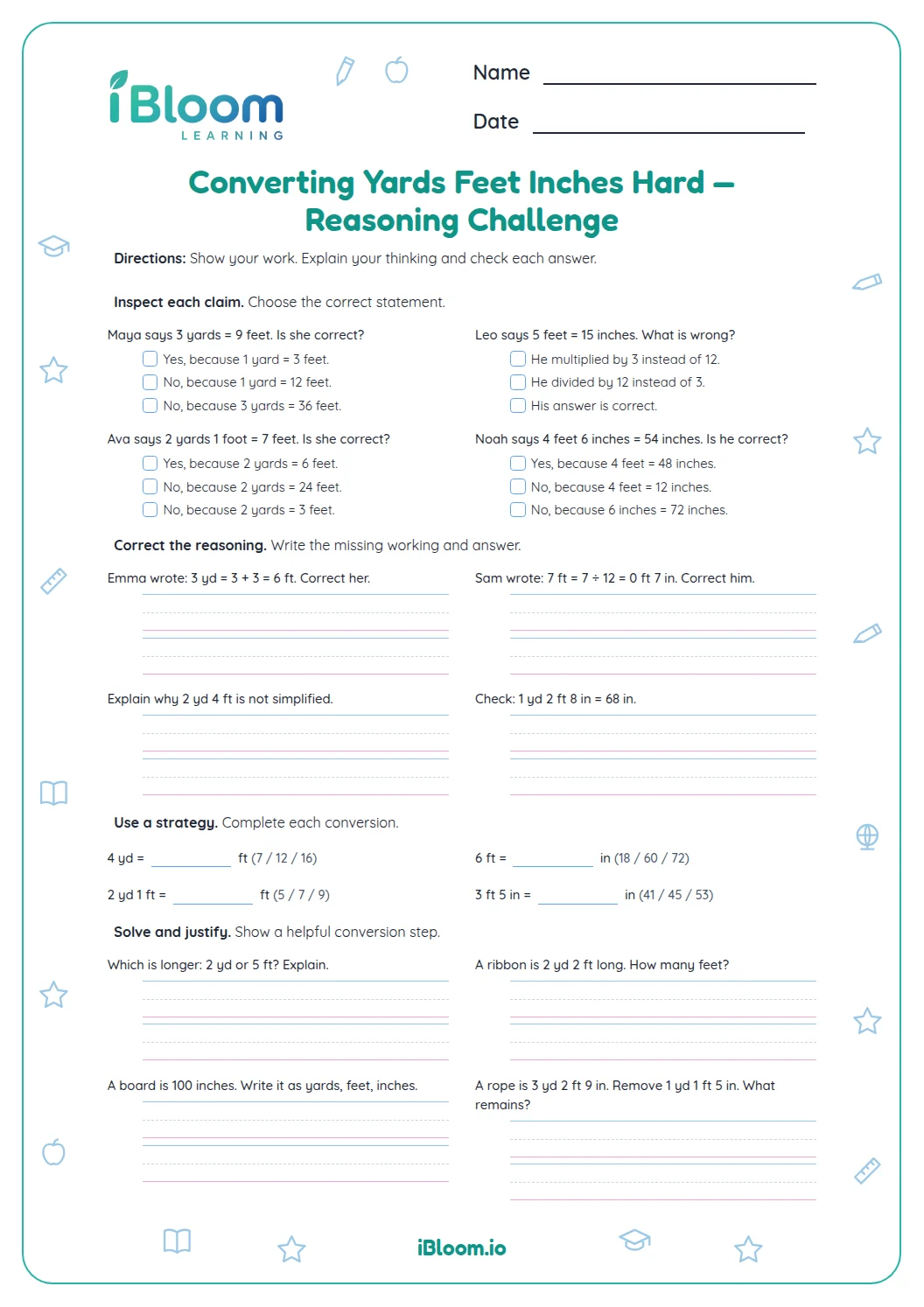
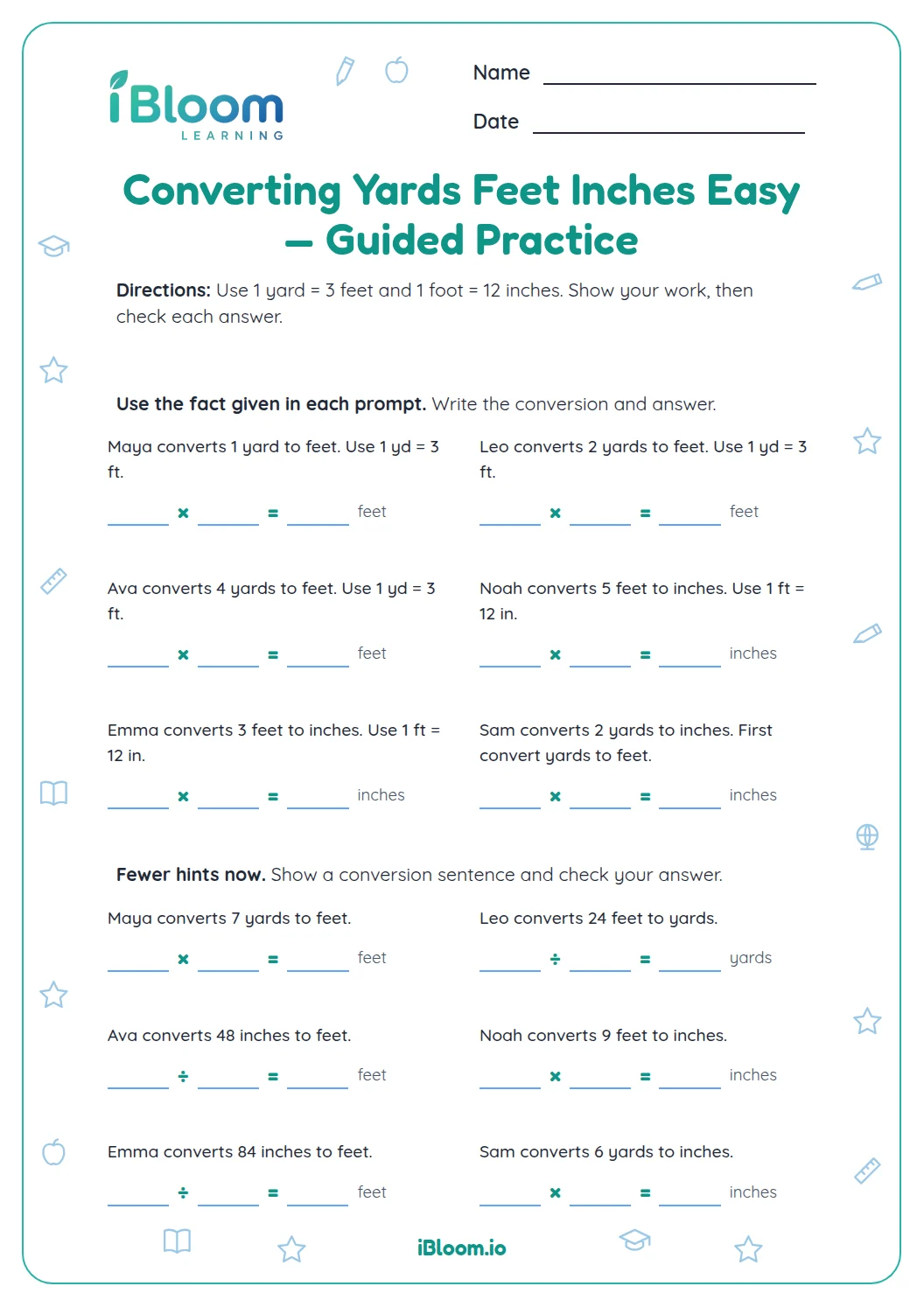
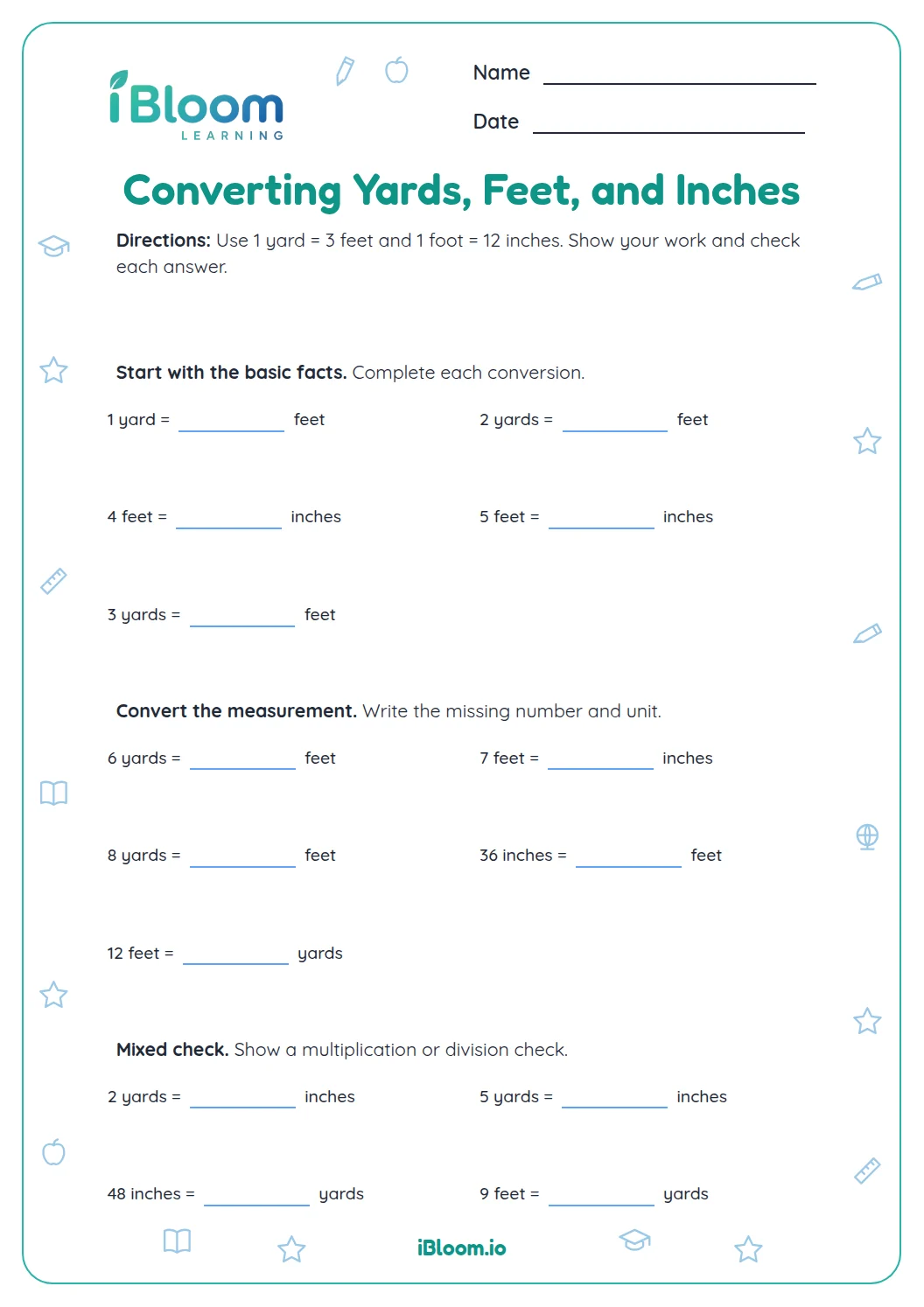
This printable Grade 3 practice sheet has 16 questions about converting yards, feet, and inches. Students first convert one unit, then combine mixed lengths or regroup inches into feet and leftover inches. The worksheet includes two practice sections and a separate answer key. It supports CCSS 4.MD.A.1 by using relationships within one measurement system.
Aligned to 4.MD.A.1
Which fact should you use first?
Use 3 feet for each yard and 12 inches for each foot. To convert yards directly to inches, apply both facts in sequence.
Question 5 changes 4 yards to inches: 4 × 3 = 12 feet, then 12 × 12 = 144 inches.
- 14 yd = 12 ft
- 212 ft = 144 in
- 3So 4 yd = 144 in
How do you combine mixed lengths?
Convert each part to the requested unit before adding. Question 7 asks for 3 yards 2 feet in feet: 3 yards make 9 feet, and 9 + 2 = 11 feet.
When the answer asks for feet and inches, divide total inches by 12 and keep the remainder as inches.
How can you check your answer?
Convert the result back to the starting unit. If 95 inches is 7 feet 11 inches, then 7 × 12 + 11 returns 95 inches.
For a single-unit conversion, use the inverse operation to check the factor.
How to use this worksheet
- 1Write the conversion facts 1 yd = 3 ft and 1 ft = 12 in.
- 2Mark the unit the question asks you to find.
- 3Convert the larger unit before adding smaller units.
- 4For feet and inches, divide inches into groups of 12 and a remainder.
- 5Check by converting back to the starting measure.
Common mistakes and quick fixes
The mistake
Multiplying yards by 12 when feet are requested
The fix
Use 3 feet per yard for a feet answer.
The mistake
Adding different units directly
The fix
Convert both parts to one unit before adding.
The mistake
Repeating the printed unit in the key
The fix
Match the key value to the blank; the unit is already shown.
Common Core alignment
This worksheet practices the math standard below.
Convert measurements to a smaller unit using relationships within one system.
On this sheet: The problems use relationships among yards, feet, and inches to convert measurements.
Show the official wordingHide the official wording
Know relative sizes of measurement units within one system of units including km, m, cm; kg, g; lb, oz.; l, ml; hr, min, sec. Within a single system of measurement, express measurements in a larger unit in terms of a smaller unit. Record measurement equivalents in a two-column table.
What to practice next
Make more practice
Further reading
Questions parents and teachers ask
What facts connect yards, feet, and inches?
One yard equals 3 feet, and one foot equals 12 inches. Use the fact that matches the units in the question. For example, to change yards to inches, first find the feet and then multiply by 12. The answer key gives numbers only when the unit is already printed.
How do I convert yards to inches?
Convert yards to feet by multiplying by 3, then convert those feet to inches by multiplying by 12. For example, 2 yards are 6 feet, and 6 feet are 72 inches. The practice includes direct and mixed conversions, and each blank shows the unit requested.
How do I solve a mixed-length question?
Change each part into the unit the question asks for, then combine the values. For 3 yards 2 feet in feet, 3 yards become 9 feet; adding 2 feet gives 11 feet. In a two-blank answer, write the feet value first and the leftover inches second.
Why does the key sometimes show two numbers?
Questions that ask for feet and leftover inches have two blanks. The key lists the feet answer first and the inches answer second, matching the order on the worksheet. For questions with one blank and a printed unit, the key shows only the number to avoid repeating the unit.
How can I check a conversion?
Use the relationship in reverse. For instance, 7 feet is 84 inches because 7 groups of 12 make 84; dividing 84 by 12 returns 7 feet. A reverse check can show whether a factor was missed or whether the answer was written in the wrong unit.