






About this worksheet
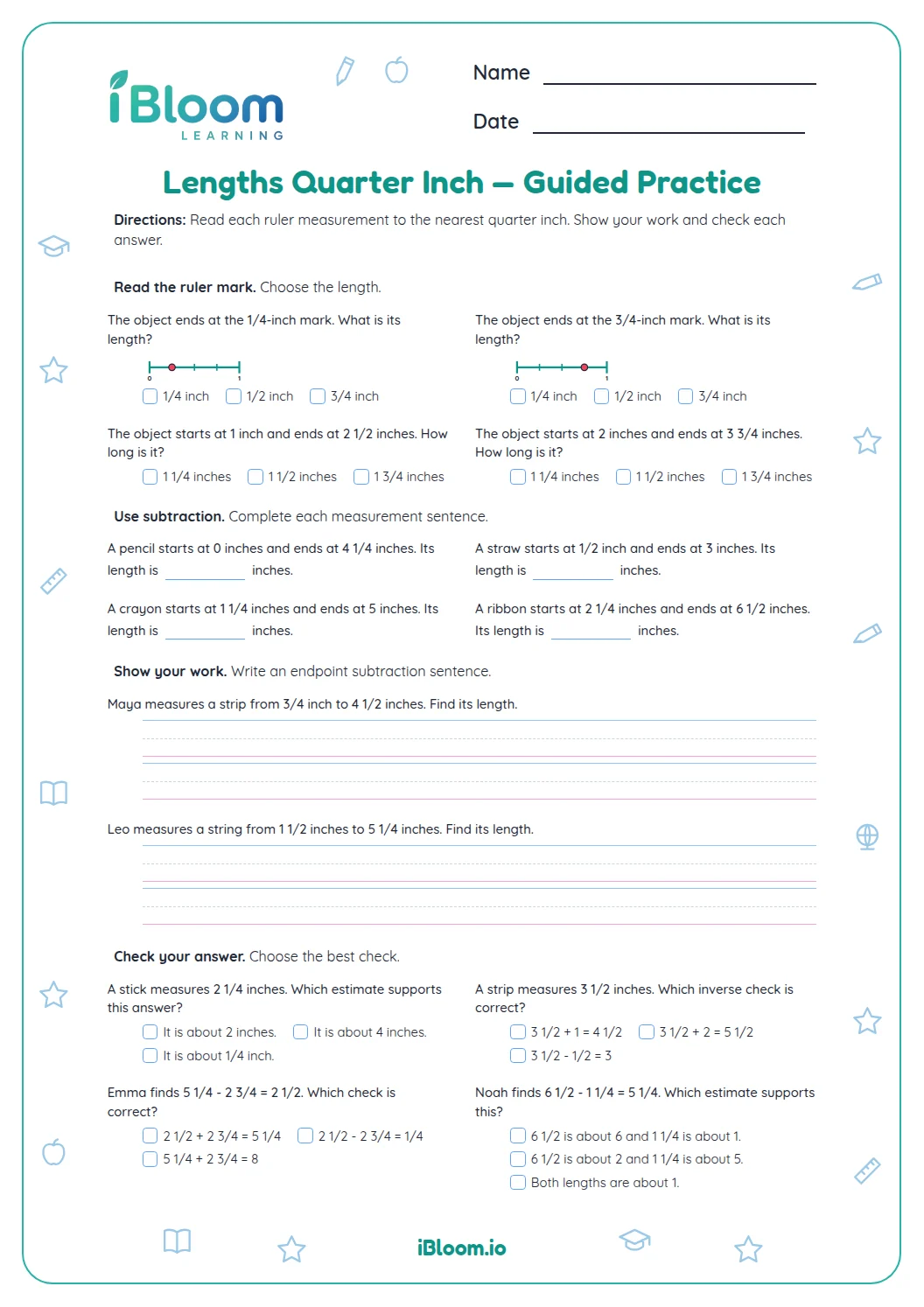
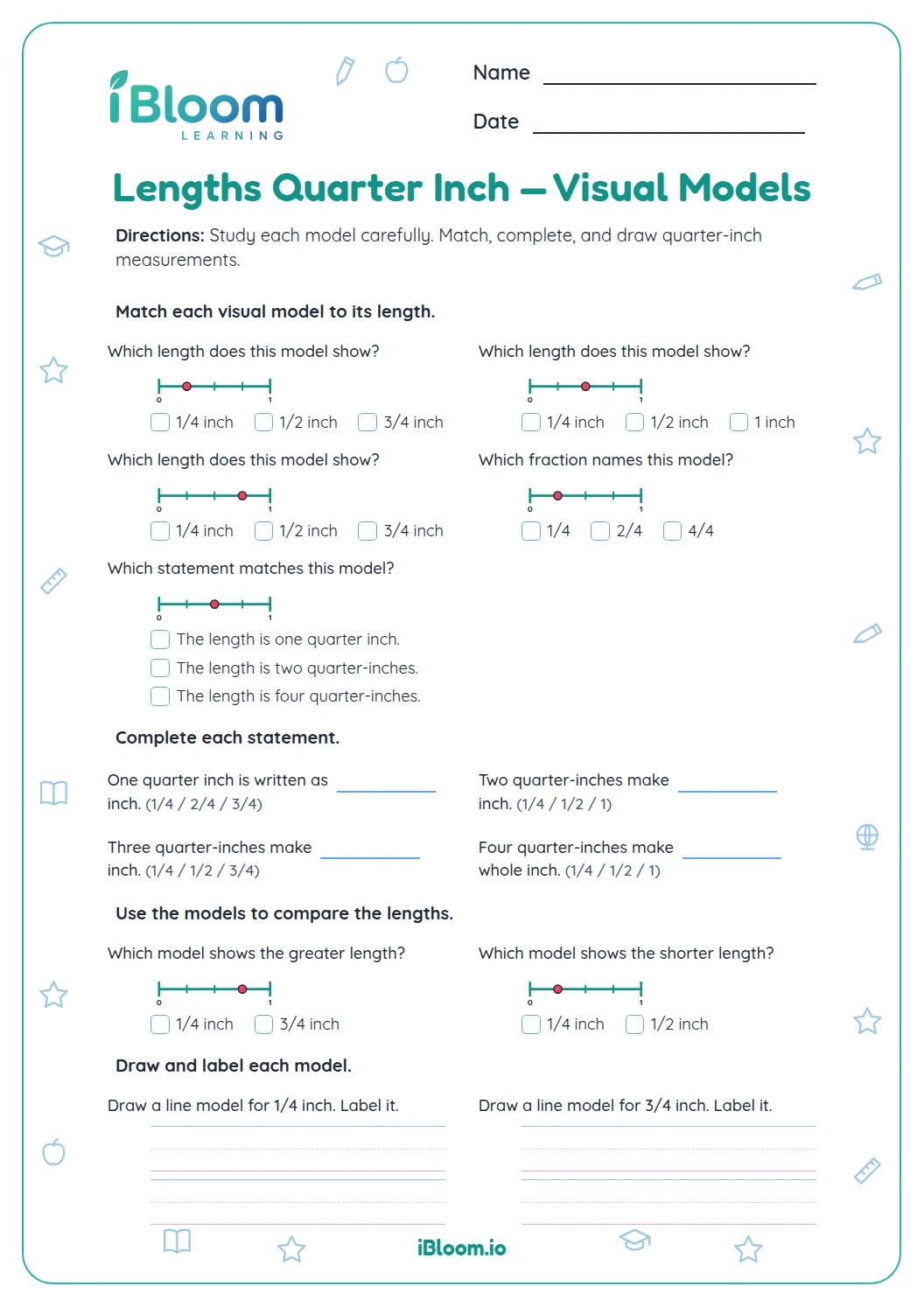
This Grade 3 printable has 16 questions about lengths to the nearest quarter inch. Students read 12 rulers marked in quarter-inch steps, compare two measurements, and solve two length calculations. The answer key shows the ruler readings as mixed numbers with inches. The practice connects to CCSS 3.MD.B.4 measurement with rulers marked in halves and fourths.
Aligned to 3.MD.B.4
How do you read the ruler endpoint?
Start at zero and follow the object's endpoint to the nearest mark. Each inch is divided into four equal intervals, so the marks represent fourths.
Question 1's pencil ends at 2 1/4 inches: two whole inches and one quarter inch.
- 12 whole inches
- 21 mark past 2 inches = 1/4 inch
- 3Length: 2 1/4 in
How do you compare quarter-inch lengths?
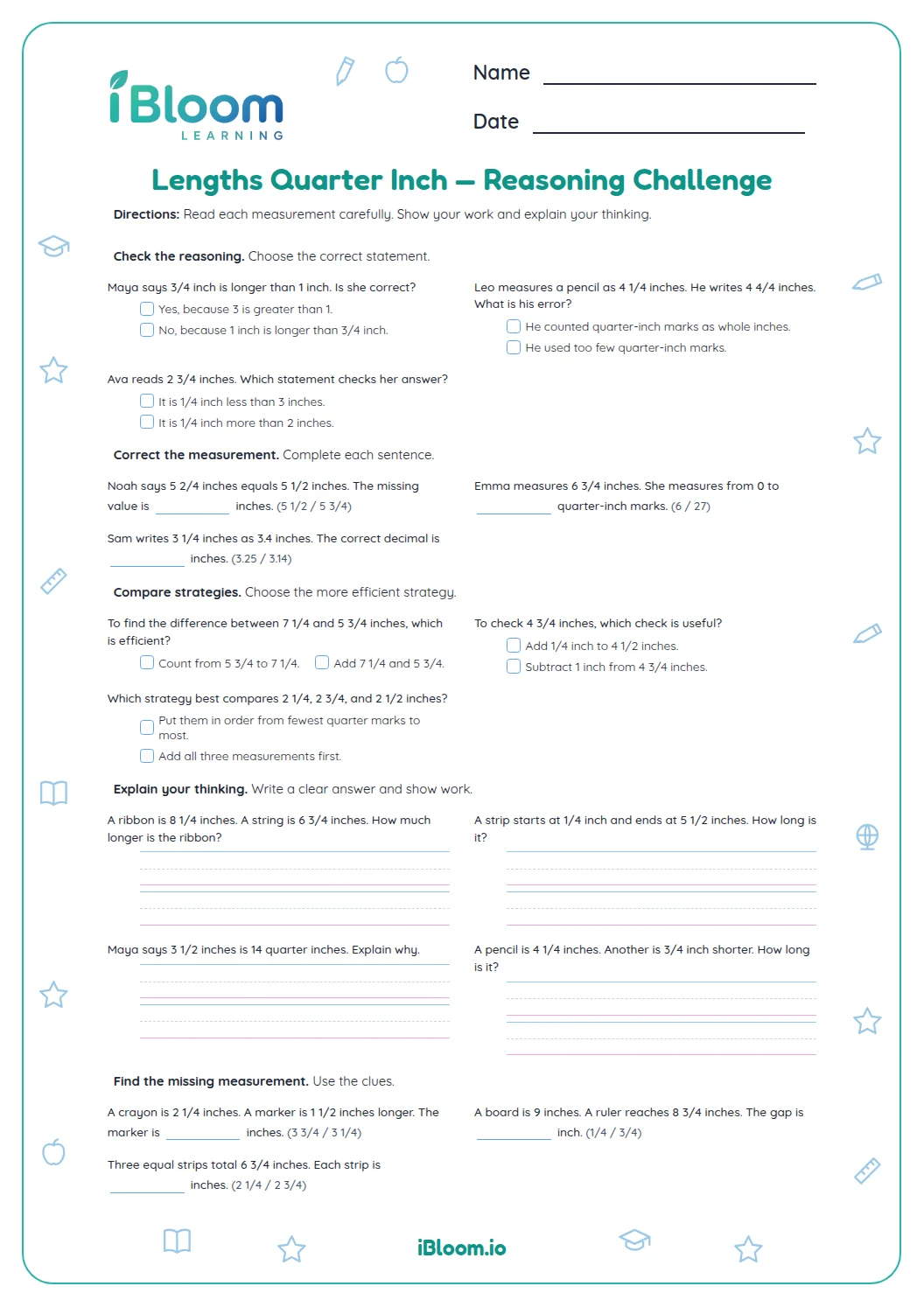
Compare the whole inches first, then compare the fractional parts. The choices use inch measurements, so match the units before deciding which is longer or shorter.
Remember that 2/4 equals 1/2.
How do you combine measured lengths?
Add or subtract whole inches and fourths. Four fourths make one whole inch, which helps regroup a result such as 3 1/4 + 1 3/4 as 5 inches.
The final questions ask for a total and a remaining length.
How to use this worksheet
- 1Find zero at the ruler's starting edge.
- 2Count whole inches to the endpoint.
- 3Count the fractional marks in fourths.
- 4Compare whole parts before fractional parts.
- 5Regroup four fourths as one inch when adding or subtracting.
Common mistakes and quick fixes
The mistake
Starting at the first inch instead of zero
The fix
Count every interval from the zero mark.
The mistake
Reading three quarter marks as one quarter
The fix
Three marks after a whole inch mean 3/4 inch.
The mistake
Adding fractions without regrouping
The fix
Trade 4/4 for one whole inch.
Common Core alignment
This worksheet practices the math standard below.
Measure lengths to the nearest quarter inch with a ruler.
On this sheet: Students read ruler marks in quarter-inch increments.
Show the official wordingHide the official wording
Generate measurement data by measuring lengths using rulers marked with halves and fourths of an inch. Show the data by making a line plot, where the horizontal scale is marked off in appropriate units—whole numbers, halves, or quarters.
What to practice next
Make more practice
Further reading
Questions parents and teachers ask
How do I read a quarter-inch ruler?
Find the object's endpoint and count the quarter-inch marks from zero. Each small interval is one fourth of an inch. The answer can be written as a mixed number, such as 2 1/4 inches, or as an equivalent fraction such as 9/4 inches.
What does one quarter inch look like on the ruler?
One quarter inch is one of four equal spaces between whole-inch marks. Two spaces make one half inch, and three spaces make three fourths inch. Read the ruler's endpoint, then combine the whole inches and fractional part. Read the numerals below the ruler marks carefully.
How do I compare two lengths?
Compare the whole-number inches first. If those match, compare the fractions using fourths: 1/4, 2/4, 3/4, and 4/4. For example, 2 1/2 inches is longer than 2 1/4 inches because 2/4 is greater than 1/4. Convert both fractional parts to fourths before comparing.
Can I add or subtract mixed lengths?
Yes. Add or subtract the whole inches and fractional parts, regrouping when needed. For example, 3 1/4 + 1 3/4 makes 4 + 4/4, or 5 inches. The last questions provide space to show this calculation. The key gives the simplified result for each calculation.
Does the answer key accept equivalent fractions?
Yes. The key gives a clear mixed-number measurement for each ruler, and equivalent forms such as 2 1/2 and 2 2/4 name the same length. Use a simplified form when possible, and include inches in answers to length questions.