



About this worksheet
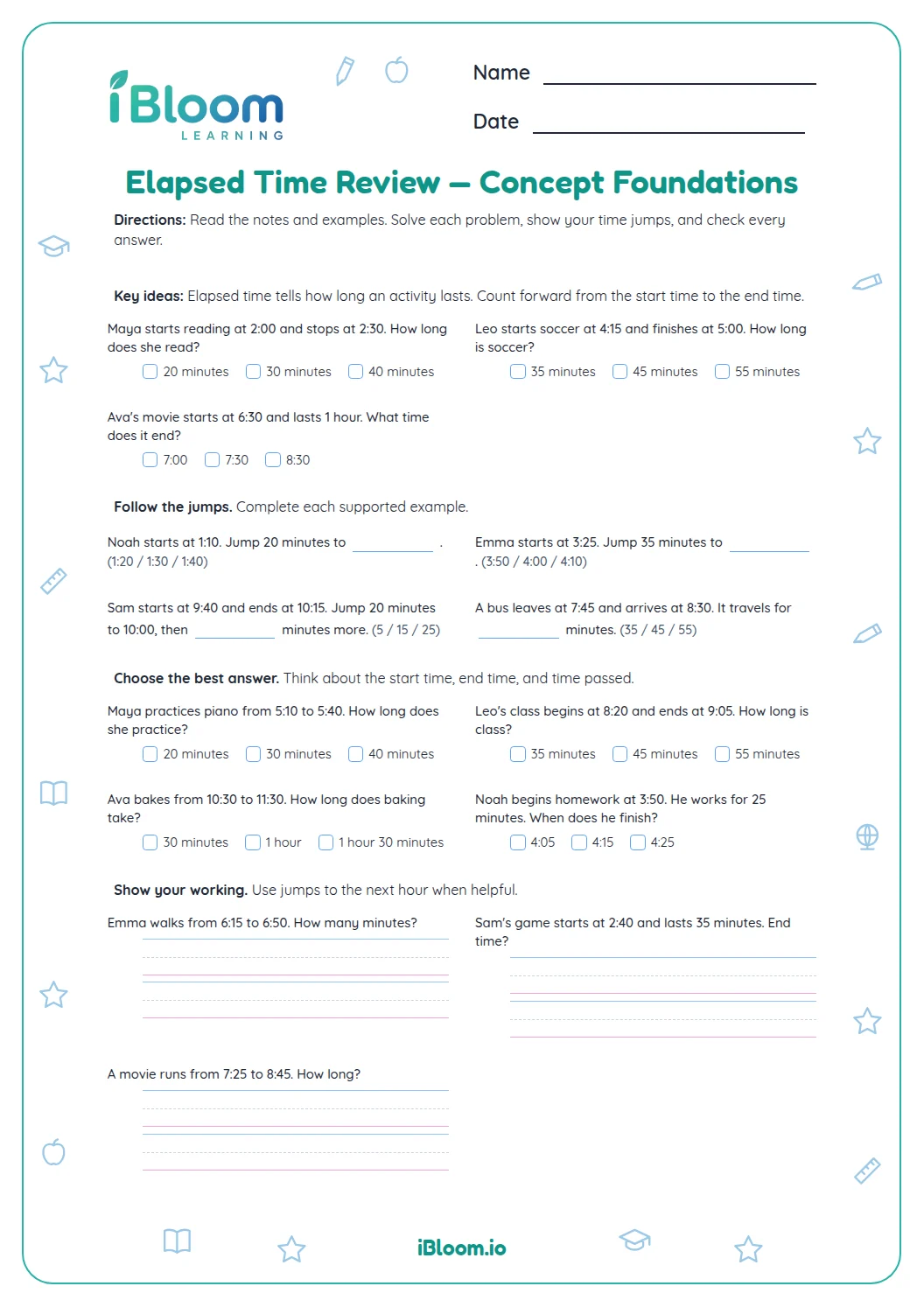
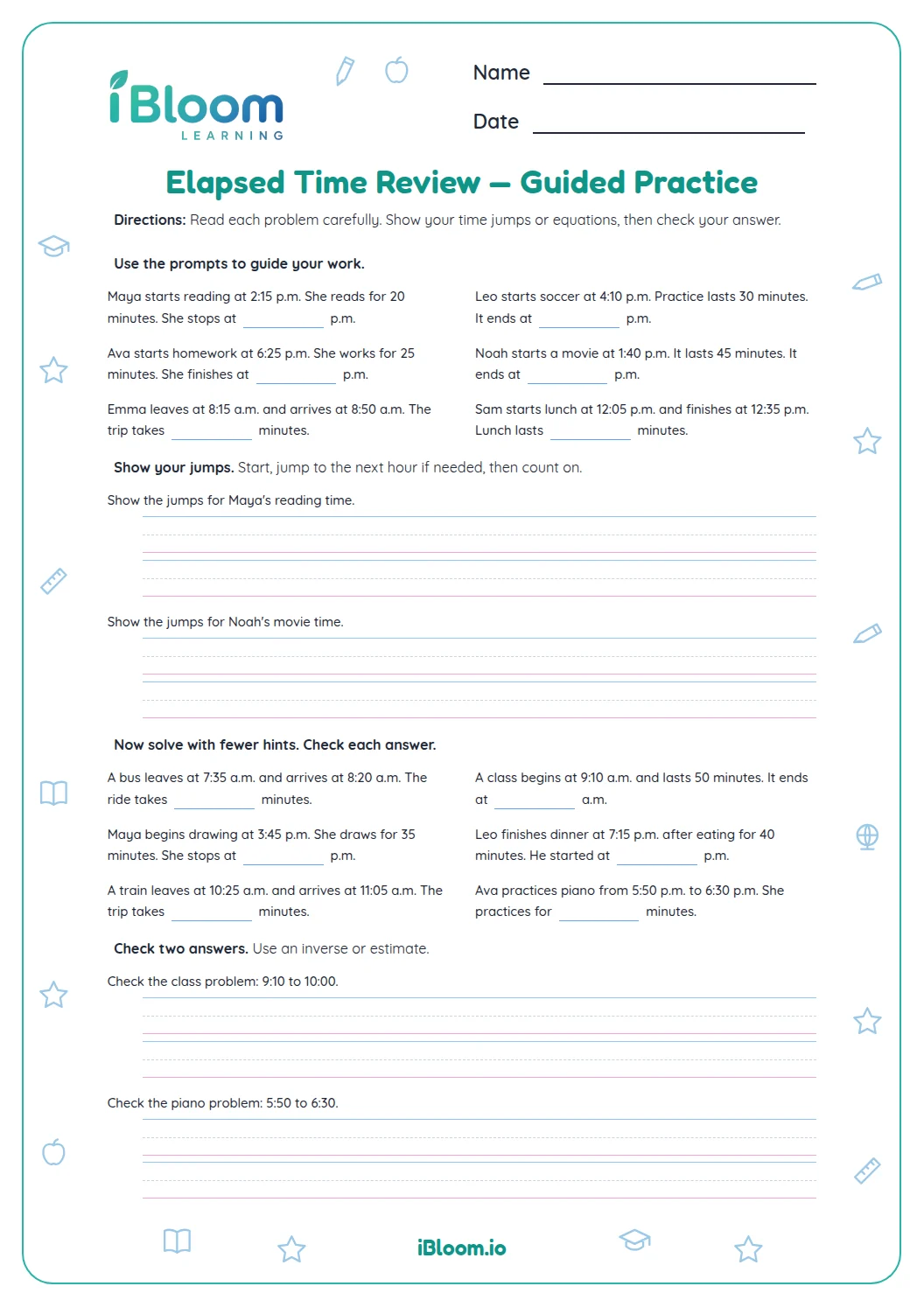
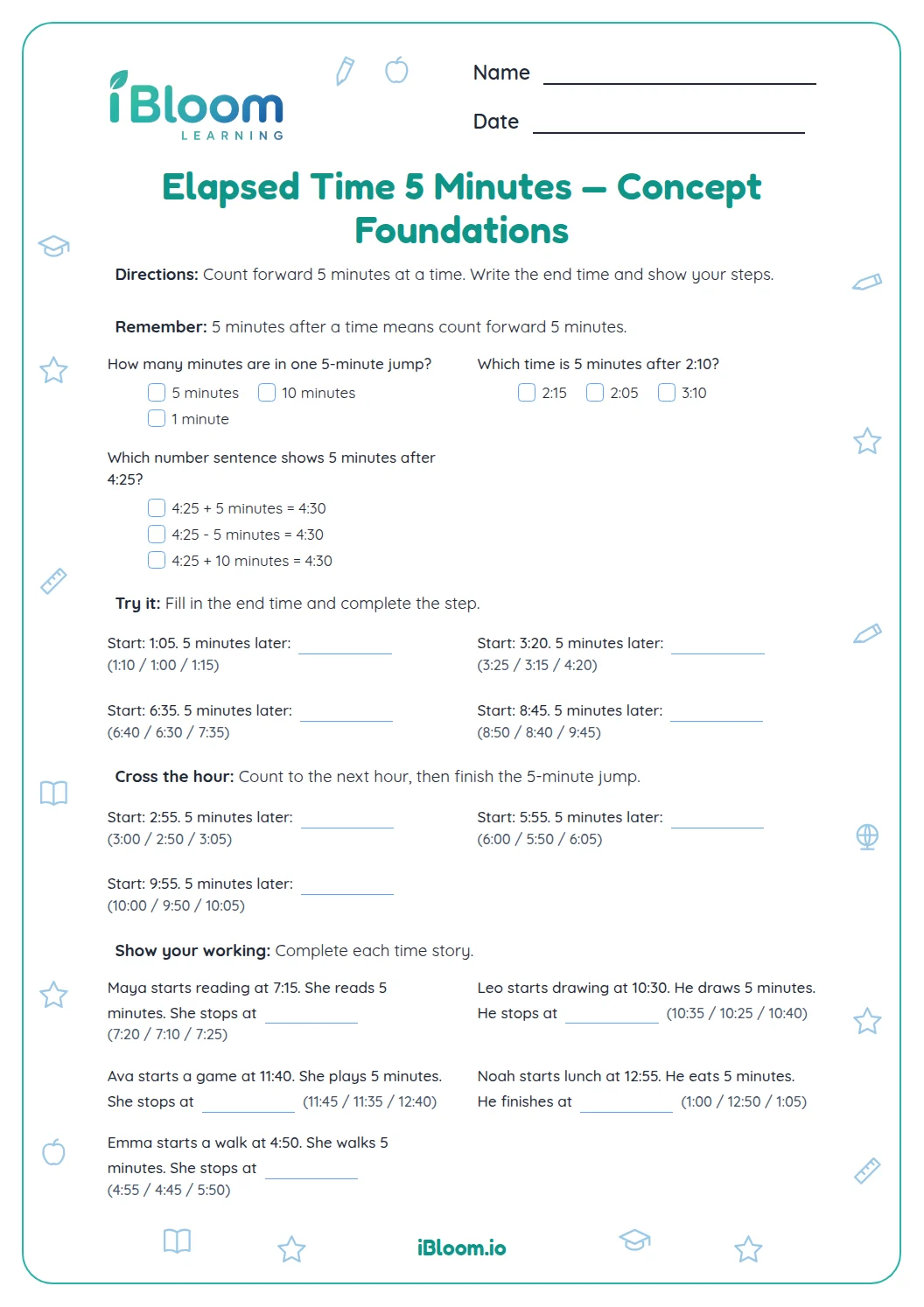
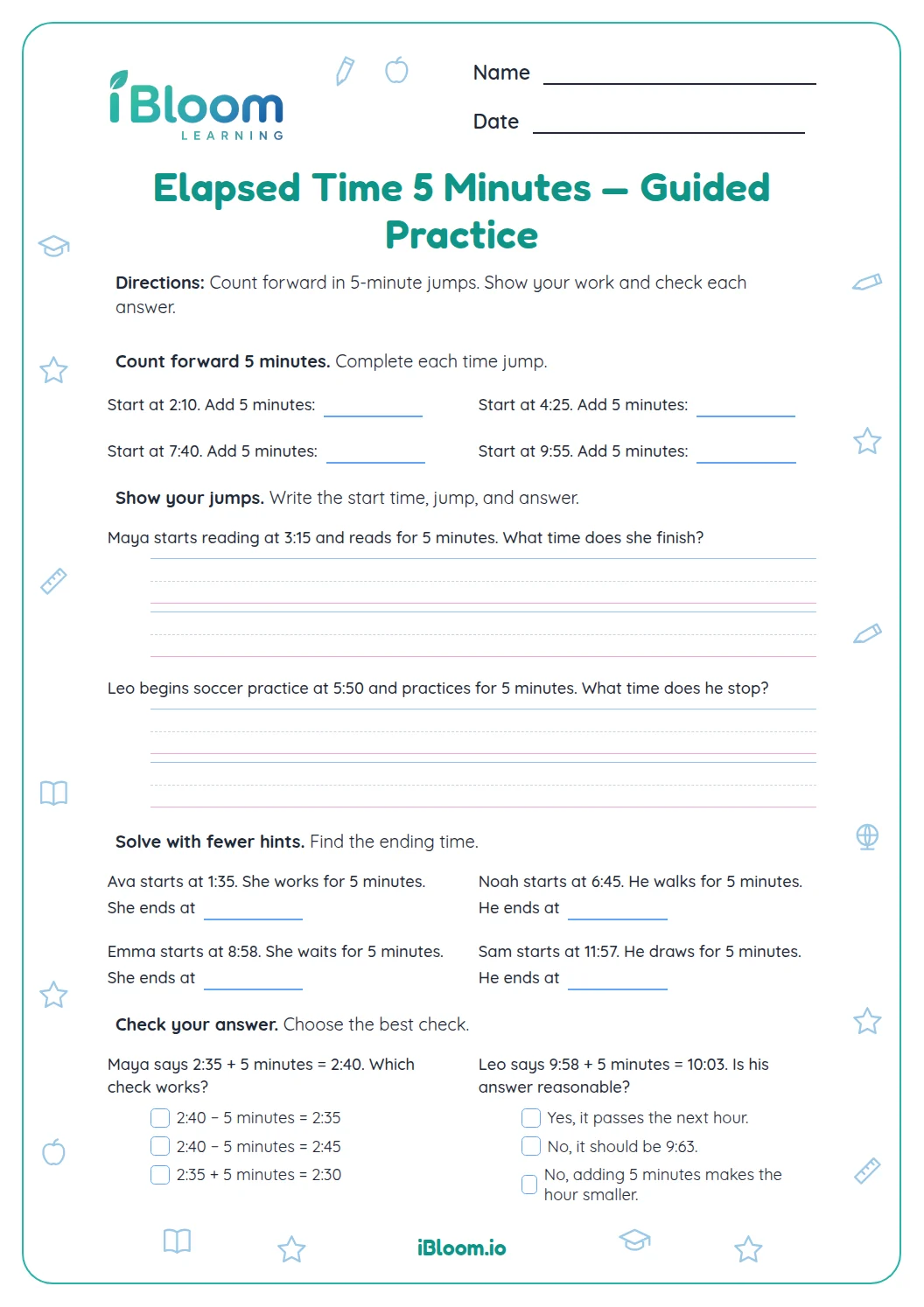
This free Grade 3 worksheet helps students measure elapsed time in minutes and solve time problems that cross an hour. Its 15 questions include direct time calculations, multiple-choice reasoning, and short applications about homework, a game, a bus, and a show. The two-page printable includes a separate answer key and practices CCSS 3.MD.A.1.
Aligned to 3.MD.A.1
How do you count elapsed minutes across an hour?
Break an interval into a jump to the next hour and a second jump to the ending time. This keeps the minutes clear when the hour changes.
In question 1, 2:35 to 3:00 is 25 minutes, and 3:00 to 3:10 is 10 more. Maya is correct: 25 + 10 = 35 minutes.
- 12:35 to 3:00 is 25 minutes
- 23:00 to 3:10 is 10 minutes
- 325 + 10 = 35 minutes; Maya is correct.
How can you find a start or finish time?
For a finish time, add the interval to the start. For a start time, count backward from the finish by the stated duration. Keep track of the hour as the minutes cross 60.
Question 2 starts at 6:50 and lasts 45 minutes: 10 minutes reaches 7:00, then 35 more minutes reaches 7:35.
What is on the two worksheet pages?
Part A has five direct elapsed-time and finish-time questions. Part B has five choices about intervals and claims. Part C has five more time calculations, including a start-time question. The separate key gives one checked result for each of the 15 questions.
How to use this worksheet
- 1Mark the start time and the end time named in the question.
- 2Jump to the next hour if the minutes cross 60.
- 3Add or subtract the minutes in each jump.
- 4For a missing start time, count backward from the ending time.
- 5Check that your answer has the right clock time or number of minutes.
Common elapsed-time mistakes
The mistake
Subtracting the minute digits without accounting for an hour change.
The fix
Split the interval at the hour, then add the two smaller intervals.
The mistake
Adding 45 minutes to 6:50 and leaving the result in the 6 o’clock hour.
The fix
Count 10 minutes to 7:00, then count the remaining 35 minutes.
The mistake
Treating 1 hour 20 minutes as 80 hours or writing 82 o’clock.
The fix
Add 1 hour to the start time, then add the 20 minutes.
Common Core alignment
This worksheet practices measuring time intervals and solving elapsed-time problems in minutes.
Measure time intervals in minutes and solve elapsed-time problems.
On this sheet: Students calculate elapsed minutes and start or finish times across an hour.
Show the official wordingHide the official wording
Tell and write time to the nearest minute and measure time intervals in minutes. Solve word problems involving addition and subtraction of time intervals in minutes, e.g., by representing the problem on a number line diagram.
What to practice next
Make more practice
Further reading
Questions parents and teachers ask
Is Maya right that 2:35 to 3:10 is 35 minutes?
Yes. From 2:35 to 3:00 is 25 minutes, and from 3:00 to 3:10 is 10 minutes. The two parts total 35 minutes. The first question asks students to check Maya’s statement, so the answer is that she is correct.
What time does the homework problem finish?
Homework starts at 6:50 and lasts 45 minutes, so it finishes at 7:35. Count 10 minutes to reach 7:00, then count the remaining 35 minutes. Keeping the hour change visible prevents the answer from being written as a time in the 6 o’clock hour.
How do students add 1 hour 20 minutes to 2:15?
First add one hour to 2:15 to reach 3:15. Then add 20 minutes to reach 3:35. The game problem uses this two-step approach; it does not combine the hour and minutes into a single number such as 80.
Is an answer key included with the worksheet?
Yes. The answer key follows the same 15 questions and gives the time, duration, or correct choice for each one. A student can solve a part before checking, then redo any item that does not match the key and explain where the hour changed.
How long should students spend on the questions?
About 25 to 30 minutes is a reasonable starting estimate for all 15 questions, especially if students write their jumps. The first part focuses on direct calculations; the next parts ask them to evaluate claims and solve start-time or finish-time problems.