


About this worksheet
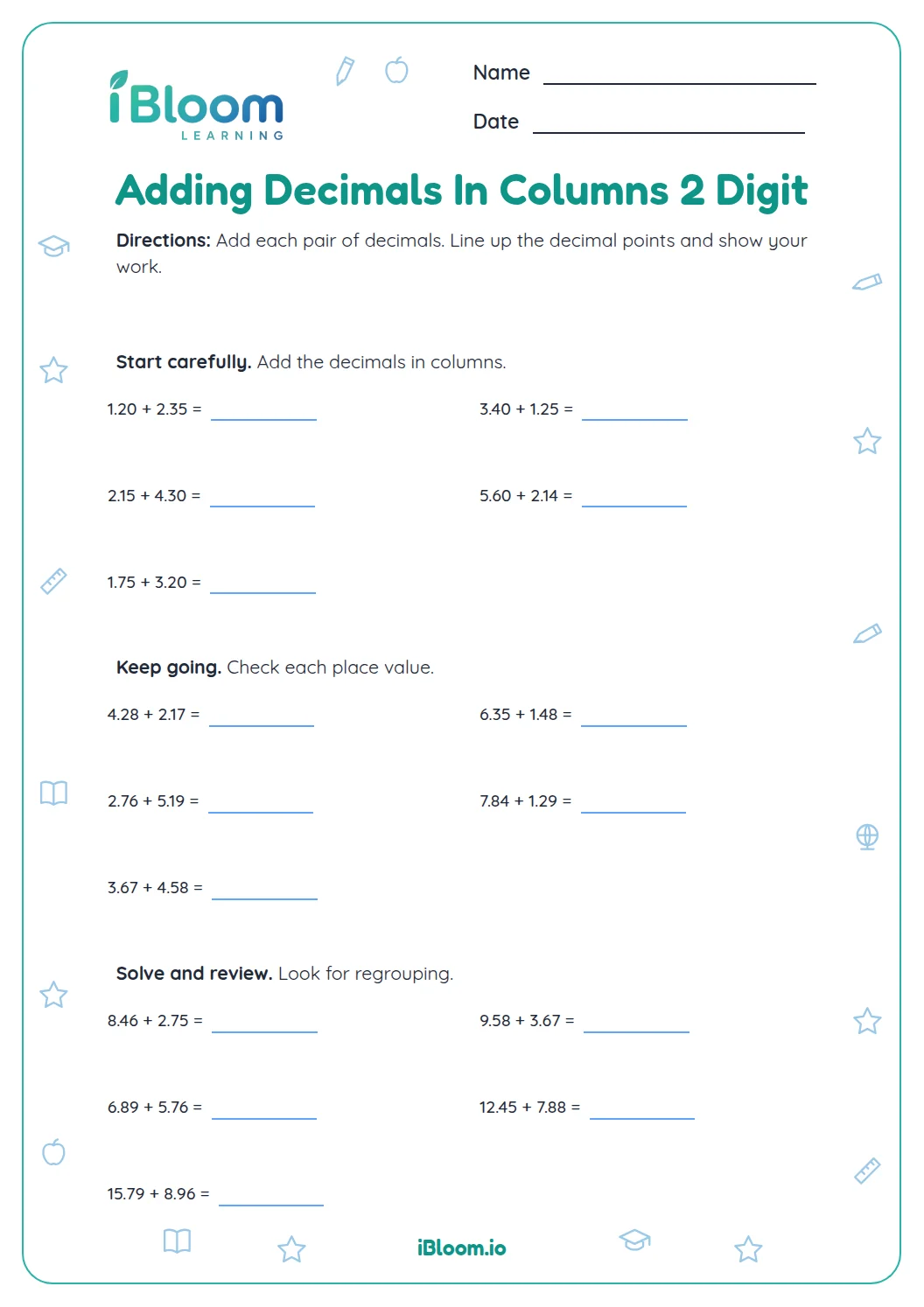
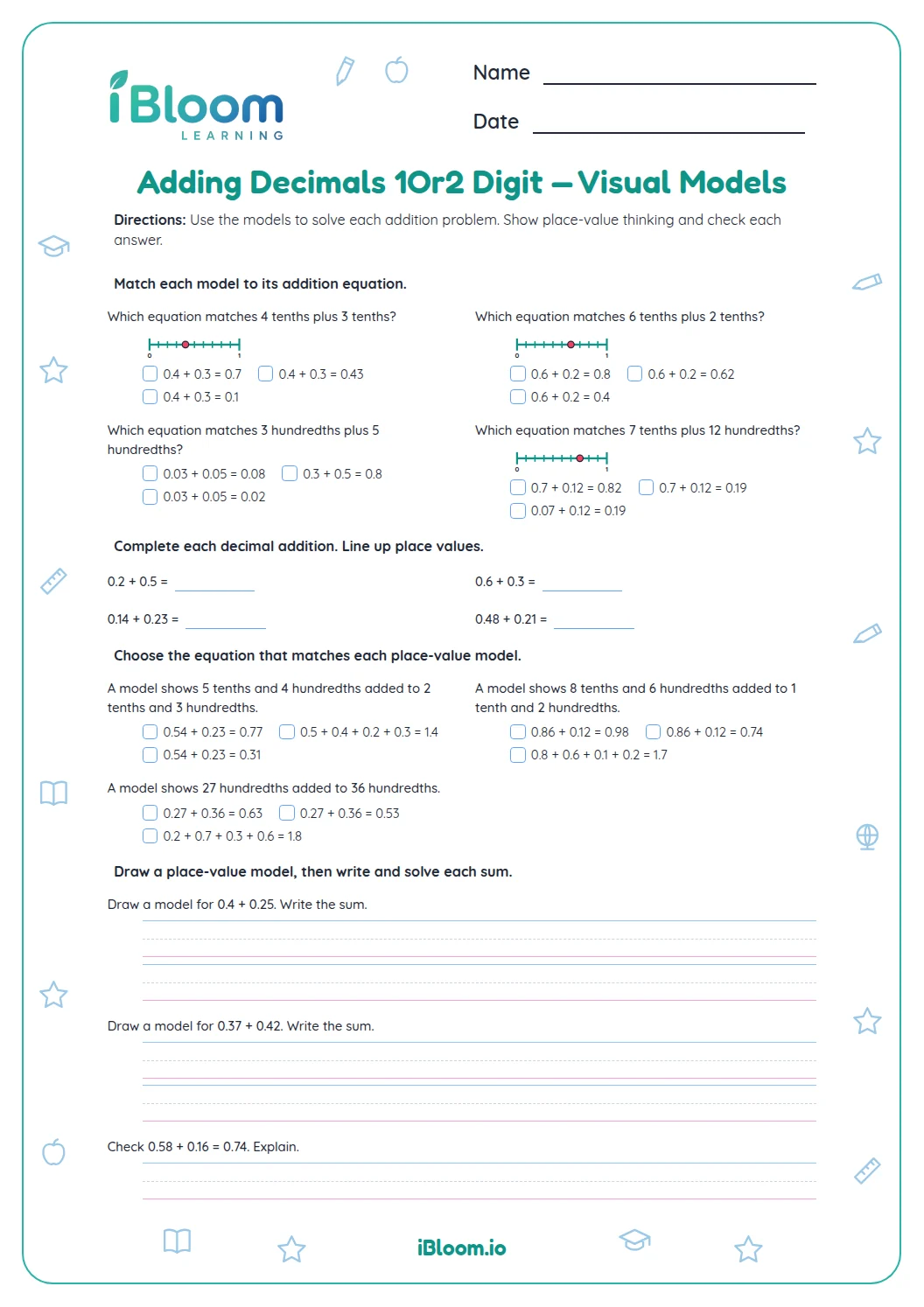
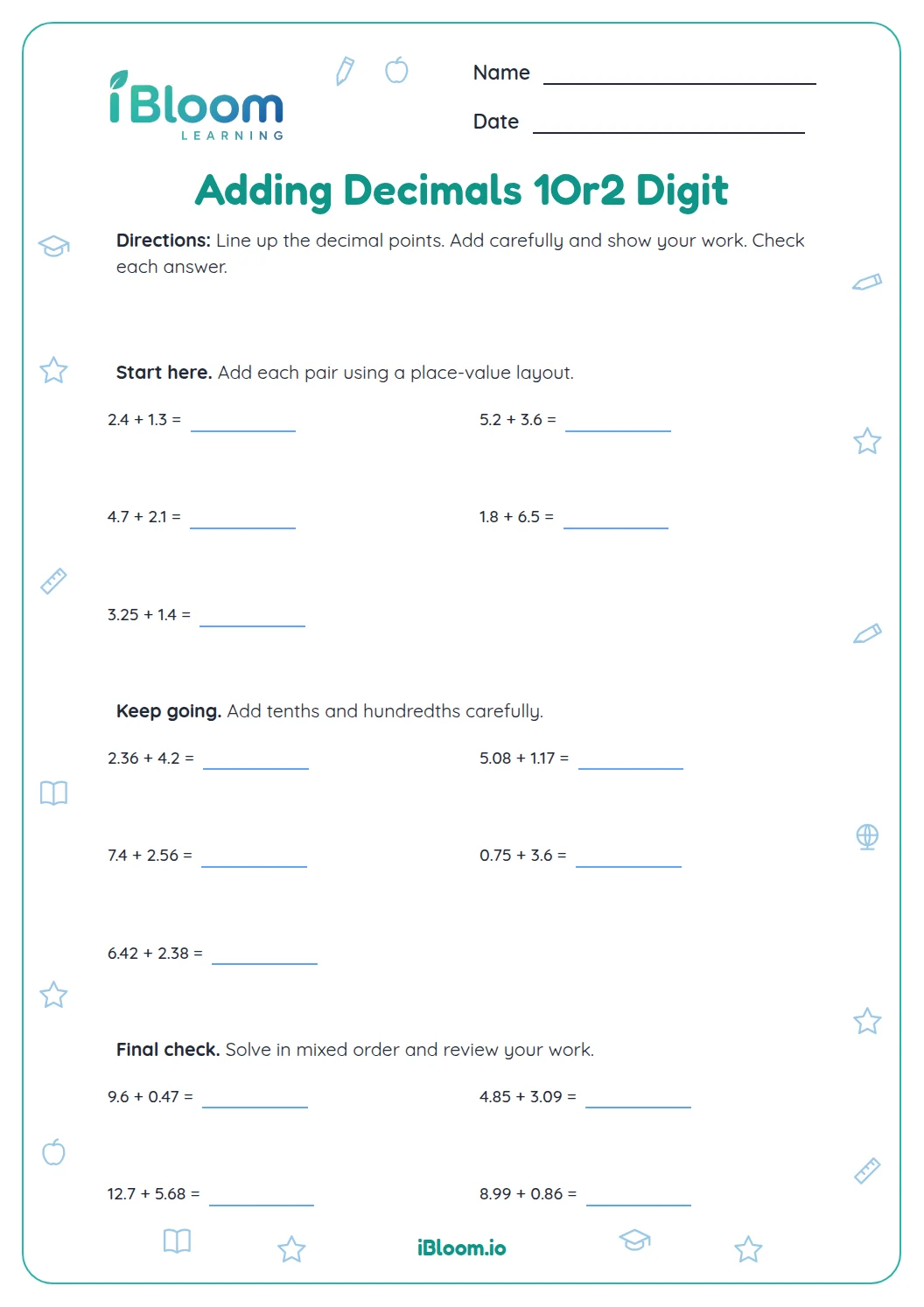
This Grade 4 concept sheet contains 16 two-place decimal addition problems designed for column work. Students align decimal points, add hundredths and tenths, and preserve zeros in values such as 5.60. Each problem has one complete sum blank, so the key does not duplicate printed digits. It practices decimal place-value reasoning associated with CCSS 4.NF.C.5.
Aligned to 4.NF.C.5
Why do decimal points line up in column addition?
Digits in the same place have the same value. Put tenths under tenths and hundredths under hundredths, so each column combines like units. Add a zero as a placeholder when a number has fewer decimal places.
Question 1 is 2.36 + 1.12. Add hundredths, then tenths, then ones to get 3.48.
- 1 2.36
- 2+ 1.12
- 3 3.48
- 4Hundredths, tenths and ones stay aligned.
How can you check a decimal sum?
Estimate using nearby whole numbers, then add in columns. In question 2, 5.60 + 1.25 is about 7; the exact result is 6.85, a reasonable sum.
Use zeros to keep hundredths visible, as in 5.60. The final answer should have two digits after the decimal point.
What will the questions help students practice?
The 16 sums include tenths and hundredths, numbers with zero in a place, and regrouping. Every equation leaves one complete sum blank so the key supplies the full value.
How to use this worksheet
- 1Write one addend under the other with decimal points aligned.
- 2Check that tenths and hundredths are in matching columns.
- 3Add hundredths, tenths and ones, regrouping as needed.
- 4Keep the decimal point aligned in the sum.
- 5Estimate to see whether the result is reasonable.
Common mistakes and quick fixes
The mistake
Putting digits next to each other without aligning place values.
The fix
Line up decimal points before adding.
The mistake
Writing the result with the decimal point in the wrong place.
The fix
Bring the decimal point straight down into the sum.
The mistake
Dropping a zero that helps show hundredths.
The fix
Keep placeholder zeros when they make the hundredths place clear.
Common Core alignment
This worksheet practices the following Common Core mathematics standard.
Align like place values before adding.
On this sheet: The questions directly practice the stated skill.
Show the official wordingHide the official wording
Express a fraction with denominator 10 as an equivalent fraction with denominator 100, and use this technique to add two fractions with respective denominators 10 and 100.
What to practice next
Make more practice
Further reading
Questions parents and teachers ask
How do you add decimals in columns?
Line up the decimal points so tenths and hundredths are in matching columns. Add from the hundredths place to the ones place, regroup when needed, and place the decimal point in the answer directly below the others. Use the printed question and the separate answer key to check the result carefully.
Why is 2.36 + 1.12 equal to 3.48?
Add hundredths: 6 hundredths plus 2 hundredths is 8 hundredths. Add tenths: 3 plus 1 is 4 tenths. Add ones: 2 plus 1 is 3, giving 3.48. Use the printed question and the separate answer key to check the result carefully.
What does a zero in 5.60 mean?
The zero marks zero additional hundredths, while 5.60 still has 6 tenths. Keeping the zero can help align hundredths when adding another decimal such as 1.25. Use the printed question and the separate answer key to check the result carefully.
Should the decimal point move in the answer?
No. Keep it aligned vertically with the decimal points in the addends. This ensures that ones, tenths, and hundredths remain in their correct places. Use the printed question and the separate answer key to check the result carefully. Use the printed question and the separate answer key to check the result carefully.
How can estimation help check a sum?
Round each addend to a nearby whole number to estimate the result, then compare the exact answer. For example, 5.60 + 1.25 is near 6 + 1, so 6.85 is reasonable. Use the printed question and the separate answer key to check the result carefully.
Is the answer key included?
Yes. A separate key gives the complete decimal sum for each of the 16 equations. Each answer is written to hundredths, including sums with a zero in a place. Use the printed question and the separate answer key to check the result carefully.