


About this worksheet
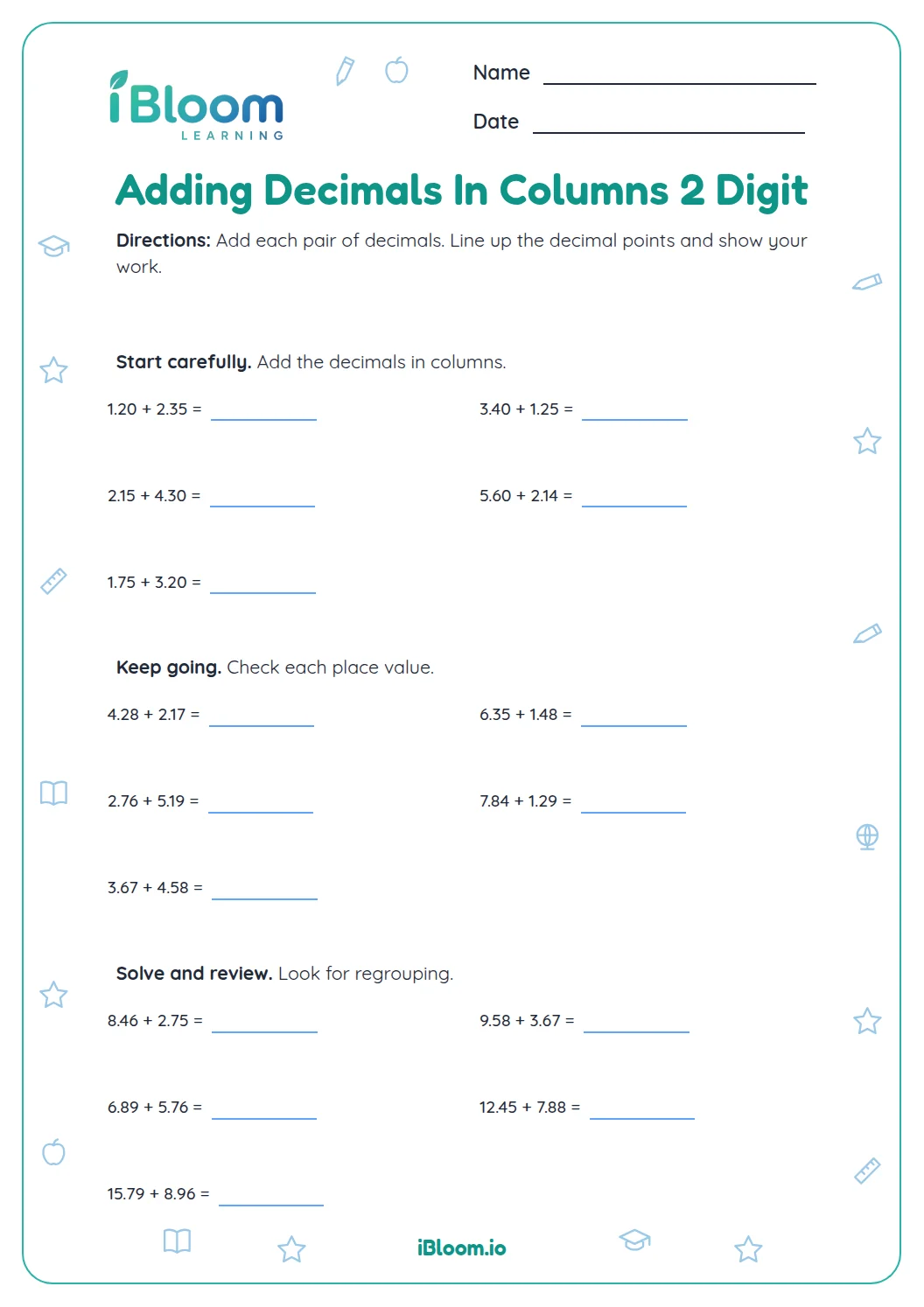
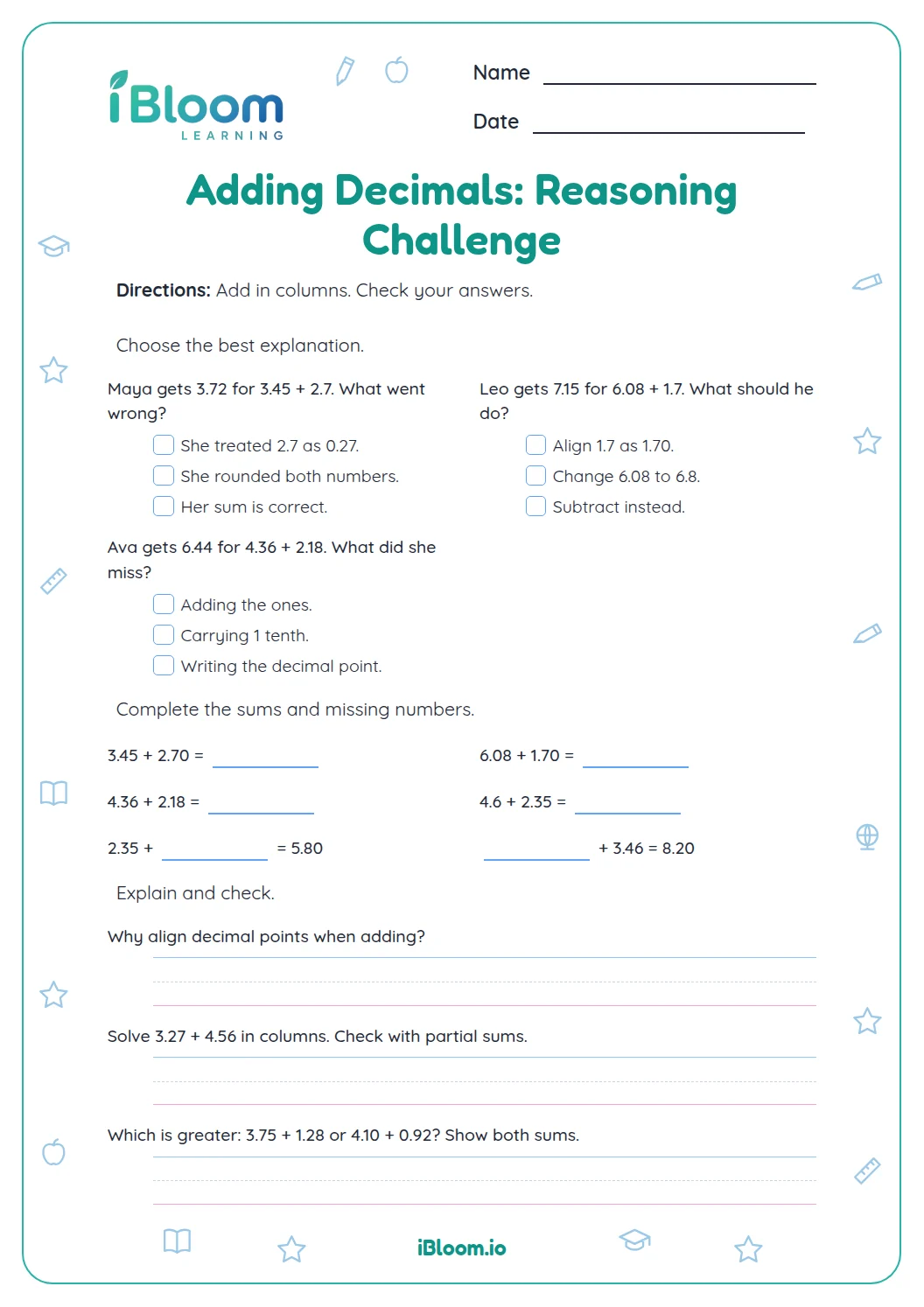
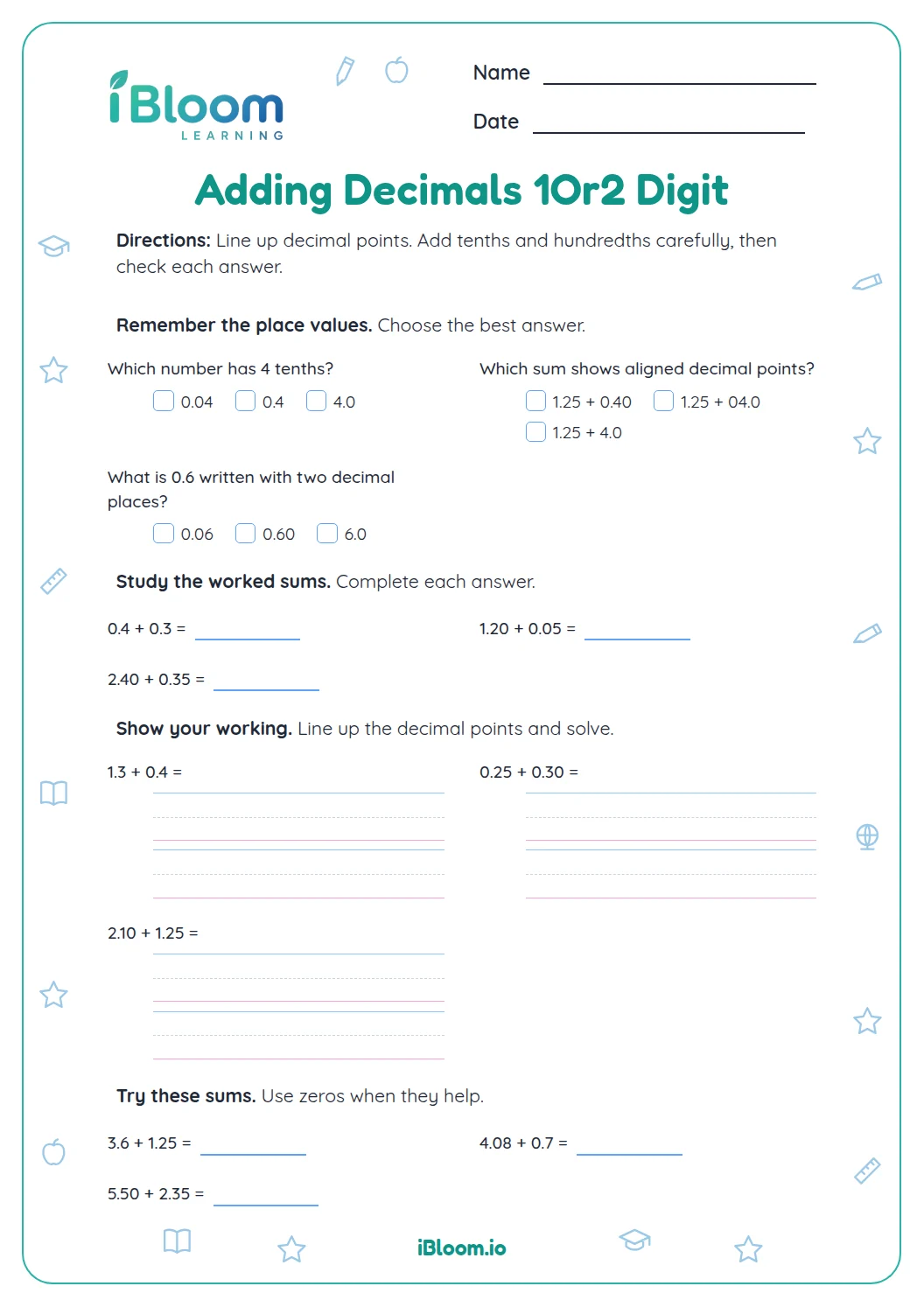
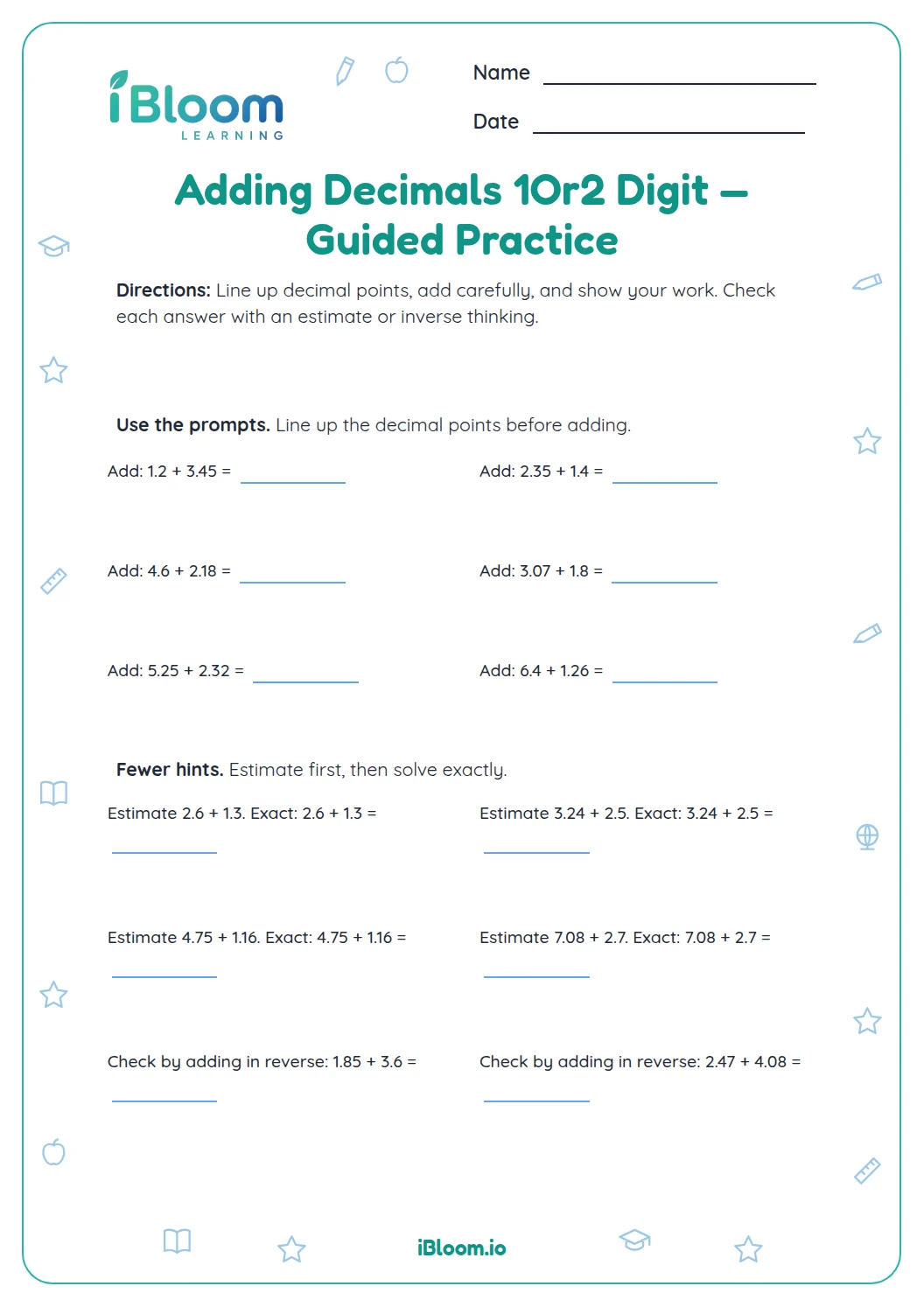
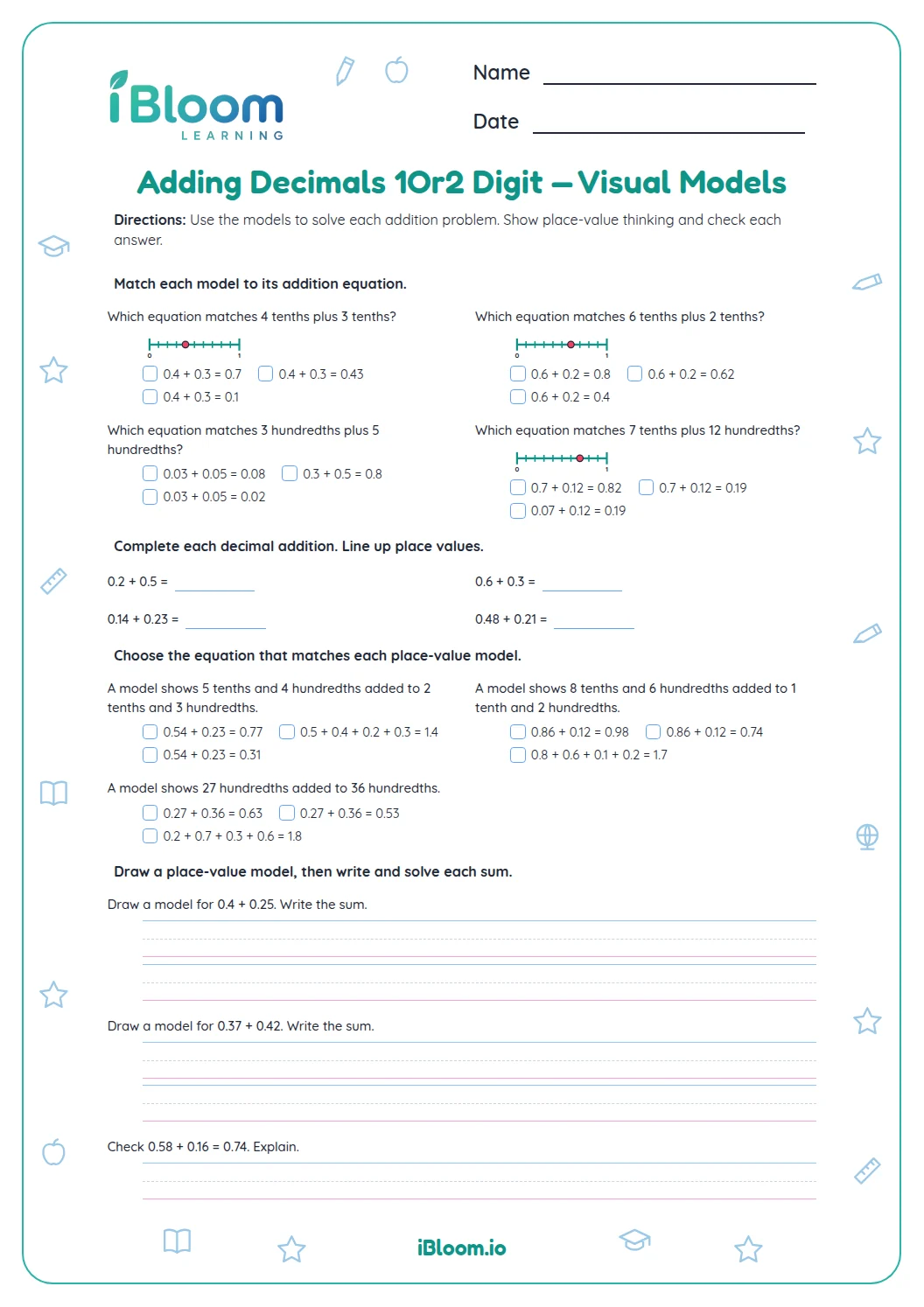
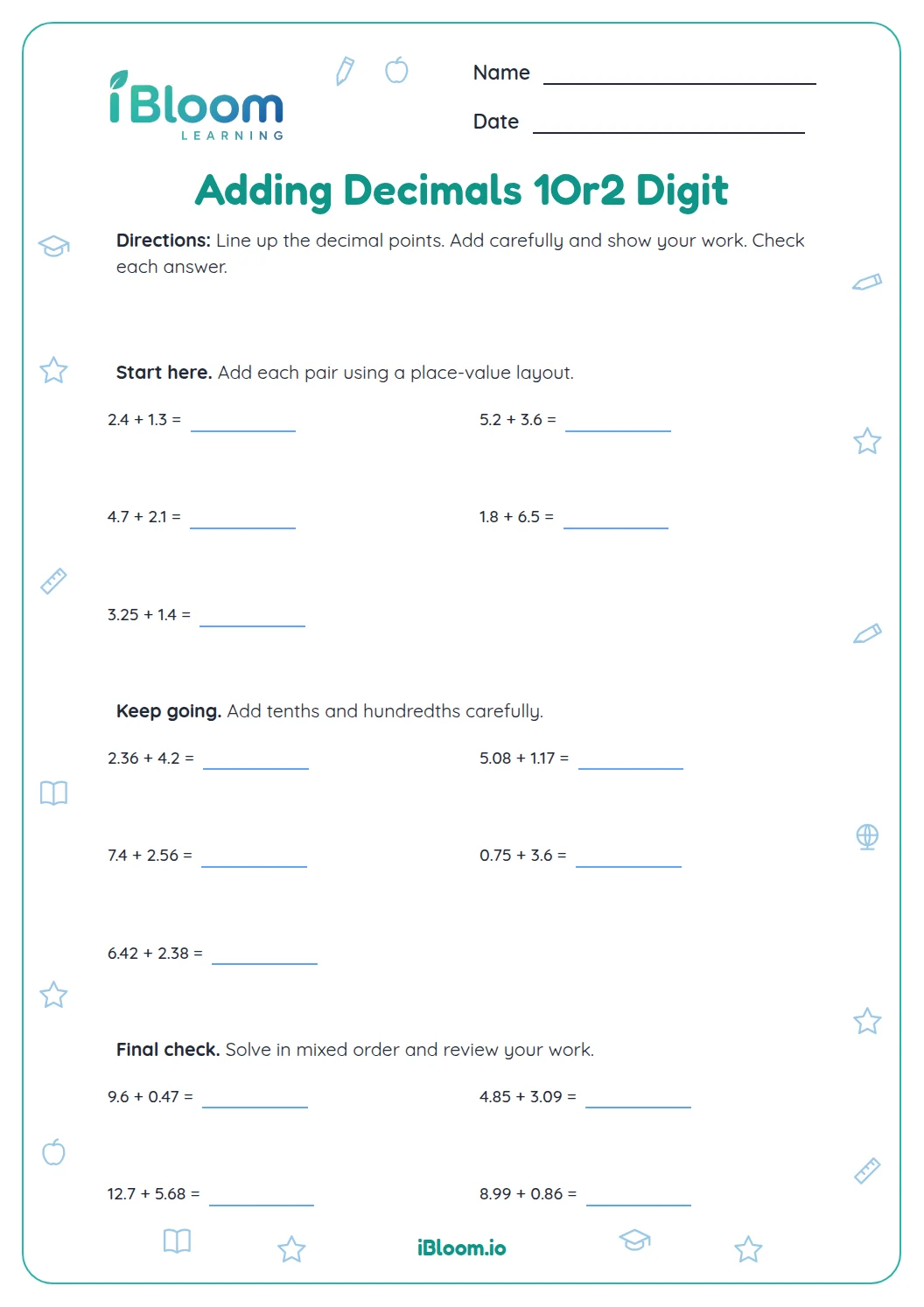
This free Grade 4 worksheet gives students 16 real-world problems that require adding two decimal amounts to hundredths. Students align decimal points and add in columns, then include the correct unit or dollar sign in each answer. Contexts include distances, lengths, capacity, weight, and money. A separate answer key supports checking each computation. The written method and decimal addition practice align with CCSS 5.NBT.B.7.
Aligned to 5.NBT.B.7
How do you line up decimal addends?
Write each amount vertically with the decimal points directly under one another. Add zeros at the end when a place is empty, then add from the hundredths place toward the left.
For question 1, align 1.24 and 2.35. Hundredths: 4 + 5 = 9; tenths: 2 + 3 = 5; ones: 1 + 2 = 3. The total is 3.59 m.
- 11.24 m + 2.35 m
- 21.24
- 32.35
- 43.59 m
Why does the unit matter?
The story names the measurement unit or dollar amount. Include that same unit in each final answer. The working box gives room to align the decimal points and add by place value.
What problems are included?
Sixteen short contexts use two decimal addends, with values to the hundredths place. Students set up each addition in columns, then write a total with its appropriate unit.
How to use this worksheet
- 1Underline the two decimal amounts in the story.
- 2Write them vertically with decimal points aligned.
- 3Add zeros at the right if a place is empty.
- 4Add from hundredths toward ones, regrouping when needed.
- 5Write the unit or dollar sign with the total.
Common mistakes and quick fixes
The mistake
Lining up the last digits instead of decimal points
The fix
Align the decimal points first so tenths and hundredths stay in their columns.
The mistake
Dropping a regrouped ten
The fix
Record each regrouped digit above the next place before adding it.
The mistake
Leaving off the unit
The fix
Reread the story and label the total in the same unit.
Common Core alignment
This practice connects to the Common Core standard below.
Add decimals to hundredths and relate the place-value strategy to written addition.
On this sheet: Students add decimal measurements and money amounts to hundredths using a written column method.
Show the official wordingHide the official wording
Add, subtract, multiply, and divide decimals to hundredths, using concrete models or drawings and strategies based on place value, properties of operations, and/or the relationship between addition and subtraction; relate the strategy to a written method and explain the reasoning used.
What to practice next
Make more practice
Further reading
Questions parents and teachers ask
Where does the decimal point go in the answer?
Keep decimal points aligned in the written addition and place the answer’s decimal point directly below them. In question 1, 1.24 + 2.35 gives 3.59, with hundredths, tenths, and ones in matching columns. The answer has two decimal places.
Should students add a zero when one amount has fewer decimal places?
A trailing zero can make the columns easier to read without changing a value. For example, 1.2 equals 1.20, so it can be written to the hundredths place before adding. The worksheet’s amounts already show hundredths where needed.
Why are the problems about different units?
The contexts help students practice reading decimal quantities and carrying the right unit into a total. Length, capacity, weight, distance, and prices appear, while every sum uses values with hundredths or fewer decimal places. Each result keeps the matching unit.
Does every question provide space for column work?
Each of the 16 word problems has a working box. Students can write the two addends in separate rows, align their decimal points, and record the sum before entering the final answer in the answer box. The problems all use the same format.
Does the answer key repeat the units?
The key includes the unit with each word-problem total because the question asks for a complete measurement or cost. For dollar sums, the answer keeps the dollar sign as part of the amount, as in question 6, where $12.45 + $8.70 = $21.15.
How can I check a decimal sum?
Estimate first, then add by place value and compare the result with the estimate. For question 6, $12.45 is about $12 and $8.70 is about $9, so the total should be near $21; the exact sum is $21.15.