


About this worksheet
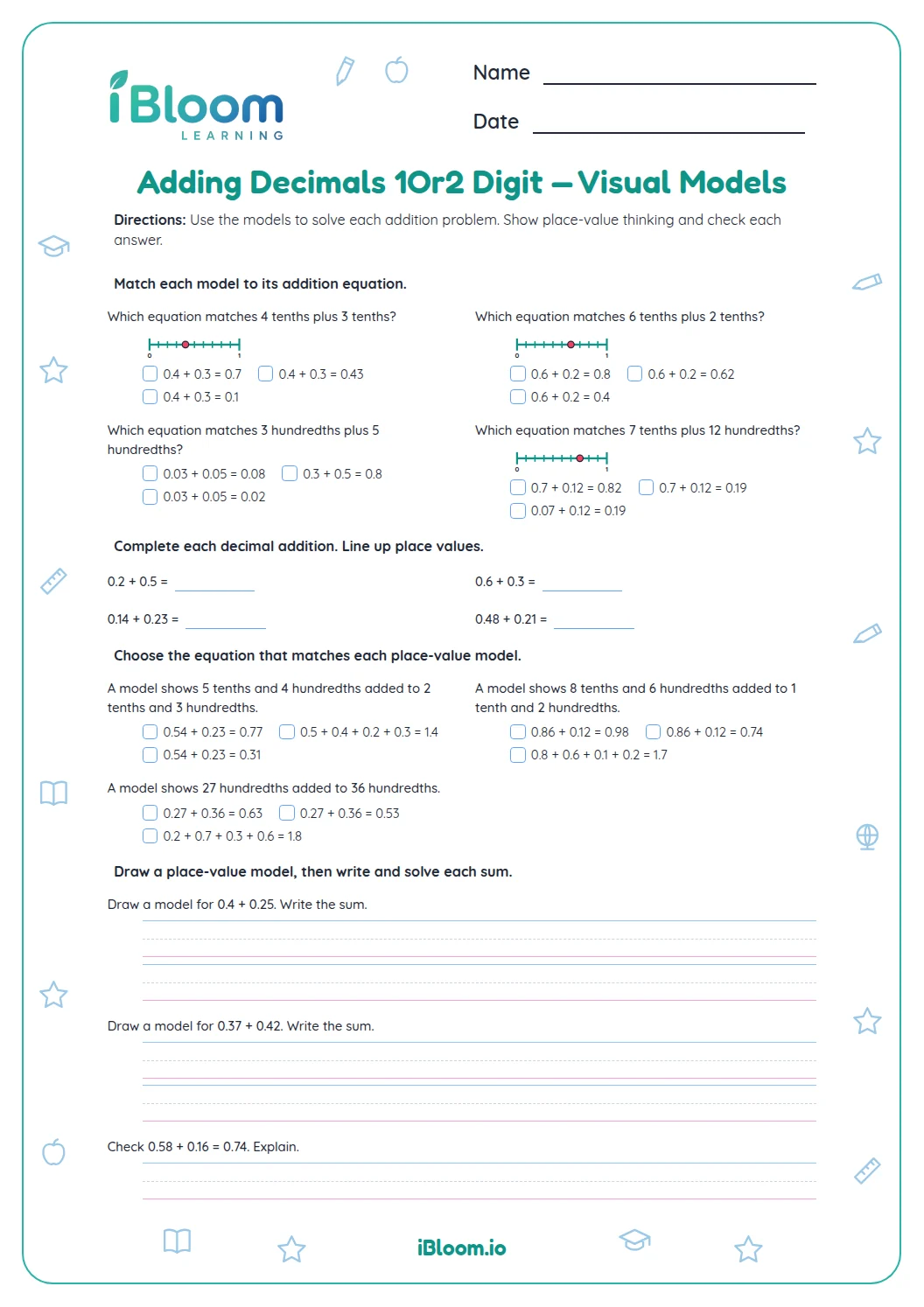
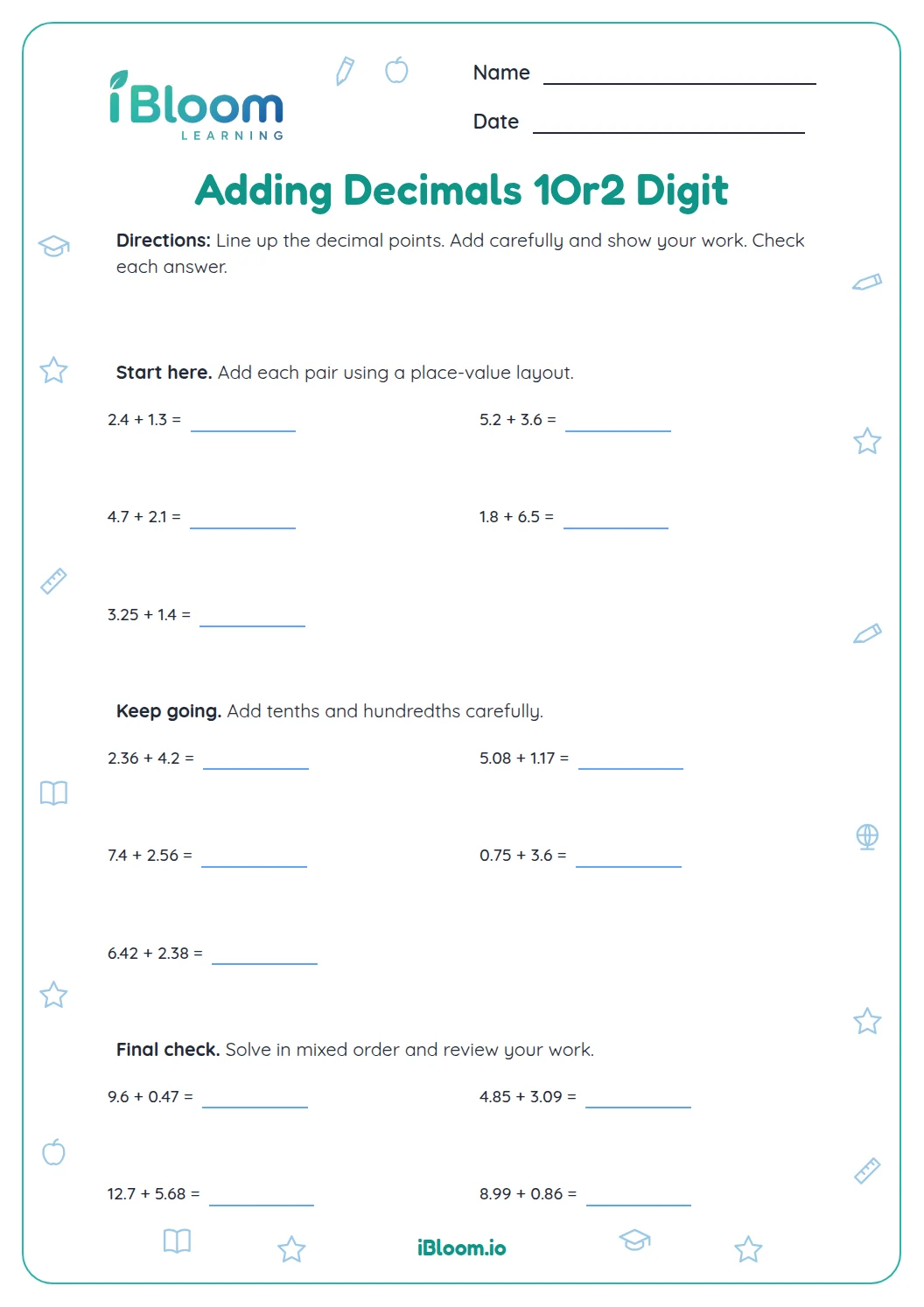
This Grade 4 visual-model worksheet presents 16 decimal addition items with a shaded hundredths grid for each sum. Students add the printed decimal values, write the decimal result, and state the number of hundredths in a separate blank. For example, 0.12 + 0.25 = 0.37, or 37 hundredths. The key gives both answers clearly.
Aligned to 4.NF.C.5
How does a hundredths grid show a decimal?
A 10-by-10 grid has 100 equal small squares. Each shaded square represents one hundredth, so 37 shaded squares represent 0.37.
Question 1 shows a grid with 37 hundredths shaded, matching 0.12 + 0.25. The answer asks for both the decimal sum and the number of hundredths.
- 10.12 + 0.25
- 212 hundredths + 25 hundredths
- 337 hundredths = 0.37
How can you combine hundredths?
Count the hundredths in each addend and combine them. If the total is at least 100 hundredths, trade 100 hundredths for one whole. The models in this set stay below one whole.
Why name the total in two ways?
The decimal form connects the model to hundredths notation. The second blank names how many small squares make that amount, so each answer has a clear place.
How to use this worksheet
- 1Read the decimal addends in the prompt.
- 2Connect each hundredth to one small square.
- 3Combine the hundredths shown by the two addends.
- 4Write the decimal sum in the first blank.
- 5Write the equivalent count of hundredths in the second blank.
Common mistakes and quick fixes
The mistake
Giving only the decimal and leaving the hundredths blank empty.
The fix
Write both forms, such as 0.37 and 37 hundredths.
The mistake
Calling 37 hundredths 3.7.
The fix
Hundredths use two decimal places: 37 hundredths is 0.37.
The mistake
Counting the decimal point as a digit.
The fix
Count the hundredths places, not the decimal point.
Common Core alignment
This worksheet practices the following Common Core mathematics standard.
Each grid square is one hundredth; 100 hundredths make one whole.
On this sheet: The questions directly practice the stated skill.
Show the official wordingHide the official wording
Express a fraction with denominator 10 as an equivalent fraction with denominator 100, and use this technique to add two fractions with respective denominators 10 and 100.
What to practice next
Make more practice
Further reading
Questions parents and teachers ask
What does one small square represent?
One small square is one hundredth of the full grid. The grid has 100 equal squares, so 37 shaded squares represent 37/100, or 0.37. Use the printed question and the separate answer key to check the result carefully. Use the printed question and the separate answer key to check the result carefully.
How does the model show 0.12 + 0.25?
The addends name 12 hundredths and 25 hundredths. Together they make 37 hundredths, which is written as 0.37. Question 1 asks students to write both forms in separate blanks. Use the printed question and the separate answer key to check the result carefully.
Why are there two blanks in each item?
The first blank asks for the decimal sum. The second asks for the equivalent number of hundredths. For example, 0.37 is 37 hundredths. Use the printed question and the separate answer key to check the result carefully. Use the printed question and the separate answer key to check the result carefully.
How do students add hundredths?
Combine the counts of hundredths. Add the number of shaded squares represented by each addend. If the total reaches 100 hundredths, that is one whole. Use the printed question and the separate answer key to check the result carefully. Use the printed question and the separate answer key to check the result carefully.
Can the decimal have a zero in the tenths place?
Yes. A value such as 0.08 means eight hundredths, with zero tenths. The decimal point and place names keep the value clear. Use the printed question and the separate answer key to check the result carefully. Use the printed question and the separate answer key to check the result carefully.
Is there an answer key?
Yes. A separate key gives both parts of each answer: the decimal sum and the number of hundredths. The student prompt also prints the values needed for each addition. Use the printed question and the separate answer key to check the result carefully.