


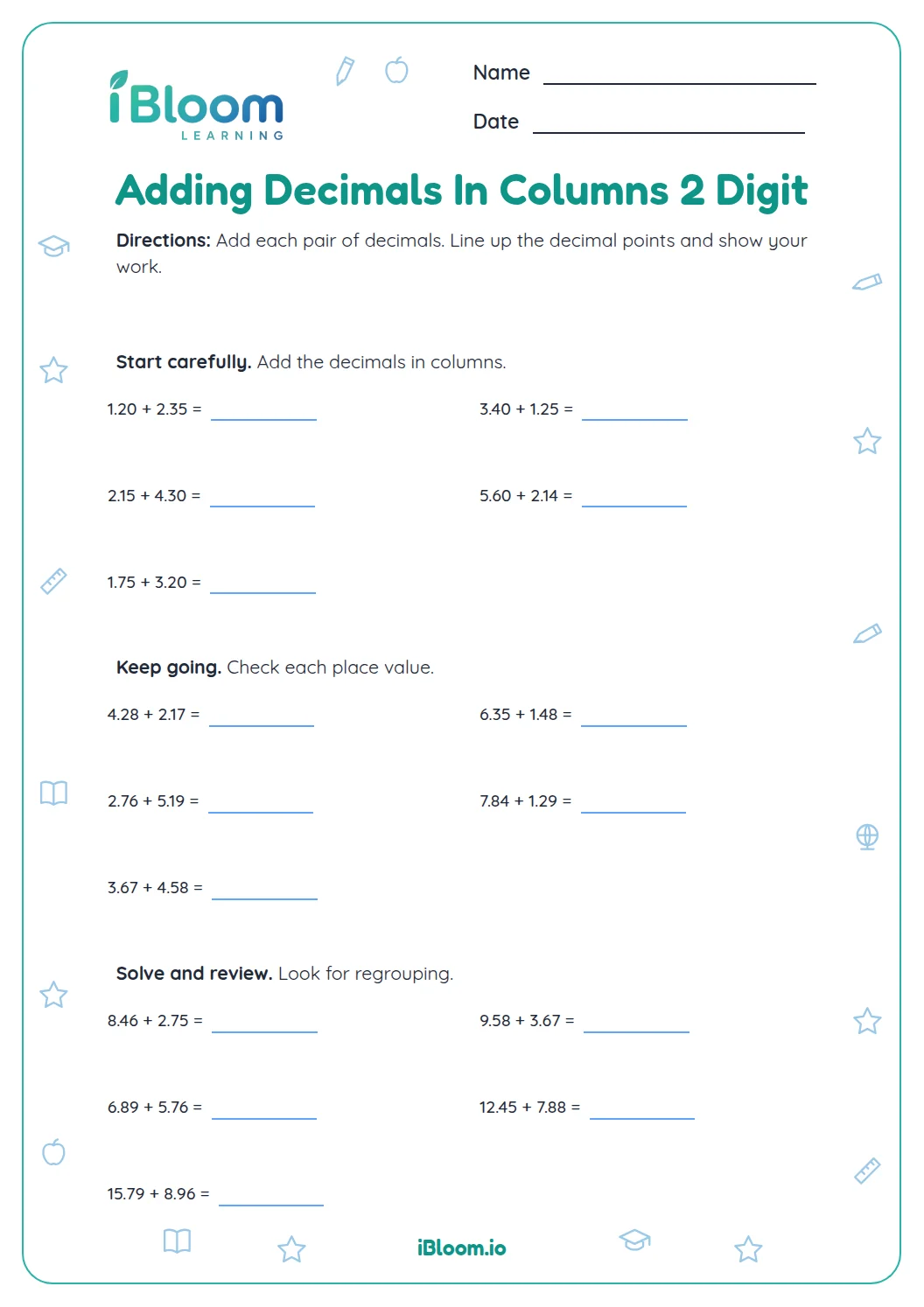
About this worksheet
This printable Grade 4 worksheet gives focused subtraction practice with decimals through hundredths. Students solve differences, complete missing-number equations, and evaluate claims such as 7.40 − 2.15 = 5.35. It includes 17 questions and a separate answer key. A separate answer key makes it easy to check each difference and review decimal place value.
How can you solve subtracting decimals to hundredths problems carefully?
Line up decimal points, use a zero as a placeholder when needed, and subtract by place value. Add the difference back to check.
For example: 7.40 − 2.15 = 5.25.
What will students work through?
The worksheet has 17 questions in three parts, moving from direct practice to reasoning checks. Each key answer matches its printed item.
- Part A: Subtract and check (17 questions)
- A separate answer key for all questions
How can a student check an answer?
Add the difference to the number subtracted; the result should match the starting decimal.
How to use the worksheet
- 1Read the directions for the current part before starting.
- 2Solve each expression and record only the requested value in its blank.
- 3For a reasoning question, check the claim against the original numbers.
- 4Estimate the answer to catch place-value or computation slips.
- 5Use the key after finishing and redo any item that did not check.
Common mistakes and quick fixes
The mistake
Changing a digit or part while carrying out the operation.
The fix
Rewrite the original expression and check one place or fraction unit at a time.
The mistake
Accepting an answer that does not fit the size of the starting numbers.
The fix
Estimate first, then compare the exact result with the estimate.
The mistake
Checking a result with a different expression.
The fix
Substitute the answer into the exact equation or recompute the original sum.
What to practice next
Make more practice
Questions parents and teachers ask
Is 7.40 − 2.15 equal to 5.35?
This sheet gives students 17 targeted questions, followed by a separate answer key. Encourage them to show a calculation or explain a choice before checking the key. That makes it easier to spot whether a mistake came from the method or a single arithmetic step.
How many pages should I print?
Print both worksheet pages for student practice. The answer key also spans two pages, so it can be kept aside until the student finishes. Together, the worksheet and key make four printed pages. The page count and question total are listed above for quick planning.
How should students check their work?
Have students return to the exact question and use its inverse operation, estimate, or equivalent expression to check. Then compare with the key. If answers differ, ask them to locate the first step where their work stops matching the original numbers.
Can students use scratch paper?
Yes. Scratch paper is useful for regrouping, finding equivalent fractions, and recording intermediate steps. Students should copy the final requested answer into the worksheet blank so it is easy to compare with the key. A quick estimate before checking can help catch an arithmetic slip.
What comes after this practice?
The linked sibling worksheets offer a nearby next step in the same skill sequence. Choose a page that focuses on the particular part a student wants to strengthen, then return to mixed practice to check that the strategy transfers.