



About this worksheet
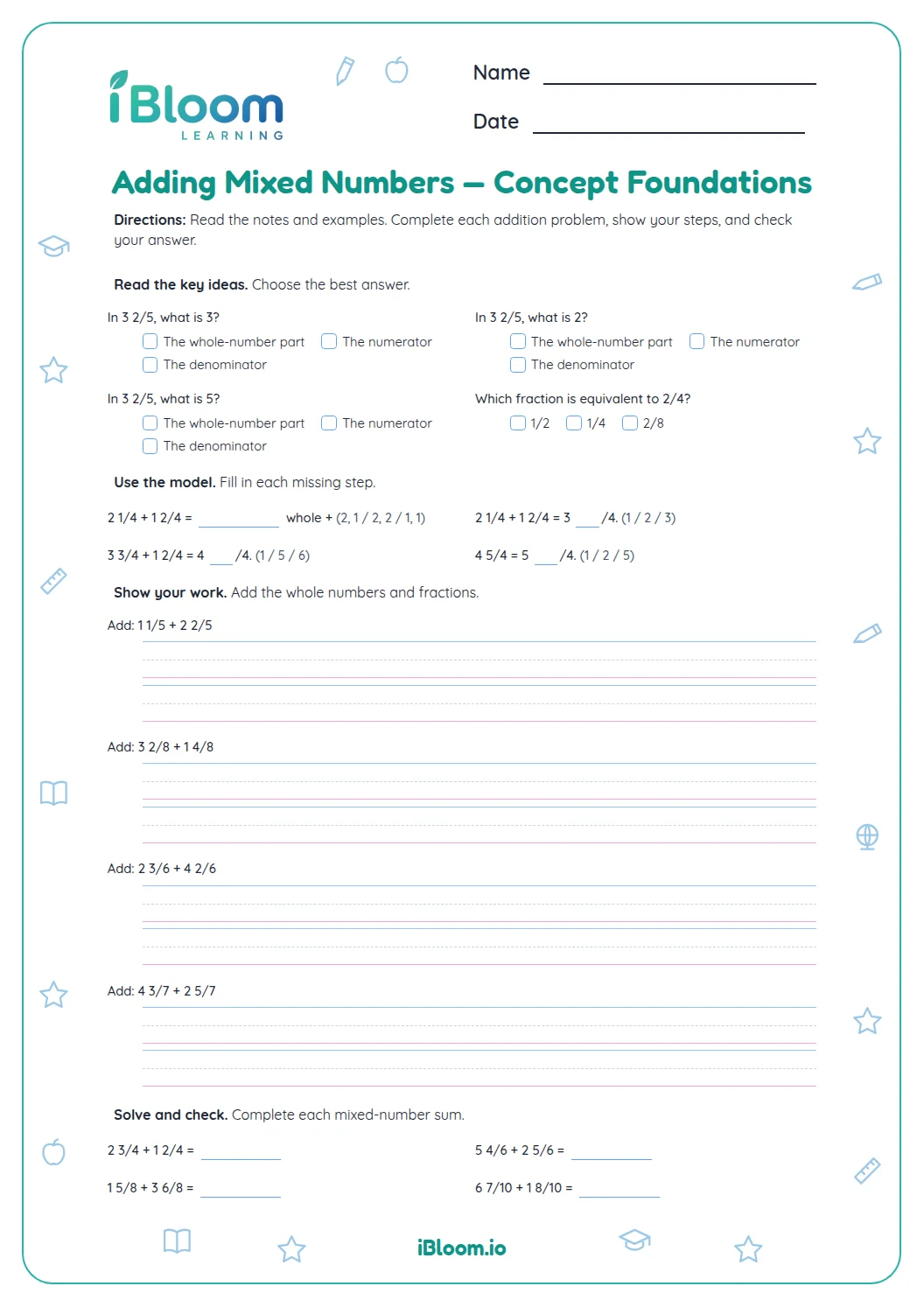
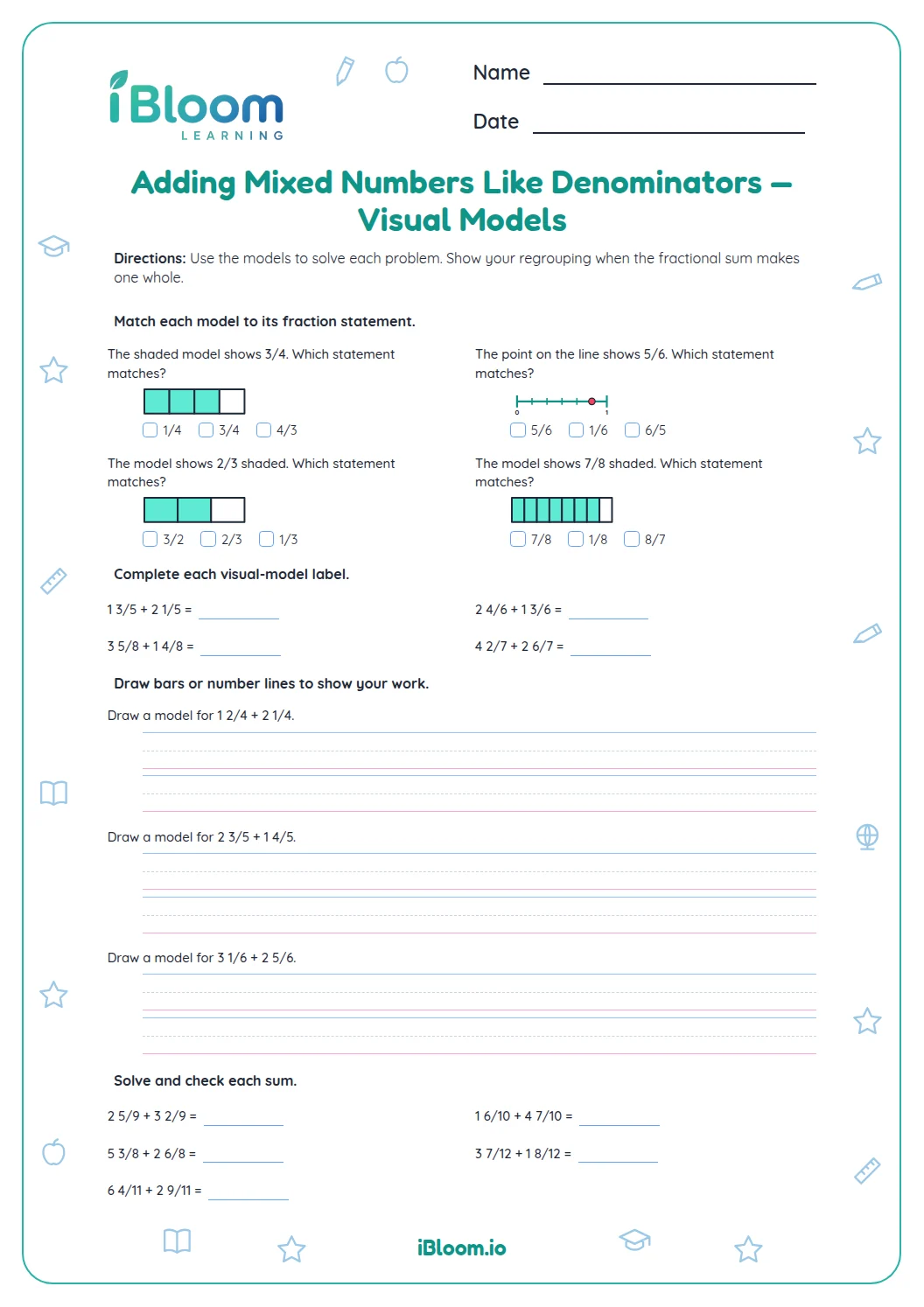
Start with a bar model for a sum in fourths. Add the whole parts, combine like fractions, then regroup a full group of parts as one whole. The remaining questions move from supported sums to context and reasoning.
Aligned to 4.NF.B.3.c
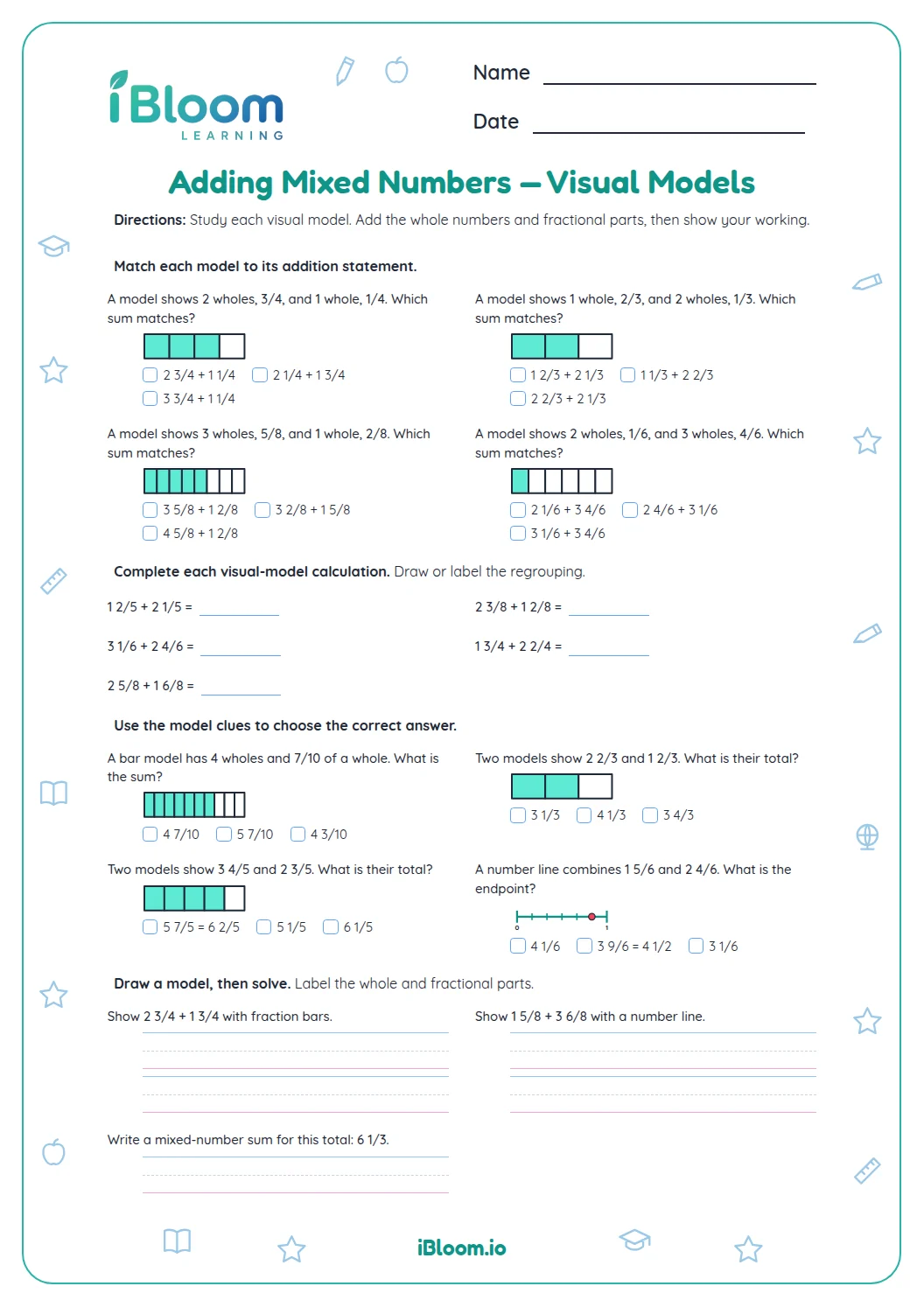
How does the first model show regrouping?
The bar shows the first addend, 2 3/4: two full wholes and three of four parts in another bar. Add 1 2/4 by combining whole parts and fourths: 3 wholes and 5/4. Since 5/4 is 1 1/4, the total is 4 1/4.
The model represents one addend; the printed equation supplies the second addend.
How does practice build from the model?
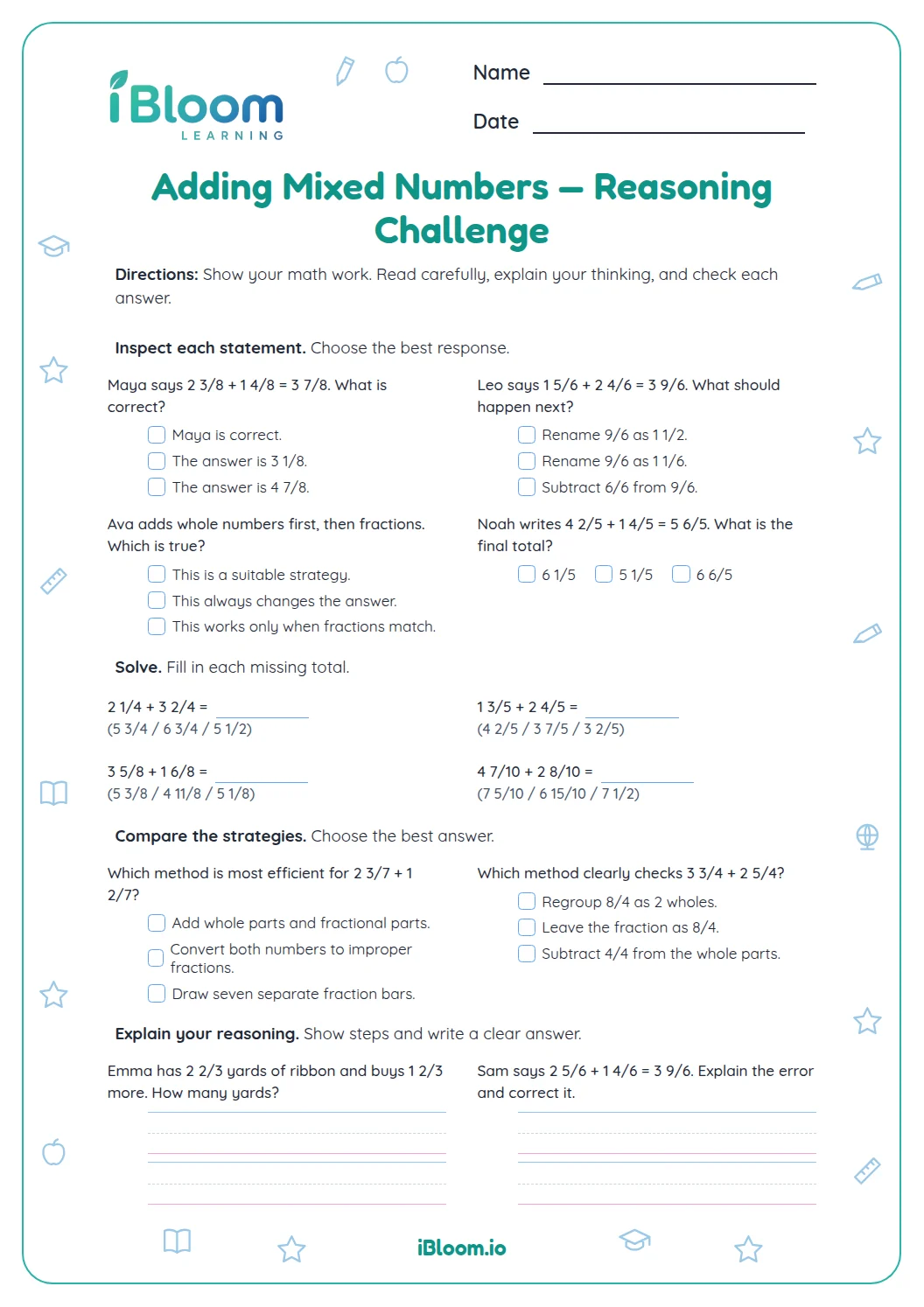
After the first modeled sum, students work through like-denominator sums, then short measurement contexts. Later questions ask for regrouped forms and a missing addend, so students use the same steps with less prompting.
How can students check regrouping?
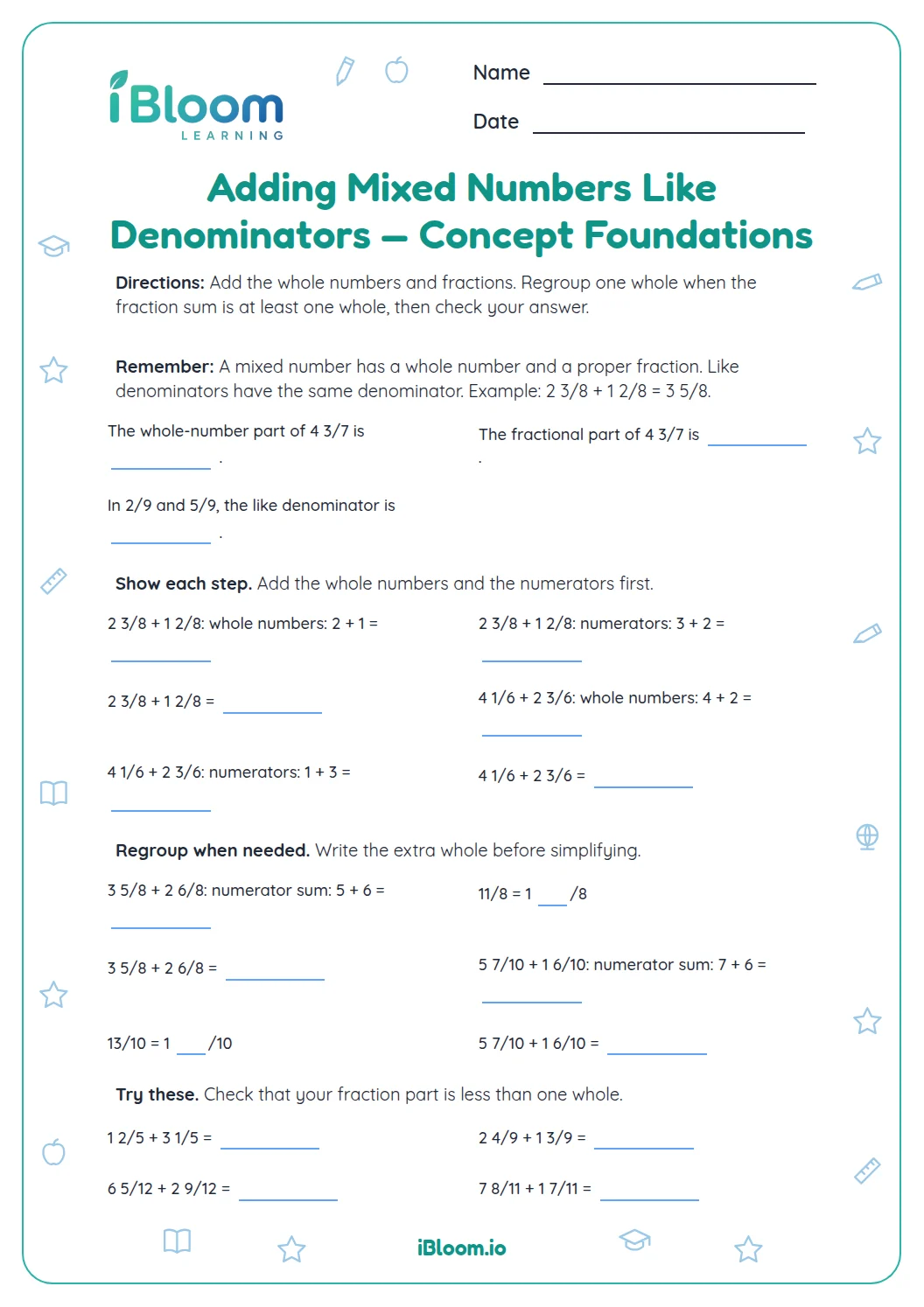
Write the fraction sum separately and trade one complete denominator group for a whole. Check that the remaining numerator is smaller than the denominator, then confirm the whole-number total includes the traded whole.
How to use this worksheet
- 1Use the shaded bar to identify the first addend’s whole parts and fourths.
- 2Add the whole numbers and numerators separately.
- 3Trade a complete group of fractional parts for one whole.
- 4Write the remaining fraction in simplest form when possible.
- 5Check the equation by adding the answer to the first addend when a missing addend is asked.
Mistakes to watch for
The mistake
Writing 4 5/4 instead of regrouping the fractional sum.
The fix
Convert 5/4 to 1 1/4, then combine the extra whole with the 3 whole units.
The mistake
Adding the denominators.
The fix
Keep the shared denominator; only the counts of parts are added.
The mistake
Forgetting to include the traded whole.
The fix
Mark the whole made from the fractions, then add it to the whole-number total.
Common Core alignment
This Grade 4 sheet practices the Common Core skill listed here.
Add and subtract mixed numbers with like denominators.
On this sheet: Students add mixed numbers with like denominators and explain regrouping.
Show the official wordingHide the official wording
Add and subtract mixed numbers with like denominators, e.g., by replacing each mixed number with an equivalent fraction, and/or by using properties of operations and the relationship between addition and subtraction.
What to practice next
Make more practice
Further reading
Questions parents and teachers ask
Why is 2 3/4 + 1 2/4 equal to 4 1/4?
The whole numbers total 3, and the fractional parts total 5/4. Five fourths is 1 1/4, so adding that regrouped amount gives 4 1/4. The first problem’s bar models the 2 3/4 addend, and the equation gives the other addend.
What should students add first?
Add the whole-number parts and the fractional parts separately. Keep the shared denominator while adding numerators. Then regroup any complete whole represented by the fraction sum and combine it with the whole-number total. A quick estimate or labeled sketch helps students check that the result fits the question.
What is 5/4 as a mixed number?
Five fourths equals 1 1/4 because four fourths make one whole with one fourth left. This is the regrouping step used in the first guided problem. The answer must keep the extra whole, rather than leaving 5/4 attached to the whole-number total.
How can students check a sum?
Estimate whether the answer should be near the whole-number total or one whole larger. After regrouping, check that the fractional part is less than one. For a missing-addend question, add the proposed addend to the number shown and see whether it reaches the stated total.
What does the answer key include?
The separate key gives an answer for each of the 15 questions, including regrouped sums, context problems, and the missing addend. The worksheet and its separate answer key each span two pages, so they can be printed together or separately.