


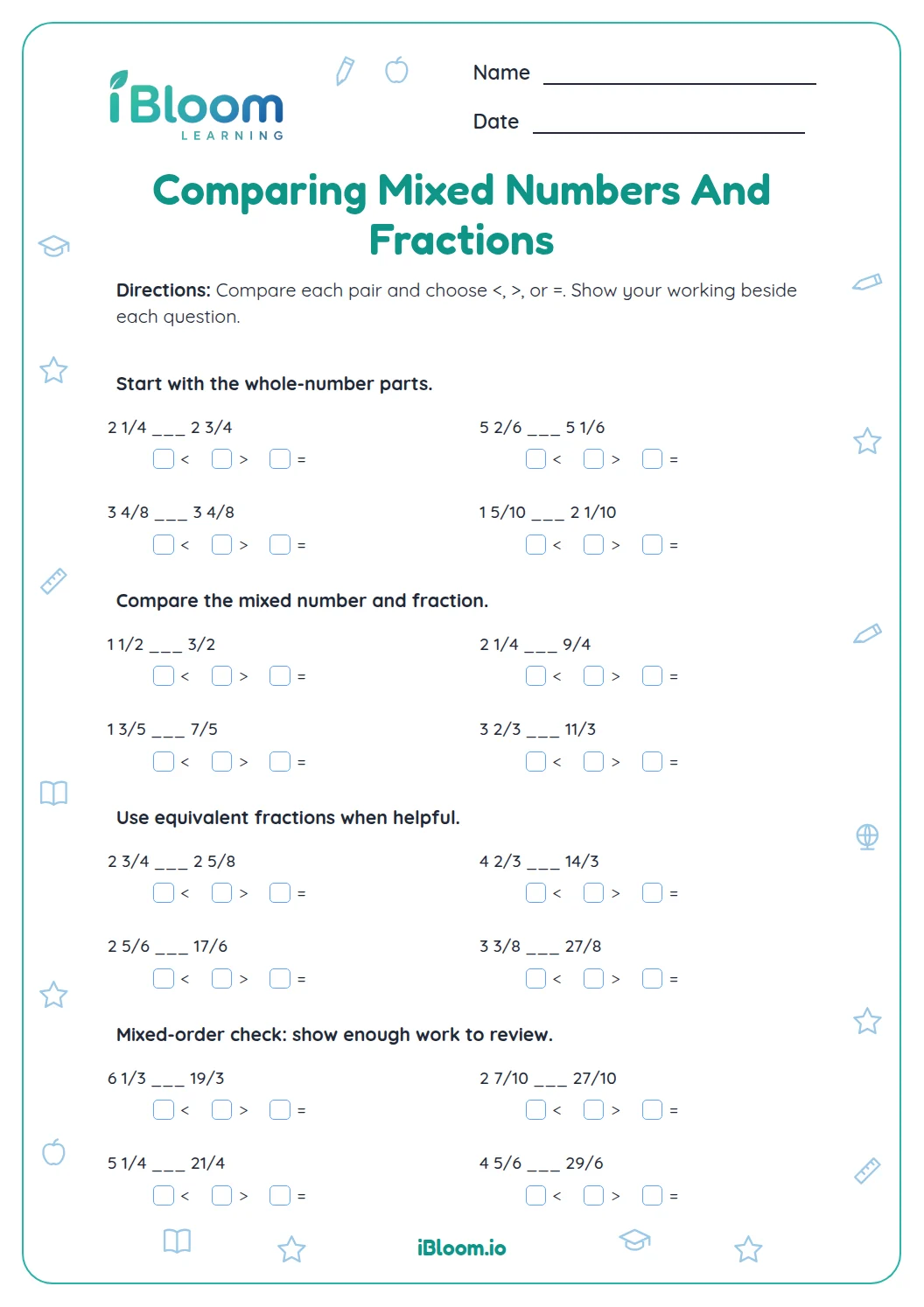
About this worksheet
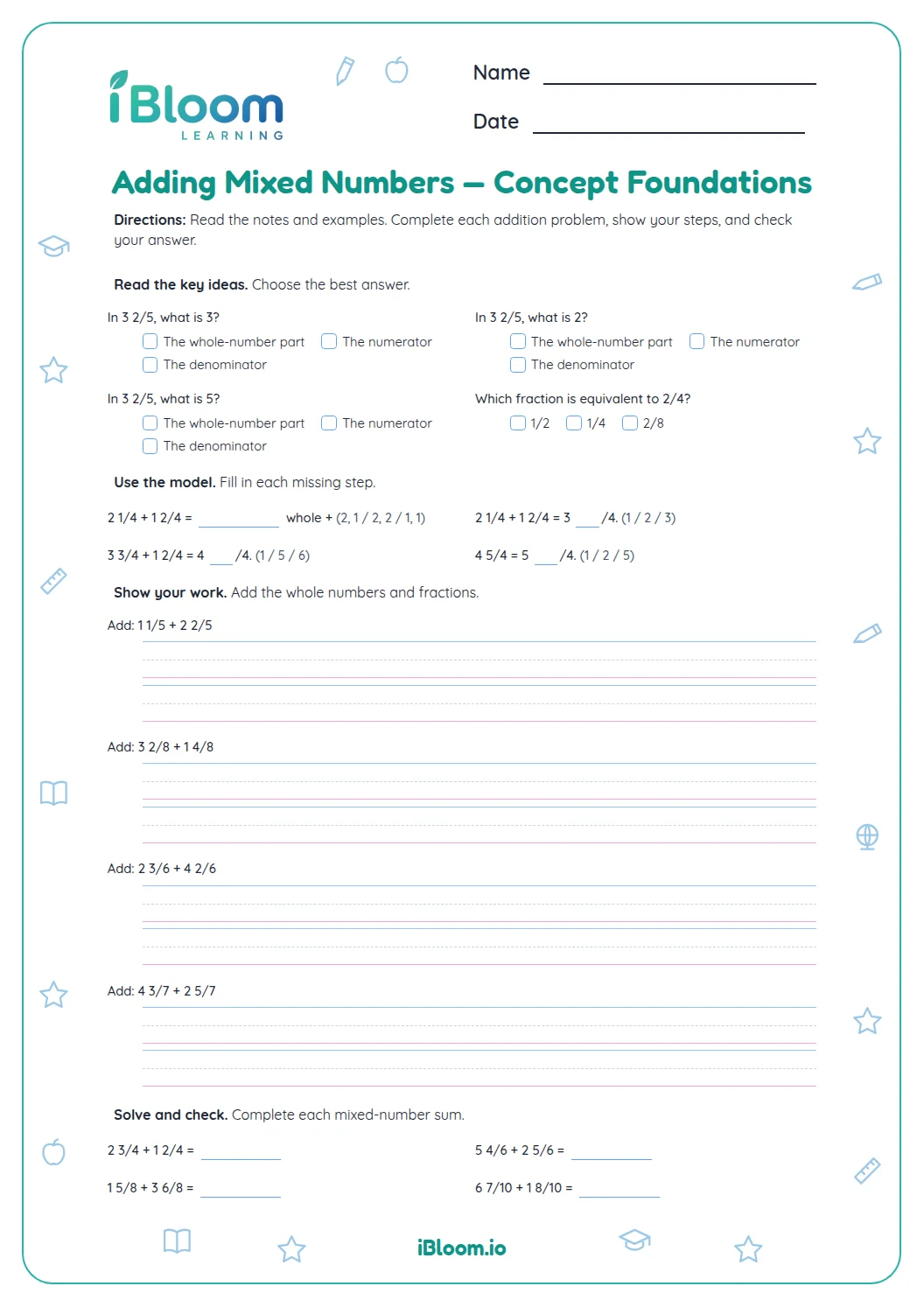
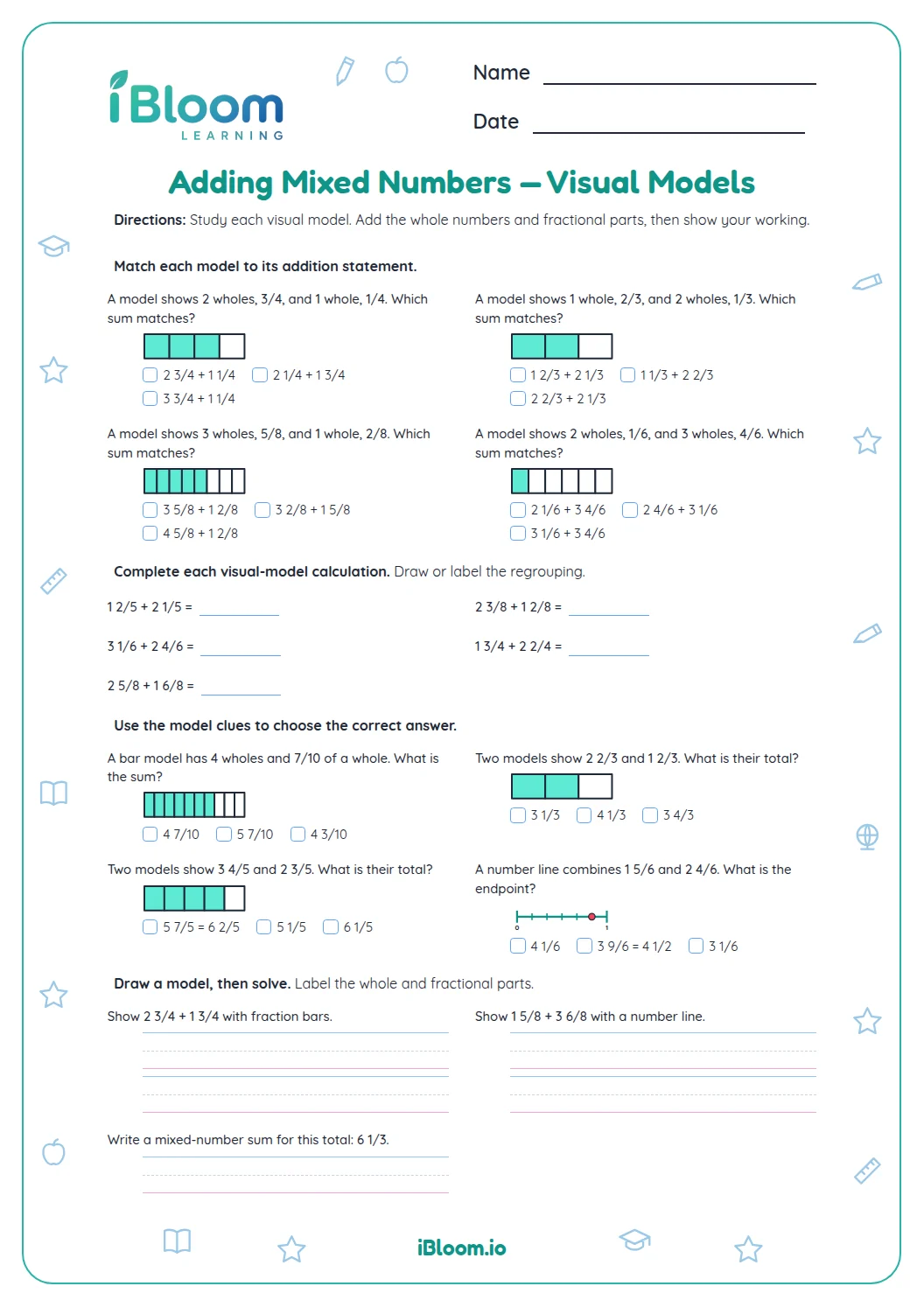
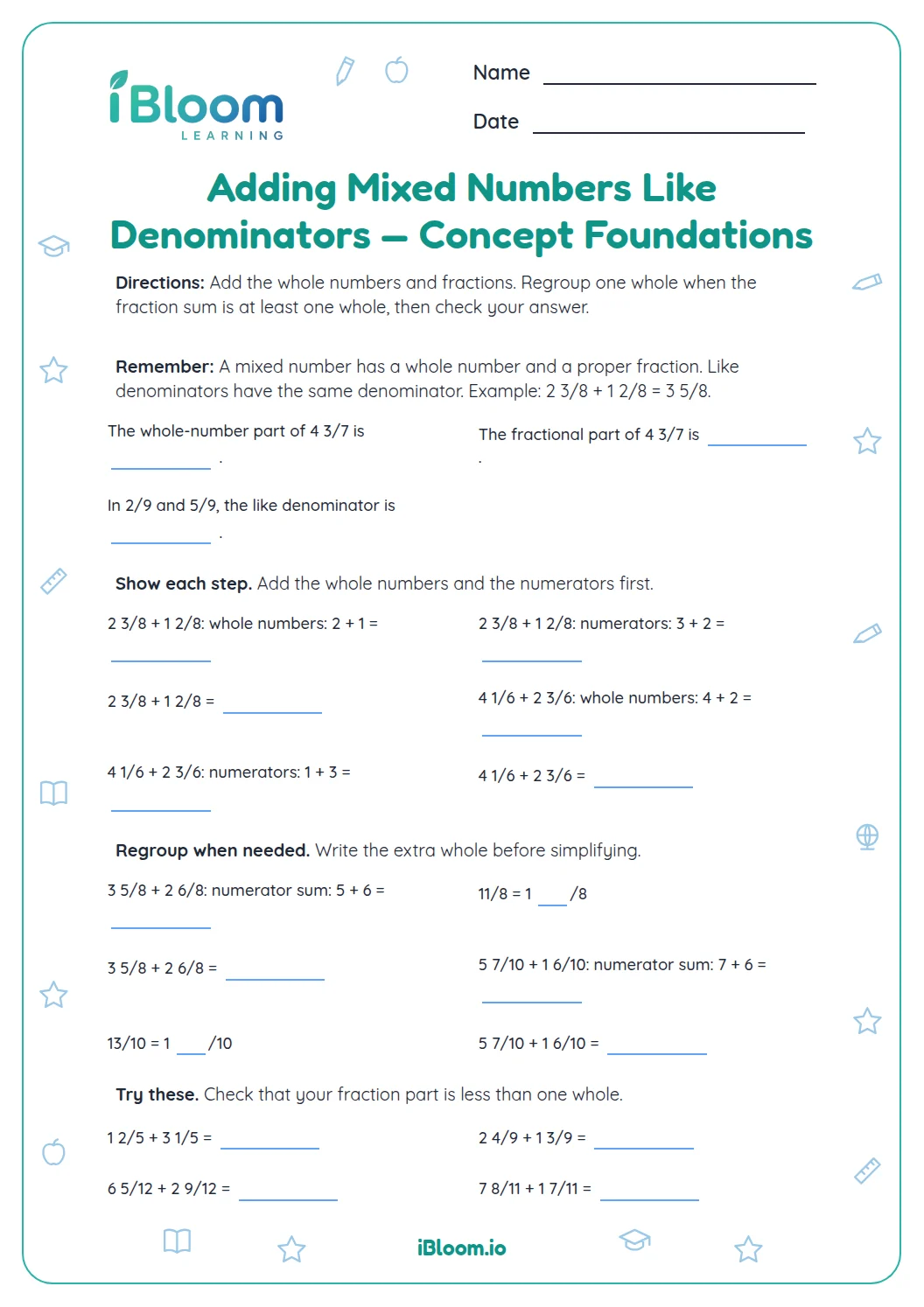
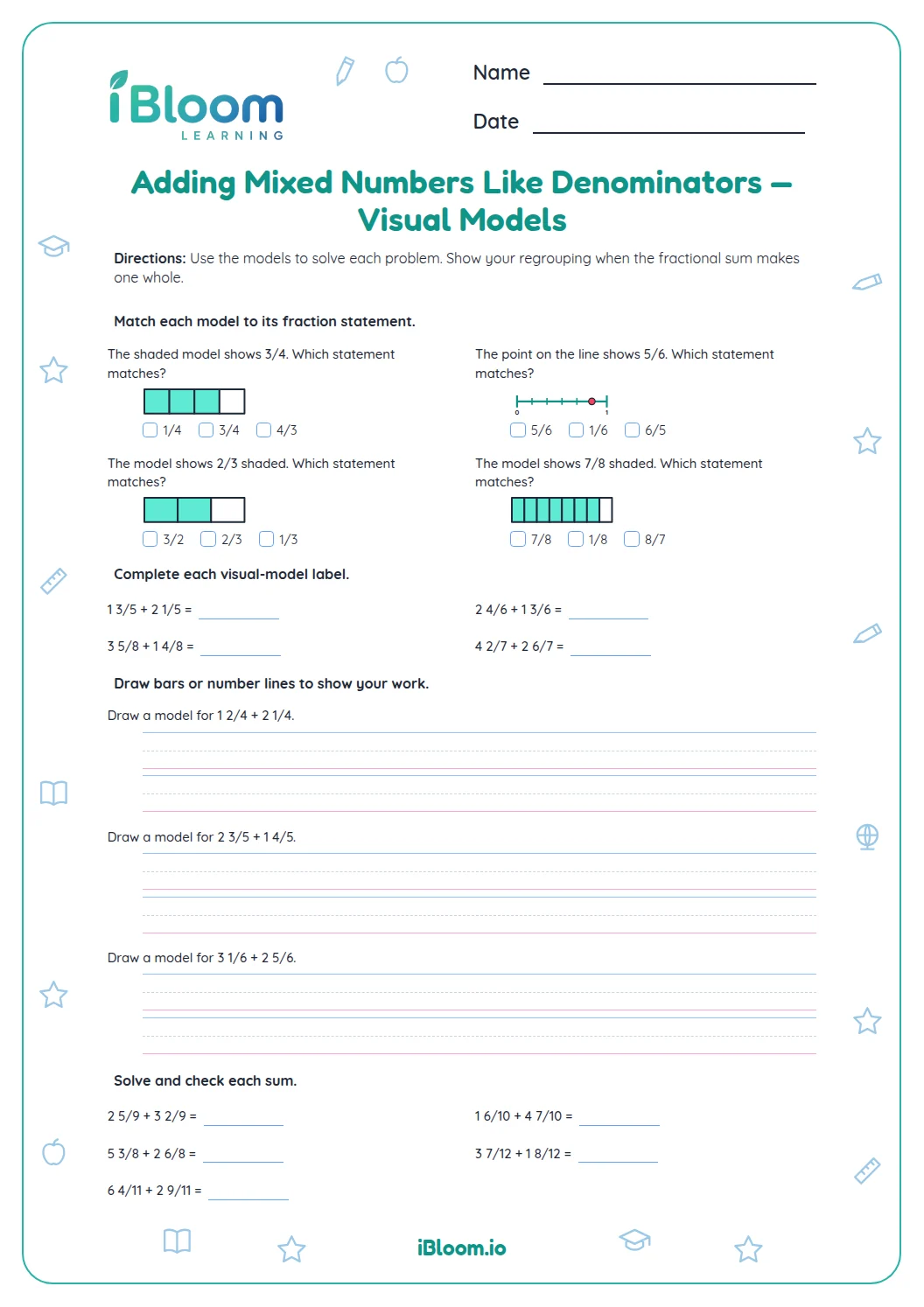
Solve each sum by adding the whole numbers and fractional parts. When the fraction reaches one whole, regroup it exactly once. Short contexts ask for a total length, distance, or amount.
Aligned to 4.NF.B.3.c
How do you regroup a mixed-number sum?
Add whole numbers and add the numerators while keeping the shared denominator. For 2 5/8 + 3 6/8, the whole parts total 5 and the fractions total 11/8. Since 11/8 is 1 3/8, the sum is 6 3/8.
Regroup only the complete group of eight eighths. The three eighths left over stay fractional, so the answer is not one extra whole plus another full group.
What does the independent practice include?
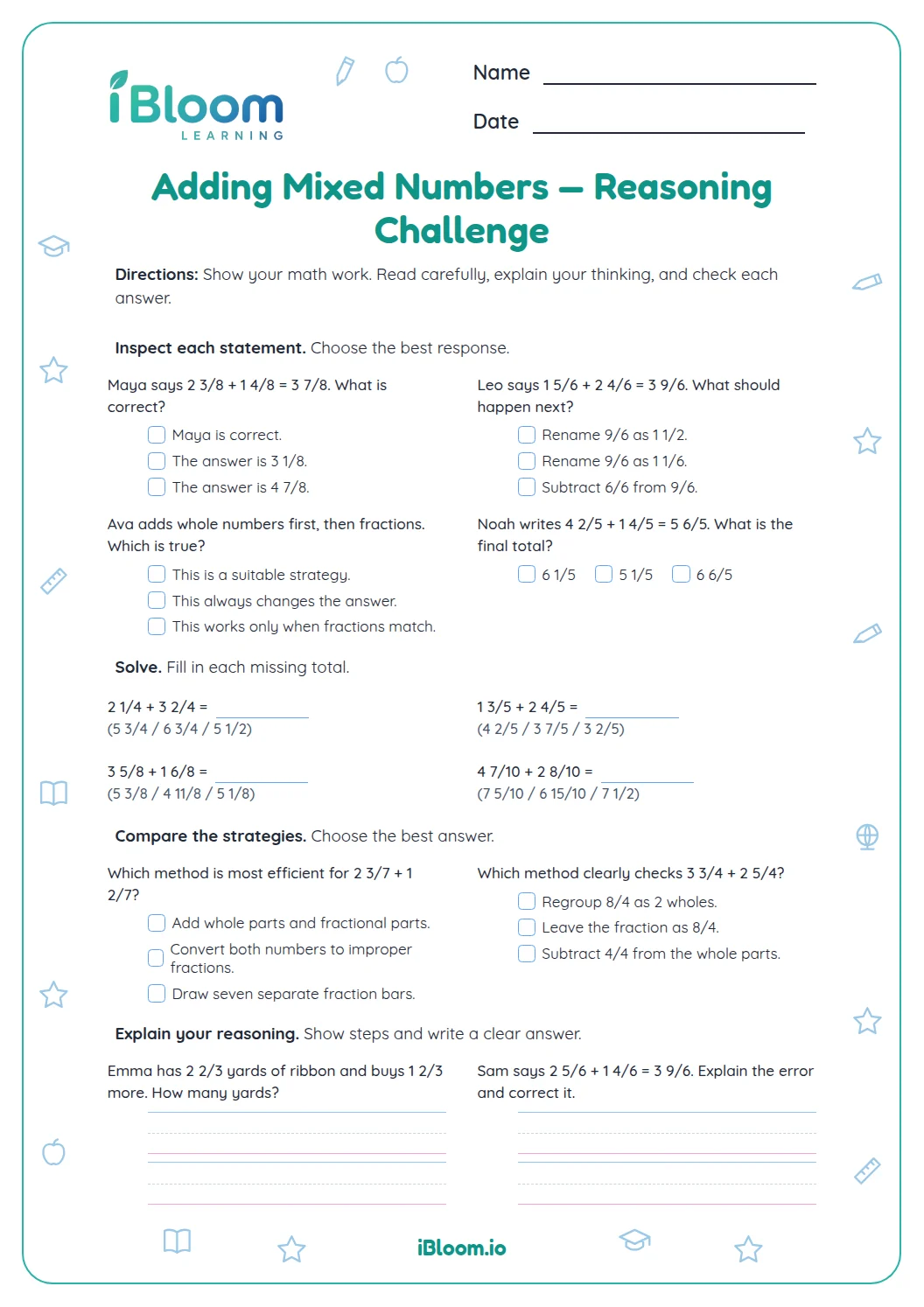
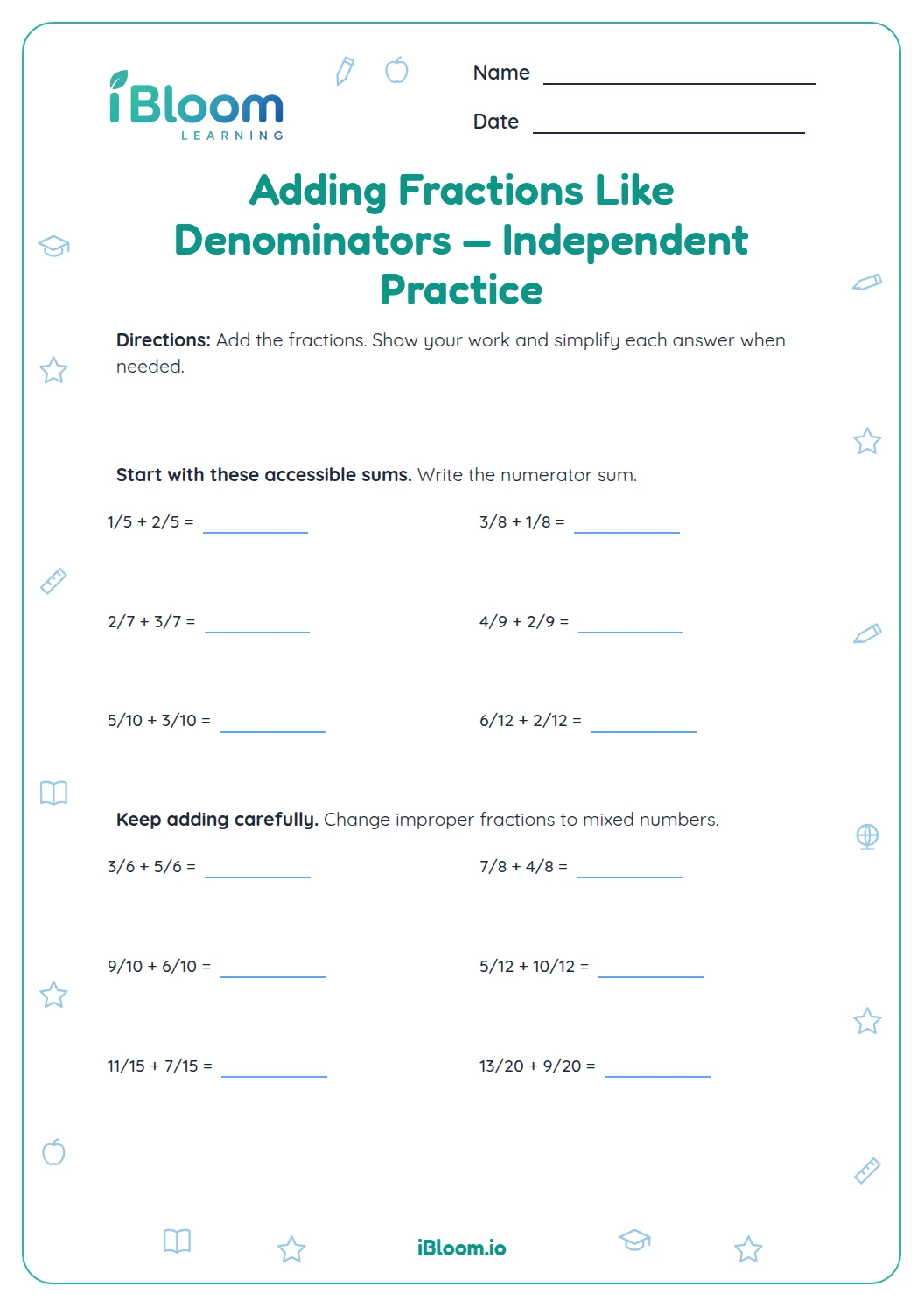
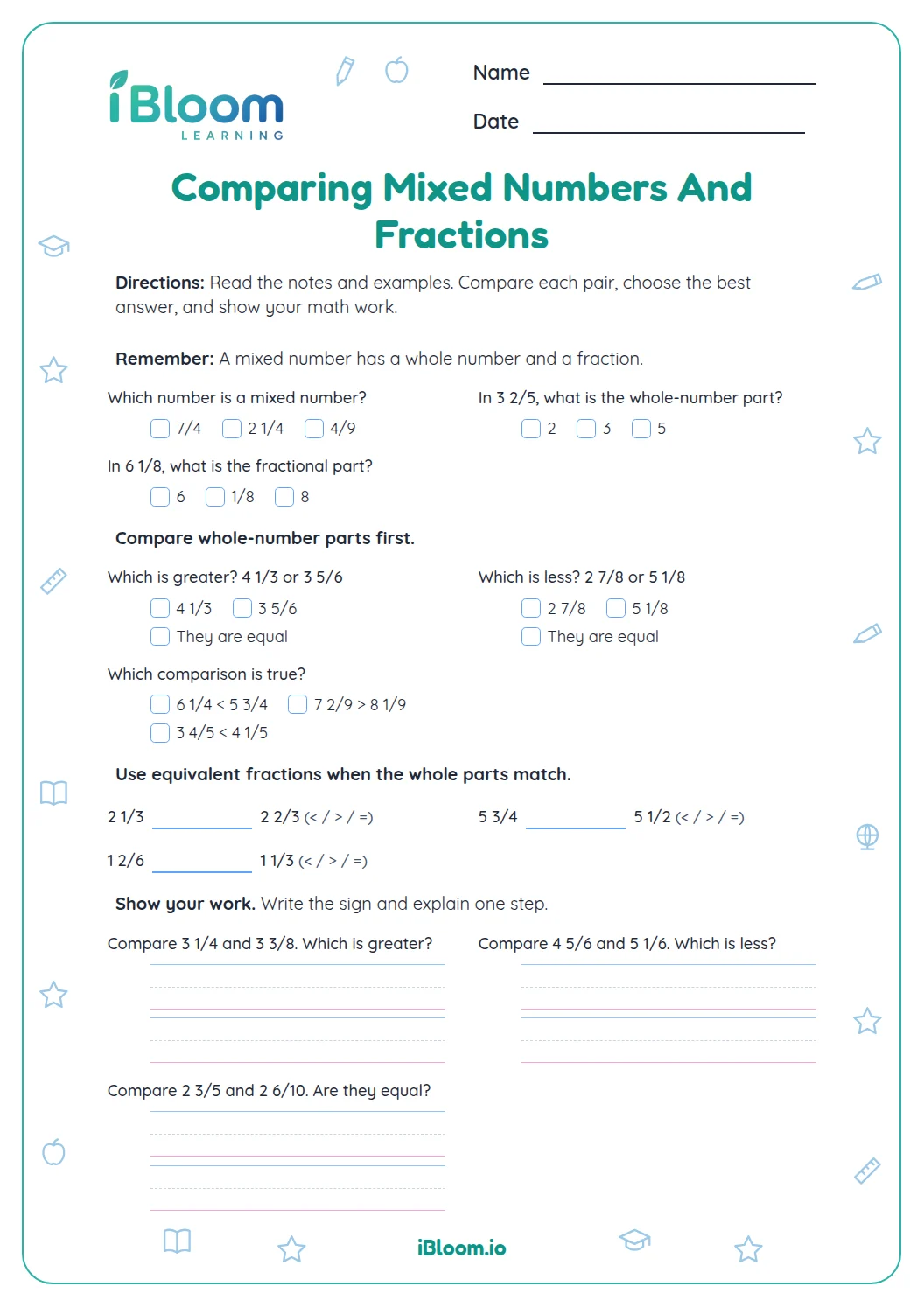
Part A has direct sums, Part B applies addition to lengths and amounts, and Part C asks children to compare totals, correct a regrouping, and find a missing addend. All sums use like denominators.
How can a student check a sum?
Estimate whether the total should be near the whole-number sum or one whole more. Then check that the fractional part is less than one after regrouping and that the result is larger than either addend.
How to use this worksheet
- 1Add the whole-number parts first.
- 2Add the numerators and keep the common denominator.
- 3Trade each full denominator group for one whole, once per group.
- 4Simplify the remaining fraction when possible.
- 5Check that the total is greater than either addend.
Mistakes to watch for
The mistake
Adding an extra whole after making a proper mixed number, such as turning 11/8 into 2 3/8.
The fix
Write 11/8 as 1 3/8, then add that single whole to the whole-number sum.
The mistake
Adding the denominators along with the numerators.
The fix
Keep the denominator because the parts are the same size.
The mistake
Leaving an improper fraction in the final answer.
The fix
Trade complete denominator groups for wholes, then simplify the fraction that remains.
Common Core alignment
This Grade 4 sheet practices the Common Core skill listed here.
Add and subtract mixed numbers with like denominators.
On this sheet: Students add mixed numbers with like denominators and regroup fractional sums over one whole.
Show the official wordingHide the official wording
Add and subtract mixed numbers with like denominators, e.g., by replacing each mixed number with an equivalent fraction, and/or by using properties of operations and the relationship between addition and subtraction.
What to practice next
Make more practice
Further reading
Questions parents and teachers ask
What is the answer to 2 5/8 + 3 6/8?
The sum is 6 3/8. Add the whole numbers to get 5, then add 5/8 + 6/8 = 11/8. That is 1 3/8, so the total is 5 + 1 3/8. This is one of the regrouping checks practiced on the worksheet.
When should a mixed-number sum be regrouped?
Regroup when the fraction total contains at least one complete whole. For eighths, eight eighths make one whole. If the numerator total is 11, trade eight eighths and keep 3/8. Add the traded whole to the whole-number total, then simplify any fraction that remains.
Does the denominator change when adding like fractions?
No. The denominator tells the size of each part, so it stays the same when the parts are combined. Add the numerators first. If the result is an improper fraction, regroup it as a whole number and a proper fraction.
How can students check an addition answer?
Estimate the total before calculating, then compare the answer with both addends. Addition should produce a sum greater than either number. Also check that any fraction left after regrouping is less than one whole. A quick estimate or labeled sketch helps students check that the result fits the question.
What kinds of problems are on this page?
The 15 questions include direct mixed-number sums, short situations involving lengths and amounts, comparisons of sums, a corrected regrouping, and a missing addend. The worksheet and answer key each span two pages. A quick estimate or labeled sketch helps students check that the result fits the question.