





About this worksheet
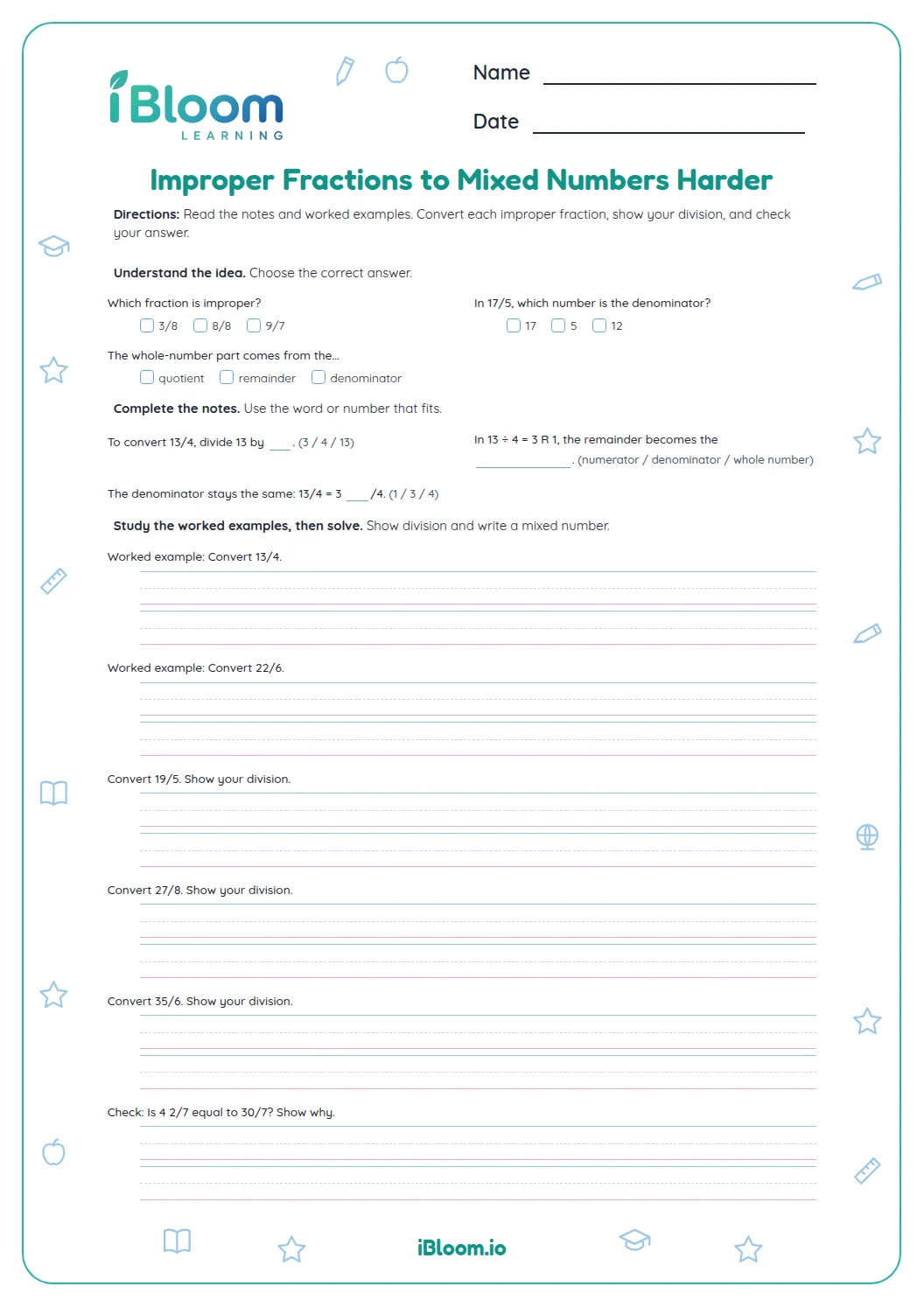
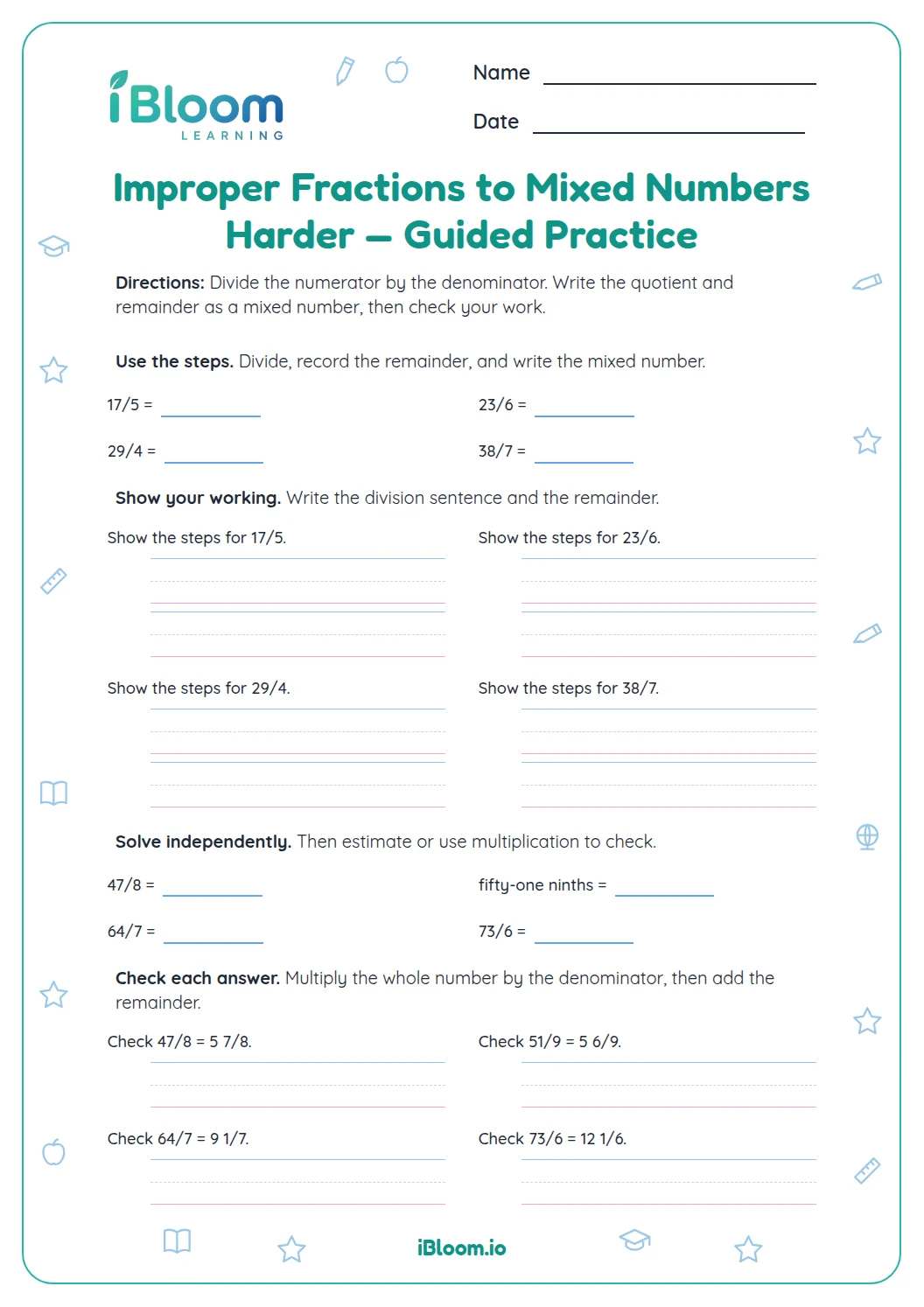
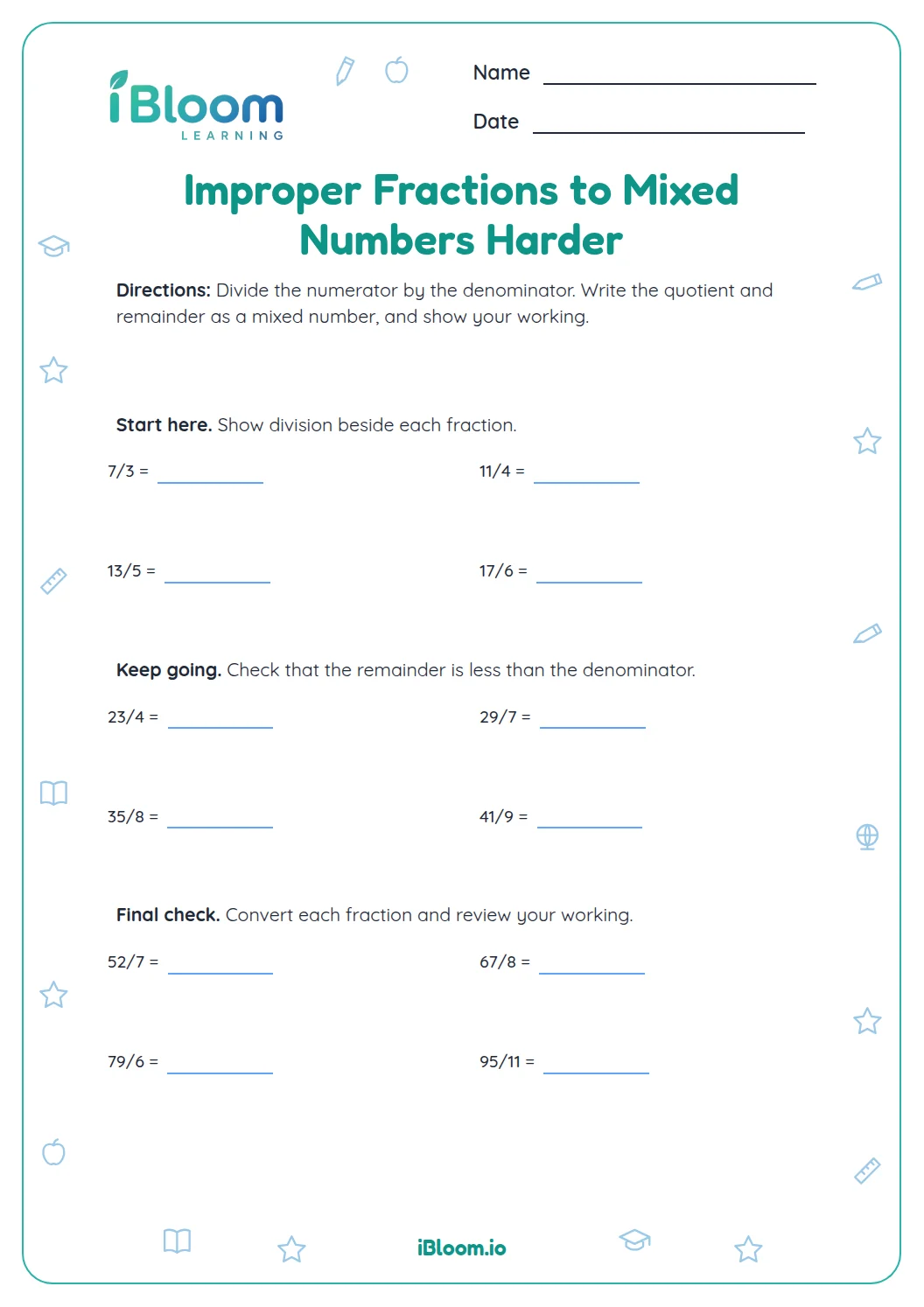
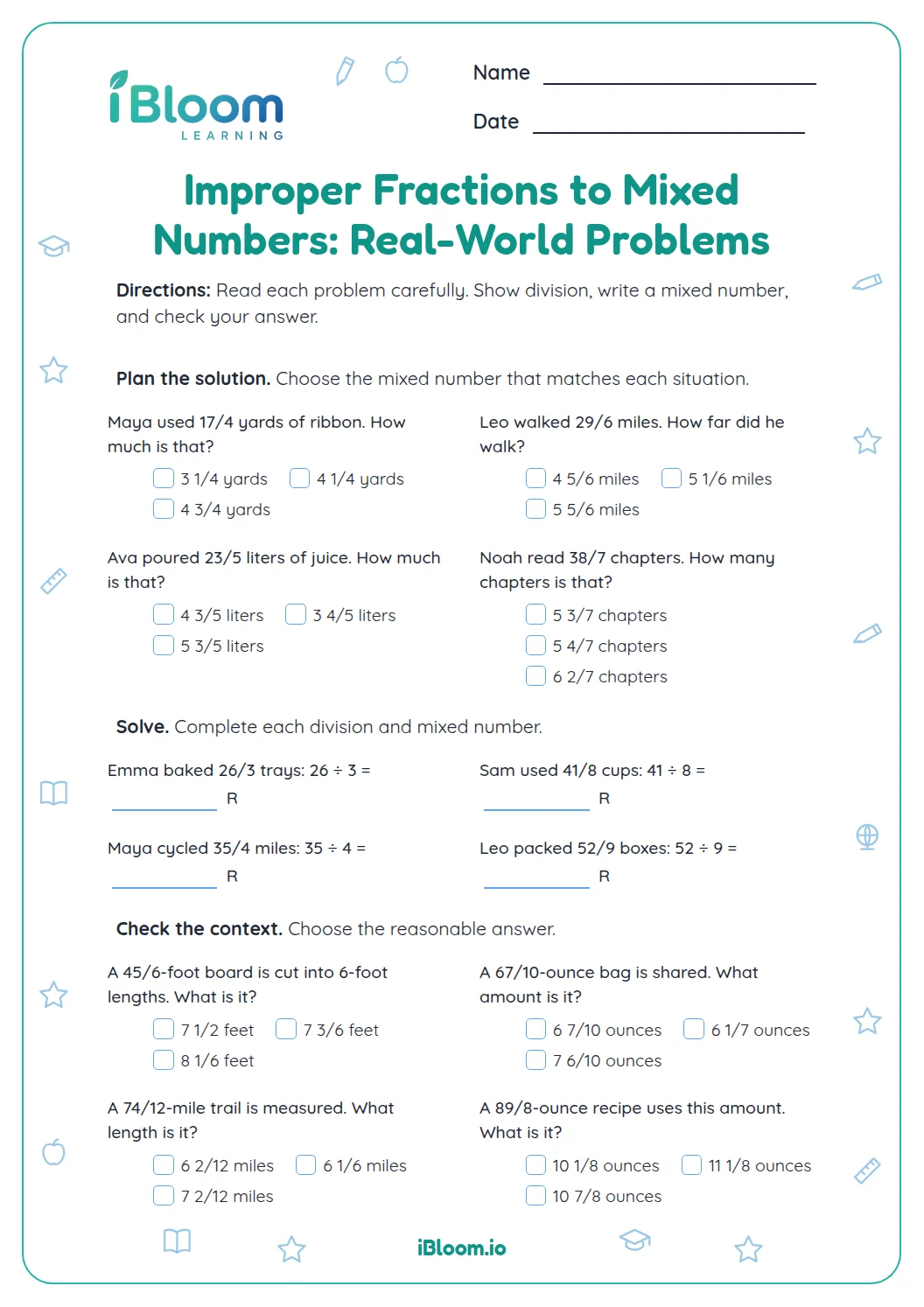
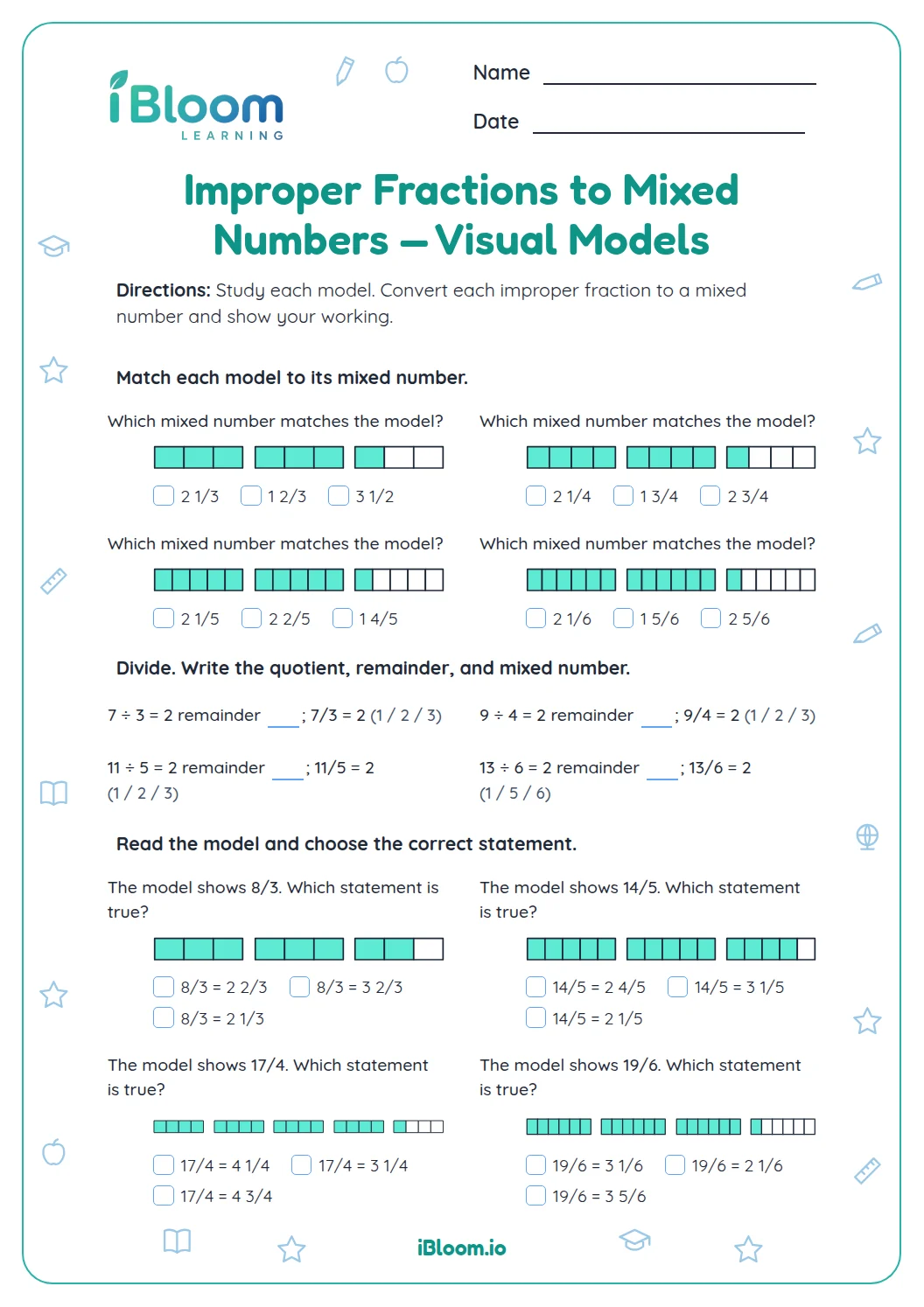
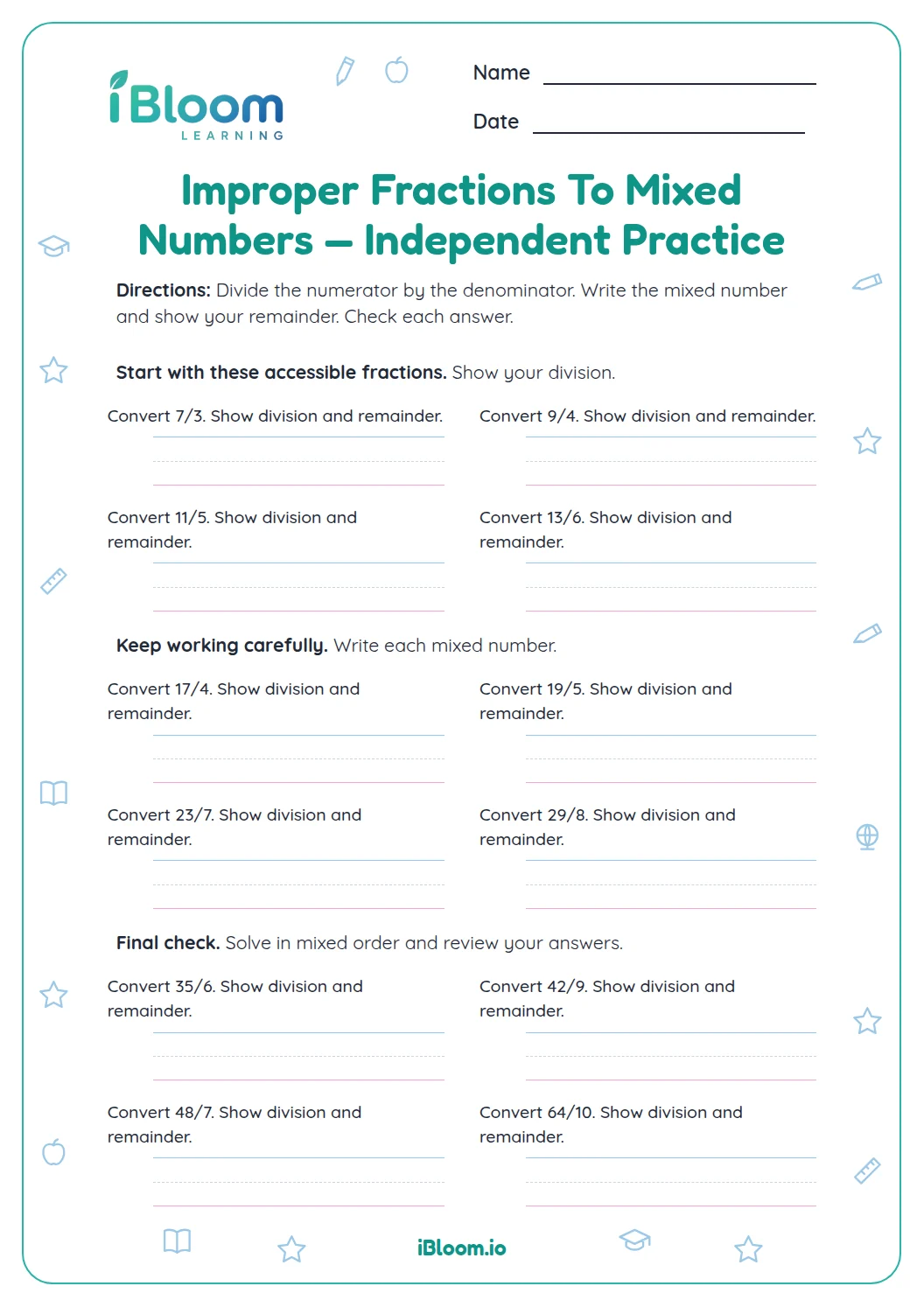
This free Grade 4 worksheet asks students to convert improper fractions and reason about how quotient, remainder and denominator fit together. It includes correction choices, direct conversion equations, strategy questions and two written checks. The 15 questions focus on fraction decomposition and checking, with an answer key on a separate page.
Aligned to 4.NF.B.3.a
How do quotient and remainder make a mixed number?
Divide the numerator by the denominator. The quotient counts complete wholes; the remainder counts leftover parts. Keep the original denominator.
For 26/8, eight fits into 26 three times, with two left over. The mixed number is 3 2/8. The question gives the full response frame, so quotient and remainder are both visible.
- 126 ÷ 8 = 3 remainder 2
- 2Keep denominator 8
- 326/8 = 3 2/8
How does multiplication verify the result?
For a mixed number a b/c, multiply a by c, then add b. If the total is the original numerator, the conversion checks. Question 2 uses 5 × 4 + 3 = 23 to verify 23/4 = 5 3/4.
What kinds of reasoning appear on the sheet?
Students correct errors, write six conversions, and choose efficient strategies or checks. The choices include plausible mistakes such as swapping quotient and remainder or using a remainder at least as large as the denominator.
How to use this worksheet
- 1Divide the numerator by the denominator.
- 2Write the quotient as the whole number.
- 3Write the remainder over the original denominator.
- 4Check a conversion by multiplying the whole number by the denominator and adding the numerator.
- 5Simplify only when the fractional part can be reduced.
Common mistakes and quick fixes
The mistake
Putting the quotient in the numerator position.
The fix
The quotient is the whole-number part; the remainder is the numerator.
The mistake
Changing the denominator during division.
The fix
Keep the original denominator because the equal parts have not changed.
The mistake
Accepting a remainder as large as the denominator.
The fix
If the remainder is at least the denominator, another whole group can be made.
Common Core alignment
This worksheet practices the Common Core skills listed below.
Understand fraction addition and subtraction as joining or separating parts of one whole.
On this sheet: Students regroup shaded fractional parts into whole shapes and identify the remaining fraction.
Show the official wordingHide the official wording
Understand addition and subtraction of fractions as joining and separating parts referring to the same whole.
What to practice next
Make more practice
Further reading
Questions parents and teachers ask
What is the remainder in a mixed number?
The remainder tells how many fractional parts are left after making all possible whole groups. In 26/8, three groups of eight use 24 eighths, leaving two eighths. Write that as 3 2/8, keeping the denominator 8. Have the student point to the related question and explain the step in their own words.
Why does the denominator stay the same?
The denominator tells the size and name of the parts. Converting 35/9 groups ninths into wholes but leaves the pieces as ninths. The result is 3 8/9, not a fraction with a new denominator. Have the student point to the related question and explain the step in their own words.
How can a student tell if a remainder is too large?
A valid remainder is smaller than the denominator. If it is equal to or greater than the denominator, there is another complete group to count. For example, 7/6 is one whole and 1/6, not 0 7/6. Have the student point to the related question and explain the step in their own words.
What multiplication check does the sheet use?
Multiply the whole-number part by the denominator and add the fractional numerator. To check 5 7/8, calculate 5 × 8 + 7 = 47. That confirms it equals 47/8. Have the student point to the related question and explain the step in their own words.
Why is 42/7 a whole number?
Seven groups of seven make 42, so there is no remainder. The quotient is 6 and the mixed-number form is simply 6. A zero fractional part does not need to be written. Have the student point to the related question and explain the step in their own words.
How is the answer key organized?
The key lists the correct correction or strategy choices, the mixed numbers for the four direct conversions, and sample quotient/remainder or multiplication checks for the final two written questions. Have the student point to the related question and explain the step in their own words.