





About this worksheet
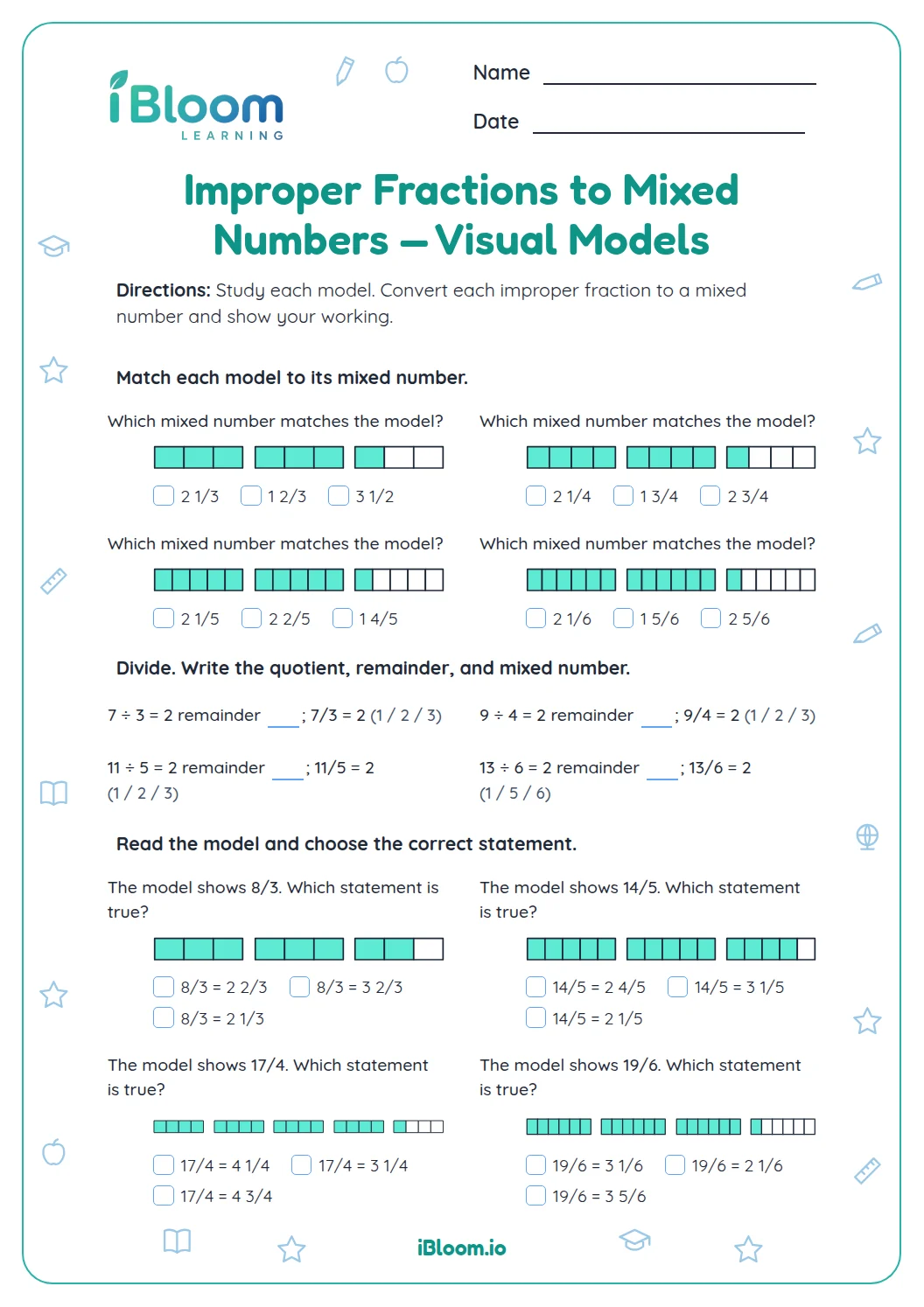
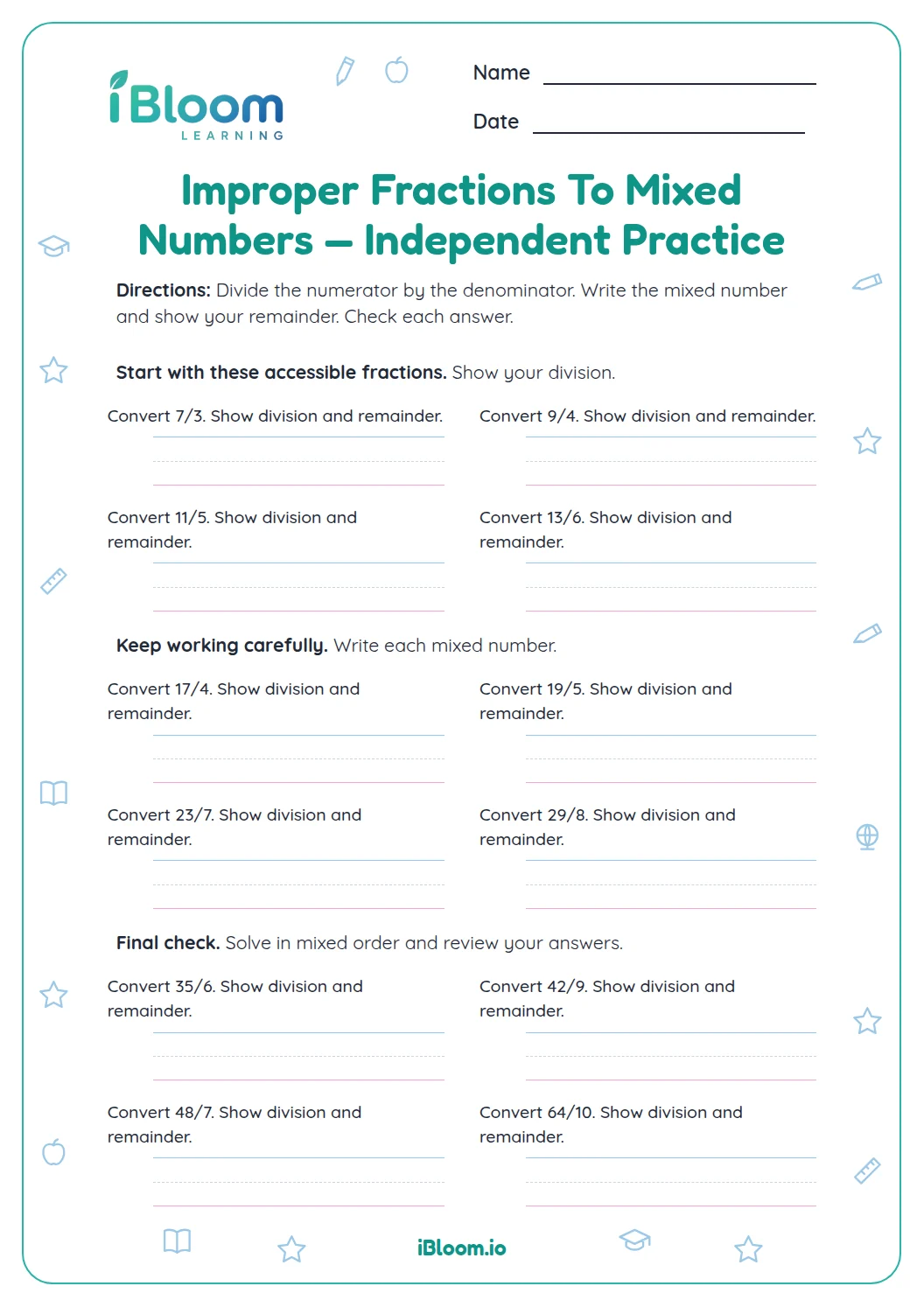
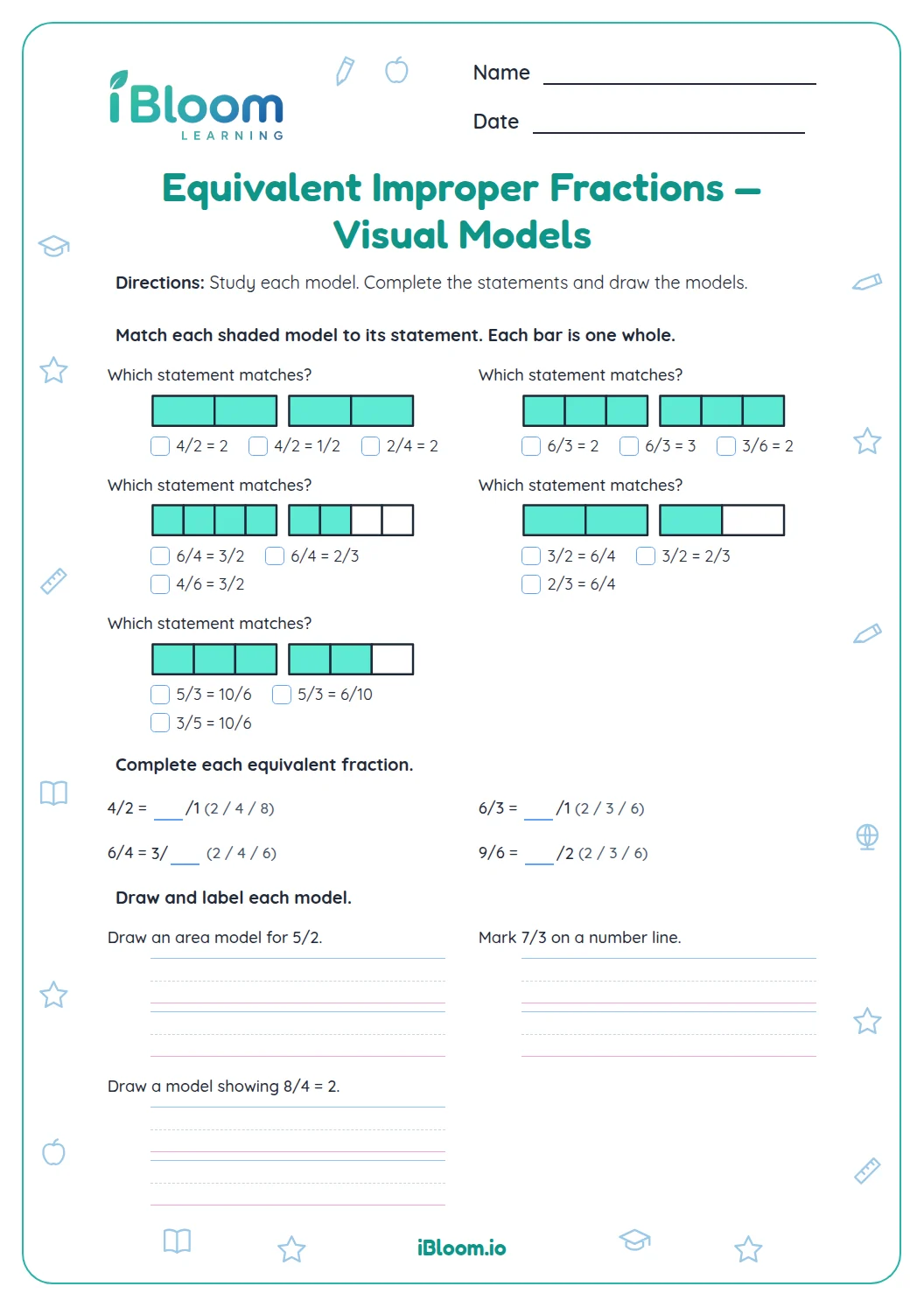
This free Grade 4 printable uses shaded shapes to show leftover fractional parts. Students identify four pictured remainders, then convert ten improper fractions to mixed numbers. The sheet focuses on regrouping equal parts into wholes and includes its own answer key.
Aligned to 4.NF.B.3.a
How do shaded parts become whole shapes?
Each model is divided into equal parts. When all parts in one shape are shaded, they make one whole. Any shaded parts left over name the fraction part of the mixed number.
In question 1, 7/3 means seven thirds. Six thirds fill two whole shapes, and one third remains.
- 17/3 = 6/3 + 1/3
- 26/3 = 2 wholes
- 37/3 = 2 wholes and 1/3 left
What should students count first?
Start with complete wholes, then count the leftover shaded sections. The denominator stays the same because the model uses equal parts throughout. Students combine the whole-group count in the prompt with the leftover fraction in the drawing.
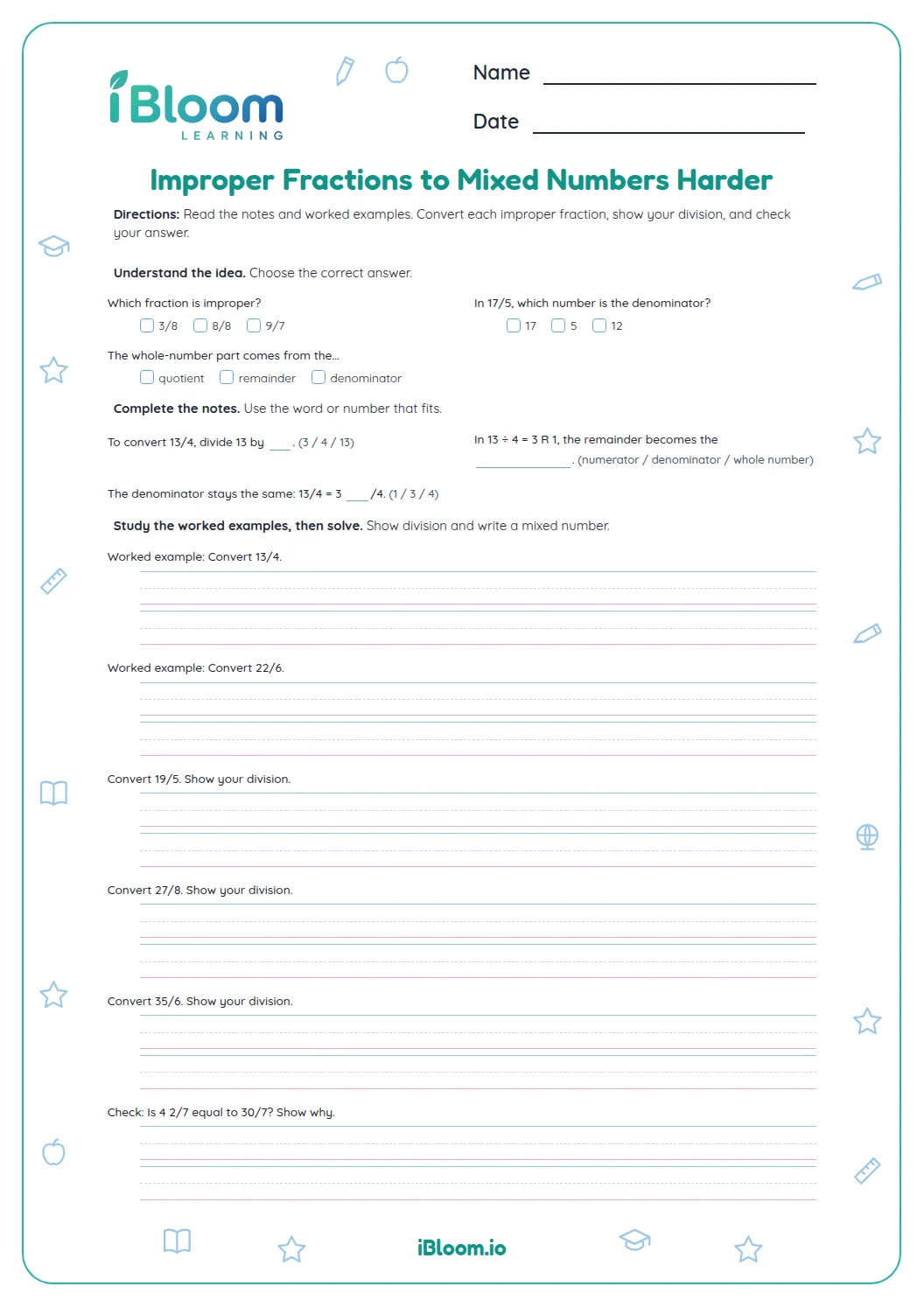
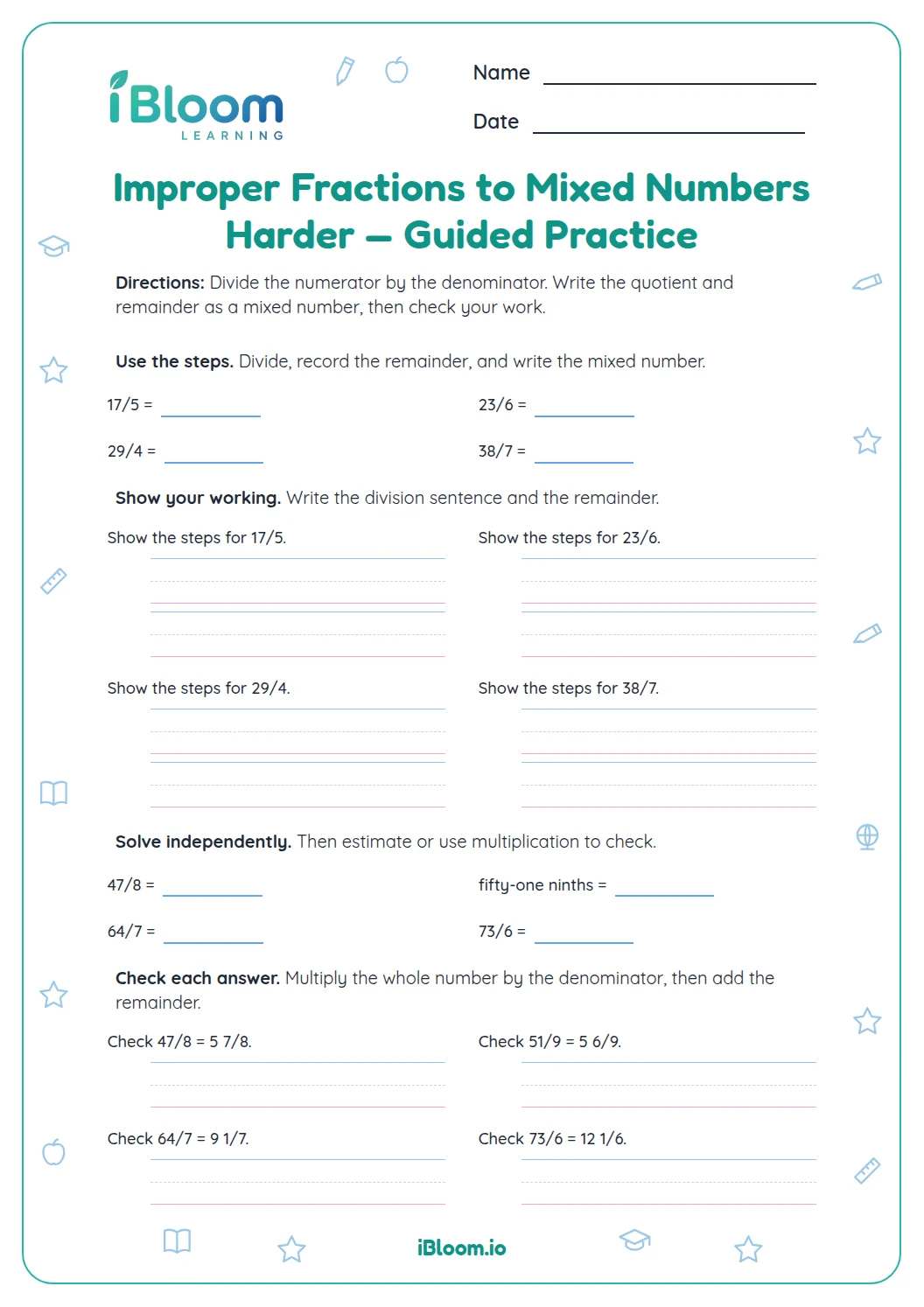
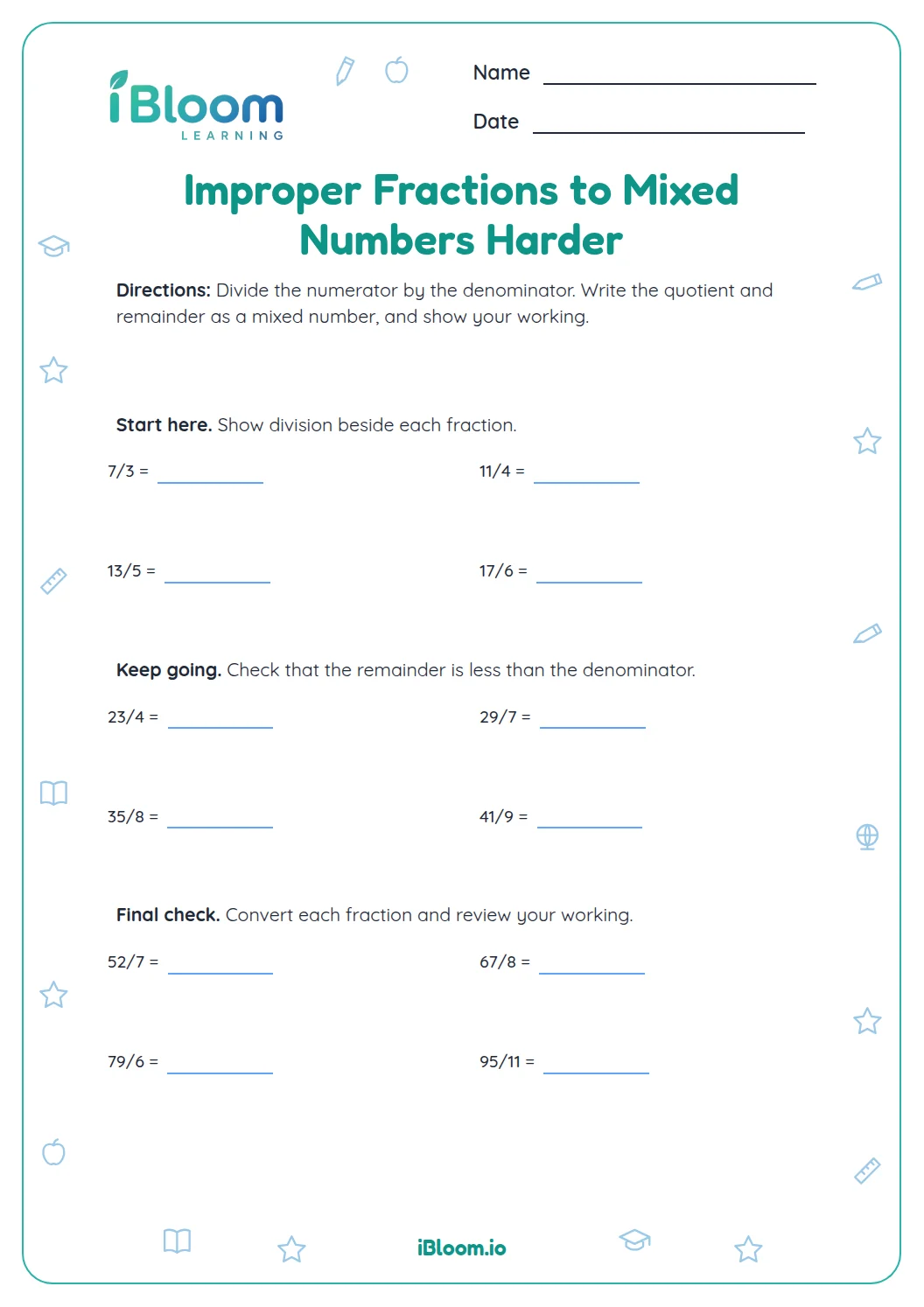
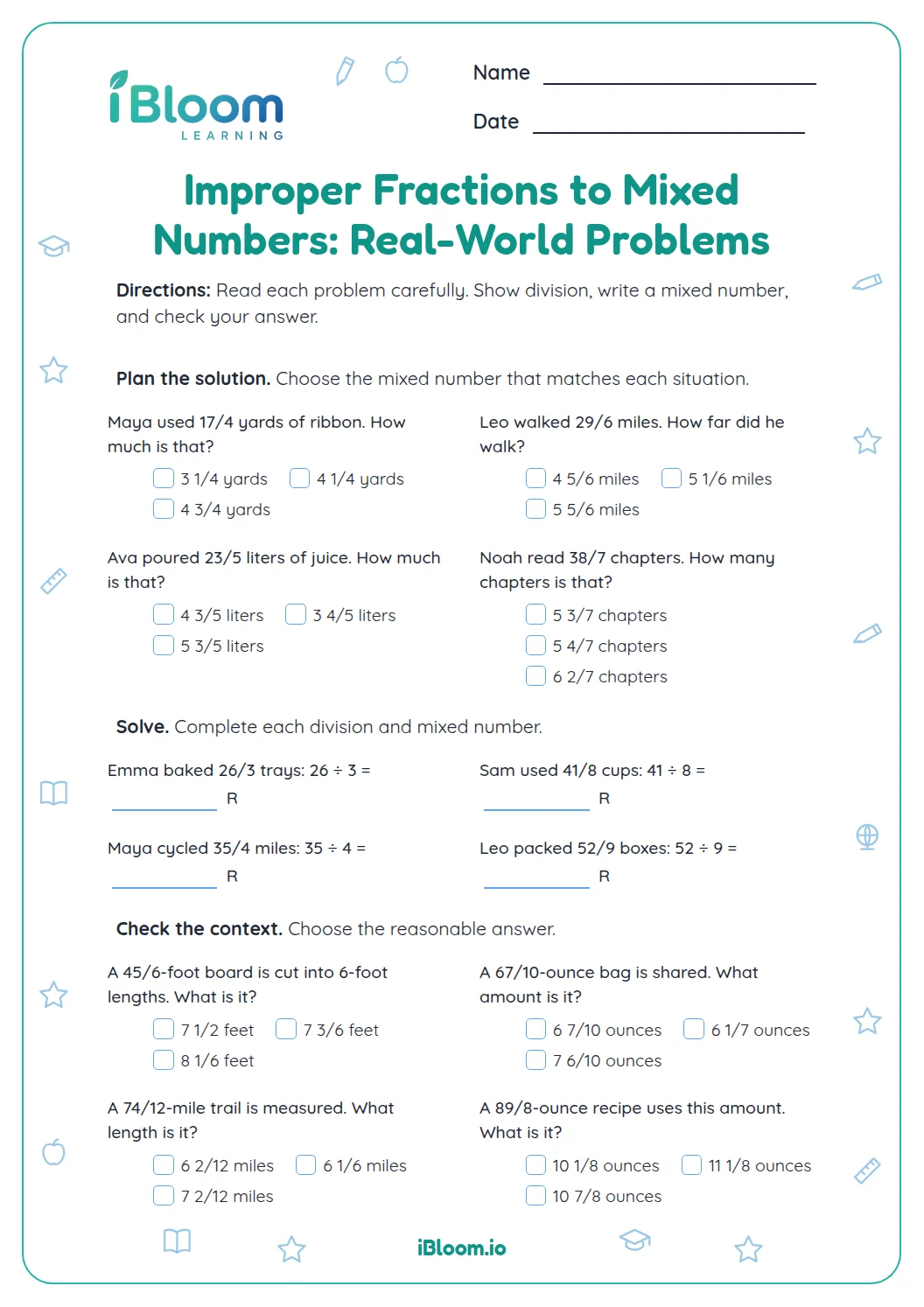
What is included in the printable?
Four model readings come first. Ten equations and choices then ask students to convert improper fractions to mixed numbers. Each model question states the number of whole groups and shows the remaining fractional part.
How to use this worksheet
- 1Read the denominator to see how many equal parts make one whole.
- 2Count each complete shaded shape as one whole.
- 3Count the shaded parts left after the full shapes.
- 4Keep the original denominator in the fractional part.
- 5Check that the whole parts and leftover parts total the original numerator.
Common mistakes and quick fixes
The mistake
Counting every shaded section as a whole.
The fix
Only a full shape is one whole; the rest stay as a fraction.
The mistake
Changing the denominator while converting.
The fix
Use the same size parts as the model.
The mistake
Leaving out the leftover shaded pieces.
The fix
Count the remaining parts after grouping complete wholes.
Common Core alignment
This worksheet practices the Common Core skills listed below.
Understand fraction addition and subtraction as joining or separating parts of one whole.
On this sheet: Students regroup shaded fractional parts into whole shapes and identify the remaining fraction.
Show the official wordingHide the official wording
Understand addition and subtraction of fractions as joining and separating parts referring to the same whole.
What to practice next
Make more practice
Further reading
Questions parents and teachers ask
How do I read a model with more than one whole?
Count the completely shaded shapes first. Each full shape represents one whole. Then count any shaded parts in the partial shape and write them over the number of equal parts in that shape. The model for 14/5, for example, has two complete wholes and four fifths.
Why does the denominator stay the same?
The denominator names the equal parts in the model. Converting 11/4 to 2 3/4 changes how the amount is grouped, but it does not change fourths into another size of part. Keep the denominator 4. Ask the student to name the unit or fraction part before checking the final result.
Can an improper fraction equal a whole number?
Yes. If the numerator is an exact multiple of the denominator, there are no leftover fractional parts. This page uses models with some leftover parts so students can practice writing a mixed number. Ask the student to name the unit or fraction part before checking the final result.
What is different from a division-only conversion?
The pictured shapes show how groups of equal fractional parts build whole shapes. This replaces the old single quotient-and-remainder blank with a visible model and a clear mixed-number response. Ask the student to name the unit or fraction part before checking the final result.
What is on the answer key?
The answer key gives the mixed number for each pictured fraction. For the first four items, it identifies the matching choice; for the remaining items, it lists the whole number and remaining fractional part. Ask the student to name the unit or fraction part before checking the final result.
What should students check after writing a mixed number?
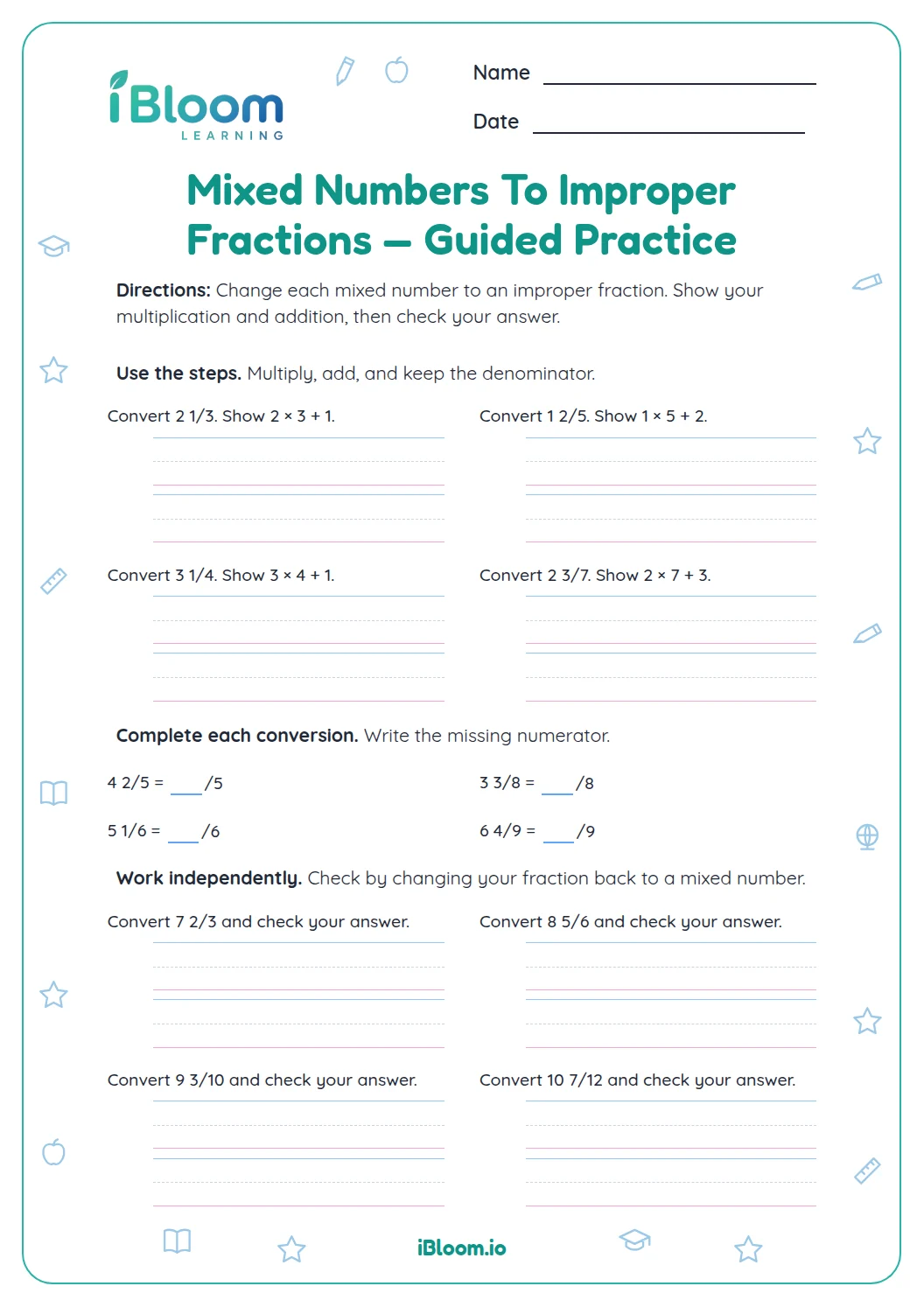
Multiply the number of whole shapes by the denominator, then add the numerator of the fractional part. For 2 3/4, two wholes contain eight fourths; add three more fourths to make 11/4. Ask the student to name the unit or fraction part before checking the final result.