



About this worksheet
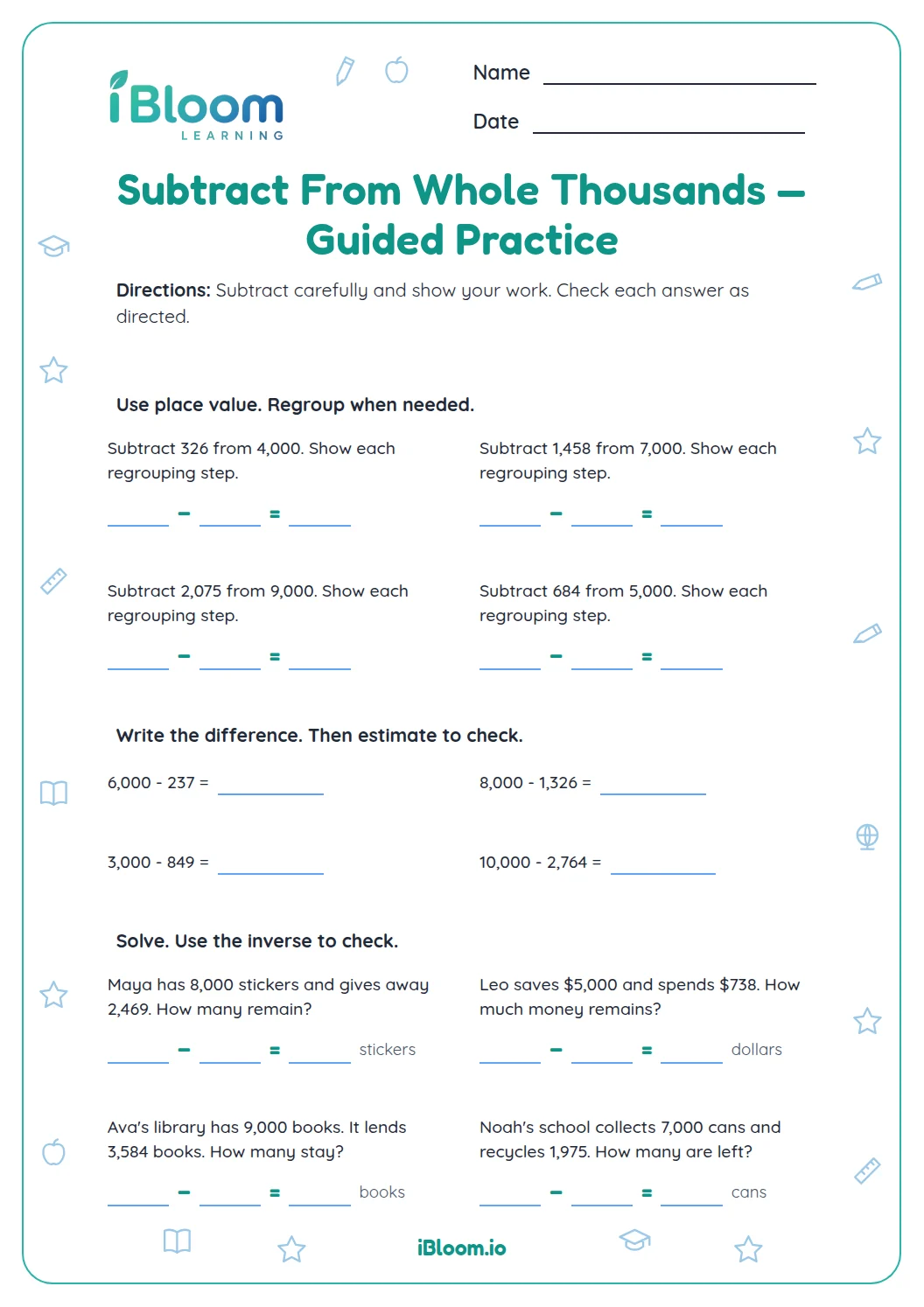
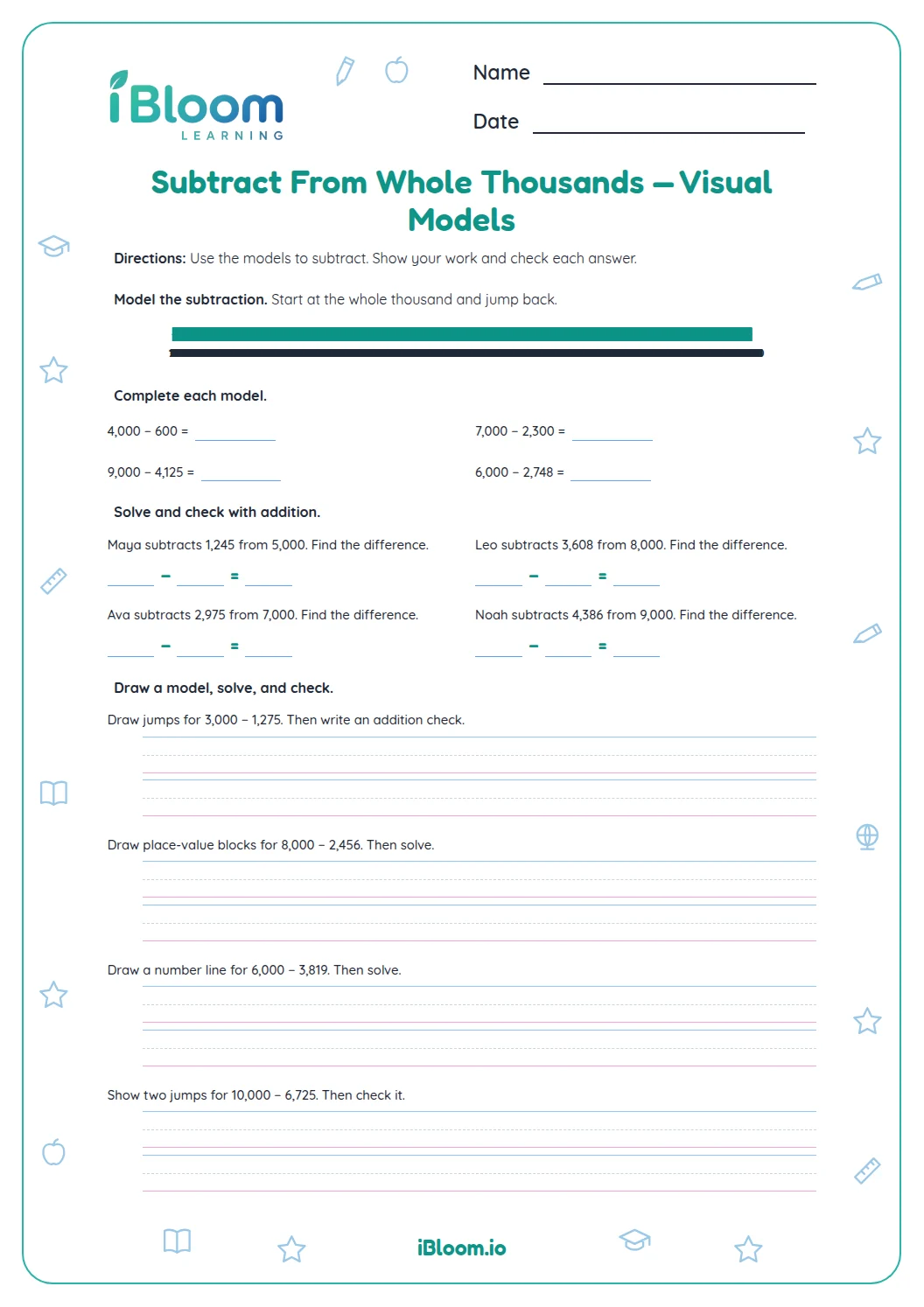
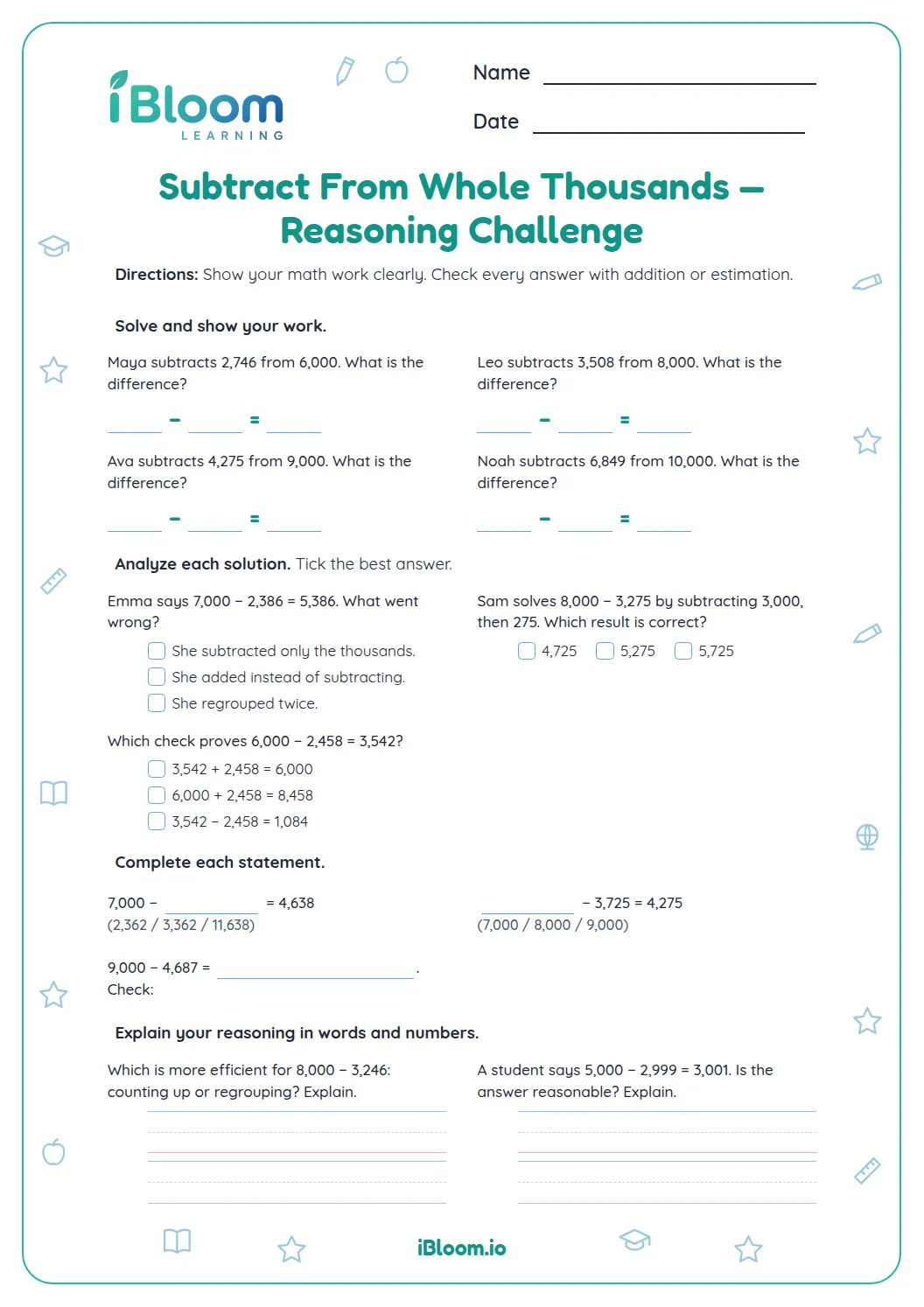
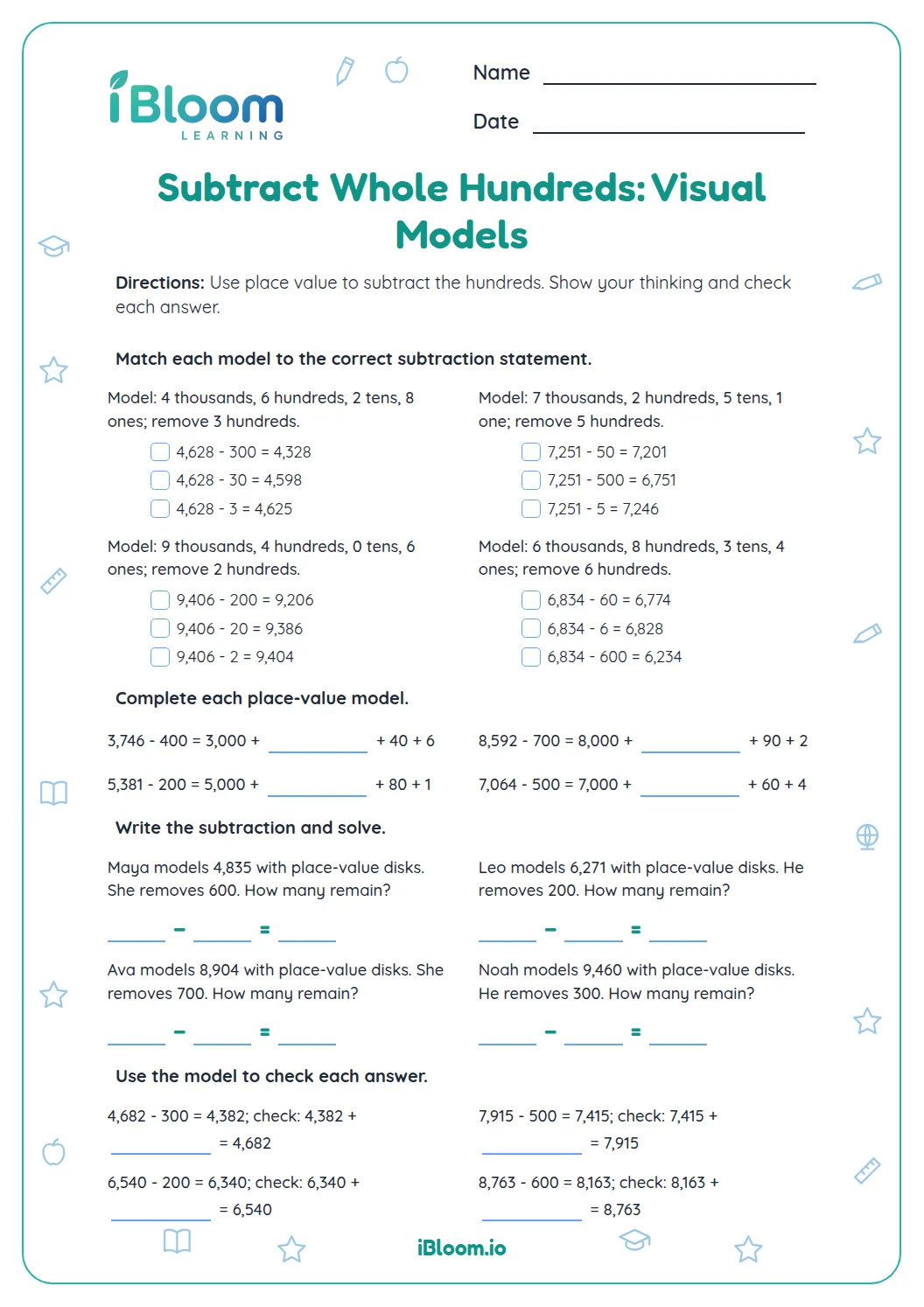
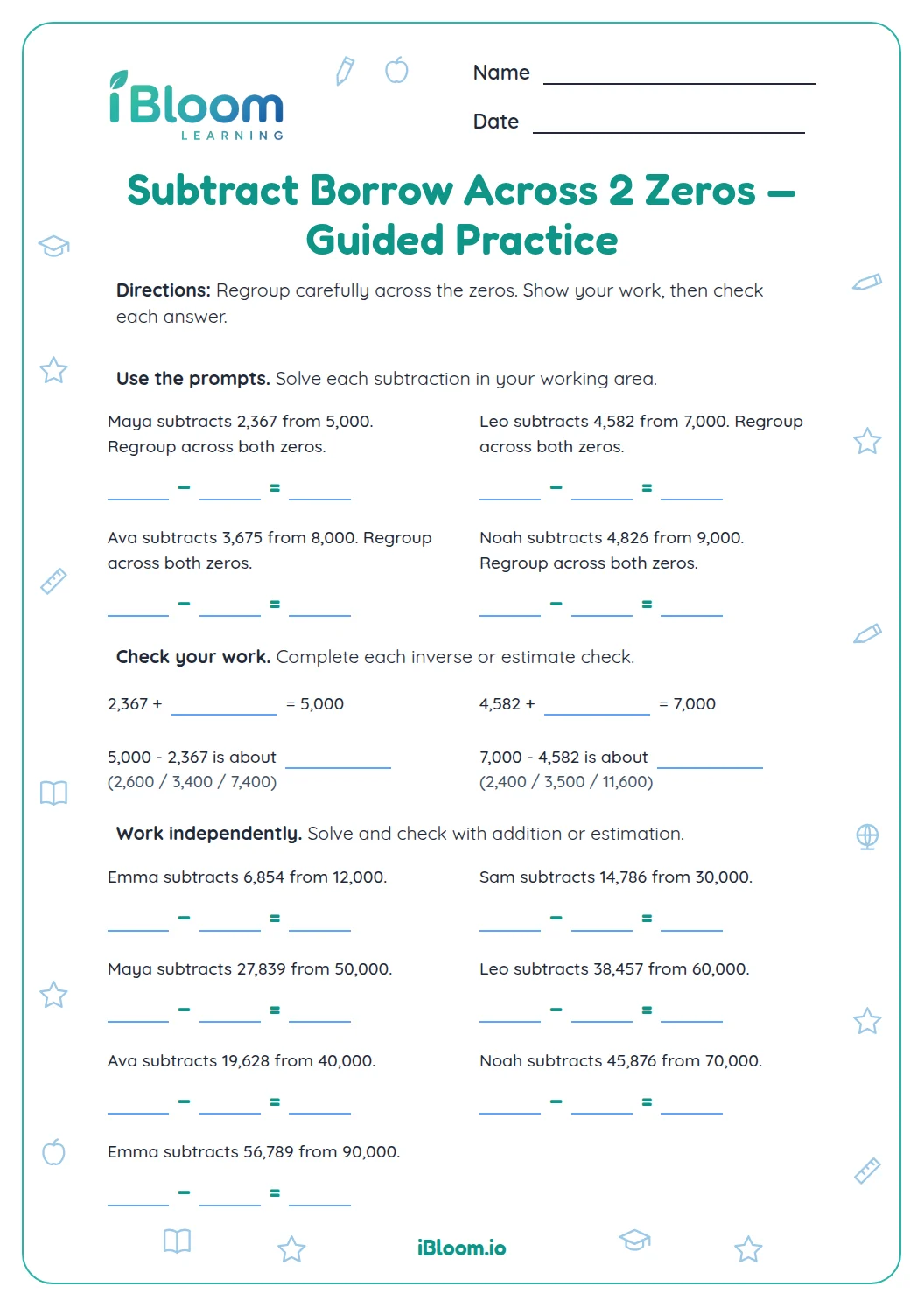
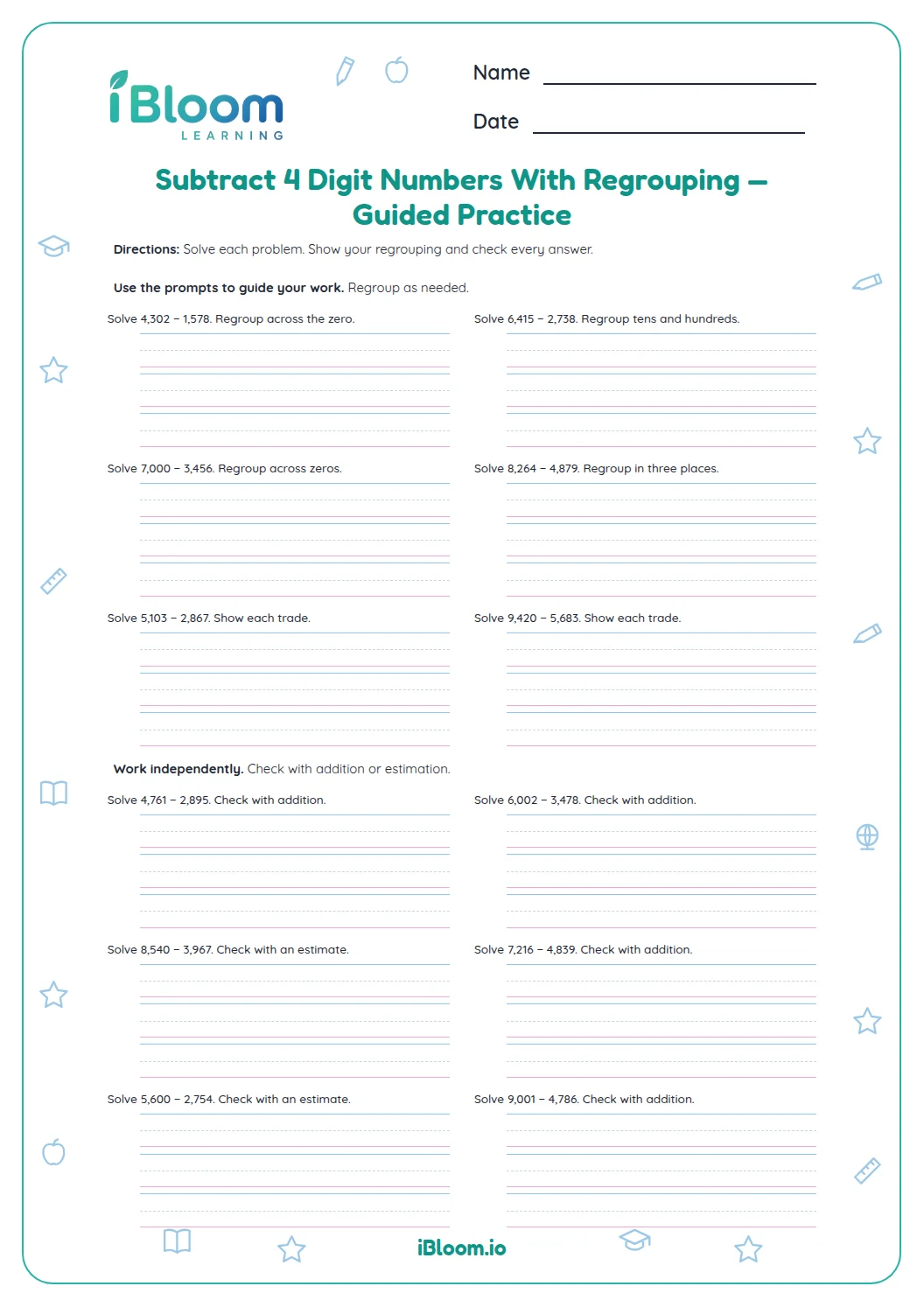
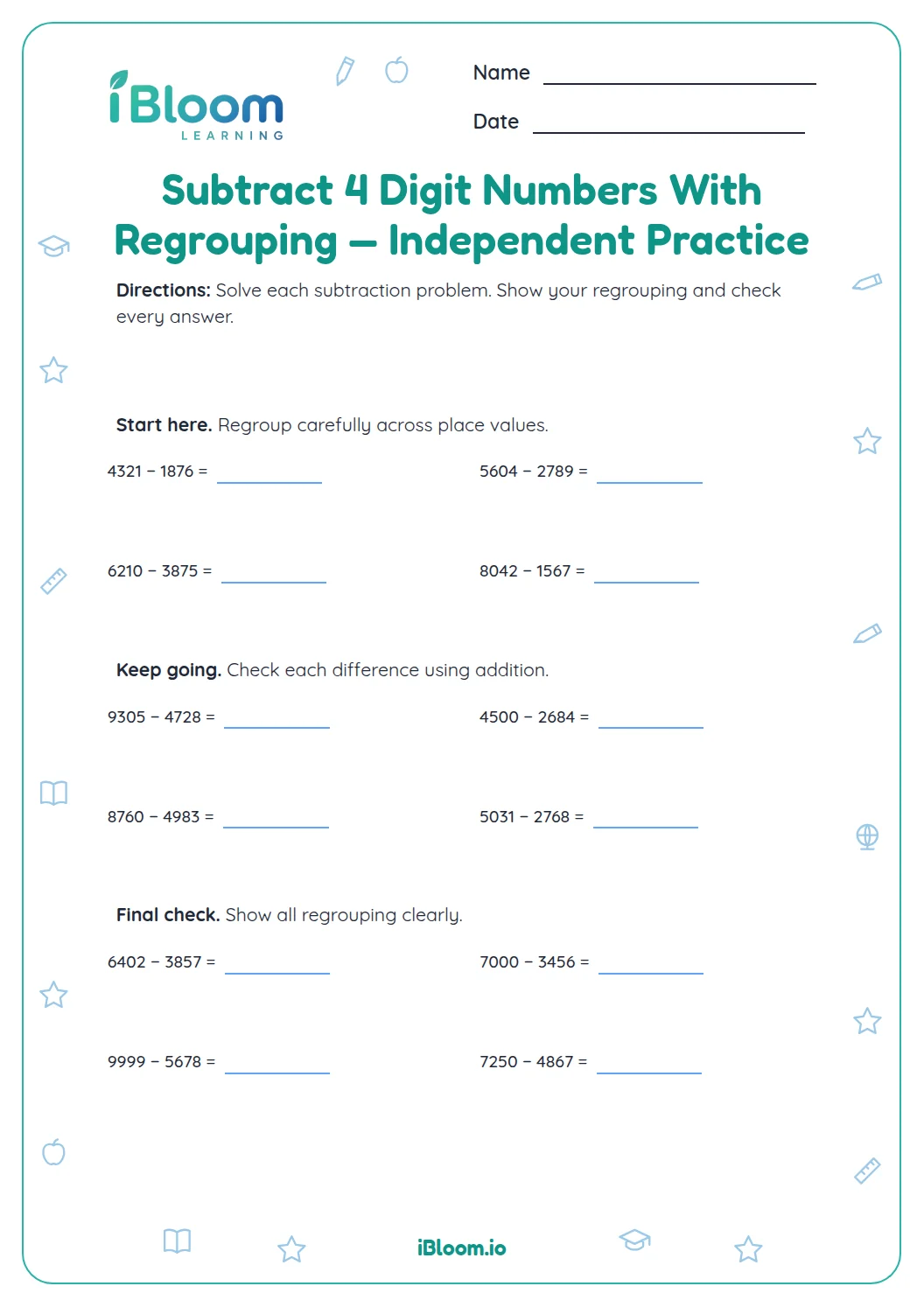
This Grade 4 worksheet develops subtraction from whole thousands by making regrouping steps explicit. Students subtract hundreds and thousands, solve short real-life situations, fill both a difference and its addition check, and complete a final set of multi-digit problems. The sixteen questions include the full numbers in every prompt and a separate answer key.
Aligned to 4.NBT.B.4
How do you subtract from a whole thousand?
A number such as 4,000 has zero hundreds, tens, and ones. To subtract 328, regroup one thousand as ten hundreds, then regroup as needed to make tens and ones. Keep each digit aligned by place.
Question 9 uses 4,000 − 328. The difference is 3,672, and addition checks it: 3,672 + 328 = 4,000.
- 14,000 − 328 = 3,672
- 2Check: 3,672 + 328 = 4,000
Where does this subtraction appear in the sheet?
The context questions use stickers, cans, books, money, apples, trees, visitors, and pencils. Each starting amount and amount taken away appears in the printed prompt, so students can set up the subtraction themselves.
How does the practice build?
Part A begins with four equations. Part B adds contexts, Part C asks students to fill both related equations, and Part D gives longer independent applications.
How can I use this worksheet?
- 1Line up the thousands, hundreds, tens, and ones.
- 2Regroup a thousand when the hundreds place has zero.
- 3Regroup a hundred when the tens place has zero.
- 4Continue to the ones place, then subtract each column.
- 5Add the difference and the amount taken away to check.
Common mistakes and quick fixes
The mistake
Writing the difference in both blanks but leaving the check blank.
The fix
Read the check sentence and fill its separate blank with the difference.
The mistake
Borrowing from the next place without reducing it.
The fix
When one thousand becomes ten hundreds, reduce the thousands by one.
The mistake
Losing a zero in the answer.
The fix
Keep place-value columns aligned and include every needed zero.
Common Core alignment
This worksheet gives students focused practice with the standard below.
Subtract multi-digit whole numbers using place value and the standard algorithm.
On this sheet: Subtract multi-digit whole numbers using place value and the standard algorithm.
Show the official wordingHide the official wording
Fluently add and subtract multi-digit whole numbers using the standard algorithm.
What to practice next
Further reading
Questions parents and teachers ask
How do you subtract 328 from 4,000?
Regroup across the zero places so there are hundreds, tens, and ones to subtract. The result is 3,672. Check it by adding 328 to 3,672; the sum returns to 4,000. Question 9 asks students to enter both the difference and check value.
Why is 5,000 − 2,000 easier than 5,000 − 2,819?
In the first equation, both numbers have only thousands, so subtracting gives 3,000 directly. In 5,000 − 2,819, the hundreds, tens, and ones must be created by regrouping. The later parts practice that full process. This gives students a second way to confirm the place value and operation.
What belongs in the check blank?
The first blank is the difference. In question 9, write 3,672 there. The second blank is also 3,672 because the check adds the difference and 328 to return to 4,000. Read each equation from left to right so you place the value in the correct blank.
Are the word problems fully specified?
Yes. Each gives the starting amount and the amount removed or missing. The student can write a subtraction equation, then report the remaining stickers, cans, books, dollars, or other named quantity. This gives students a second way to confirm the place value and operation.
Is an answer key included?
Yes. The separate key gives each difference and, for questions with two blanks, the value for each blank in order. For word problems, it includes the number and matching unit so students can check both the calculation and what the answer describes.