

About this worksheet
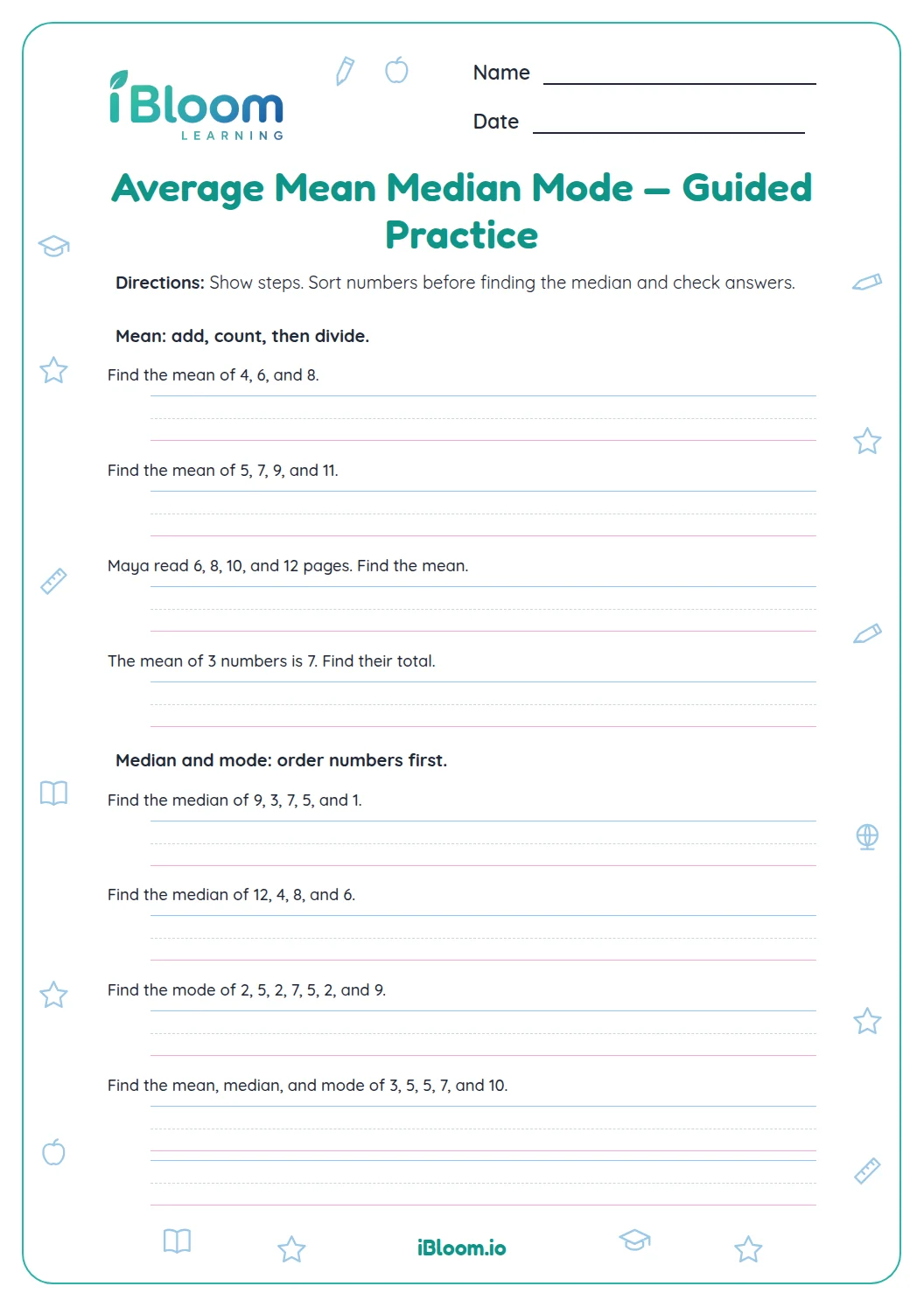
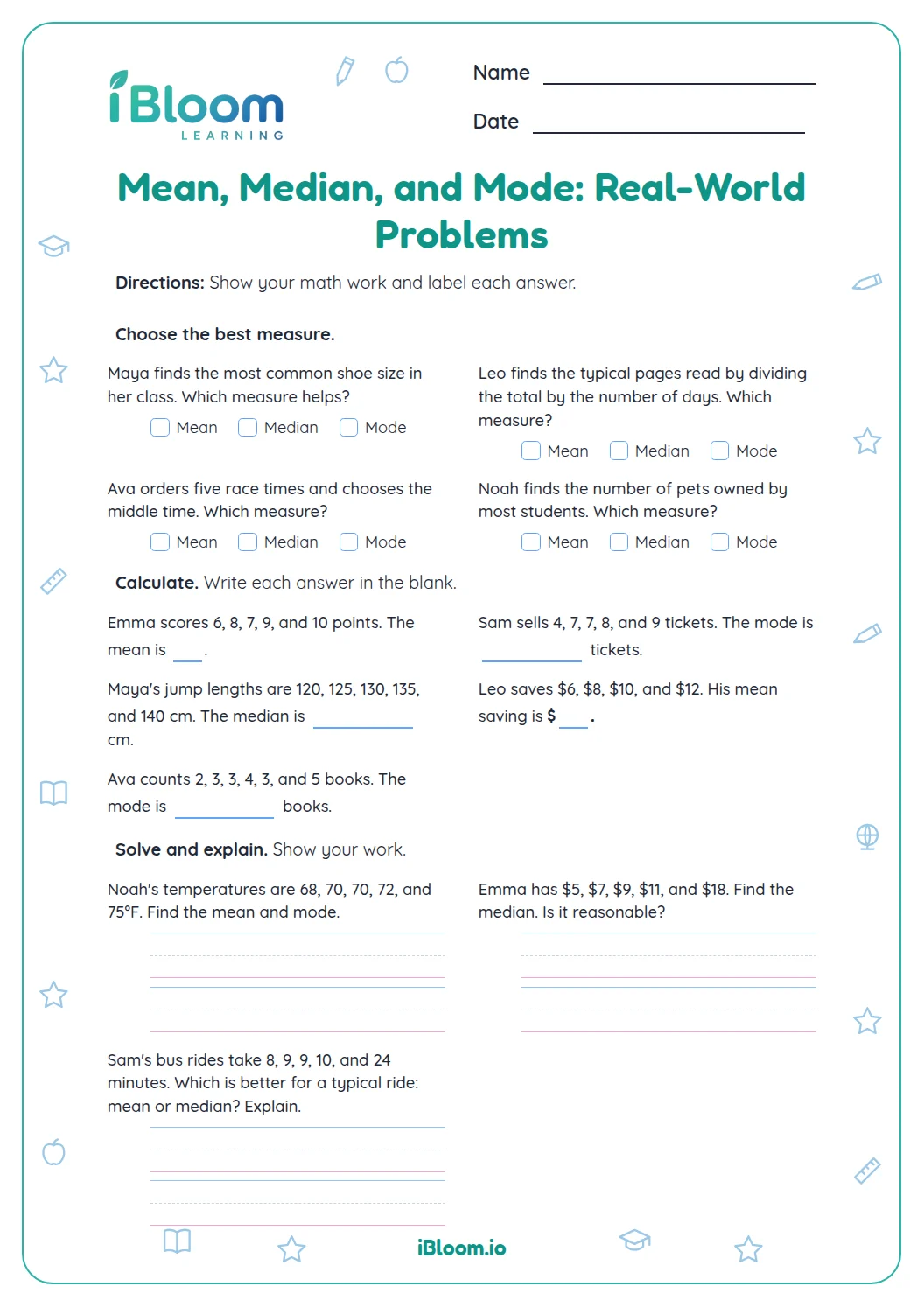
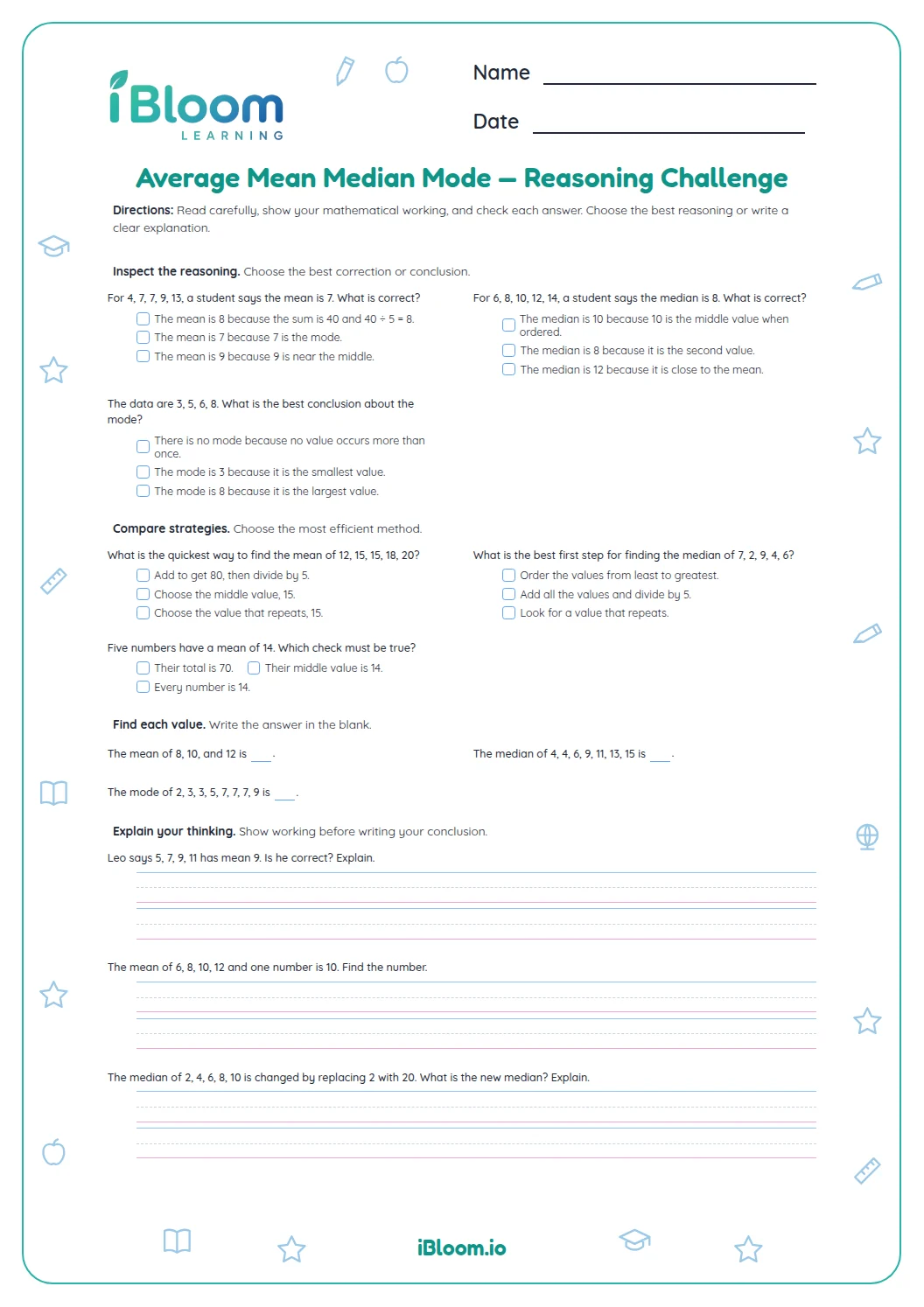
This Grade 5 worksheet introduces three ways to describe a numerical data set: mean, median, and mode. Students calculate each measure from given values, sort data to find the middle, and identify both tied modes when two values occur most often. Fourteen questions span three parts, with a separate answer key that lists the measures and short explanations.
How do you find the mean?
Add all values in the data set, then divide by the number of values. The mean is the equal share each value would have if the total were redistributed evenly.
- 1Find the mean of 5, 7, and 9.
- 2Answer: (5 + 7 + 9) ÷ 3 = 7
How do you find the median?
Order the values from least to greatest. With an odd number of values, use the middle value; with an even number, average the two middle values.
Can a set have two modes or no mode?
Part A finds means, Part B finds medians, Part C finds modes, and Part D combines the measures or interprets a data set, including tied modes and a set with no mode.
Steps for describing a data set
- 1List each value and count how many observations there are.
- 2Add the values and divide by the count to find the mean.
- 3Order the values before finding the median.
- 4Count repeats to find the most frequent value or values.
- 5Check whether a tie or no mode is possible.
Mean, median, and mode mistakes
The mistake
Finding the median before sorting.
The fix
Rewrite values from least to greatest before locating the center.
The mistake
Calling tied modes “no mode.”
The fix
If two values share the highest frequency, report both modes.
The mistake
Dividing the mean by the largest value.
The fix
Divide the total by the number of observations.
What to practice next
Make more practice
Further reading
Questions parents and teachers ask
How is the mean different from the median?
The mean is the sum of all values divided by their count. The median is the middle value after sorting the data, or the average of the two middle values when there are an even number of observations. The worksheet includes practice finding each one.
Can a data set have two modes?
Yes. If two values tie for appearing most often, both are modes. In 2, 2, 4, 6, 6, the values 2 and 6 each appear twice, so the set has two modes. Report both values when the highest frequency is shared. Report both values when the highest frequency is shared.
Can a data set have no mode?
Yes. If every value occurs the same number of times, there is no single value that appears more often than the others. One question on the sheet asks students to identify this case and distinguish it from tied modes. Equal frequencies mean no mode.
How do you find the median of an even number of values?
Order the values, identify the two in the center, and find their average. For 3, 5, 7, and 9, the center values are 5 and 7, and their average is 6. This is the process for an even-sized set. This is the process for an even-sized set.
What is included in the answer key?
The answer key lists the mean, median, or mode requested in each question. For data sets with multiple measures, it gives each measure; it also recognizes tied modes and sets with no mode. It explains why a set may have one mode, two modes, or none. It gives answers for all 14 questions.