
About this worksheet
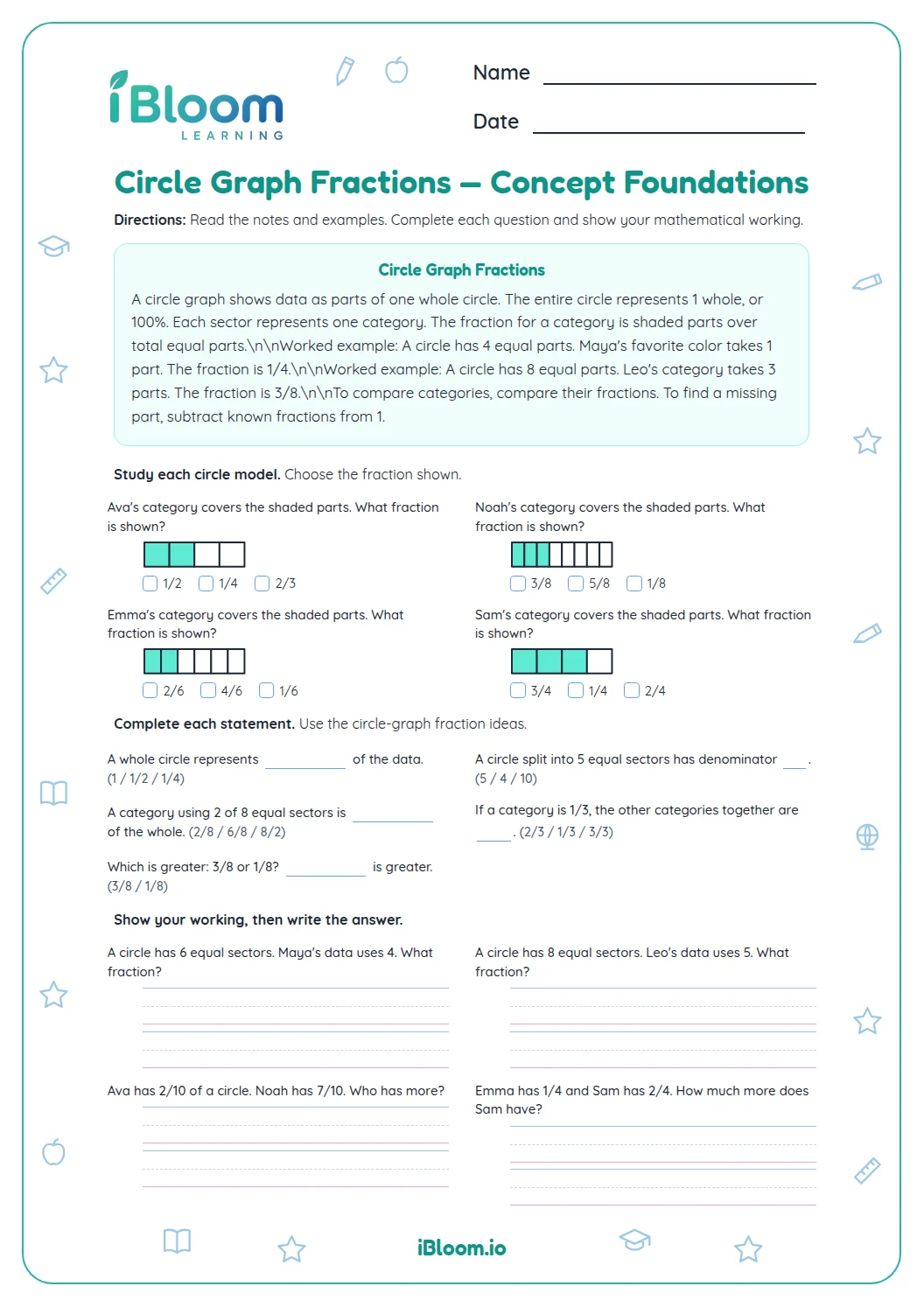
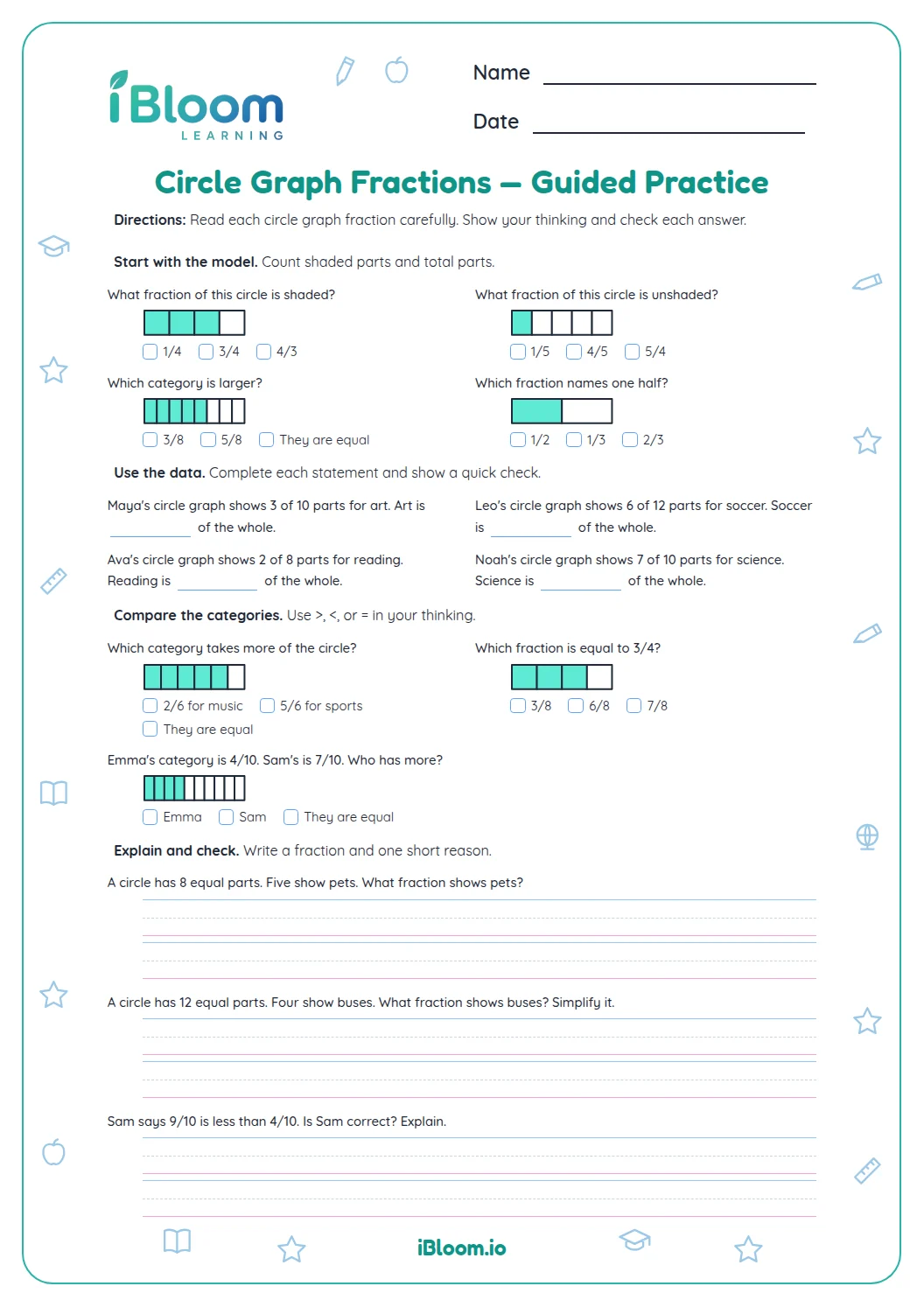
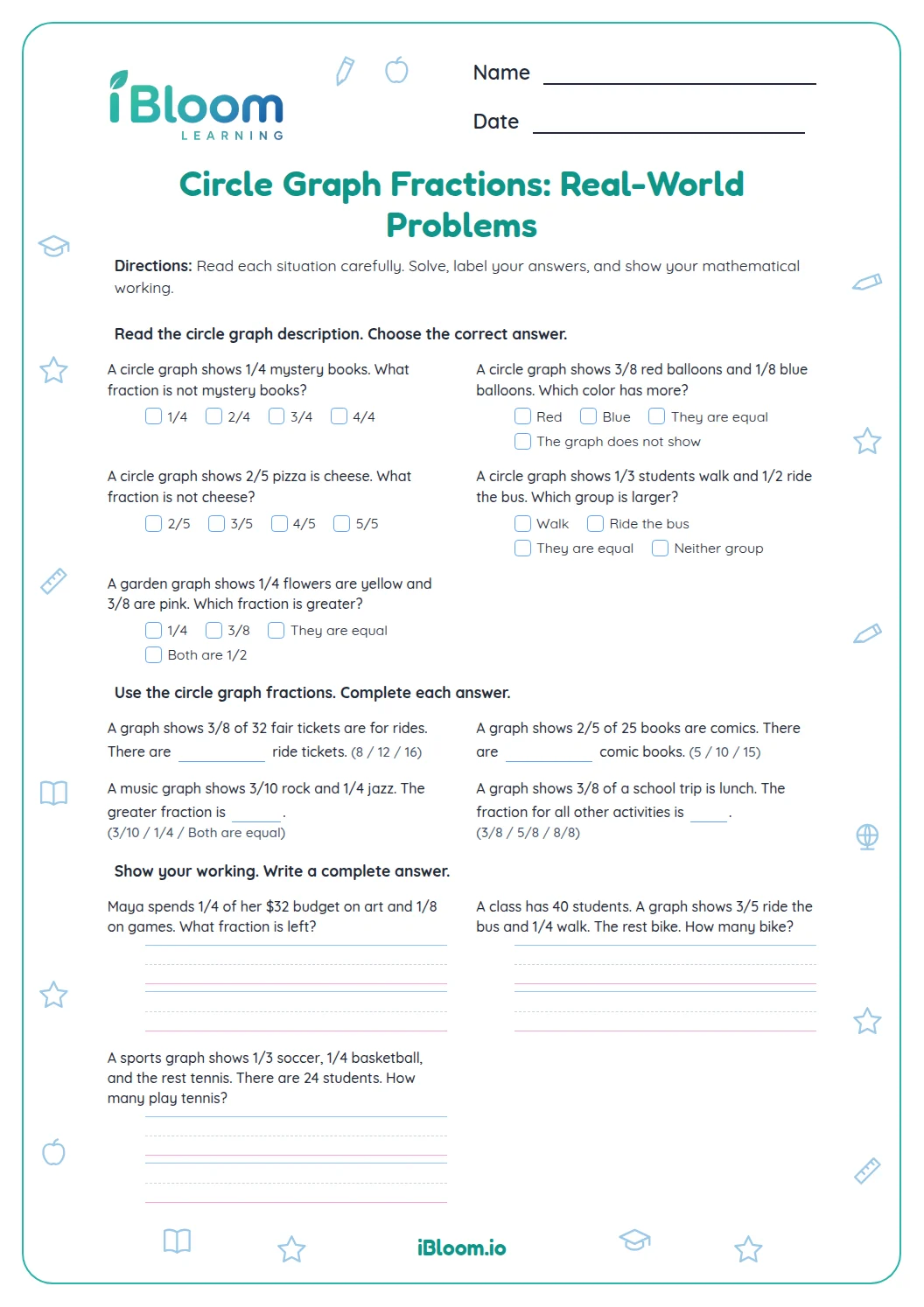
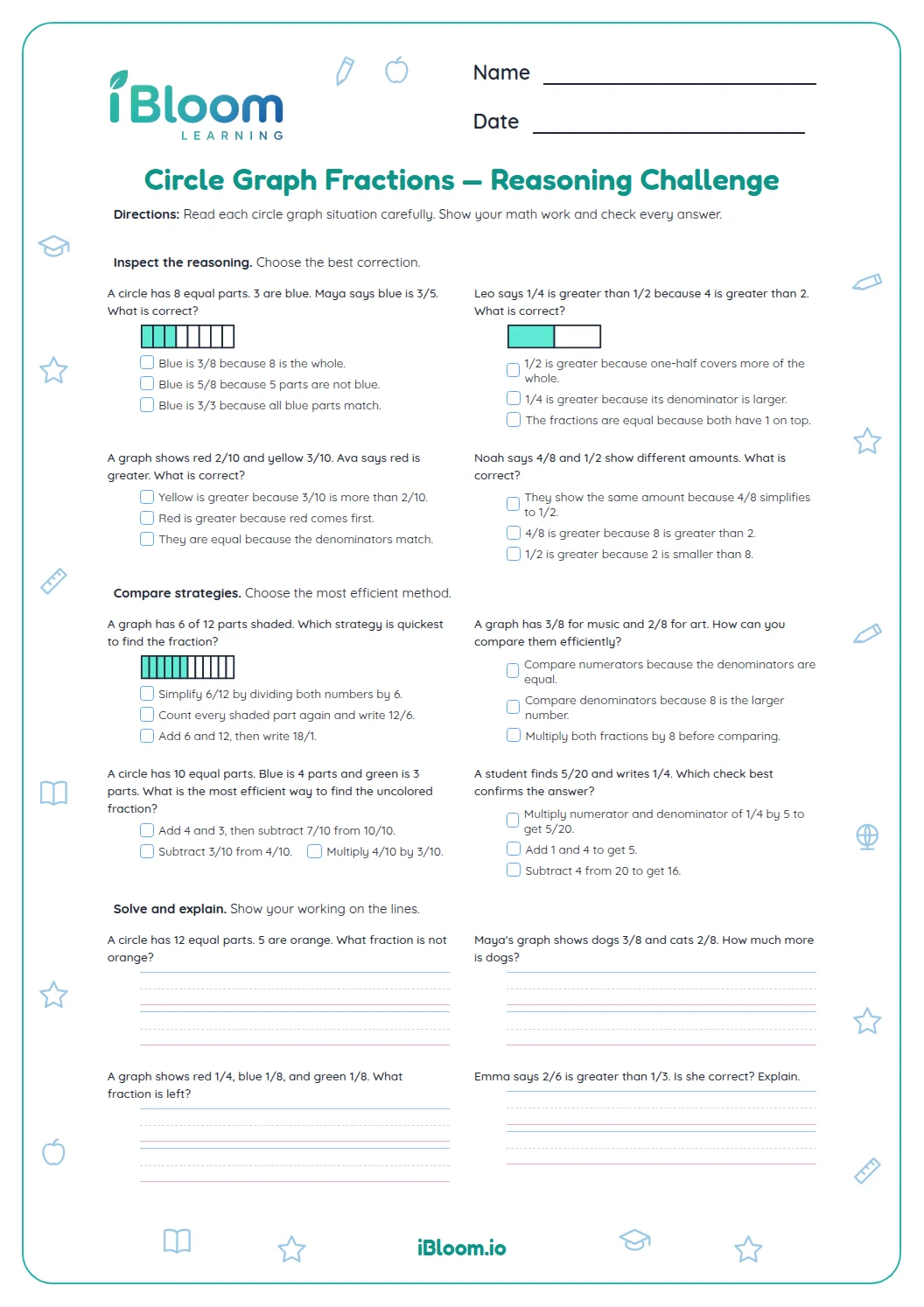
This Grade 5 worksheet gives students 16 equal-part circle models to read as circle graphs. For each one, they count the shaded sector pieces for the numerator and all equal pieces for the denominator. The answer key records the fraction shown by each model. These part-to-whole models support the fraction interpretation in CCSS 5.NF.B.3.
How do you read a shaded share?
For q1, two of eight equal sectors are shaded, so the shaded share is 2/8. The numerator is the number shaded; the denominator is the total number of sectors.
What counts as the whole?
Count every sector in the circle, including shaded and unshaded pieces. For q7, eight of twelve sectors are shaded, so the model shows 8/12.
Should you simplify the fraction?
Write the counts shown in the model. For example, q8 shows 4 of 6 sectors shaded, so record 4/6; simplify only if your teacher asks.
How to use this worksheet
- 1Count the equal parts in the whole circle for the denominator.
- 2Count the shaded parts for the numerator.
- 3Write the shaded amount over the total amount.
- 4Check that the model has equal-sized parts.
Common mistakes and quick fixes
The mistake
Using the number of unshaded parts as the denominator.
The fix
The denominator counts every equal part in the entire circle.
The mistake
Counting the whole circle as one shaded part.
The fix
Count each equal wedge separately, whether it is shaded or not.
The mistake
Reversing numerator and denominator.
The fix
Say “shaded out of total” before writing the fraction.
What to practice next
Make more practice
Further reading
Questions parents and teachers ask
How do you read a fraction from a circle model?
Count the shaded equal sectors for the numerator and all sectors in the complete circle for the denominator. In q1, two of eight pieces are shaded, so the model shows 2/8. The key gives the fraction represented by every circle.
Does the denominator count only the unshaded pieces?
No. The denominator counts all equal pieces in the complete circle, shaded and unshaded. The numerator counts only the shaded pieces. Keeping those two counts separate helps students read the portion as part of one whole. Then reduce only if directions ask.
What should students do if a circle has many parts?
Count each wedge once, keeping a separate count of shaded and unshaded pieces if that helps. Then add both groups for the denominator. The sectors are equal, so each piece contributes the same share of the whole circle. The answer key records the shaded share.
Why are circle graphs useful for data?
A circle graph divides a whole set of data into categories, with each sector showing a category’s share. These models use shading to mark one category and ask students to name its part-to-whole fraction. They focus on reading the share represented by the shaded sector.
Can equivalent fractions describe the same share?
Yes. Different fractions can represent the same share, such as 2/4 and 1/2. This worksheet asks for the numerator and denominator counted directly from each model, so keep that form unless an instructor requests a simplified equivalent. The model itself shows the fraction to record.