



About this worksheet
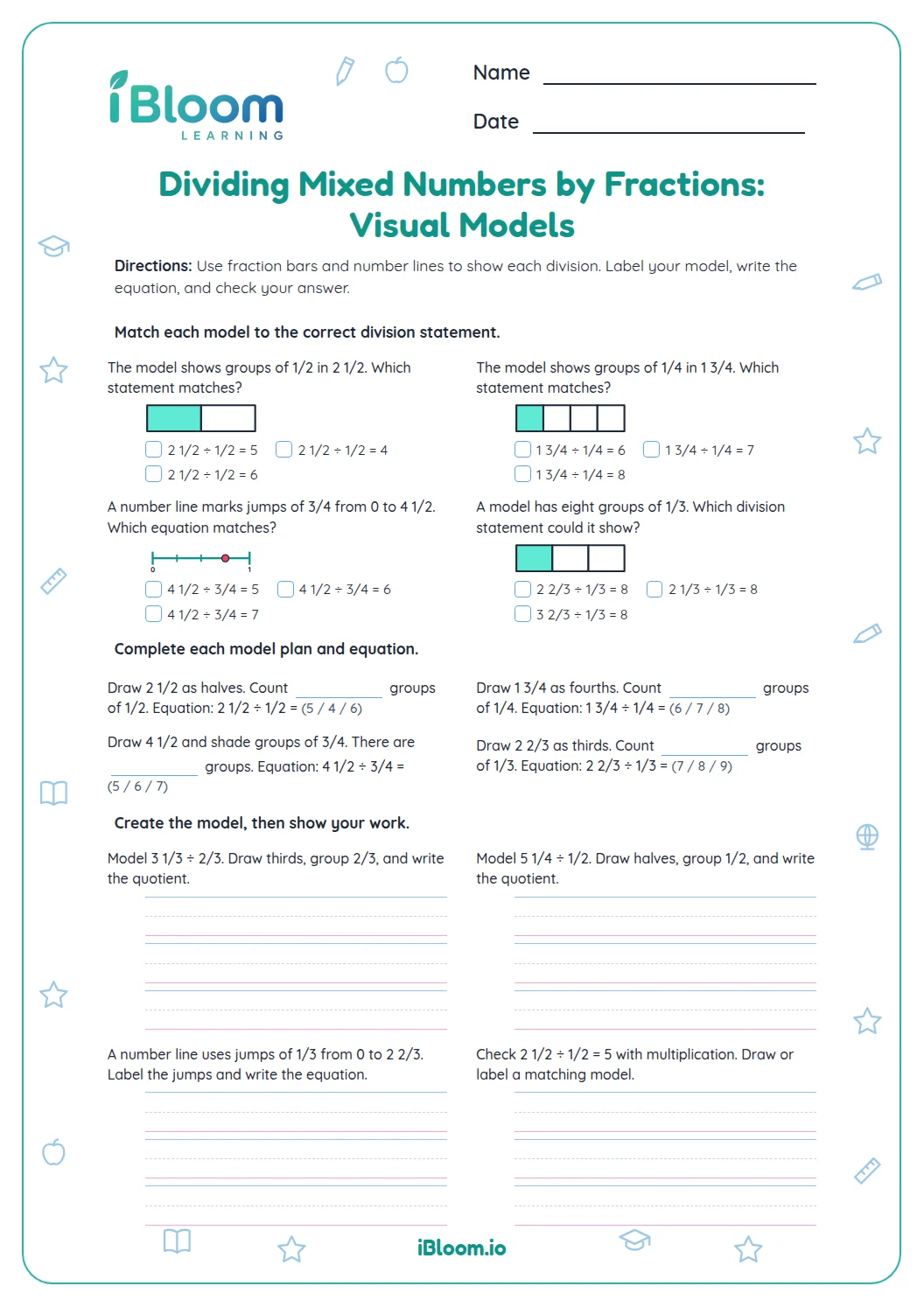
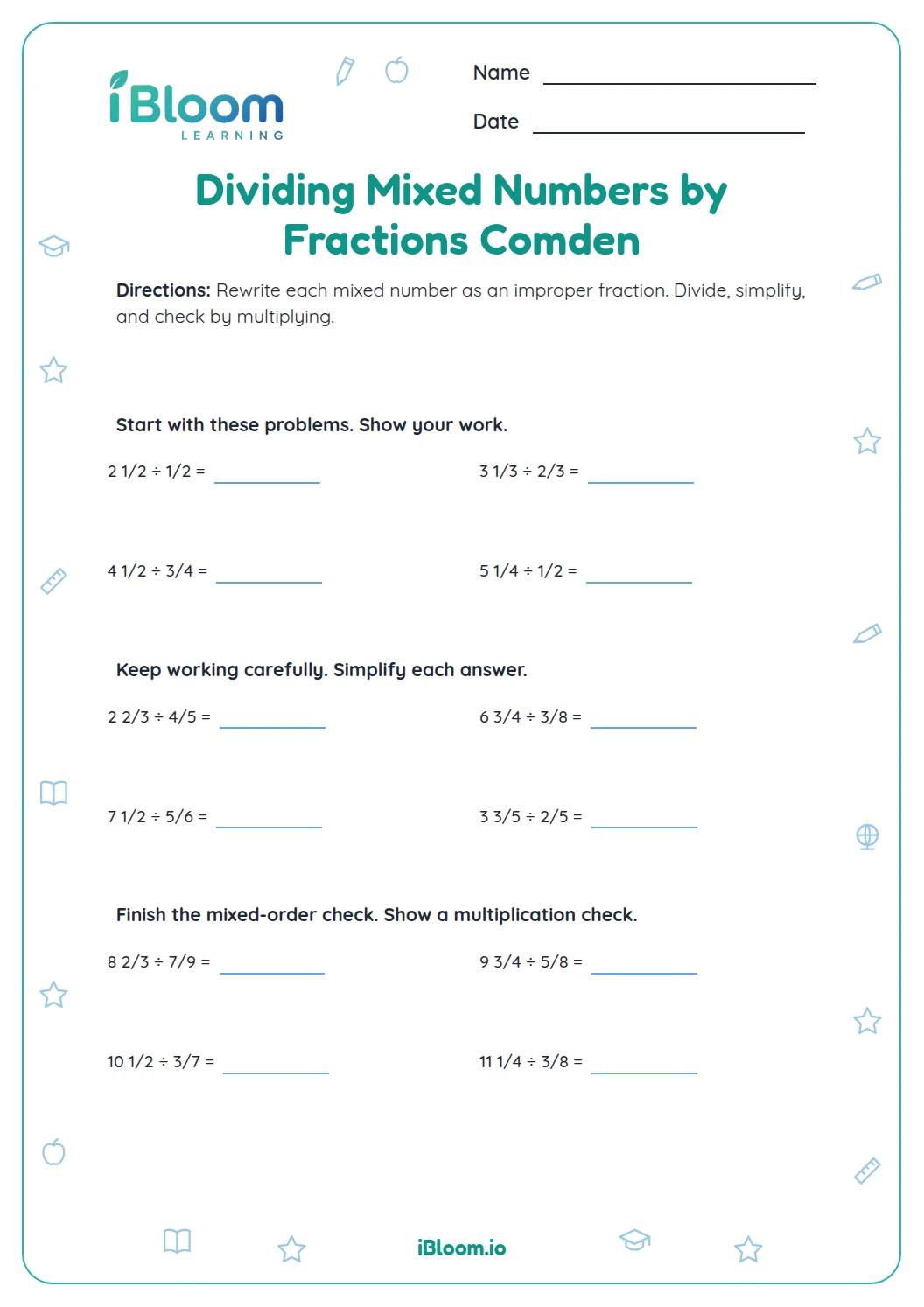
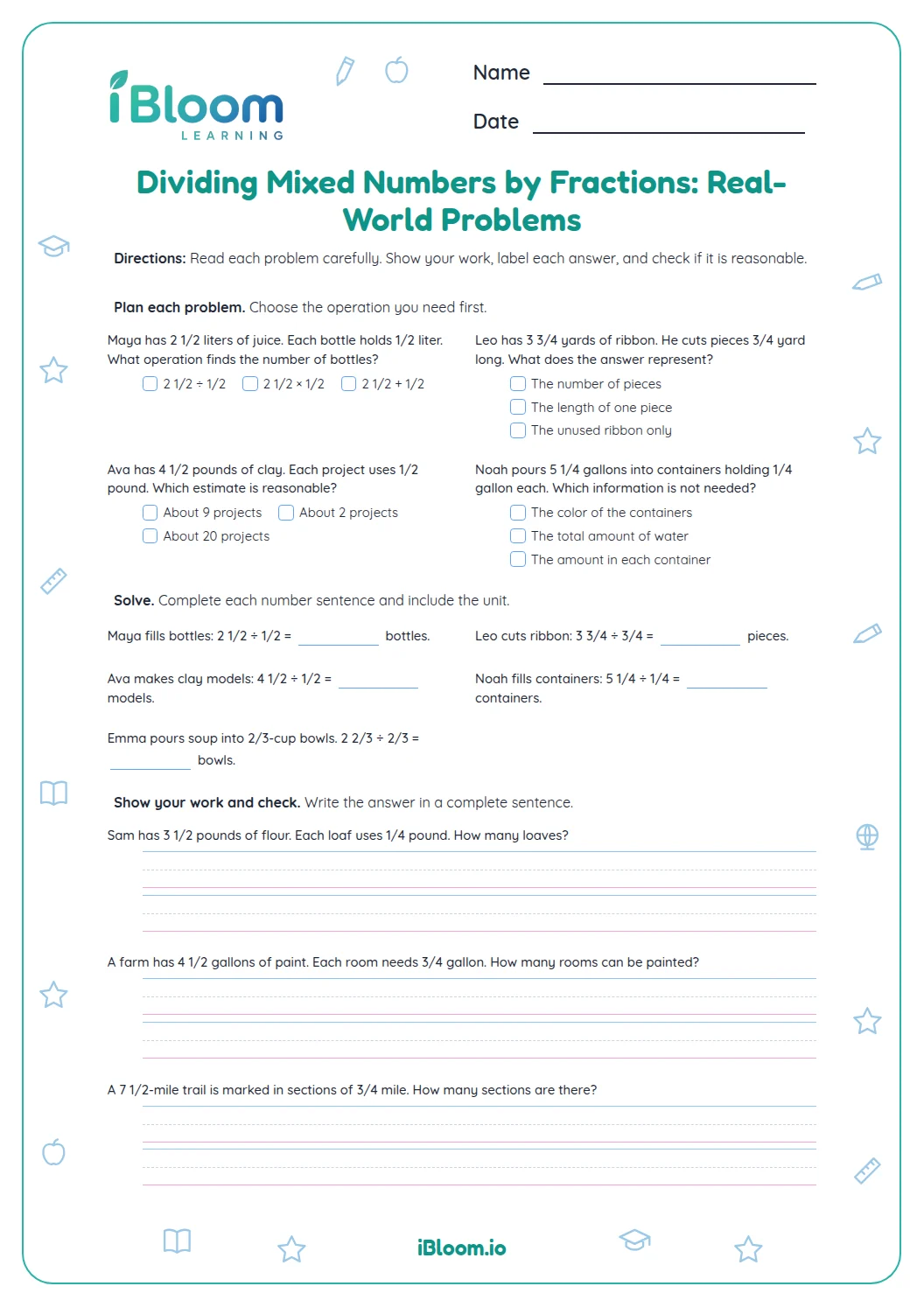
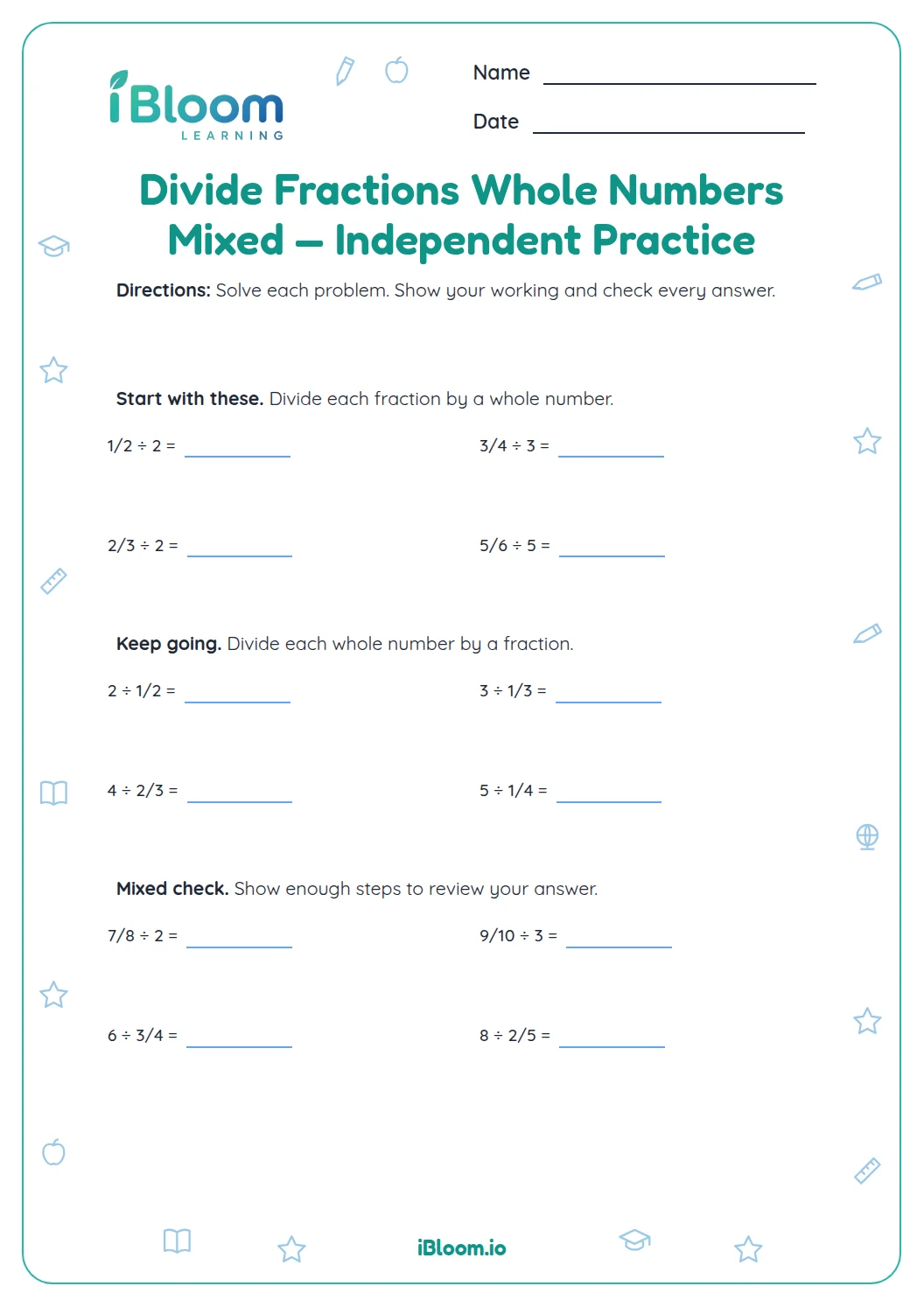
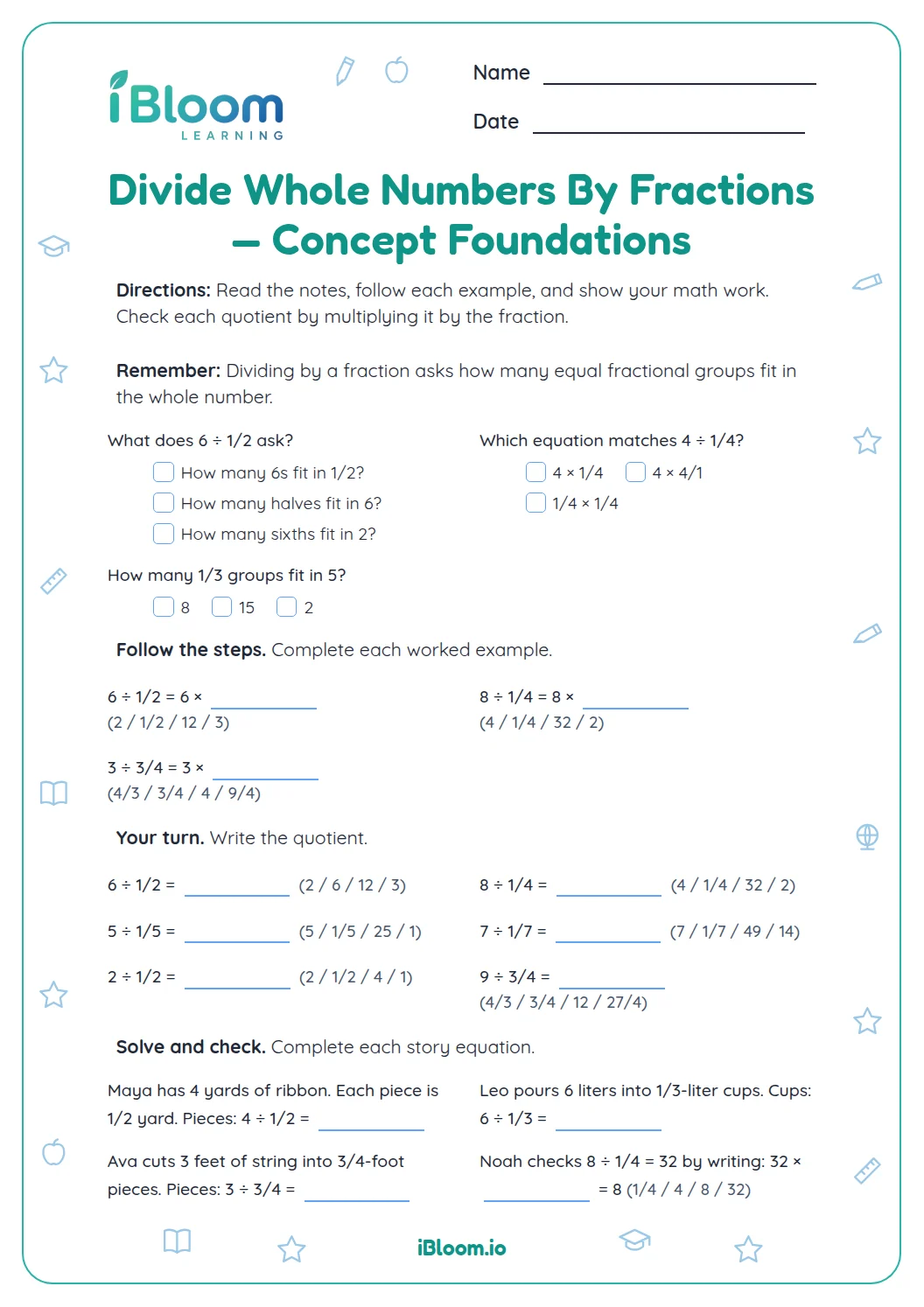
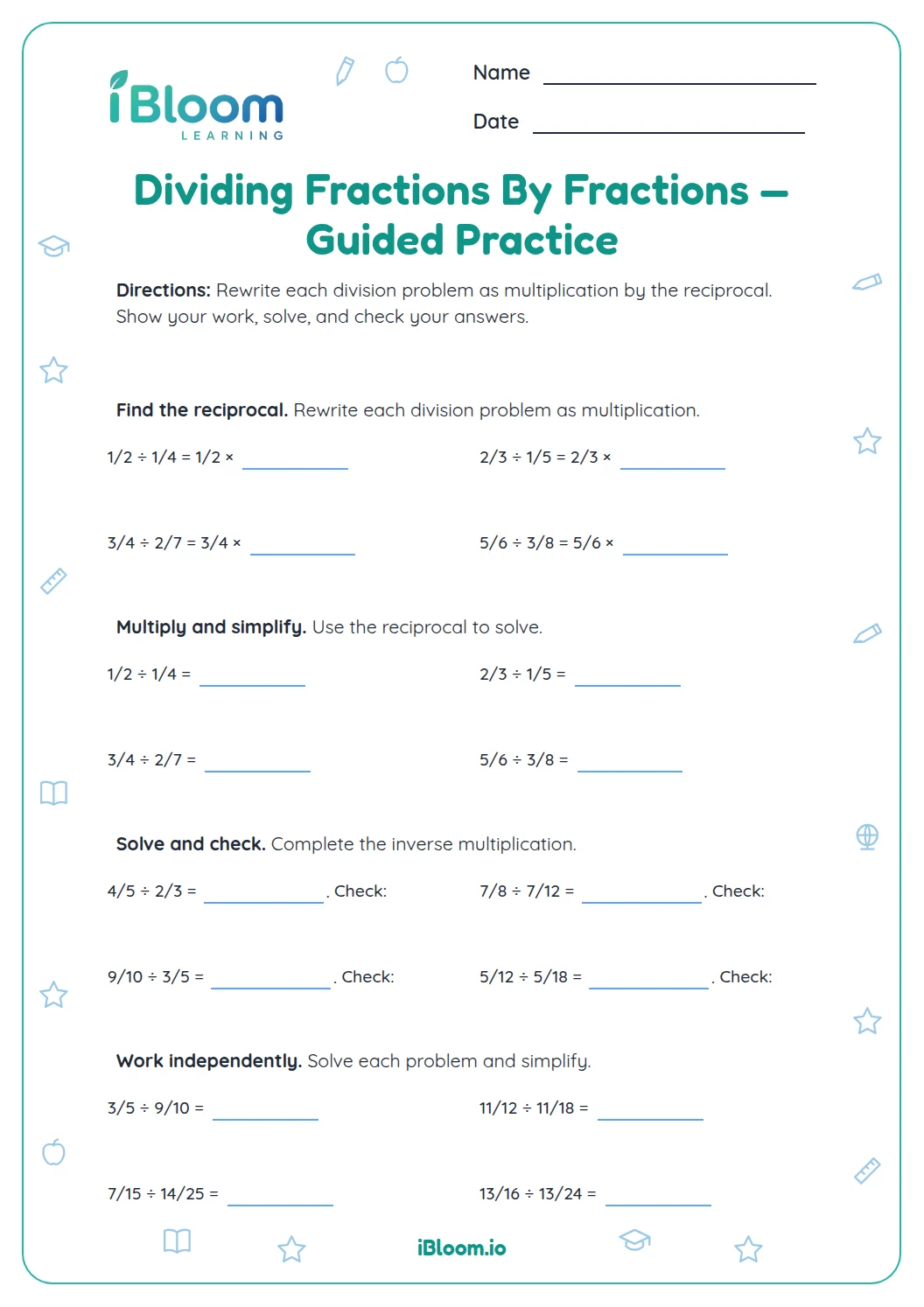
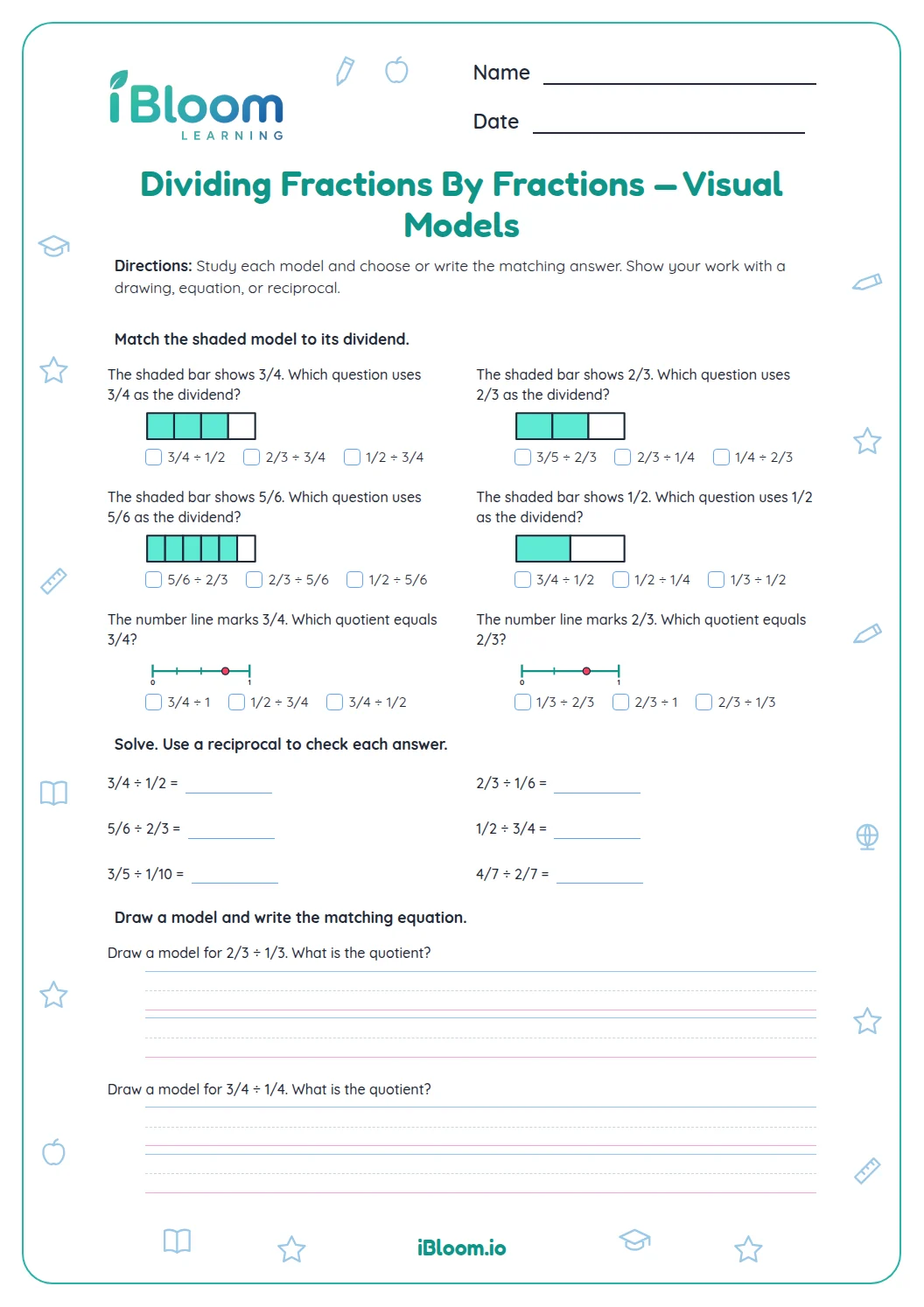
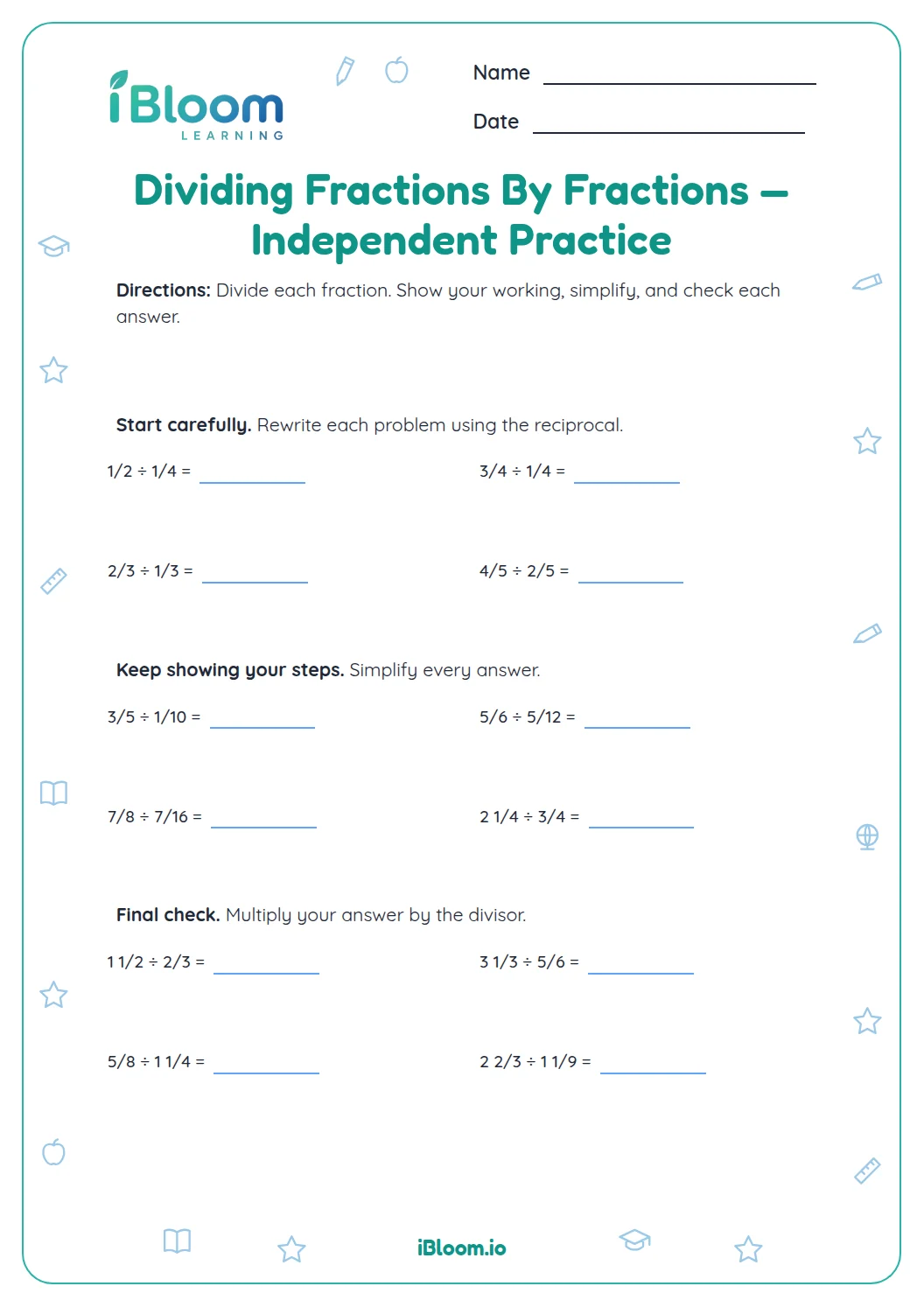
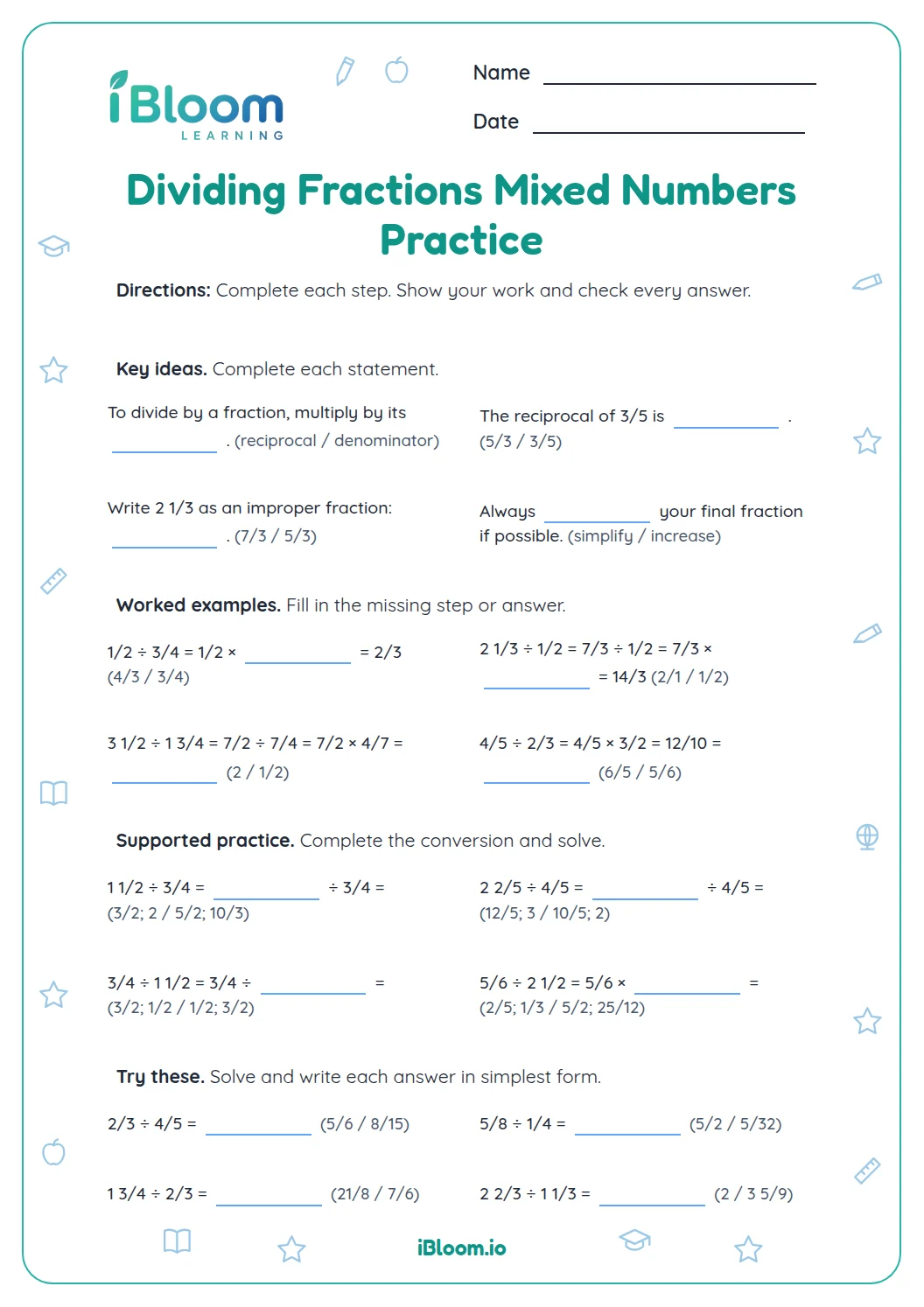
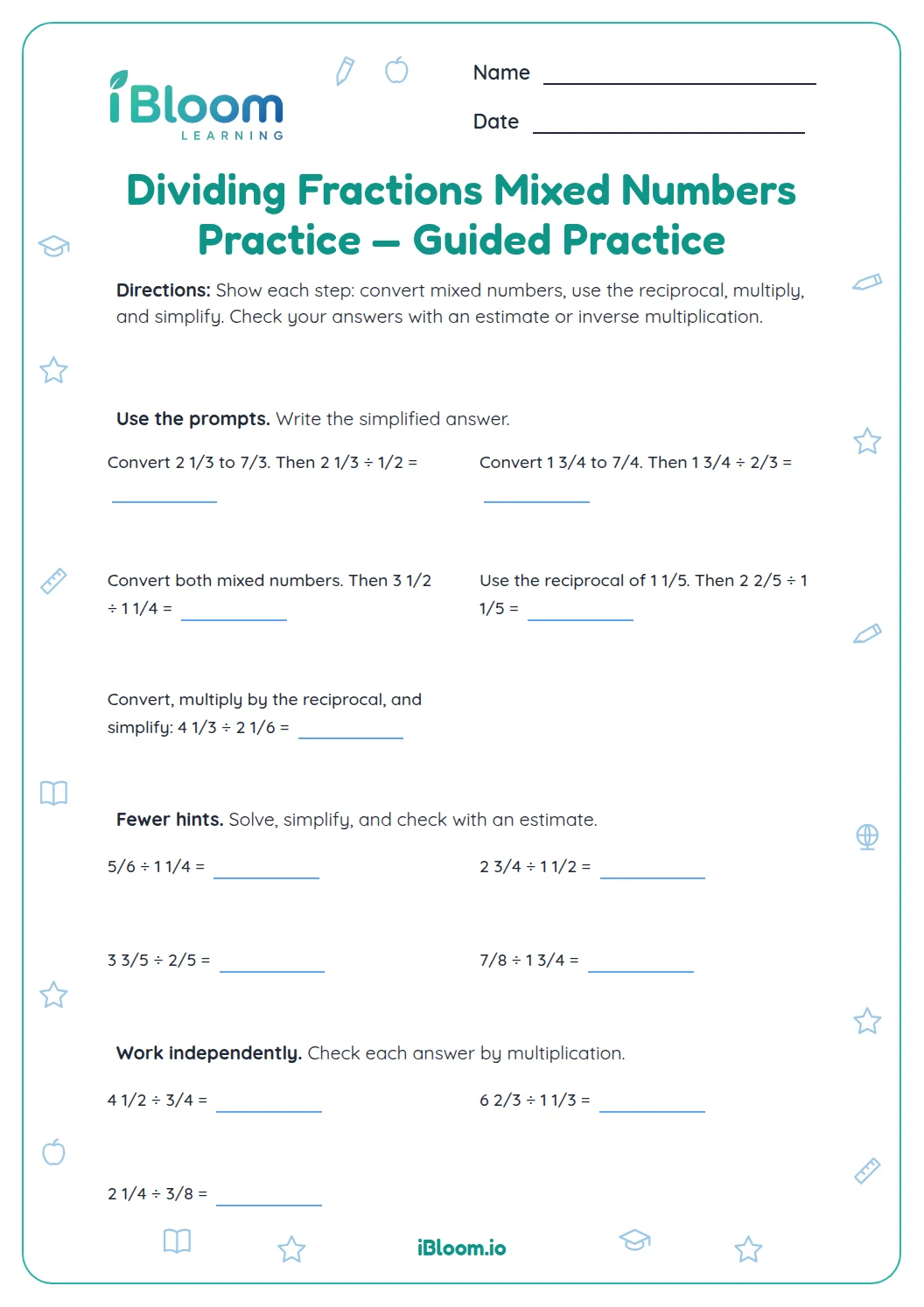
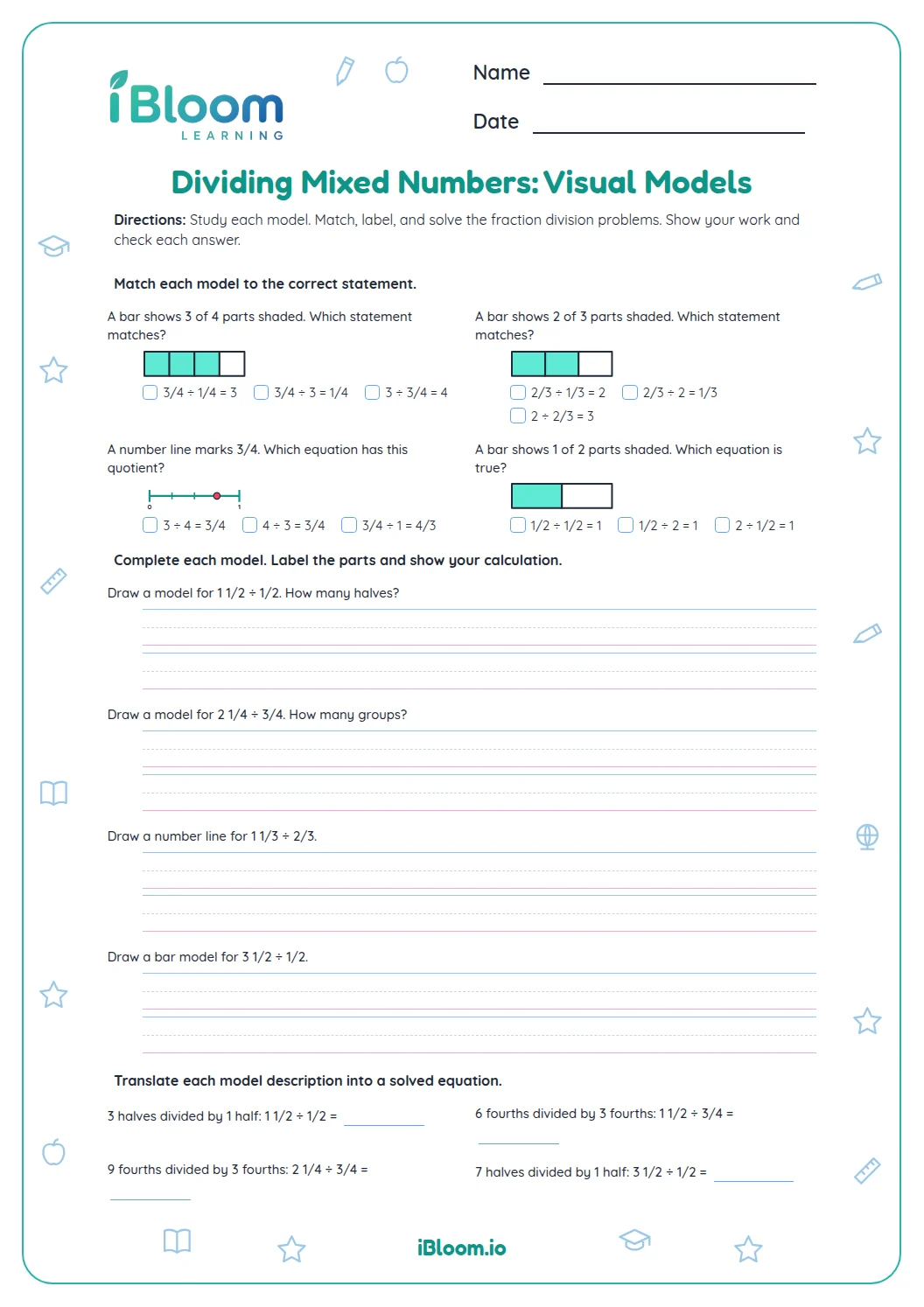
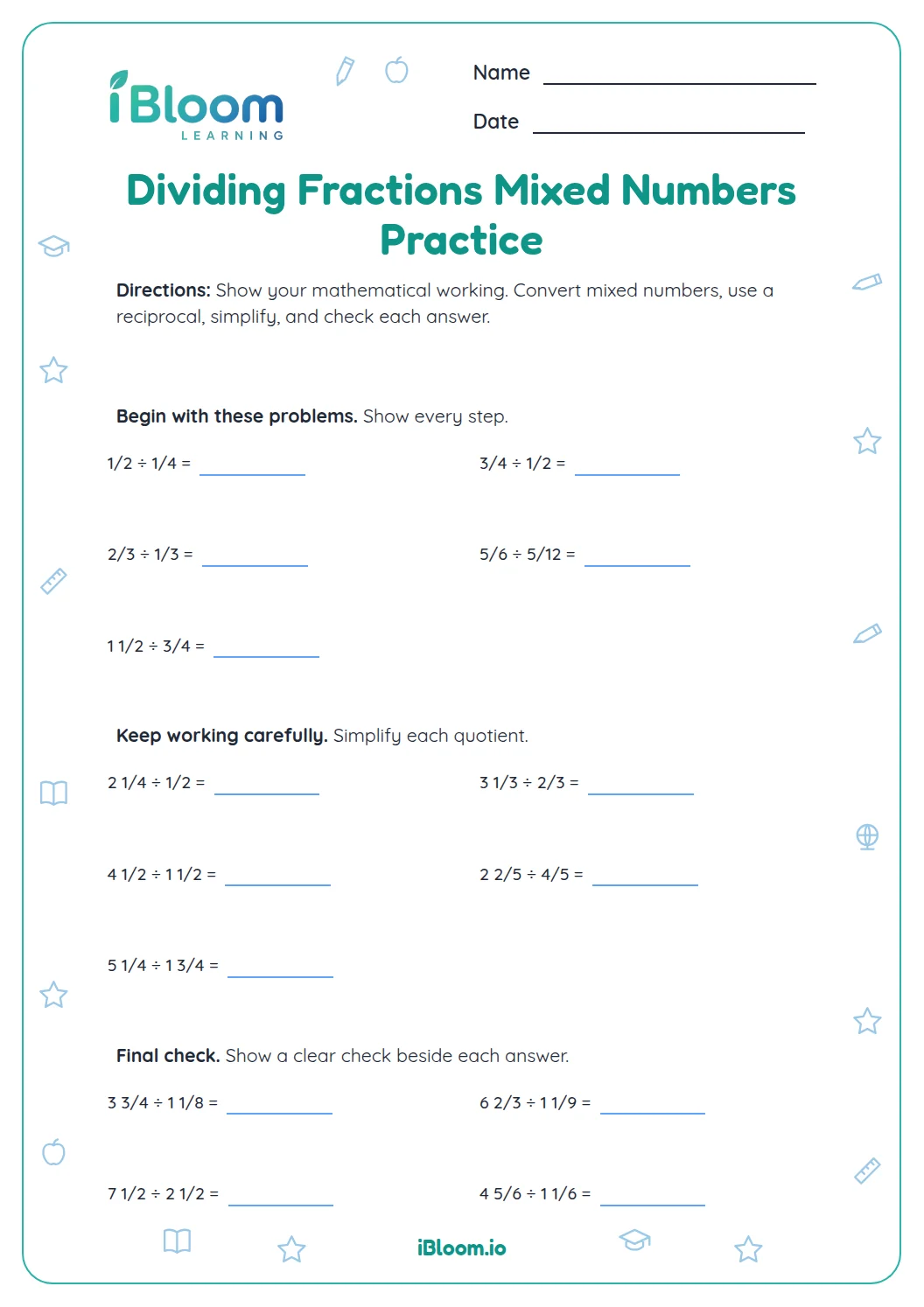
This Grade 5 reasoning worksheet practices dividing mixed numbers by fractions. Students solve quotient problems, find an unknown dividend or divisor, and check a quotient by multiplying. Fourteen problems fill two worksheet pages, and the answer key gives 6 for the missing dividend in ___ ÷ 2/3 = 9 because 6 ÷ 2/3 = 9.
Aligned to 6.NS.A.1
How do you divide a mixed number by a fraction?
Rename a mixed number as an improper fraction, then multiply by the reciprocal of the divisor. For 2 1/4 ÷ 3/4, calculate 9/4 × 4/3 = 3.
To check a quotient, multiply it by the divisor. For the unknown dividend ___ ÷ 2/3 = 9, the missing number is 6 because 6 ÷ 2/3 = 9.
- 1Rename a mixed number as an improper fraction, then multiply by the reciprocal of the divisor. For 2 1/4 ÷ 3/4, calculate 9/4 × 4/3 = 3.
What reasoning does the worksheet ask for?
Students solve direct quotients, determine a missing dividend or divisor, and show a check. In 4 1/2 ÷ ___ = 6, the missing divisor is 3/4 because 6 × 3/4 = 4 1/2.
How can students check a division answer?
Multiply the quotient by the divisor and compare the product with the dividend. For a missing divisor, multiply the quotient by the unknown divisor to recover the given dividend.
A simple practice routine
- 1Identify the dividend and divisor.
- 2Convert mixed numbers to improper fractions.
- 3Write the reciprocal of the divisor.
- 4Multiply and simplify the quotient.
- 5Multiply quotient by divisor to check.
Common mistakes and quick fixes
The mistake
Using the reciprocal on both numbers.
The fix
Circle the divisor and flip only that fraction.
The mistake
Treating 4 1/2 ÷ ___ = 6 like 4 1/2 ÷ 6.
The fix
Multiply 6 by the missing divisor to recover 4 1/2.
The mistake
Accepting a quotient without checking.
The fix
Multiply the quotient by the divisor and compare the product with the dividend.
Common Core alignment
These problems give students practice applying the standard with mixed numbers.
Compute quotients of fractions and solve fraction-division problems.
On this sheet: The questions directly practice dividing mixed numbers by fractions with the stated numbers.
Show the official wordingHide the official wording
Interpret and compute quotients of fractions, and solve word problems involving division of fractions by fractions, e.g., by using visual fraction models and equations to represent the problem.
What to practice next
Make more practice
Further reading
Questions parents and teachers ask
Does the worksheet include an answer key?
Yes. A separate answer key gives the result for each of the 14 problems, including the missing dividend and missing divisor. It also shows a multiplication check for the stated quotient. Students can use the key after attempting both unknown-value questions and compare the checks as well as the values.
What does the missing-number section practice?
One item asks students to recover a dividend when the divisor and quotient are known. Another asks for a divisor when the dividend and quotient are known. Multiplication helps check both answers. The direct quotients and unknowns keep attention on division of mixed numbers by fractional divisors.
Why is the missing dividend 6 in ___ ÷ 2/3 = 9?
Division by 2/3 asks how many groups of 2/3 make the dividend. Nine groups make 9 × 2/3 = 6, so 6 ÷ 2/3 = 9. Students can verify the division by multiplying the quotient, 9, by 2/3; this returns the missing dividend, 6.
How can students check the missing divisor?
Multiply the quotient by the missing divisor. In 4 1/2 ÷ ___ = 6, 6 × 3/4 = 18/4 = 4 1/2, so 3/4 makes the equation true. The check is 6 × 3/4 = 4 1/2, which confirms that dividing by 3/4 gives a quotient of 6.
How can an adult support the reasoning?
Ask the student to name the dividend, divisor, and quotient in each equation. For an unknown, ask which inverse operation will restore the number that is already given. These prompts let the student decide whether multiplication or division will undo the operation shown.