



About this worksheet
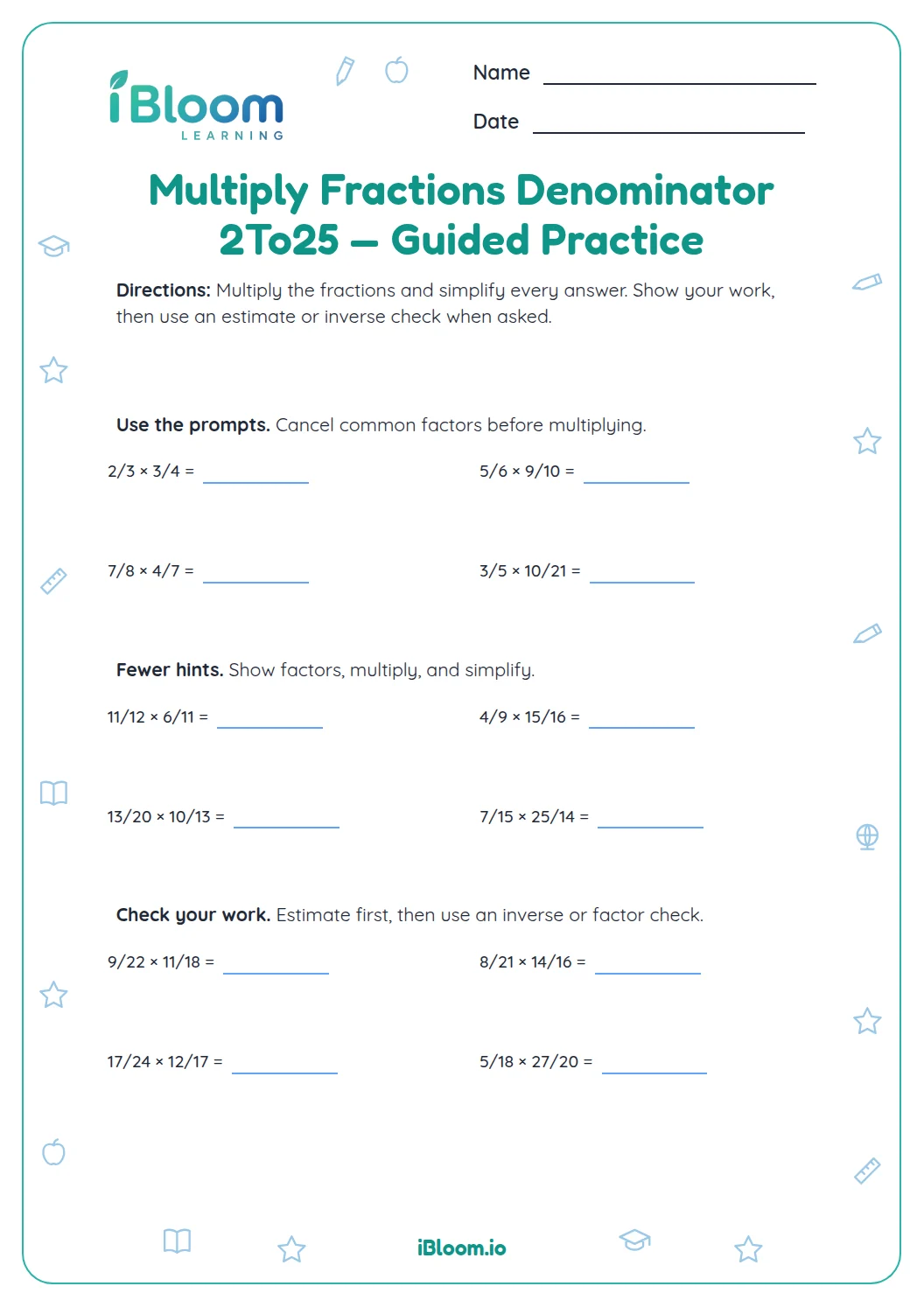
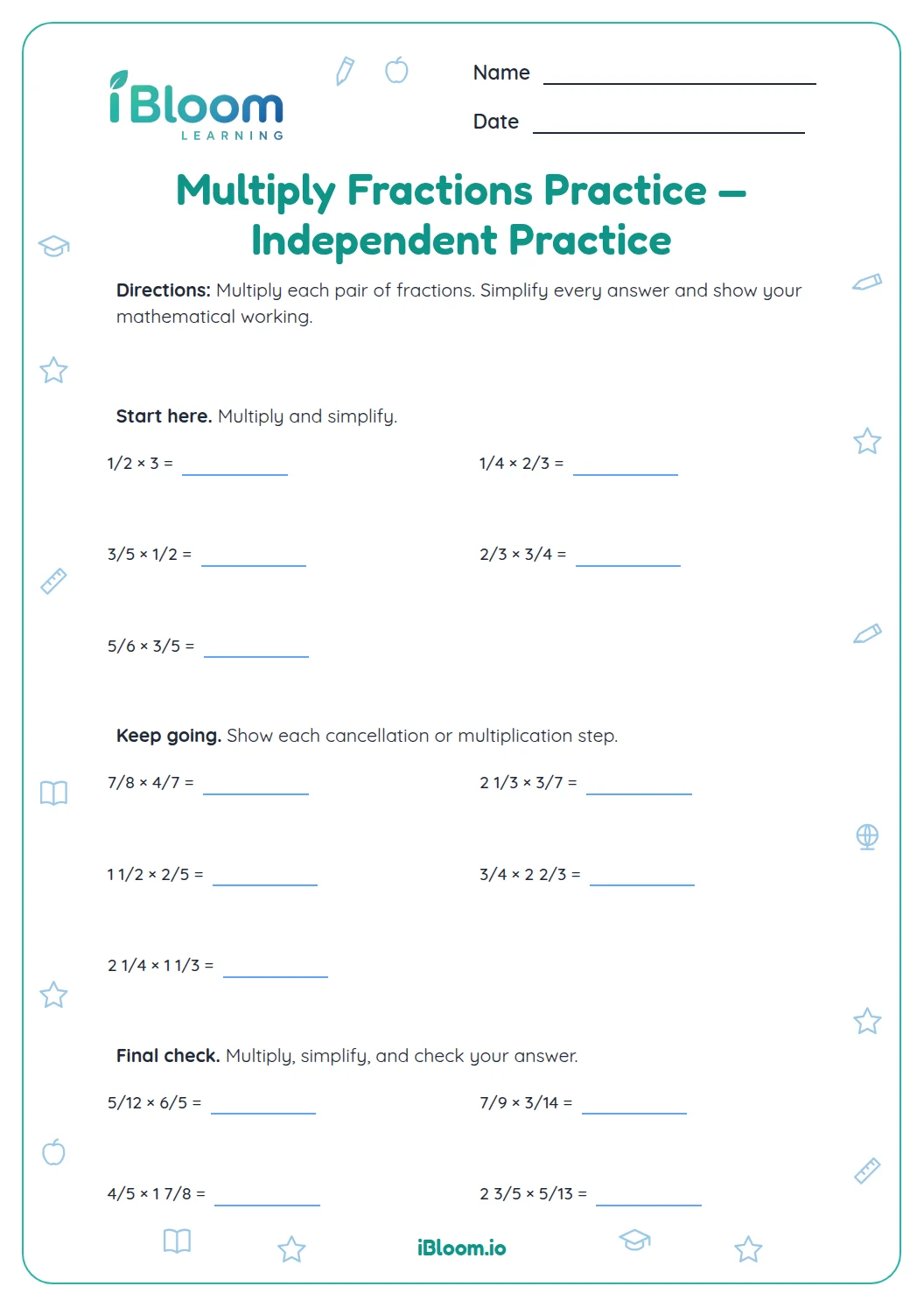
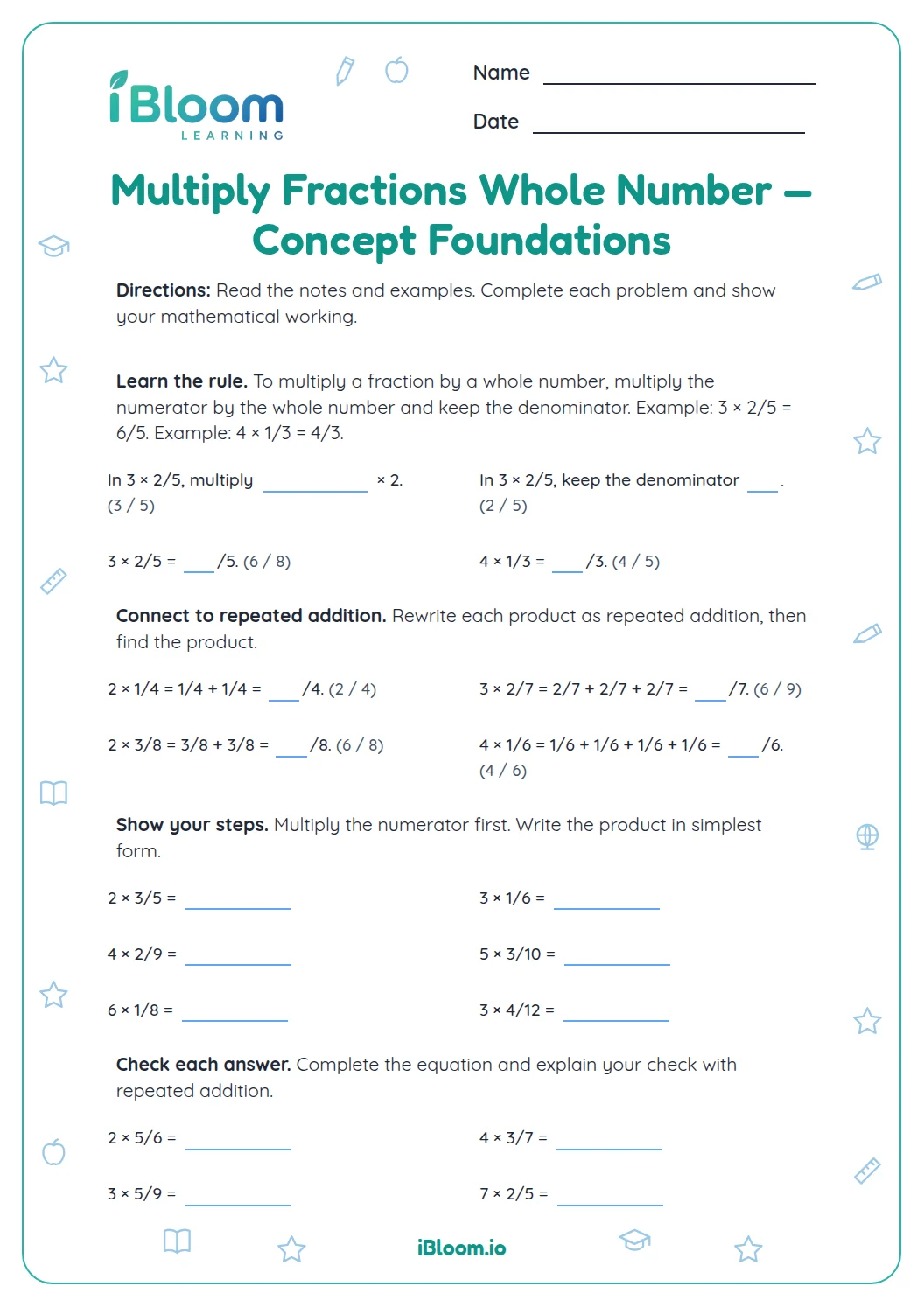
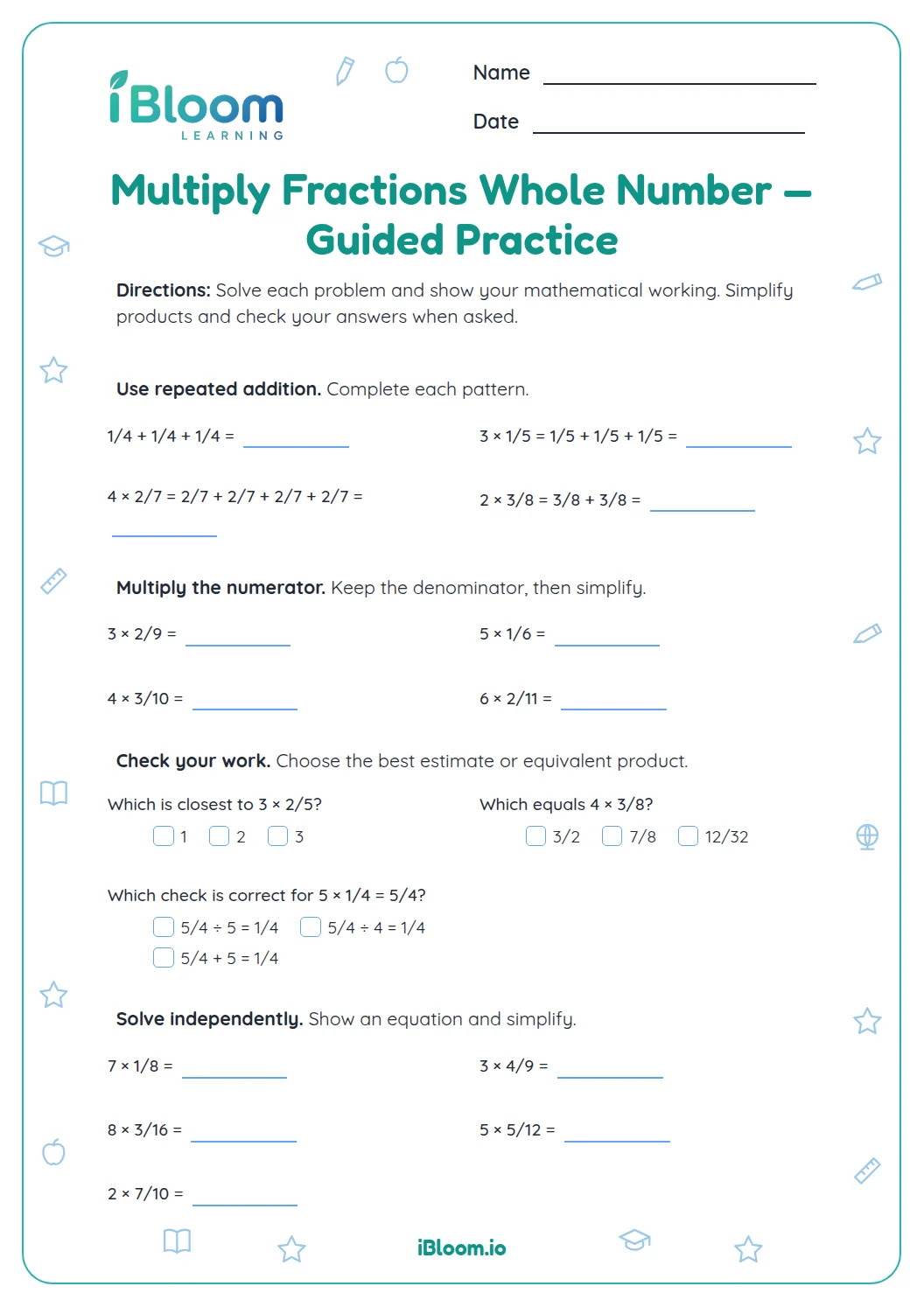
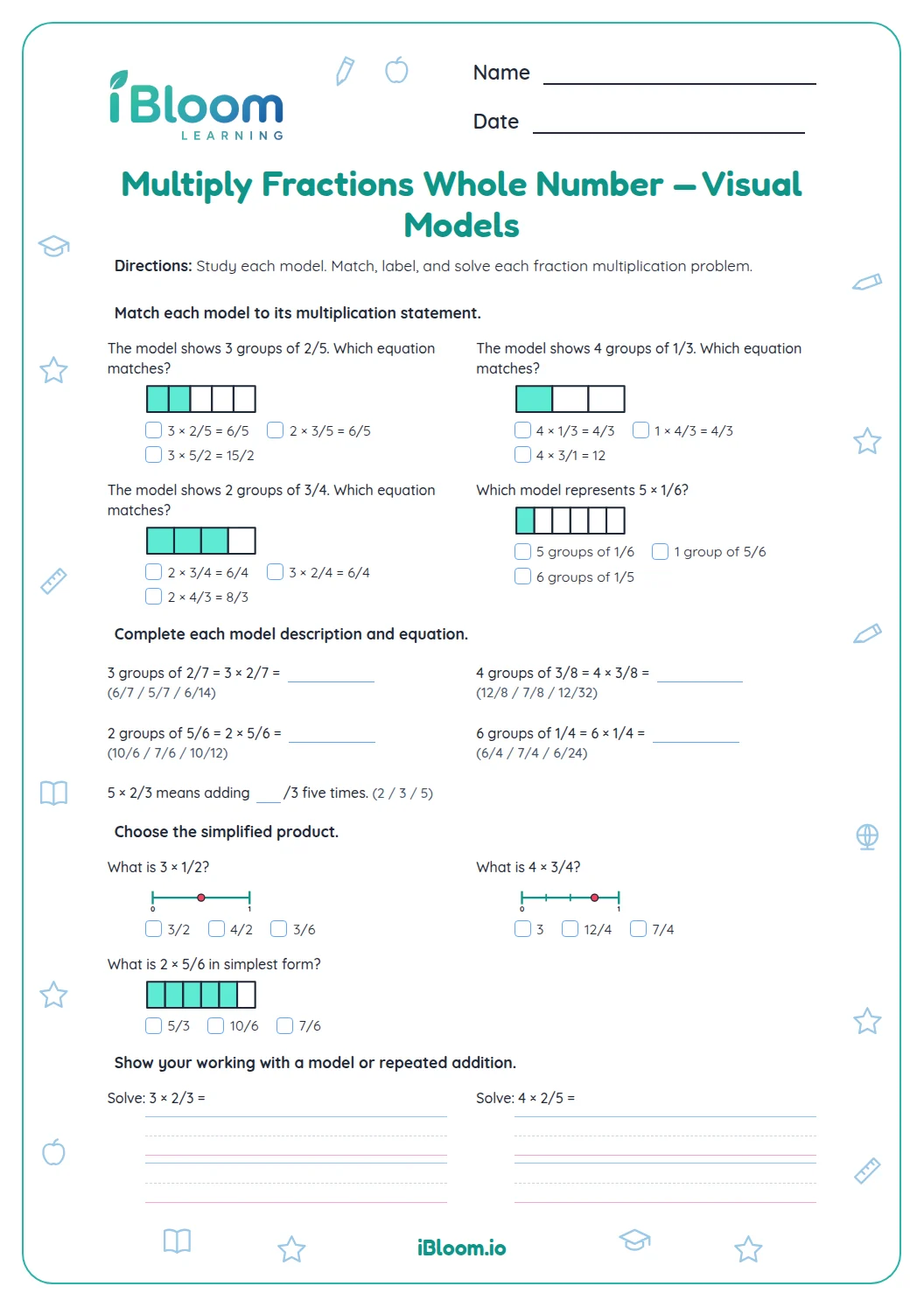
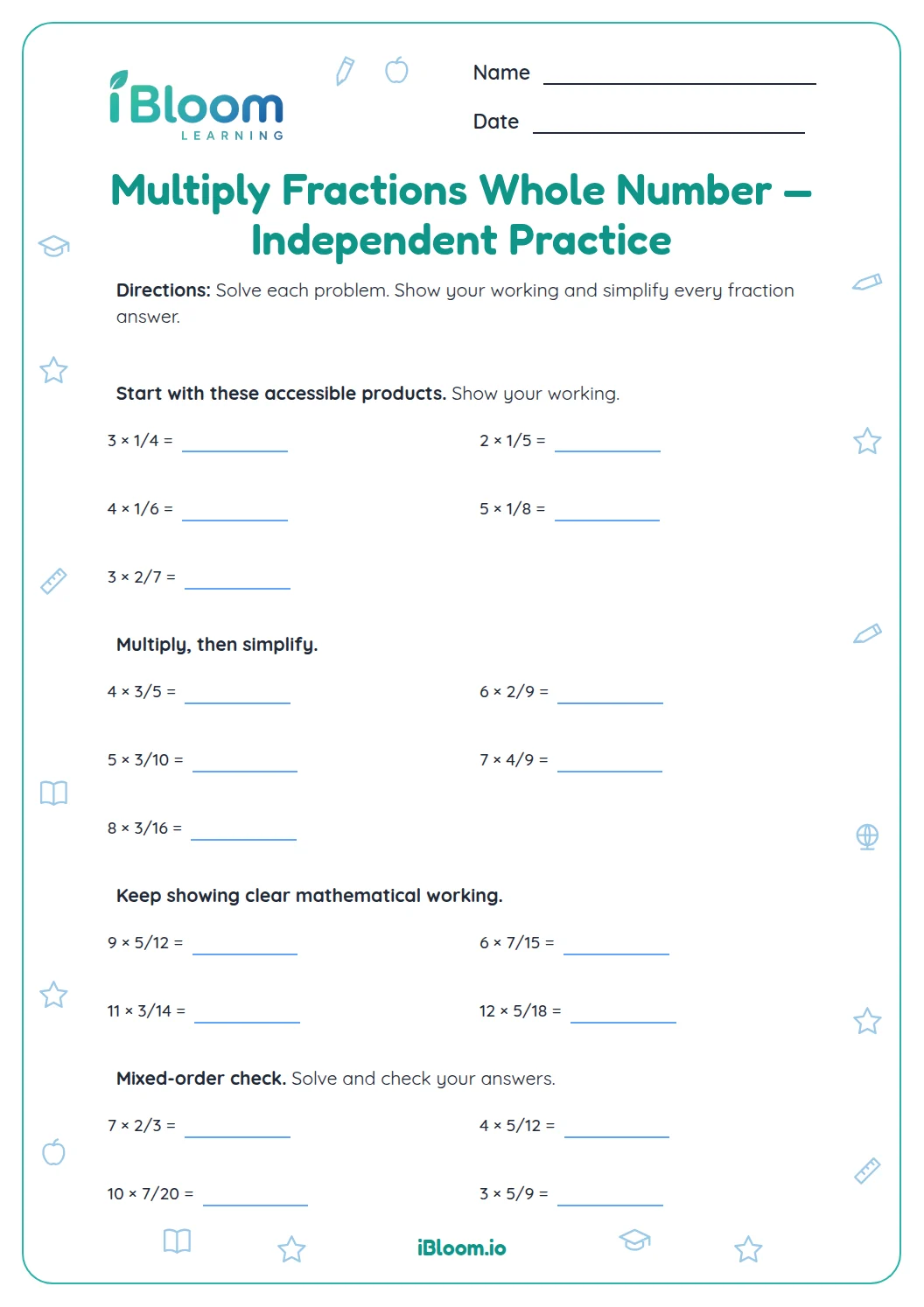
This Grade 5 printable gives students 20 questions on multiplying fractions and whole numbers. The four parts move from real-world situations to fraction products, shaded models, and more applications. Students can simplify products and use the separate answer key to check their work. The sheet practices CCSS 5.NF.B.4.
Aligned to 5.NF.B.4
How can a fraction scale a recipe?
For 3/4 cup used in each of 4 batches, multiply 3/4 × 4. Four groups of three fourths equal 12/4, or 3 cups.
Why simplify a product?
Simplifying names the same amount with smaller numbers. In 4/9 × 3/8, cancel common factors or multiply to get 12/72, then reduce to 1/6.
How can a model support multiplication?
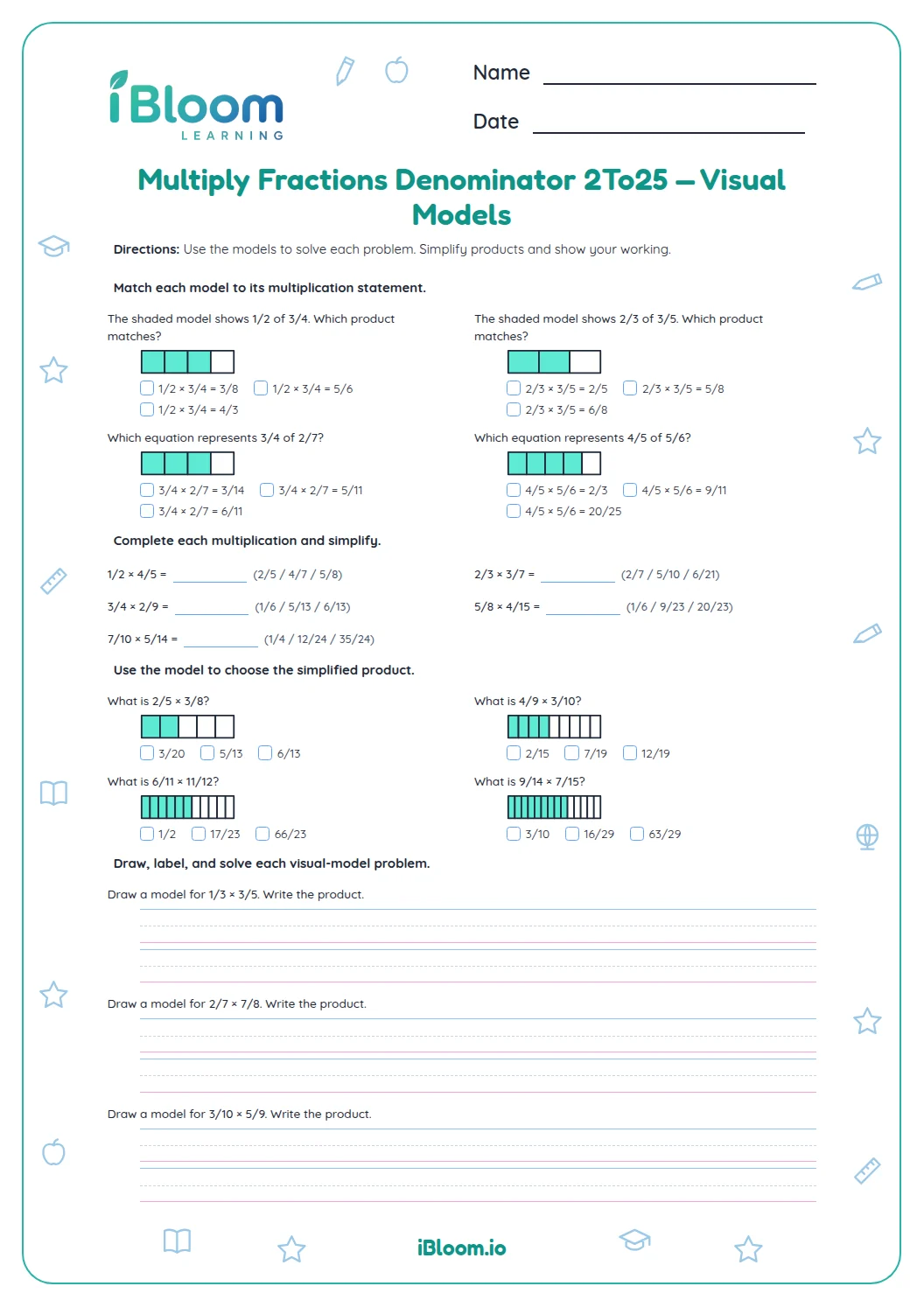
A shaded model makes the amount visible. Read the shaded fraction first, then multiply it by the fraction named in the question.
How to use this worksheet
- 1Identify the amount for one group.
- 2Write the multiplication expression.
- 3Multiply numerators and denominators.
- 4Simplify by dividing top and bottom by a common factor.
- 5Check that the result fits the story.
Common mistakes and quick fixes
The mistake
Multiplying denominators but forgetting numerators.
The fix
Multiply the numerator and denominator, then simplify.
The mistake
Adding the fractions in a repeated-group story.
The fix
Use multiplication when the same fractional amount repeats.
The mistake
Reporting an unsimplified fraction.
The fix
Divide numerator and denominator by their greatest common factor.
These problems connect measurement conversion to Grade 5 number and measurement work.
Students multiply fractions and whole numbers in situations and simplify the resulting products.
On this sheet:
Show the official wordingHide the official wording
Apply and extend previous understandings of multiplication to multiply a fraction or whole number by a fraction.
What to practice next
Make more practice
Further reading
Questions parents and teachers ask
How many questions are on this fraction sheet?
There are 20 questions in four parts: real-world multiplication, fraction products, shaded models, and additional story problems. Students multiply the quantities in each situation or read the model before finding a product. A separate answer key is included.
Does the answer key include units?
Yes, story answers include the unit named in the question. For a blank that already prints a unit after it, the key gives only the missing number or fraction. Students can write the conversion fact beside the problem to make each step easy to follow and verify.
What should students do after multiplying?
They should simplify the product when possible and check that it makes sense in the situation. For example, 3/4 cup repeated four times is 3 cups. Students can write the conversion fact beside the problem to make each step easy to follow and verify.
Can students use the models to solve?
Yes. The final part includes shaded fraction models so students can name the visible amount and apply a fractional factor to it. Students can write the conversion fact beside the problem to make each step easy to follow and verify.
Which standard does the page address?
The worksheet connects fraction multiplication to 5.NF.B.4, applying and extending multiplication to multiply a fraction or whole number by a fraction. Students can write the conversion fact beside the problem to make each step easy to follow and verify. Students can note the unit relationship first, then calculate and compare the size of the result with the starting measurement.