





About this worksheet
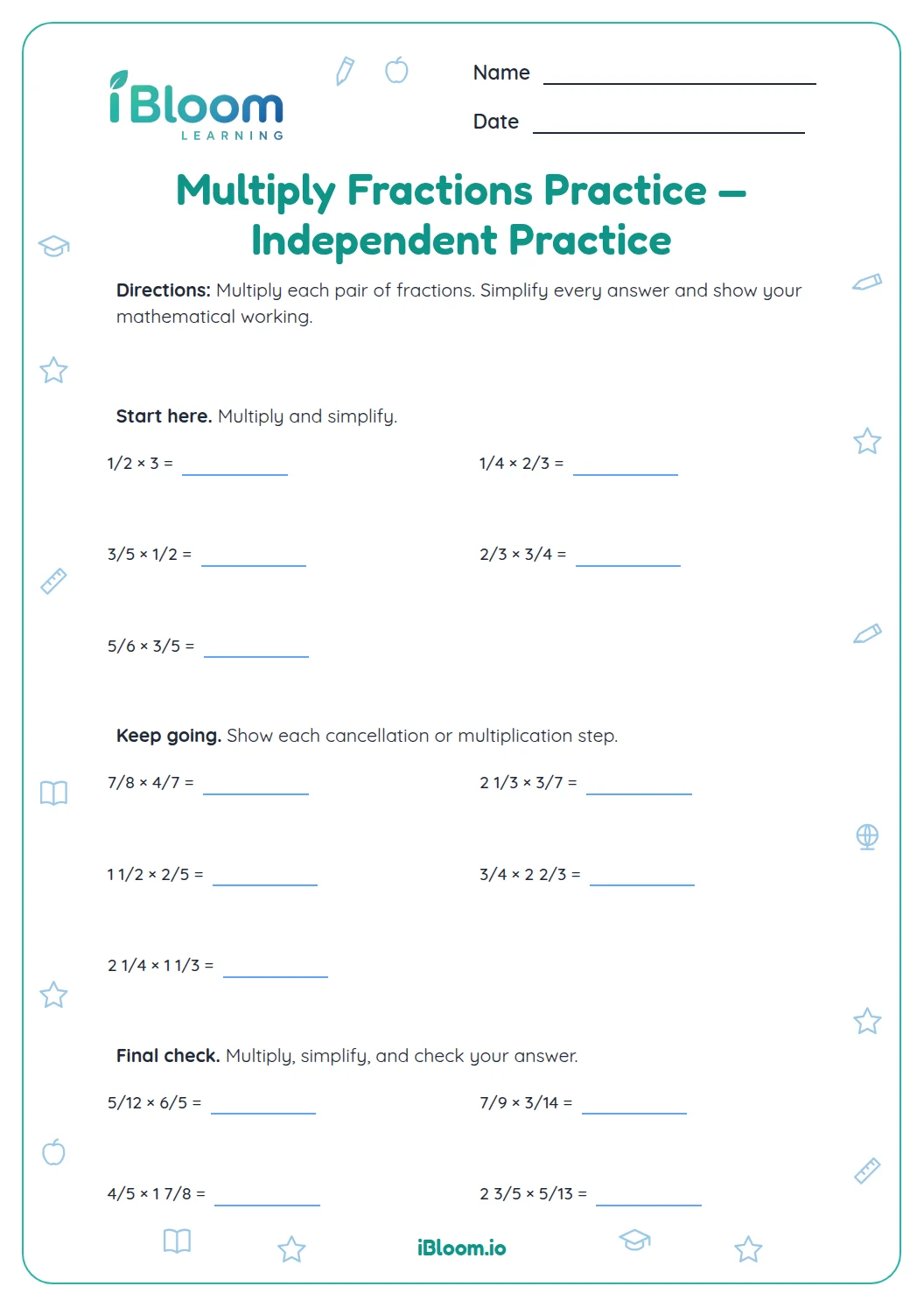
This Grade 5 worksheet builds fluency with multiplying fractions. Students find and simplify products, estimate and check selected products, and apply multiplication to recipes, distances, and measurements. For example, 2/3 × 3/4 = 6/12 = 1/2.
Aligned to 5.NF.B.4
How do you find a fraction product?
Multiply the top numbers and the bottom numbers, then simplify. For example, 2/3 × 3/4 = 6/12 = 1/2.
A product of two positive fractions less than 1 is smaller than either factor, which makes a quick estimate useful.
- 12/3 × 3/4 = 6/12
- 26/12 = 1/2
Why estimate before checking?
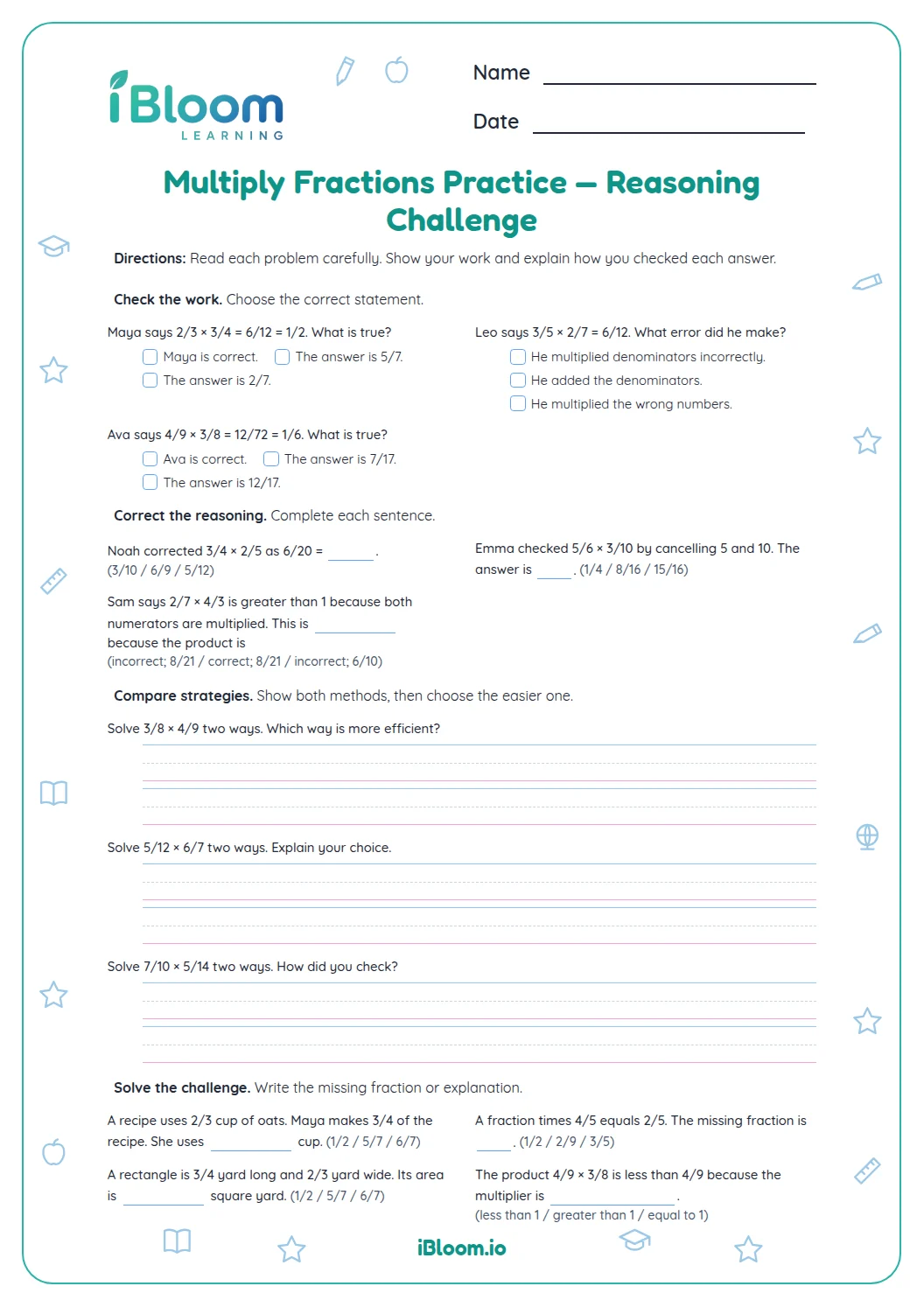
An estimate predicts the product’s size. For 3/4 × 2/3, both factors are near one half or a little larger, so a product near 1/2 is reasonable. Multiplying the simplified answer by the second factor can confirm the equation.
What is on the worksheet?
Sixteen problems appear in three parts, moving from direct multiplication to estimation and short applications.
- Part A: six fraction products to simplify
- Part B: five items with separate product, estimate and check spaces
- Part C: five word problems with equation space
How can students judge whether a product makes sense?
When both factors are positive fractions below 1, the product should be smaller than each factor. Simplifying and estimating offer two ways to catch a multiplication error.
How to use this worksheet at home or in class
- 1Review how to multiply numerators and denominators.
- 2Simplify one product together, such as 2/3 × 3/4 = 6/12 = 1/2.
- 3Ask the student to predict whether each product will be greater or less than its factors.
- 4In Part B, complete the estimate and check after writing the product.
- 5For Part C, name the quantity being measured before writing the equation.
Common mistakes and quick fixes
The mistake
Adding numerators and denominators instead of multiplying.
The fix
Multiply across: numerator by numerator and denominator by denominator.
The mistake
Forgetting to simplify an equivalent fraction.
The fix
Look for a common factor in the numerator and denominator.
The mistake
Accepting a product larger than both proper-fraction factors.
The fix
Estimate first; multiplying by a fraction below 1 makes the amount smaller.
Common Core alignment
This worksheet practices the following Common Core mathematics standard.
Apply and extend previous understandings of multiplication and division to multiply and divide fractions.
On this sheet: Apply and extend previous understandings of multiplication and division to multiply and divide fractions.
Show the official wordingHide the official wording
Apply and extend previous understandings of multiplication to multiply a fraction or whole number by a fraction.
What to practice next
Make more practice
Further reading
Questions parents and teachers ask
How do you multiply two fractions?
Multiply the numerators and multiply the denominators, then simplify the product. For example, 2/3 × 3/4 = 6/12 = 1/2. The first part gives students practice finding products and reducing them to simplest form. Students also simplify equivalent products such as 6/12 to 1/2, keeping the final answer in simplest form.
How can students estimate a fraction product?
Round each factor to a nearby familiar fraction, then multiply for an approximate product. For 2/5 × 3/4, a benchmark estimate is about 1/4. Part B asks students to record an estimate separately from the exact product and multiplication check.
What does the answer key include?
The key gives the simplified product for every item. For Part B, it also shows a reasonable estimate and the multiplication equation used to check the product. Students can compare each part of their response with its matching answer. This gives a complete worked check.
How are fractions used in the word problems?
Part C asks students to find a fraction of a fractional amount, such as 3/5 of a 5/6-mile trail. Each situation can be represented by multiplying the two fractions, and the answer includes the appropriate unit when the context provides one.
How many questions are on this worksheet?
There are 16 questions across three parts: six direct products, five estimate-and-check problems, and five word problems. The separate answer key includes the products and the checks for Part B, helping students review both computation and reasonableness. They can use benchmark fractions to judge whether each exact product is reasonable before reviewing the key.