





About this worksheet
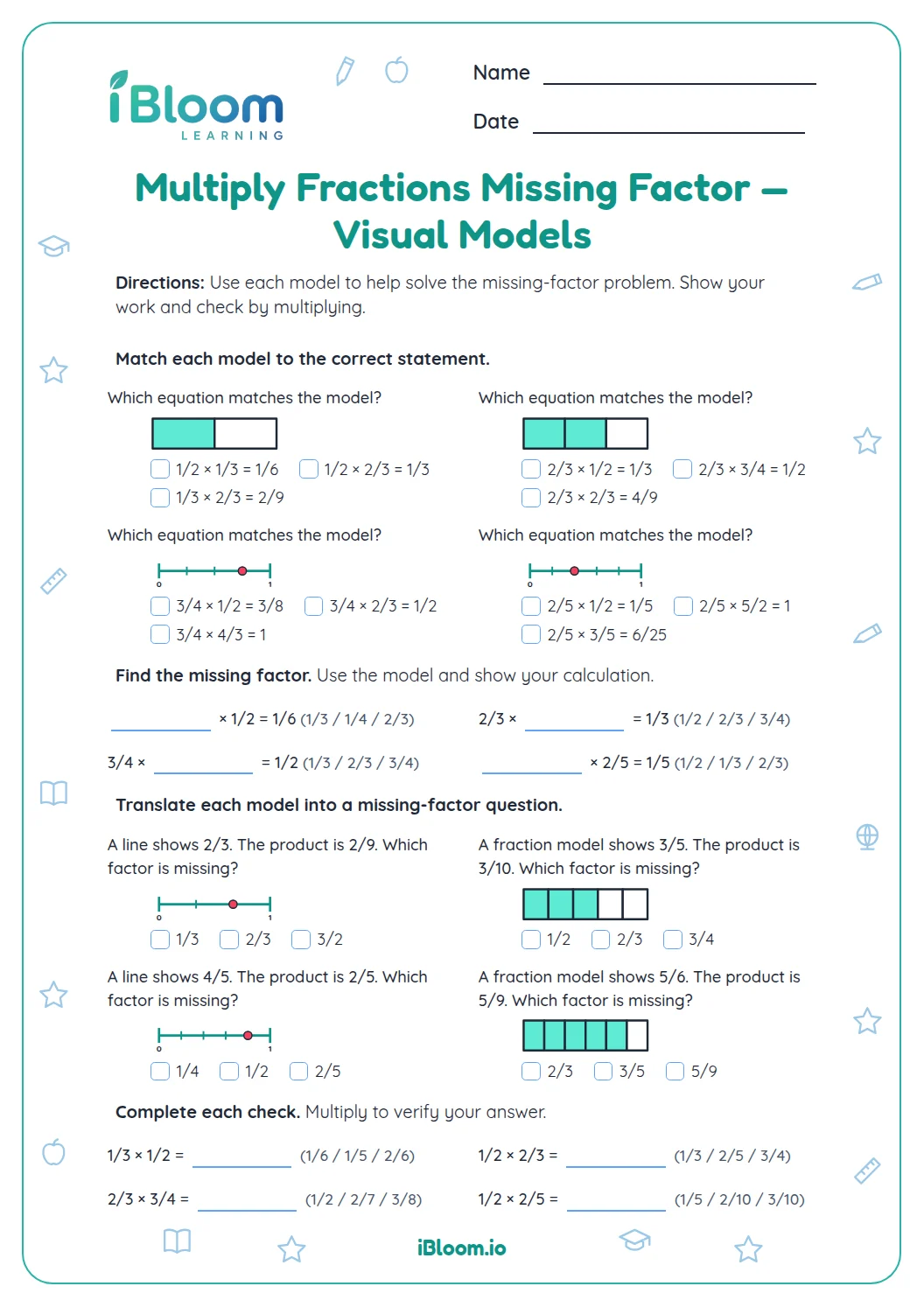
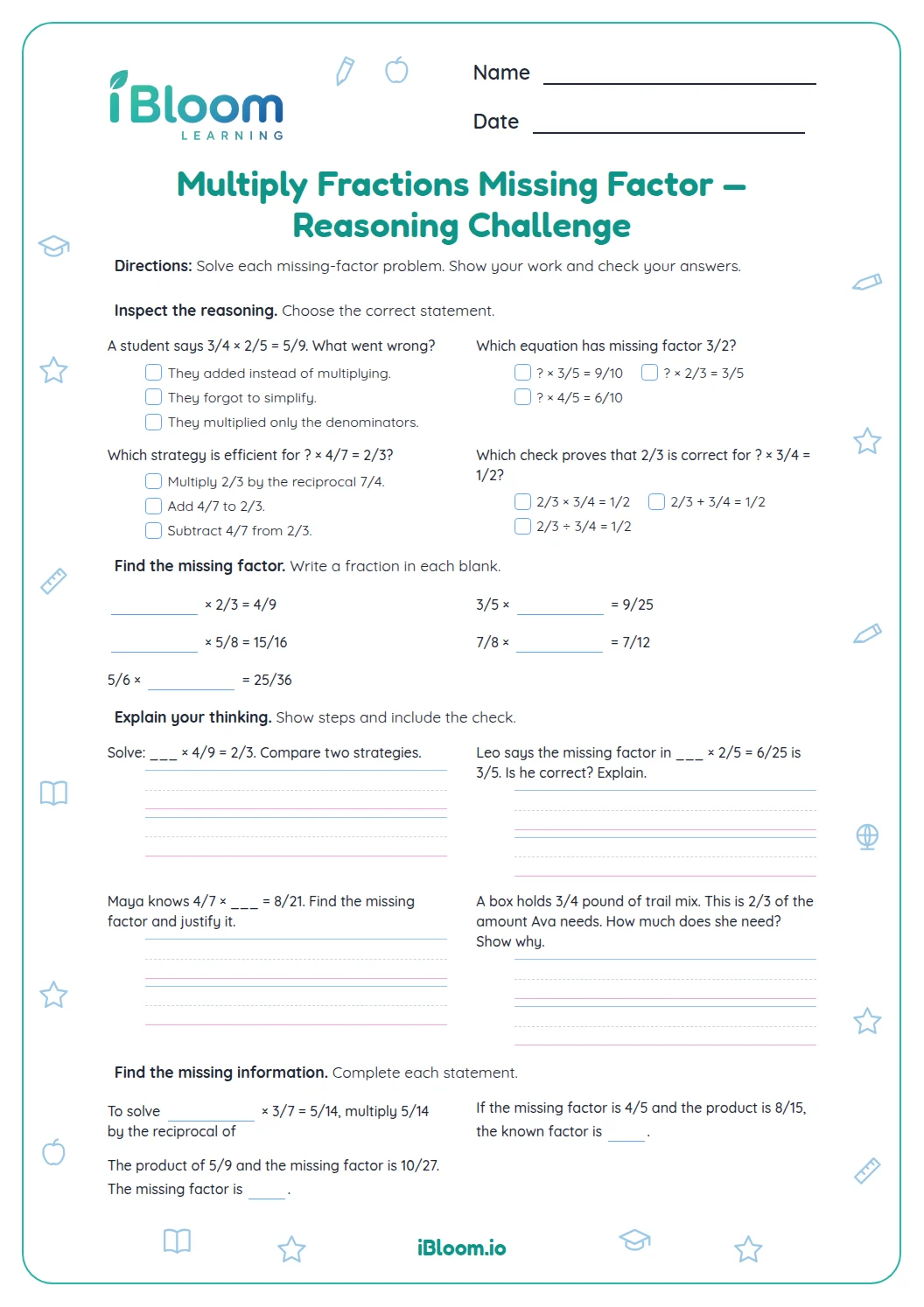
This Grade 5 worksheet gives students 14 equations for finding a missing factor in fraction multiplication. Students use inverse division, simplify their answers, and multiply back to verify each equation. The answer key shows that the missing factor in 7/10 × ___ = 21/40 is 3/4.
Aligned to 5.NF.B.4
How do you find a missing fraction factor?
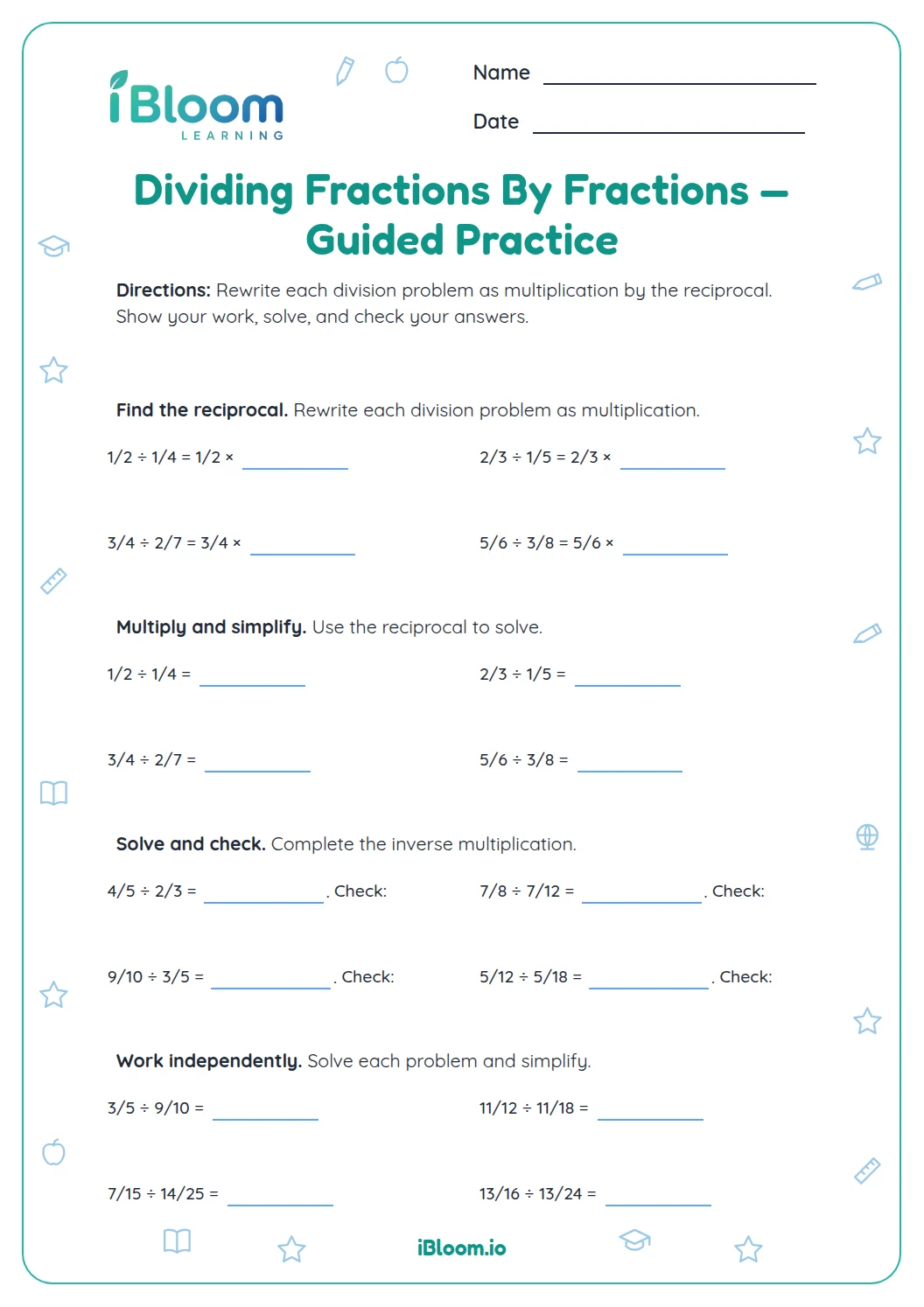
Divide the product by the known factor. For 7/10 × ___ = 21/40, calculate 21/40 ÷ 7/10 = 21/40 × 10/7 = 3/4.
Check by multiplying: 7/10 × 3/4 = 21/40.
- 1Divide the product by the known factor. For 7/10 × ___ = 21/40, calculate 21/40 ÷ 7/10 = 21/40 × 10/7 = 3/4.
What kinds of equations are on the sheet?
All 14 questions ask for one missing factor. The sections move from accessible equations to inverse reasoning and then simplified answers, so students practice the same skill with changing fraction values.
How can students check a missing factor?
Multiply the known factor by the answer. The product should match the right side of the equation. If it does not, recheck the division and simplify the quotient.
A simple practice routine
- 1Locate the known factor and product.
- 2Divide the product by the known factor.
- 3Multiply by the reciprocal when dividing fractions.
- 4Simplify the missing factor.
- 5Substitute it in the original product to check.
Common mistakes and quick fixes
The mistake
Dividing the known factor by the product.
The fix
Divide the product by the known factor to isolate the missing value.
The mistake
Multiplying the product by the known factor.
The fix
Use division, the inverse operation, to find the unknown factor.
The mistake
Forgetting to simplify.
The fix
Reduce the quotient, then multiply it back to verify the product.
Common Core alignment
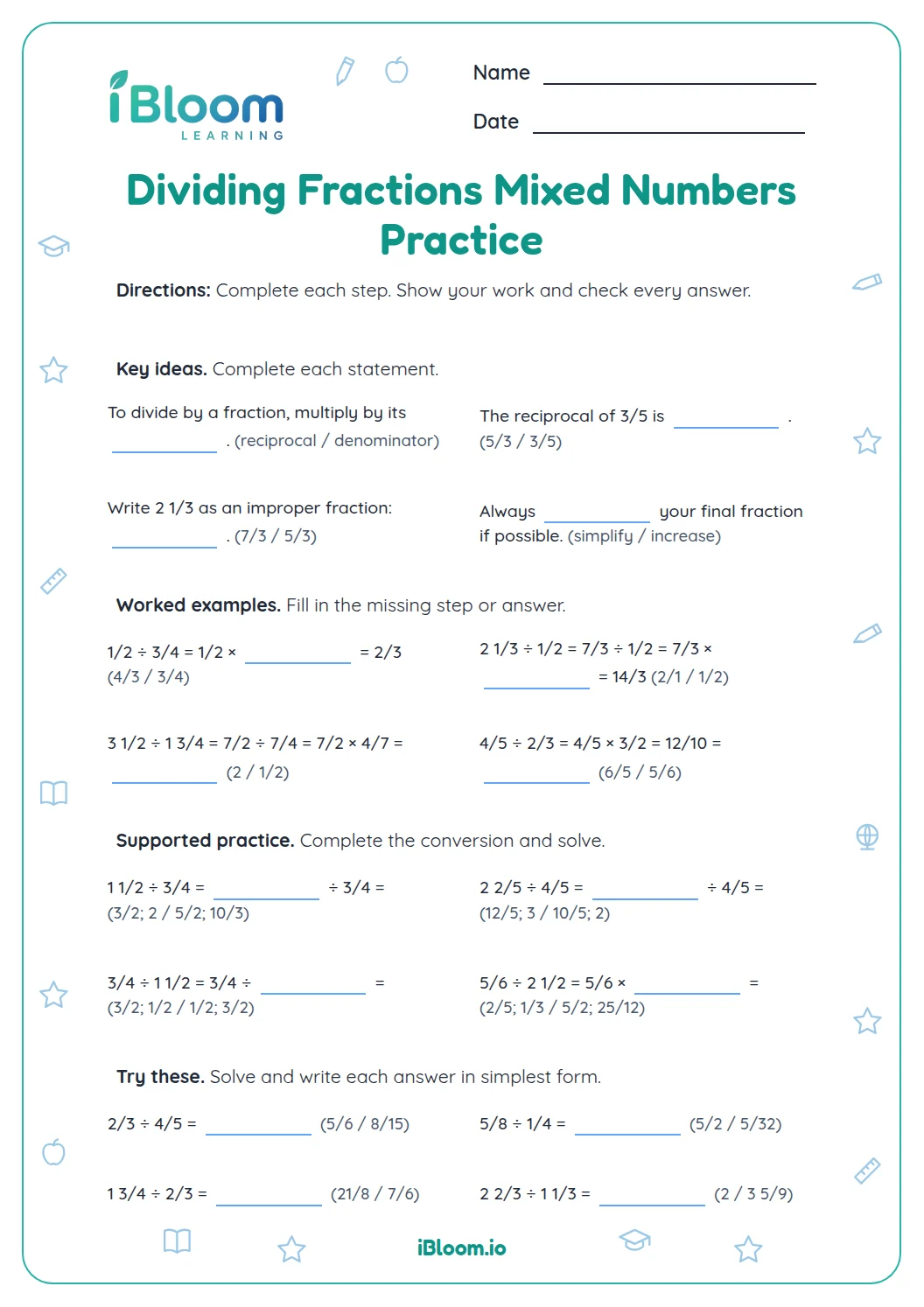
These problems give students practice applying the standard with mixed numbers.
Multiply a fraction or whole number by a fraction.
On this sheet: The questions directly practice finding a missing factor in fraction multiplication with the stated numbers.
Show the official wordingHide the official wording
Apply and extend previous understandings of multiplication to multiply a fraction or whole number by a fraction.
What to practice next
Make more practice
Further reading
Questions parents and teachers ask
Does this worksheet include an answer key?
Yes. The key lists a missing factor for each of the 14 equations. Students can compare only after completing the equations, then verify an answer by multiplying it by the known factor. The answer key follows the same numbering as the student sheet and includes simplified factors for quick checking.
What operation finds the missing factor?
Use division. Divide the product by the factor that is already shown, then simplify the quotient if possible. This reverses the multiplication in the original equation. Each equation includes the product and one known factor, giving enough information to solve for exactly one value.
Why is the missing factor 3/4 in 7/10 × ___ = 21/40?
Divide 21/40 by 7/10: multiply 21/40 by 10/7 and simplify to 3/4. Multiplication confirms it because 7/10 × 3/4 equals 21/40. Multiplying 7/10 by 3/4 gives 21/40, confirming the quotient used to find the unknown factor. This final multiplication step verifies the value rather than relying on a visual guess.
Should students simplify every answer?
Yes. The sheet asks for simplified fractions, so reduce the quotient before writing it. A multiplication check can also reveal whether a simplification changed the value. Reducing a fraction keeps its value while expressing it in simplest form, as the directions request.
How can I help without giving the factor?
Ask the student what operation reverses multiplication and which number is the product. Then invite them to multiply their result by the known factor to check the equation. The student can explain their inverse operation, then verify the answer with multiplication.