



About this worksheet
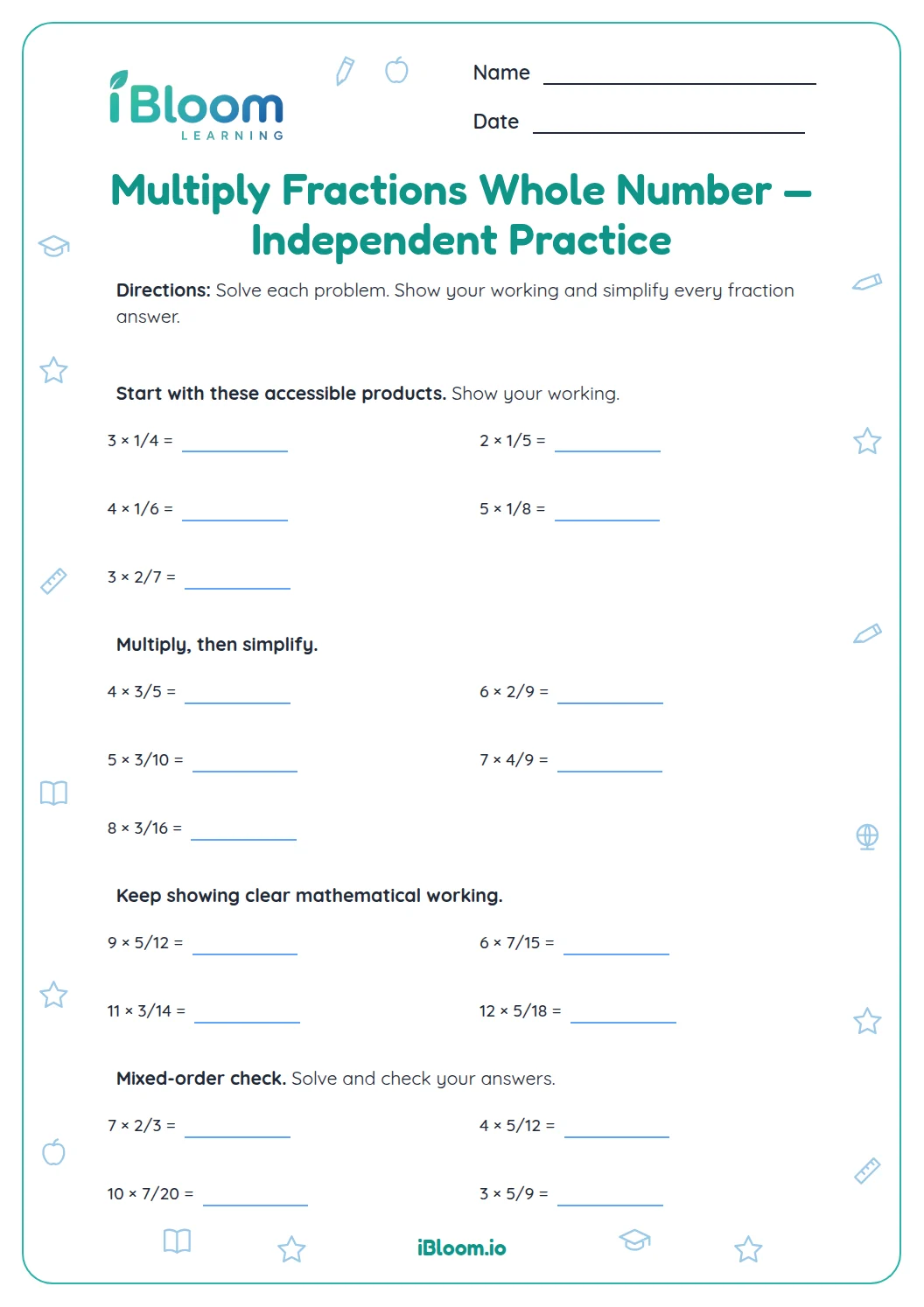
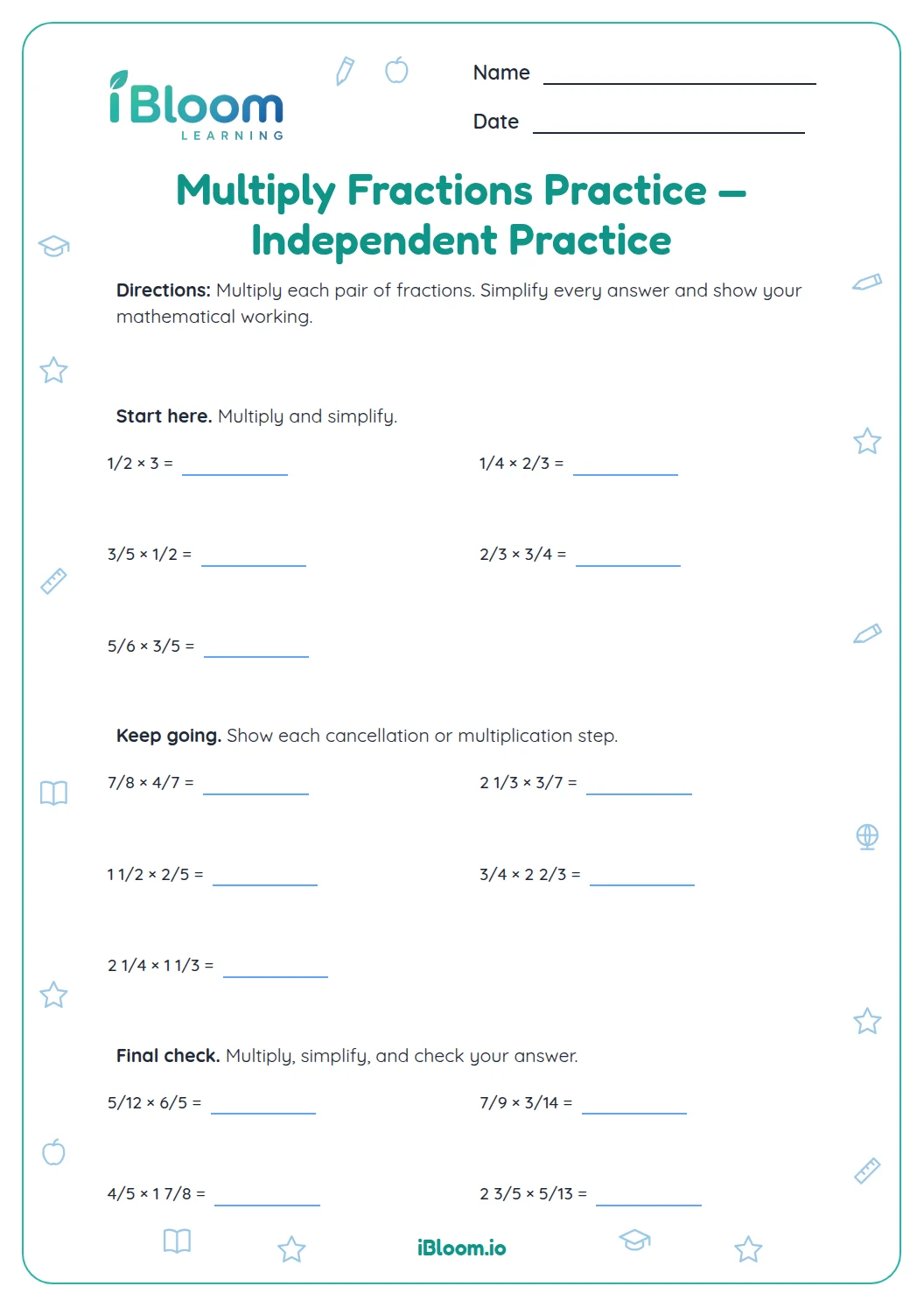
This free Grade 5 printable helps students connect a shaded fraction to multiplication by a whole number. The 14 questions move from reading four shaded models to solving missing-factor equations and interpreting groups of a fraction. The work practices CCSS 5.NF.B.4, with an answer key on its own page.
Aligned to 5.NF.B.4
How does a shaded model show a fraction group?
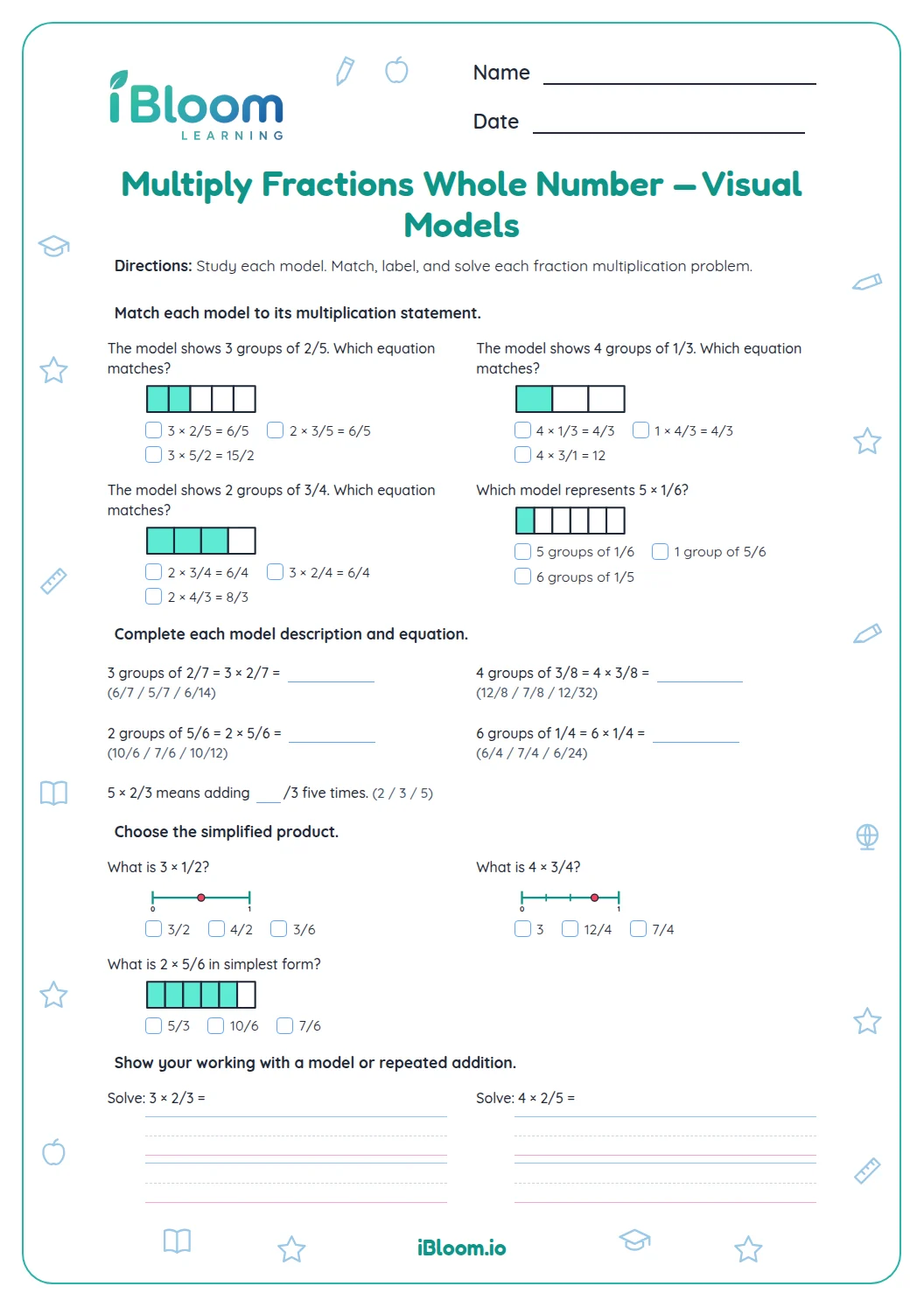
Read the equal parts first. In question 1, the bar has 2 of 3 parts shaded, so one group is 2/3. Three such groups are 6 thirds, written 6/3.
The model and equation describe the same amount: 3 × 2/3 = 6/3. The product can be greater than one whole.
- 1One group: 2/3
- 2Number of groups: 3
- 33 × 2/3 = 6/3
How can you find a missing whole-number factor?
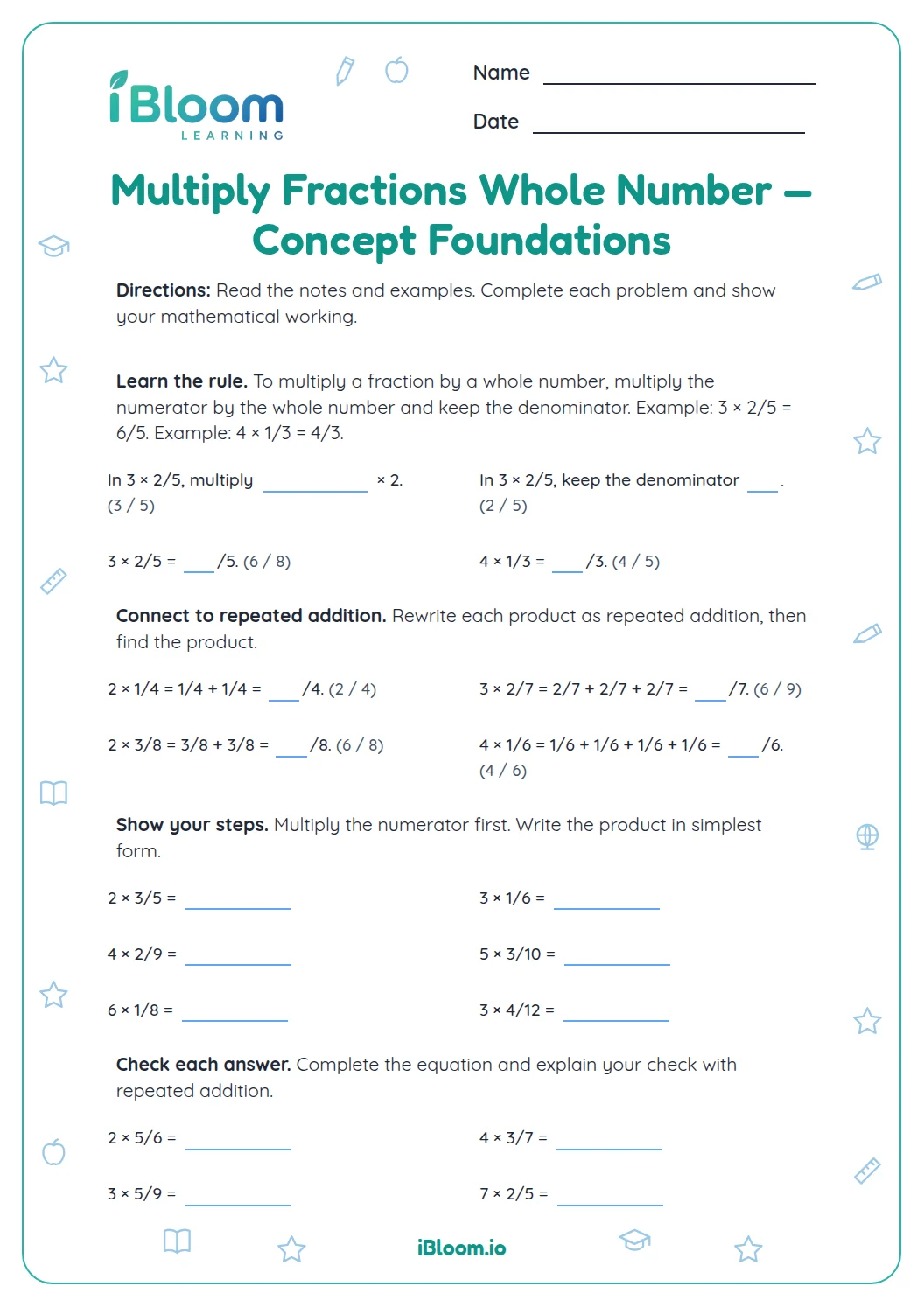
Use the numerator to count how many fractional parts the product contains. For ___ × 2/5 = 8/5, eight fifths contain four groups of two fifths.
Check by multiplying the missing whole number by the numerator and keeping the denominator.
What is in each part of the printable?
Four model choices come first, followed by ten equations or group statements with one missing whole-number factor or product. The pictured values and prompt numbers agree.
How to use this worksheet
- 1Name the numerator and denominator in each model before choosing an equation.
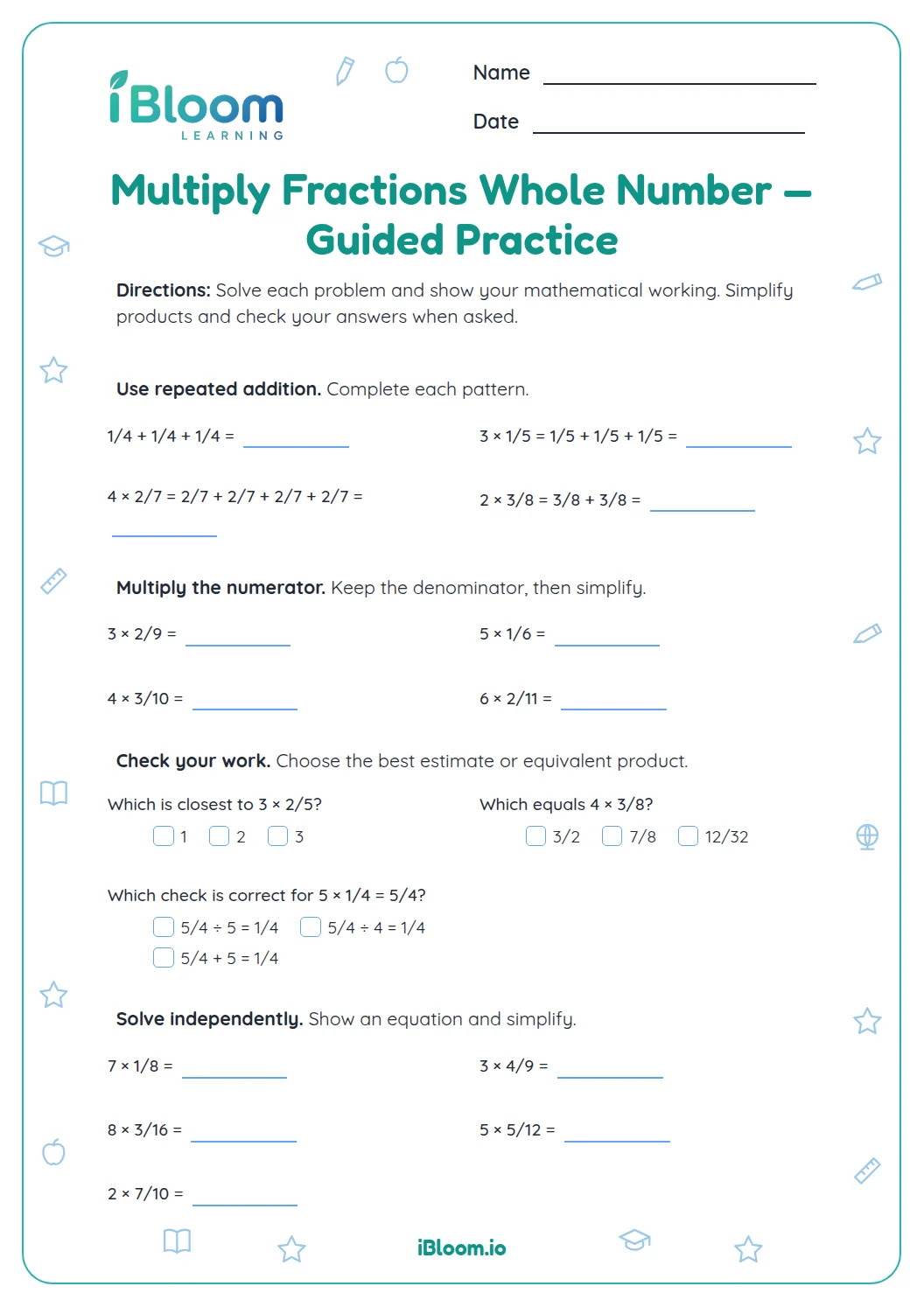
- 2For each model question, multiply the numerator by the number of groups.
- 3In the missing-factor part, ask how many equal numerator groups make the product numerator.
- 4Write an improper fraction for each group problem.
- 5Use the key to check both numerator and denominator.
Common mistakes and quick fixes
The mistake
Multiplying the denominator by the number of groups.
The fix
Keep the denominator because the size of each part stays the same.
The mistake
Writing only the numerator as the product.
The fix
Include the denominator: 4 groups of 2/5 are 8/5.
The mistake
Forgetting that an improper fraction can exceed one.
The fix
Count all the fractional parts, even when they make one or more wholes.
Common Core alignment
This worksheet practices the Common Core skills listed below.
Multiply a fraction by a whole number and interpret the product.
On this sheet: The questions multiply unit and non-unit fractions by whole-number groups and interpret products.
Show the official wordingHide the official wording
Apply and extend previous understandings of multiplication to multiply a fraction or whole number by a fraction.
What to practice next
Make more practice
Further reading
Questions parents and teachers ask
Why can the product be greater than 1?
A fraction such as 5/6 is one group of five sixths. Several groups can make more than six sixths, which is more than one whole. For example, two groups of 5/6 make 10/6. The improper fraction records all ten sixths before converting to a mixed number.
What stays the same when multiplying a fraction by a whole number?
The denominator stays the same because every group contains parts of the same size. The numerator counts how many of those parts there are altogether. For example, four groups of 2/5 make 8 fifths, or 8/5. Have the student point to the related question and explain the step in their own words.
How do students check a missing factor?
Multiply the proposed factor by the fraction’s numerator and keep the denominator. In ___ × 2/5 = 8/5, four groups give 4 × 2 = 8, so 4 is the missing factor. Substituting it back checks the full equation. Have the student point to the related question and explain the step in their own words.
Are the shaded shapes answer choices?
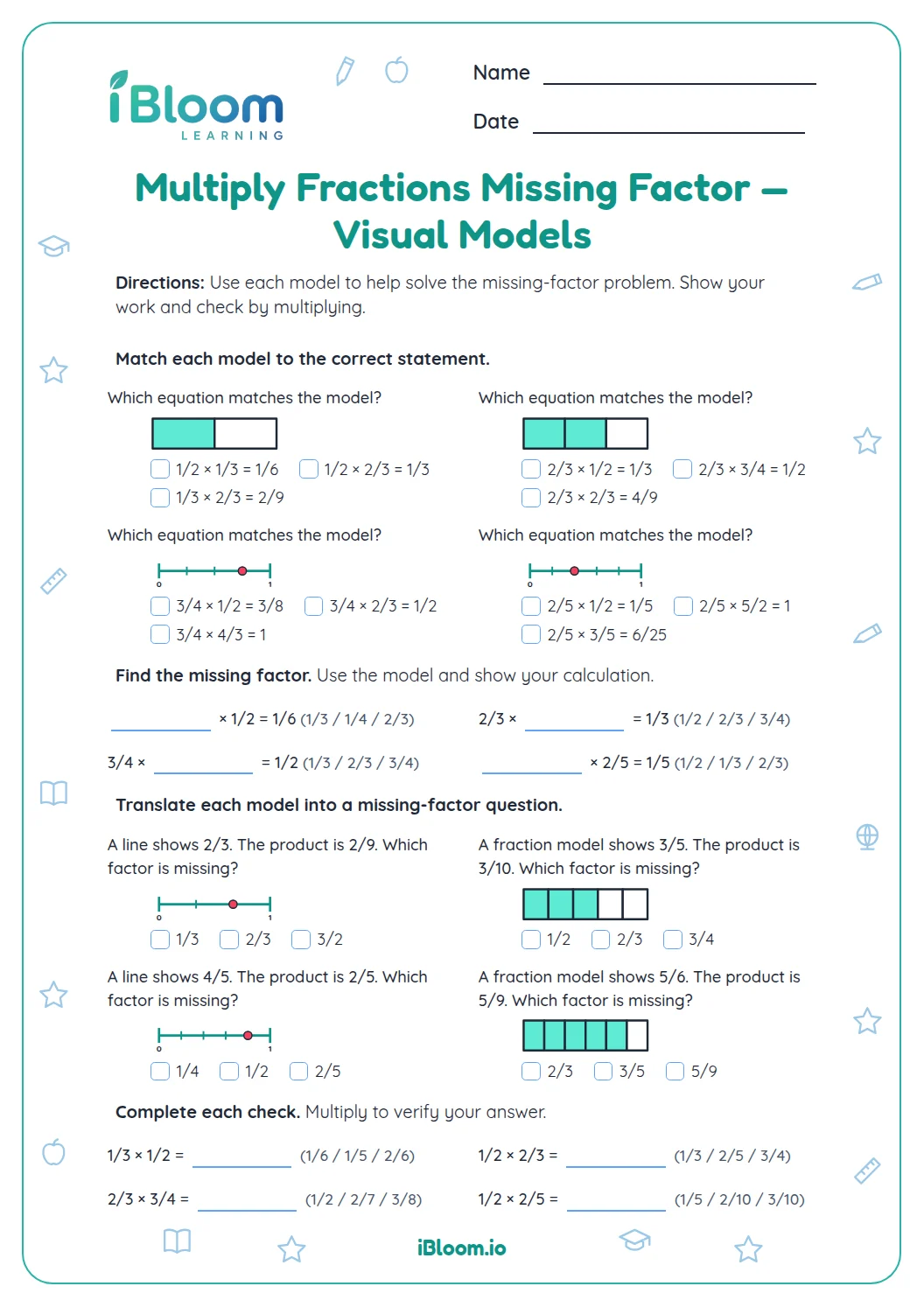
The shaded bars, circles and squares are the fraction models for Part A and Part C. Students read the number of equal parts and the shaded parts, then use the values printed in the question to select or write a product.
What does the separate answer key include?
The answer key lists the matching multiplication equations, missing whole-number factors and products for the four group questions. It lets an adult check the numerical work after the student completes the printable. Have the student point to the related question and explain the step in their own words.
Which standard does this worksheet practice?
It practices CCSS 5.NF.B.4, applying multiplication understanding to a fraction multiplied by a whole number. Students use equal fractional parts, repeated groups and improper-fraction products throughout the page. Have the student point to the related question and explain the step in their own words.