



About this worksheet
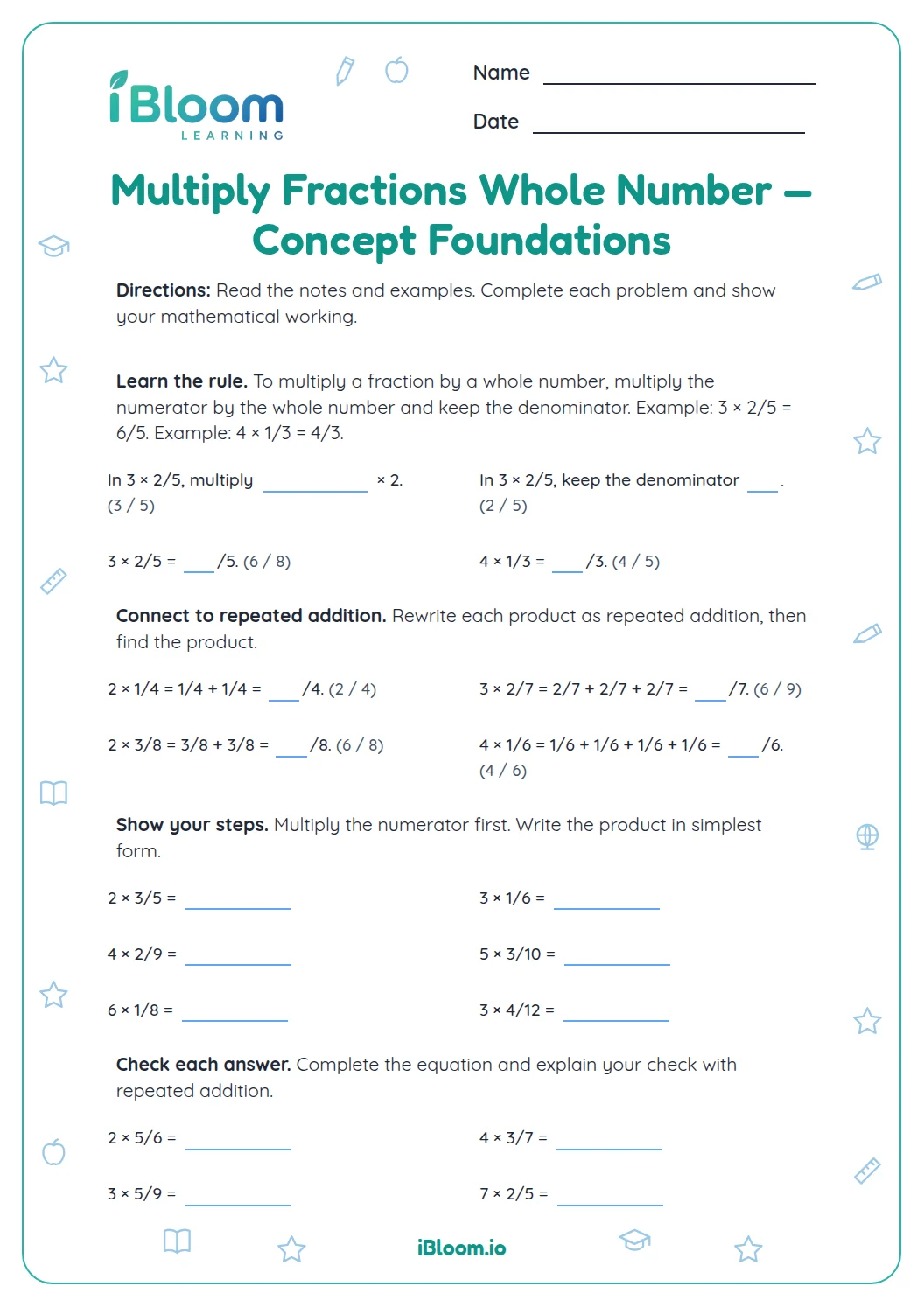
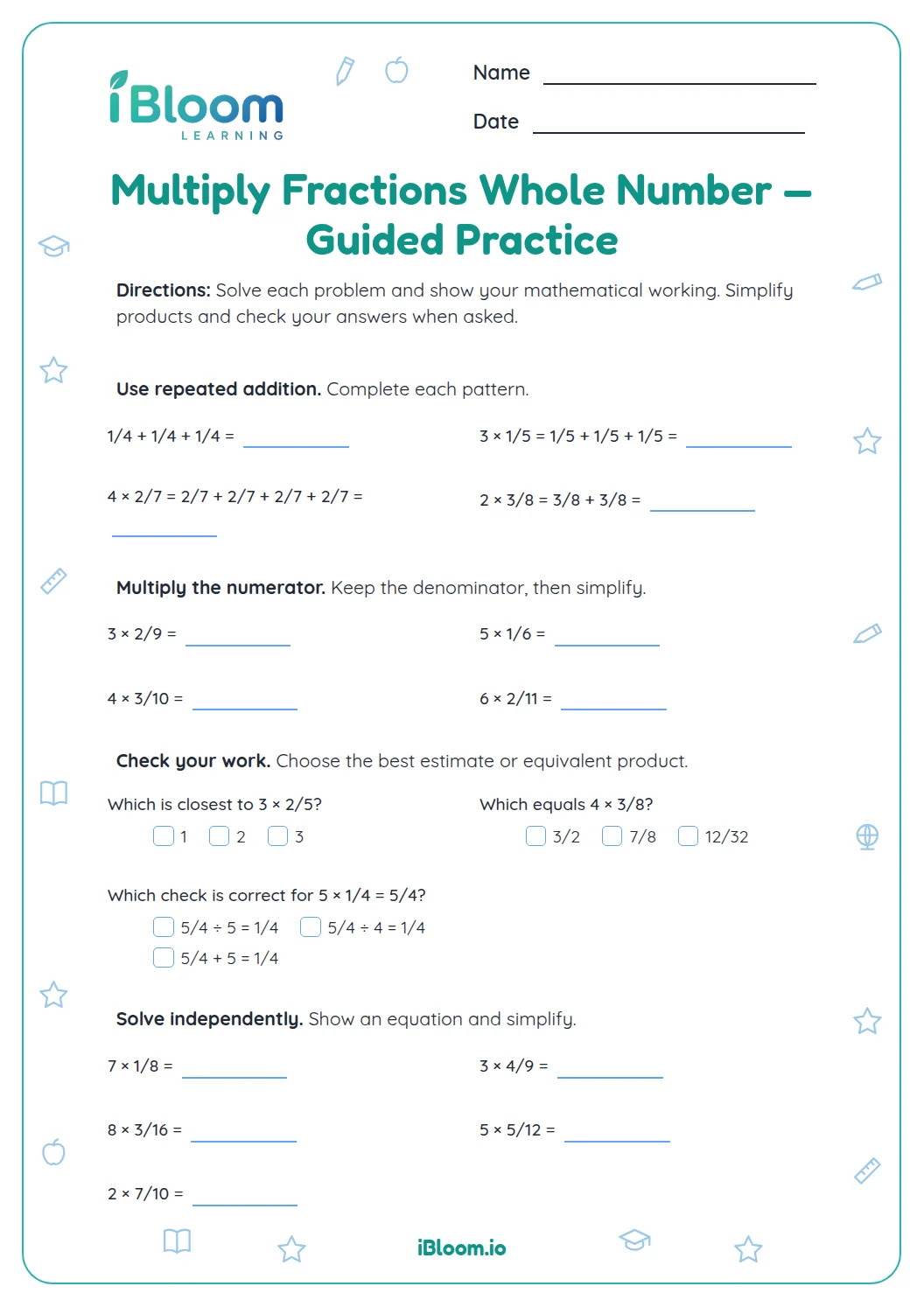
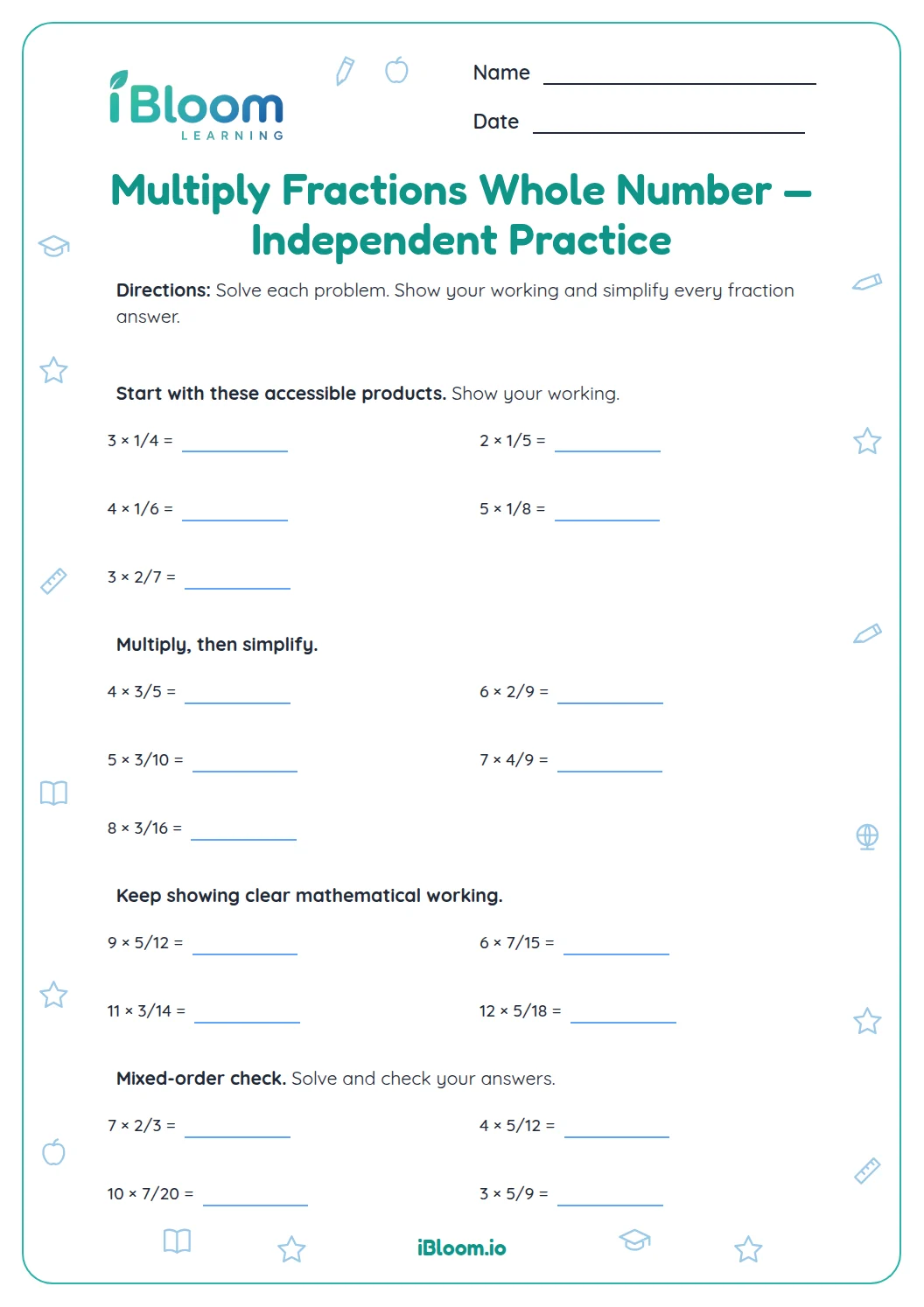
This Grade 5 reasoning challenge practices multiplying a fraction by a whole number. Students write equivalent fractions, compare expressions, evaluate common errors, and solve short applications. For example, 2 × 3/10 = 6/10 = 3/5.
Aligned to 5.NF.B.4
What does a whole-number factor mean?
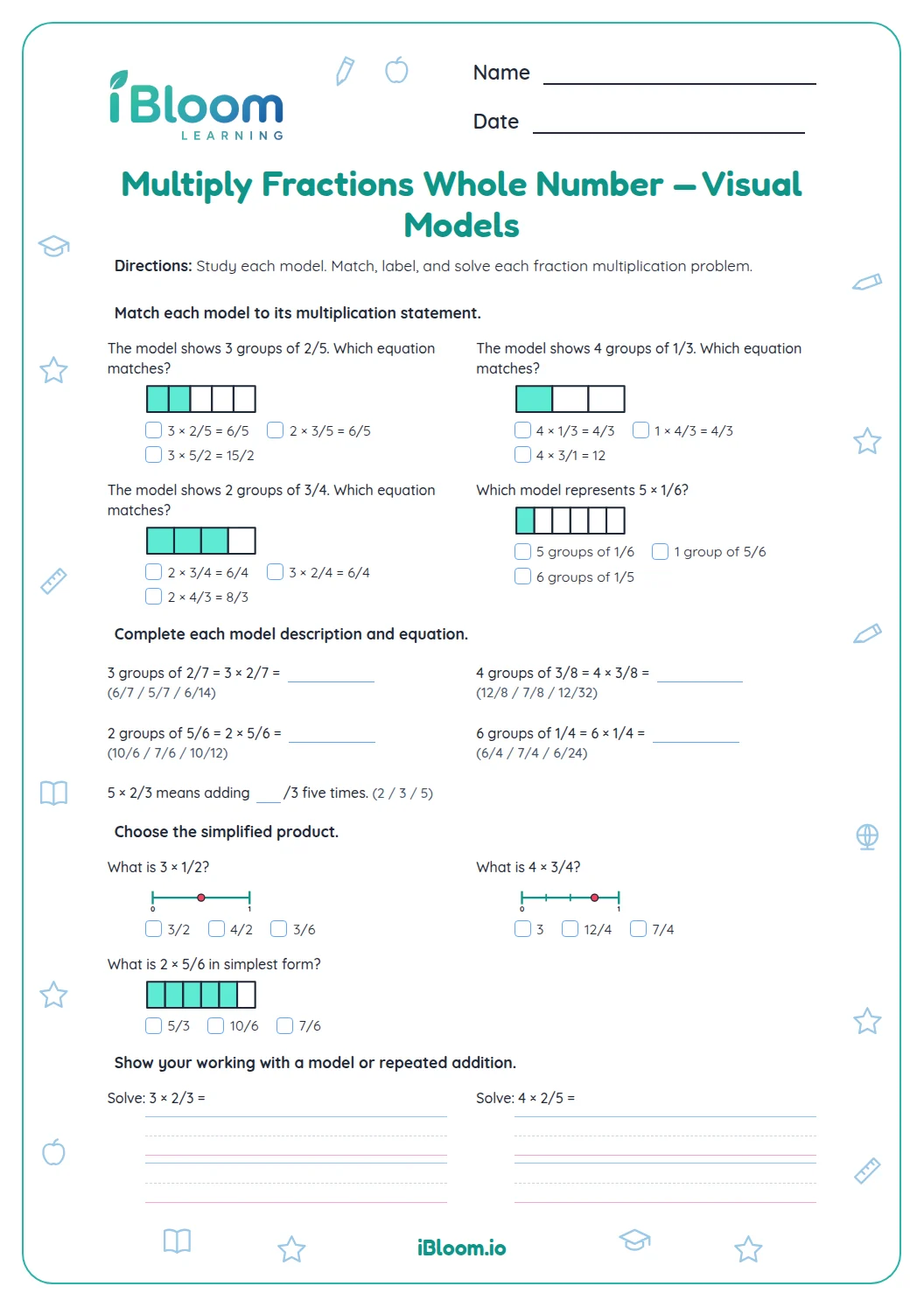
A whole number times a fraction means that many equal groups of the fraction. For 2 × 3/10, multiply the numerator by 2 to get 6/10, then simplify to 3/5.
- 12 × 3/10 = 6/10 = 3/5
Why write an equivalent fraction first?
A whole number can multiply the numerator while the denominator stays the same: 2 × 3/10 = 6/10. The equivalent form 3/5 makes the product easier to interpret.
What reasoning appears on the worksheet?
Sixteen questions move from equivalent-fraction calculations to comparisons, error analysis, and short explanations or applications.
- Part A: six equations with two blanks, filled in order
- Part B: five multiple-choice comparison and error items
- Part C: five reasoning and real-world questions
How can students test a product claim?
Compute the product, simplify it, and compare it with the original fraction. If a whole number greater than 1 multiplies a positive fraction, the result must be larger than one copy of the fraction.
How to use this worksheet at home or in class
- 1Begin with a visual explanation: three groups of 2/5 make 6/5.
- 2Complete one two-blank equation and name the numerator and simplified product separately.
- 3For Part B, calculate both sides before comparing.
- 4When critiquing a claim, find the first step that changes the value incorrectly.
- 5Use a sentence or equation to support Part C answers.
Common mistakes and quick fixes
The mistake
Changing the denominator when multiplying by a whole number.
The fix
Keep the denominator and multiply the numerator by the whole number.
The mistake
Leaving an improper fraction without interpreting it.
The fix
Simplify it or rewrite it as a mixed number when useful.
The mistake
Claiming a product is smaller than one fraction copy after multiplying by more than 1.
The fix
Think of the whole-number factor as repeated groups.
Common Core alignment
This worksheet practices the following Common Core mathematics standard.
Multiply a whole number by a fraction and compare product sizes.
On this sheet: Multiply a whole number by a fraction and compare product sizes.
Show the official wordingHide the official wording
Apply and extend previous understandings of multiplication to multiply a fraction or whole number by a fraction.
What to practice next
Make more practice
Further reading
Questions parents and teachers ask
How do you multiply a fraction by a whole number?
Multiply the whole number by the numerator and keep the denominator. Then simplify if possible. For example, 2 × 3/10 = 6/10 = 3/5. The first part gives six problems that use this equivalent-fraction structure. The denominator stays the same because the whole number multiplies the number of fractional groups, not the size of each part.
Why can a product be greater than one?
A whole number can make several groups of a fraction, and those groups can add up to more than one whole. For example, 4 × 3/8 = 12/8 = 1 1/2. Students compare products with their fractional factors in Part B.
What is the purpose of the error-analysis questions?
They ask students to inspect a claim, identify the incorrect reasoning, and state a correct product or comparison. The key provides a sample explanation, while students may use different words to express the same mathematical idea. Students should explain the mathematical step in their own words and use a correct product as evidence for the correction.
How many questions are included?
The worksheet has 16 questions in three parts: six equivalent-fraction products, five comparisons or multiple-choice reasoning items, and five written explanations or applications. The sequence moves from computing products to explaining how they compare. The final section gives space for short explanations and equations so students can show how they reached a result.
Does the worksheet include real-world practice?
Yes. The final part includes applications such as repeated walks around a loop and flour needed for several loaves. Students write a multiplication equation and calculate the total amount, connecting repeated fractional groups to multiplication. These applications reinforce that multiplying a fraction by a whole number represents repeated equal fractional groups.