



About this worksheet
This Grade 6 printable connects decimal addition to visual models and written place-value work. The first eight questions pair an addition sentence with a hundredths grid and ask whether the shaded amount matches its sum. The next eight ask students to add in columns, including values through millionths. A separate key supports checking; the work practices the decimal fluency named in CCSS 6.NS.B.3.
Aligned to 6.NS.B.3
How do the hundredths grids check a sum?
Each hundredths grid represents an amount in hundredths. Add the two decimals in the question, then decide whether the shaded value equals that sum.
For Question 1, 0.24 + 0.35 = 0.59. The grid has 59 shaded squares, so the model matches.
- 10.24 + 0.35 = 0.59
- 259 shaded squares represent 0.59
- 3Choose Yes
How do students add through six decimal places?
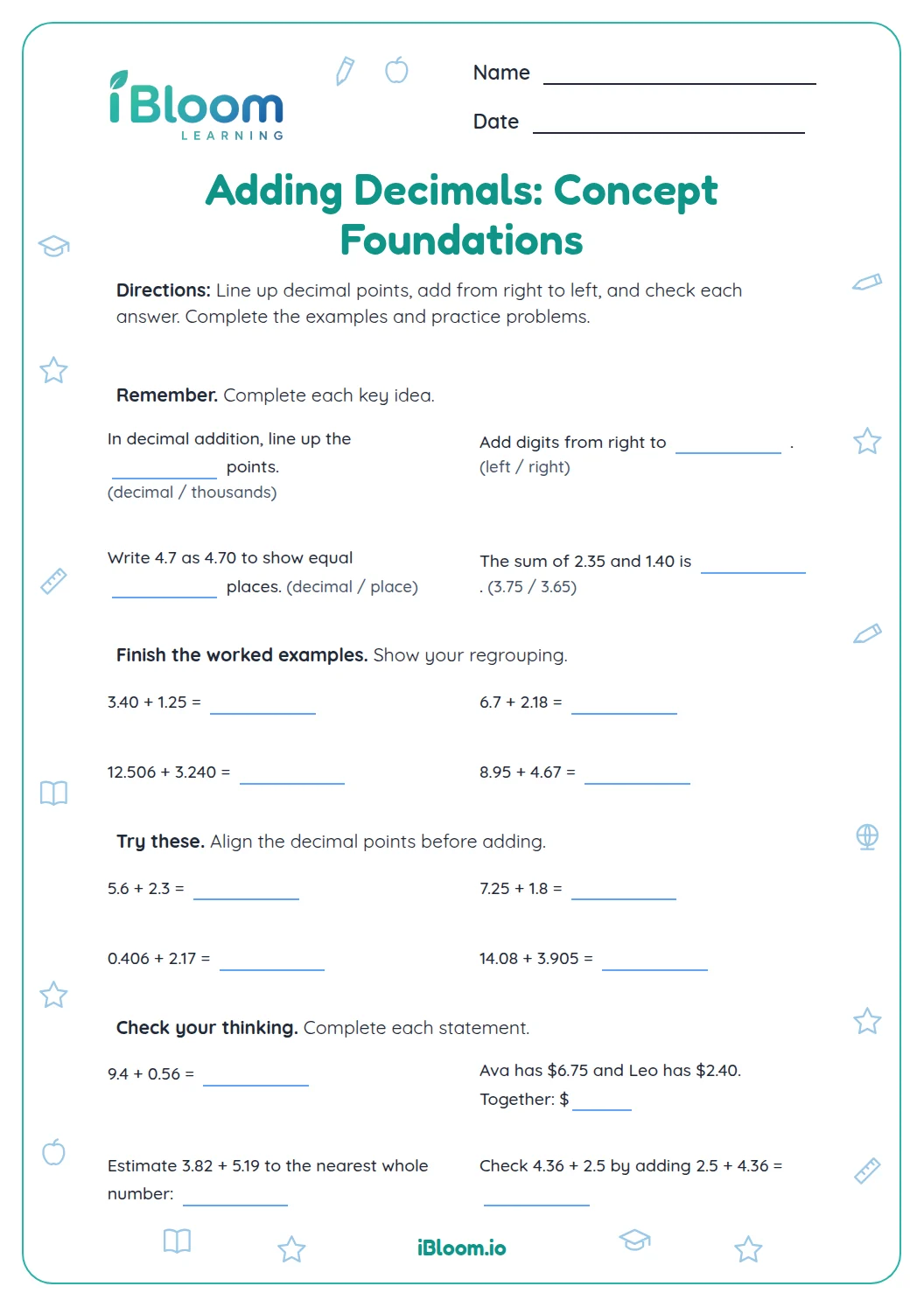
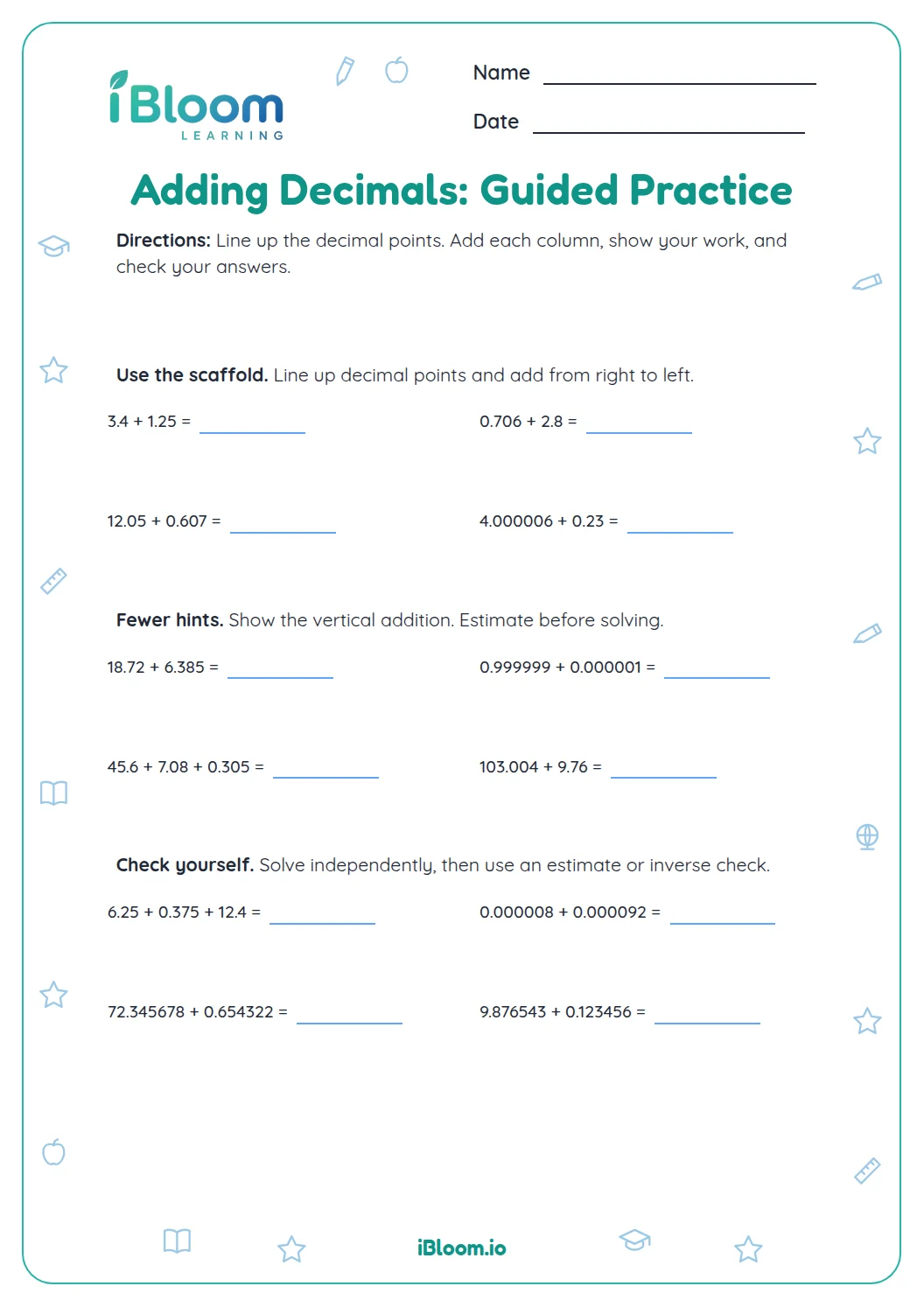
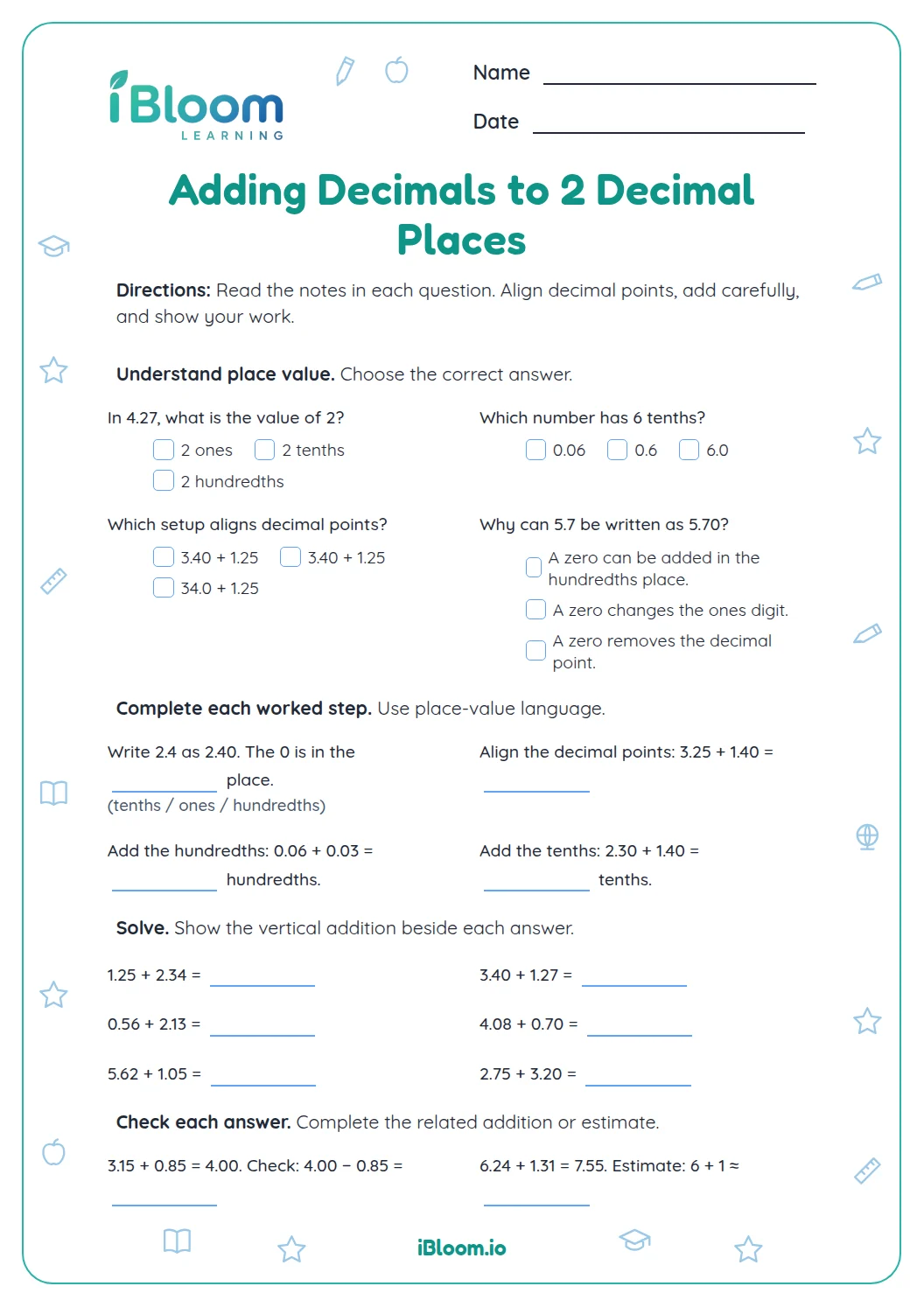
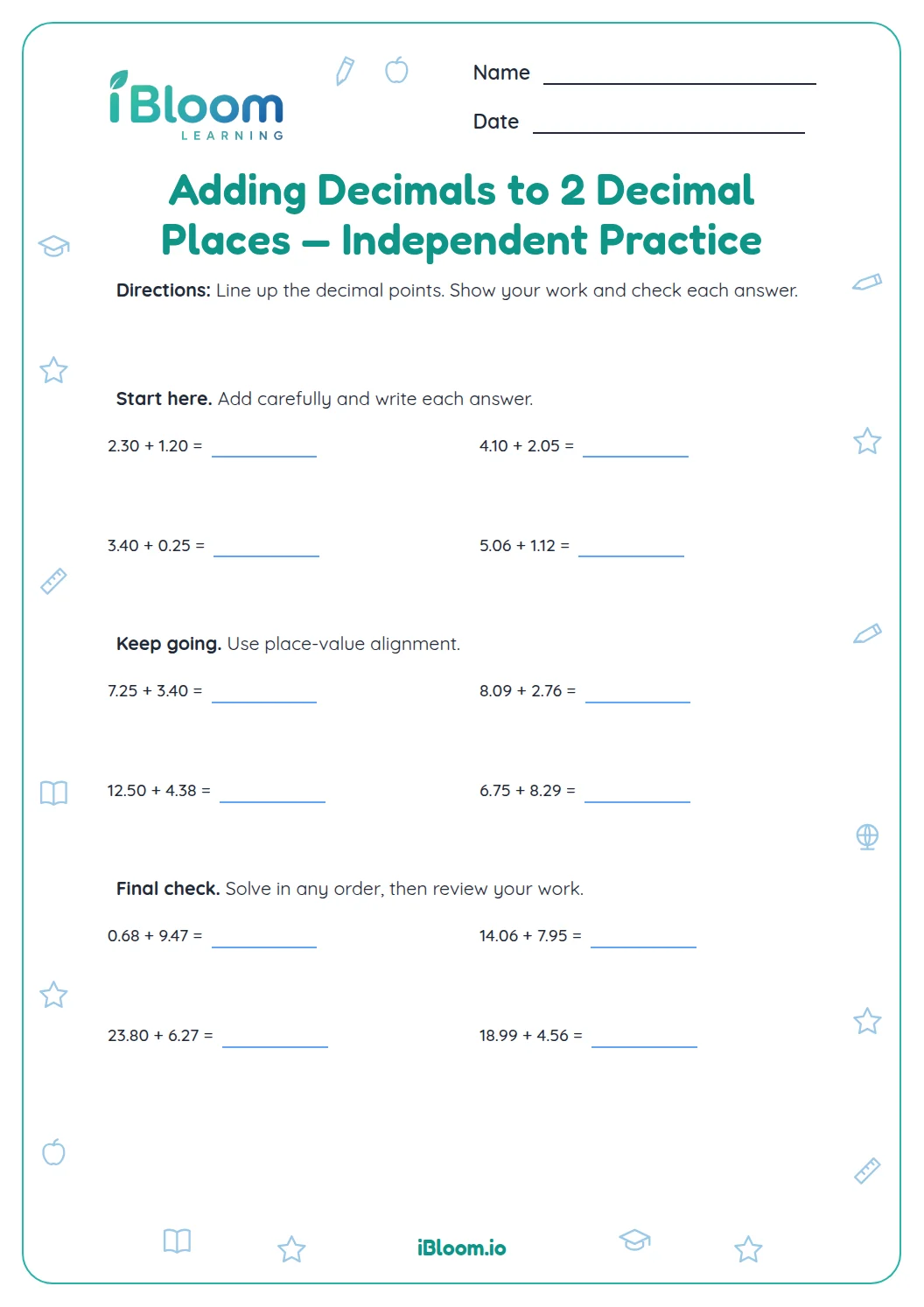
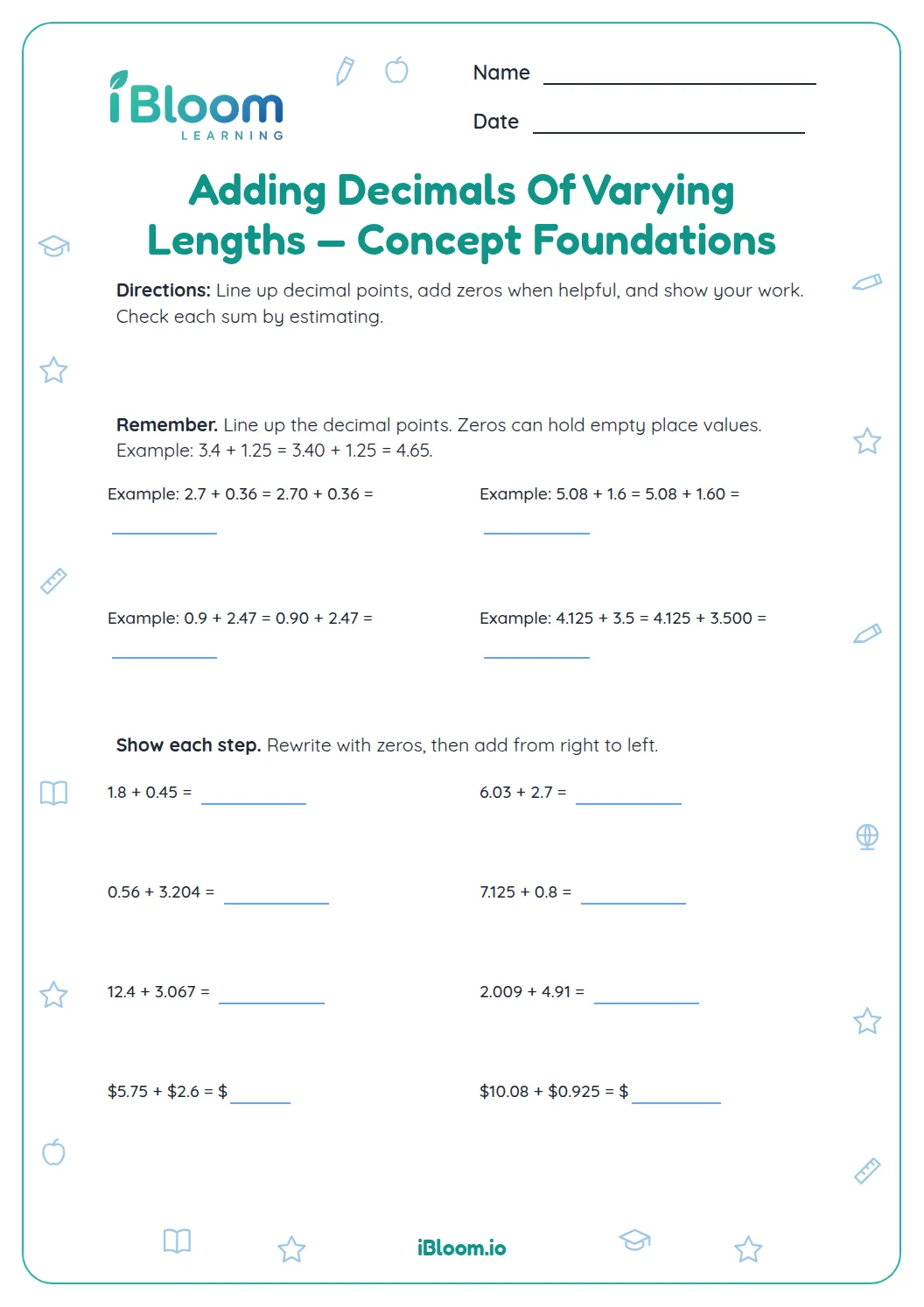
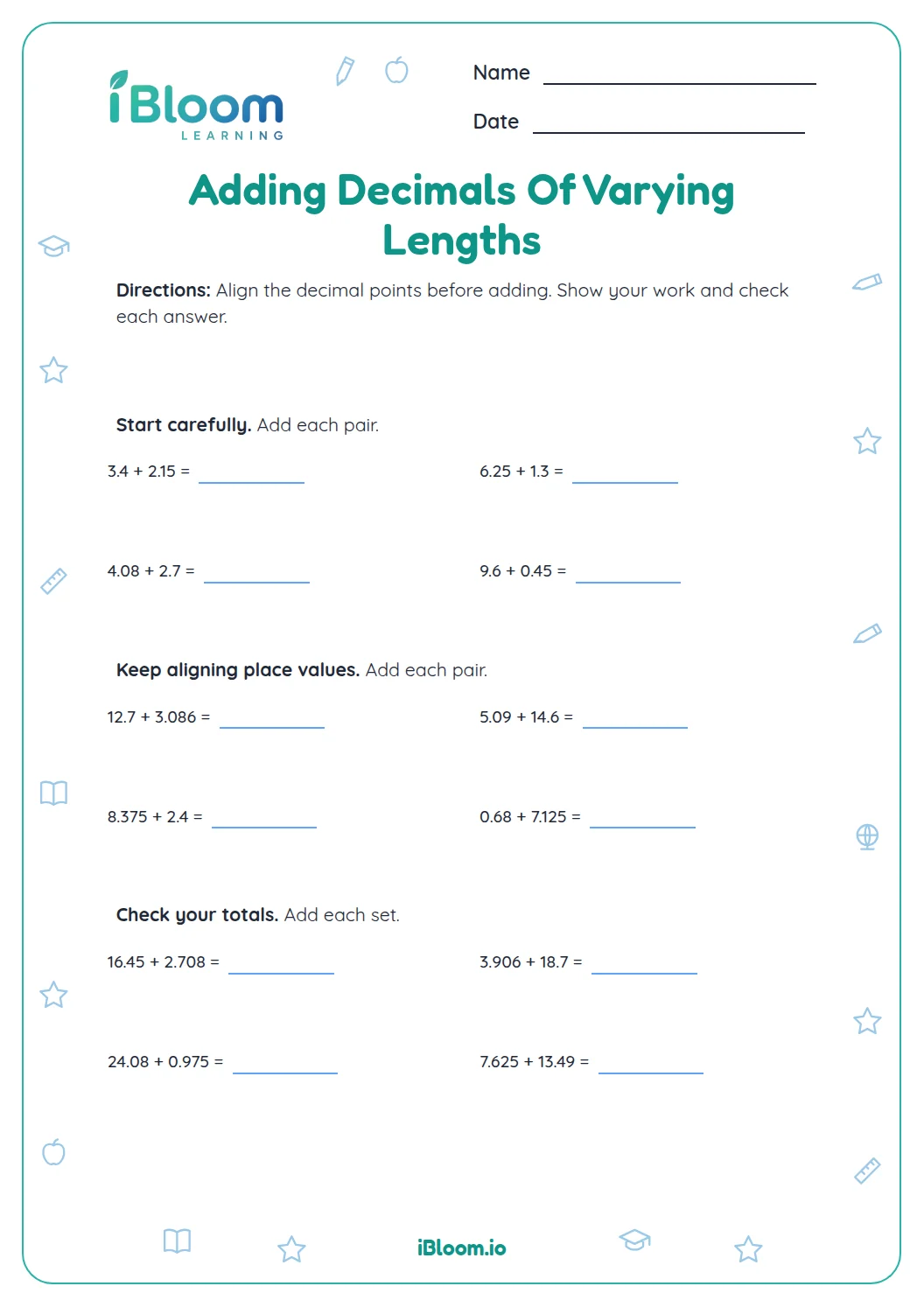
Line up decimal points so digits with the same place value share a column. Add zeros to the right when a place is empty, then add and regroup from right to left.
For 0.123456 + 0.000003, the sum is 0.123459.
How can students check their work?
For a model question, compare the exact sum with the hundredths shown. For a column problem, estimate the size and inspect the rightmost place values and any regrouping.
How to use the worksheet
- 1Read whole units and shaded hundredths in the model.
- 2Copy the first amount and the written addend.
- 3Align decimal points and add zeros where places are empty.
- 4Add from right to left, regrouping when needed.
- 5Check the sum against an estimate.
Mistakes to watch for
The mistake
Calling a model a match without adding both numbers.
The fix
Find the exact sum before comparing it with the shaded squares.
The mistake
Shifting digits when addends have different lengths.
The fix
Align decimal points and use zeros in empty places.
The mistake
Dropping a small place value in a six-place sum.
The fix
Keep every column through millionths and check regrouping.
Common Core alignment
Fluently add, subtract, multiply, and divide multi-digit decimals.
On this sheet: The sheet builds accurate addition of decimals by aligning place values.
Show the official wordingHide the official wording
Fluently add, subtract, multiply, and divide multi-digit decimals using the standard algorithm for each operation.
What to practice next
Make more practice
Further reading
Questions parents and teachers ask
What does a hundredths grid show in the first part?
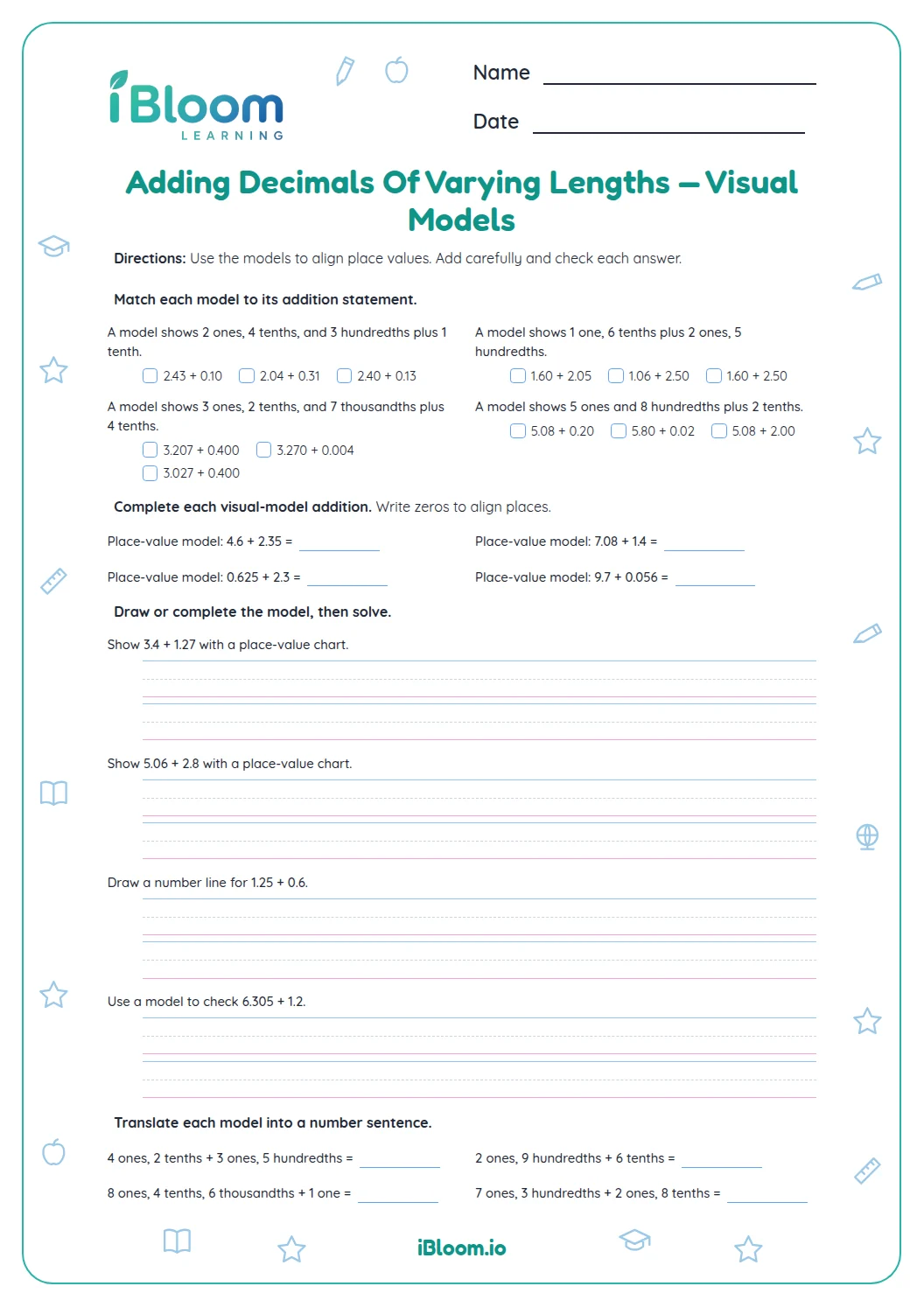
One full grid represents 1.00, and each small square represents 0.01. The first eight items give two addends and ask whether the shaded amount matches their sum. Students should calculate first, then count the grid to choose Yes or No.
How do I add decimals with many places?
Align decimal points so ones, tenths, hundredths, and smaller places share columns. Add zeros to the right when useful, then add from the rightmost column and regroup as needed. Keep the decimal point aligned in the answer. Use a zero only as a placeholder, never as a new value.
What does a zero do in a decimal sum?
A zero can hold an empty place without changing a decimal’s value. For example, 3.14 can be written as 3.140000 before adding a number through millionths. This makes each place value visible and keeps the columns aligned. Preserve all six places when the problem includes millionths.
How can I check a six-place sum?
Estimate the total first to check its size, then inspect the columns from millionths toward ones. Confirm that each carried value is included and that the decimal point stays aligned. The key provides an exact result for each of the eight column sums.
Why combine models and column addition?
The grids make hundredths visible and give students a way to compare a sum with a shaded amount. The later questions extend place-value alignment to longer decimals. Together, the two sets connect a visual representation with the written addition method.