



About this worksheet
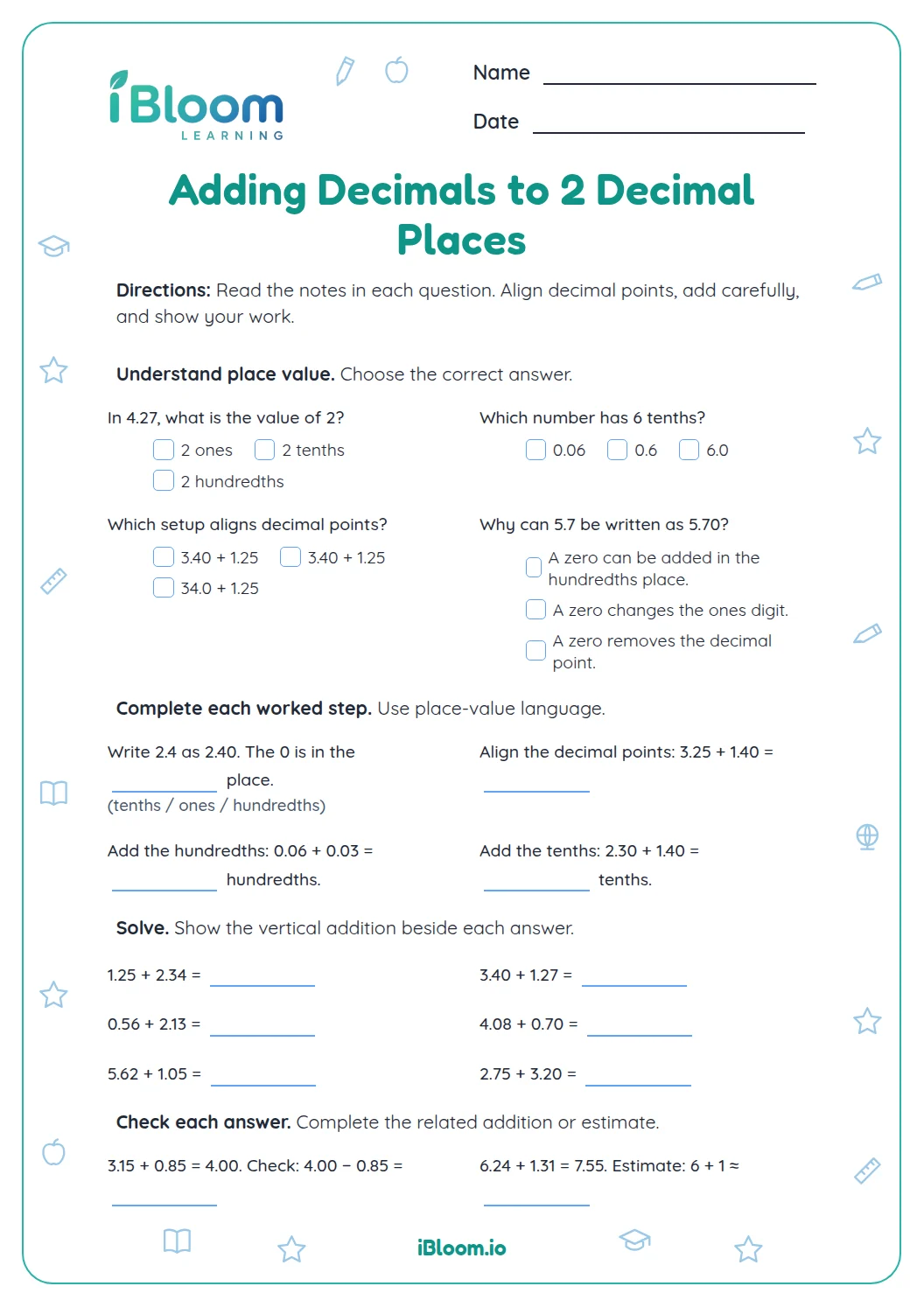
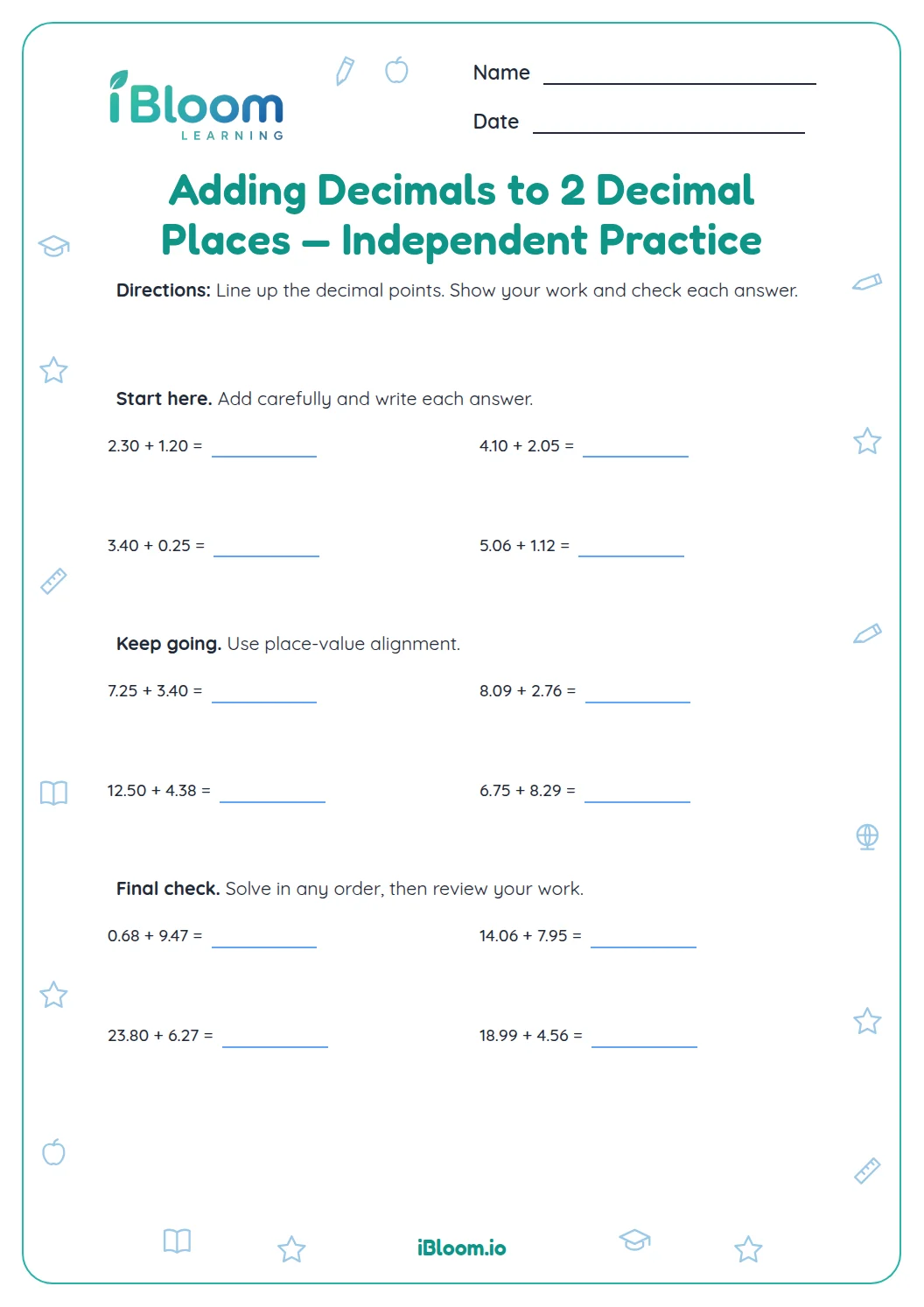
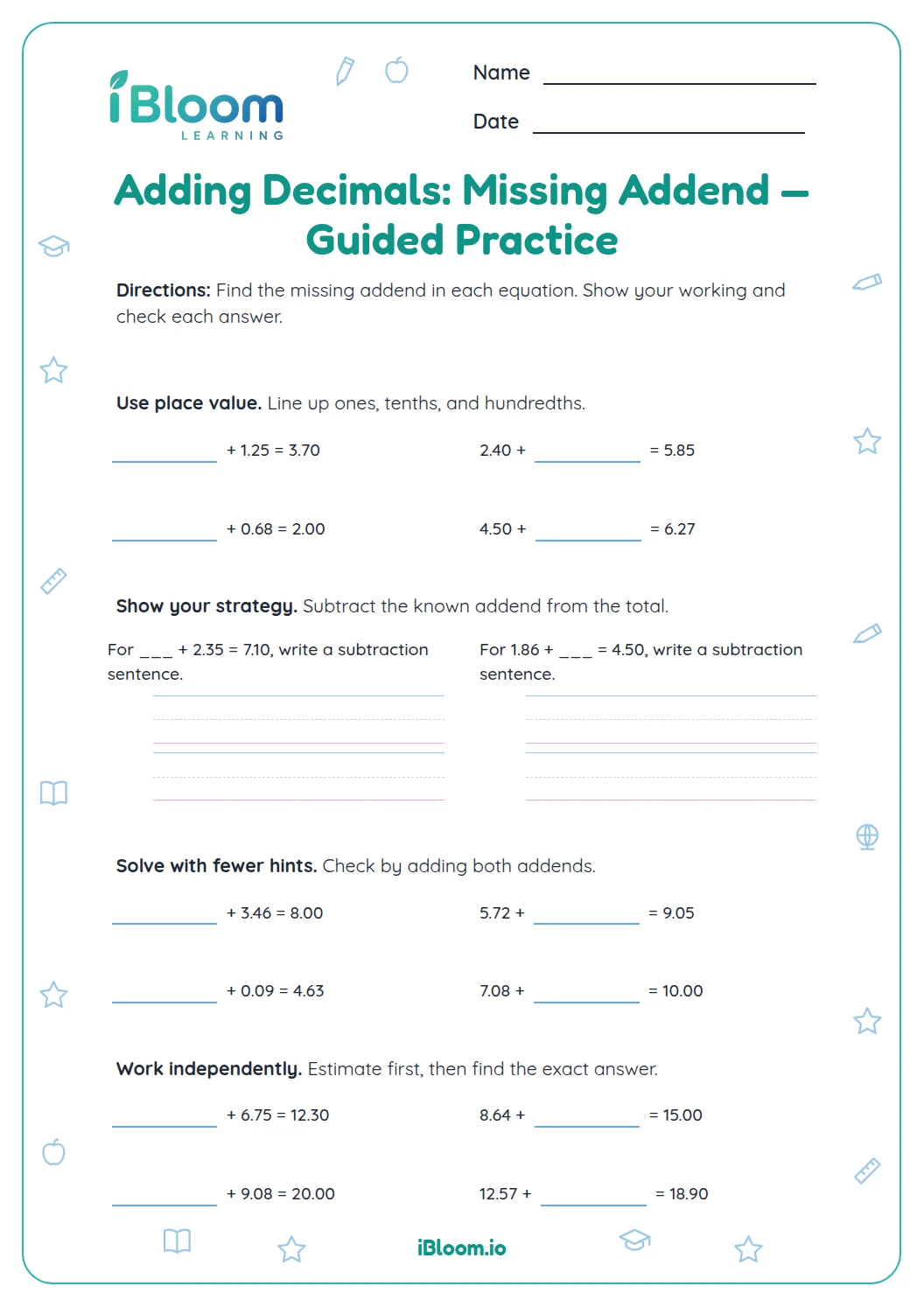
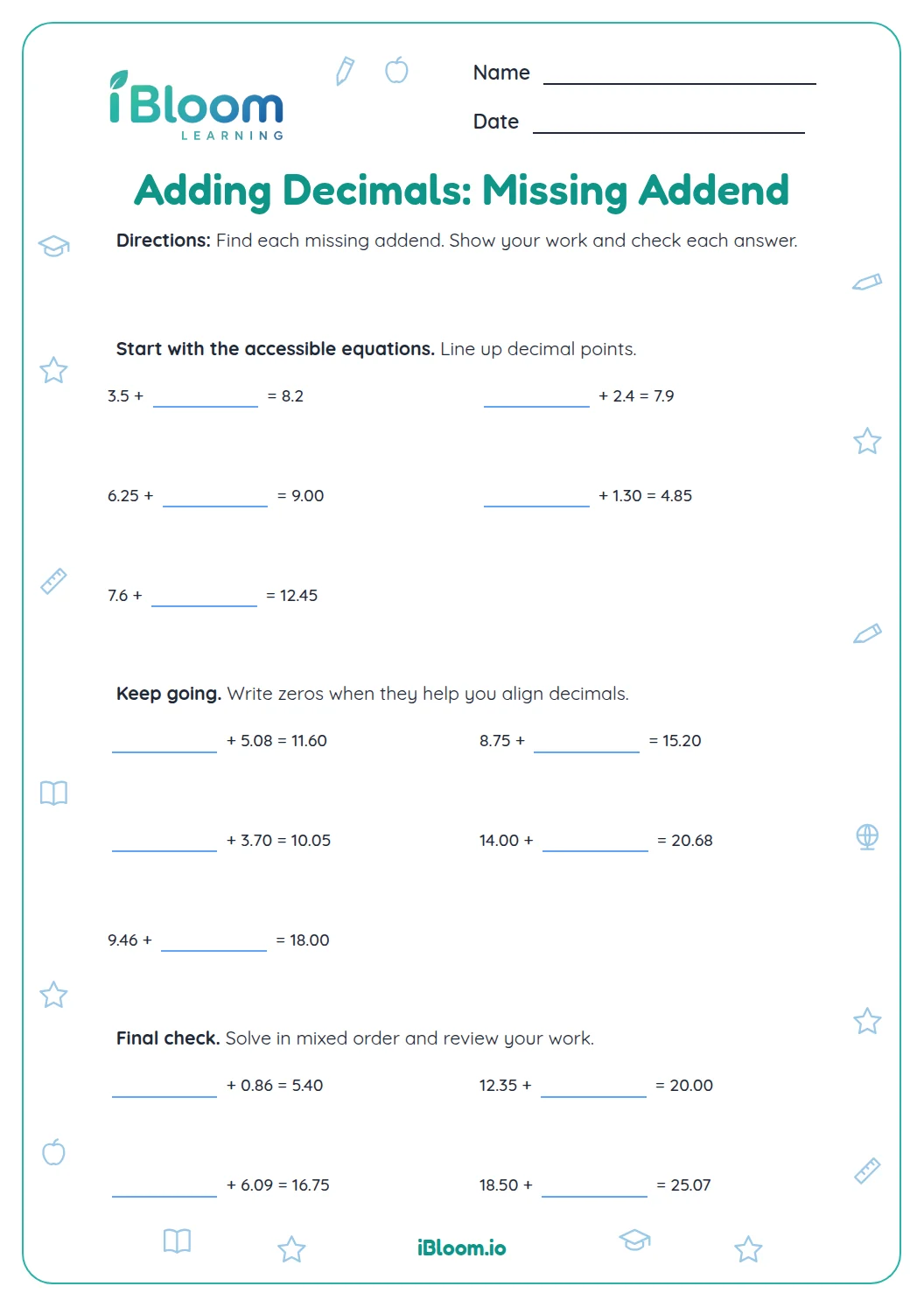
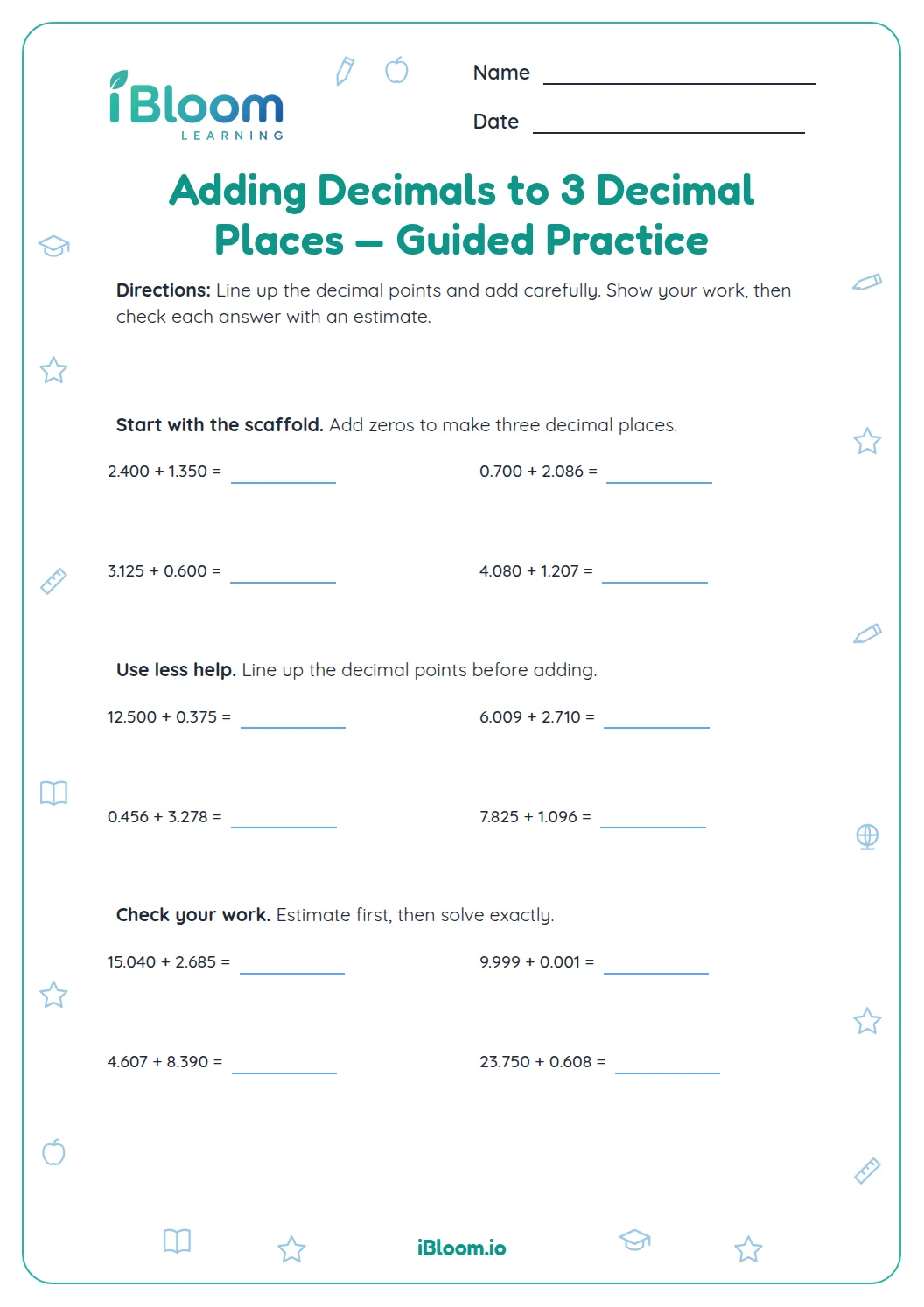
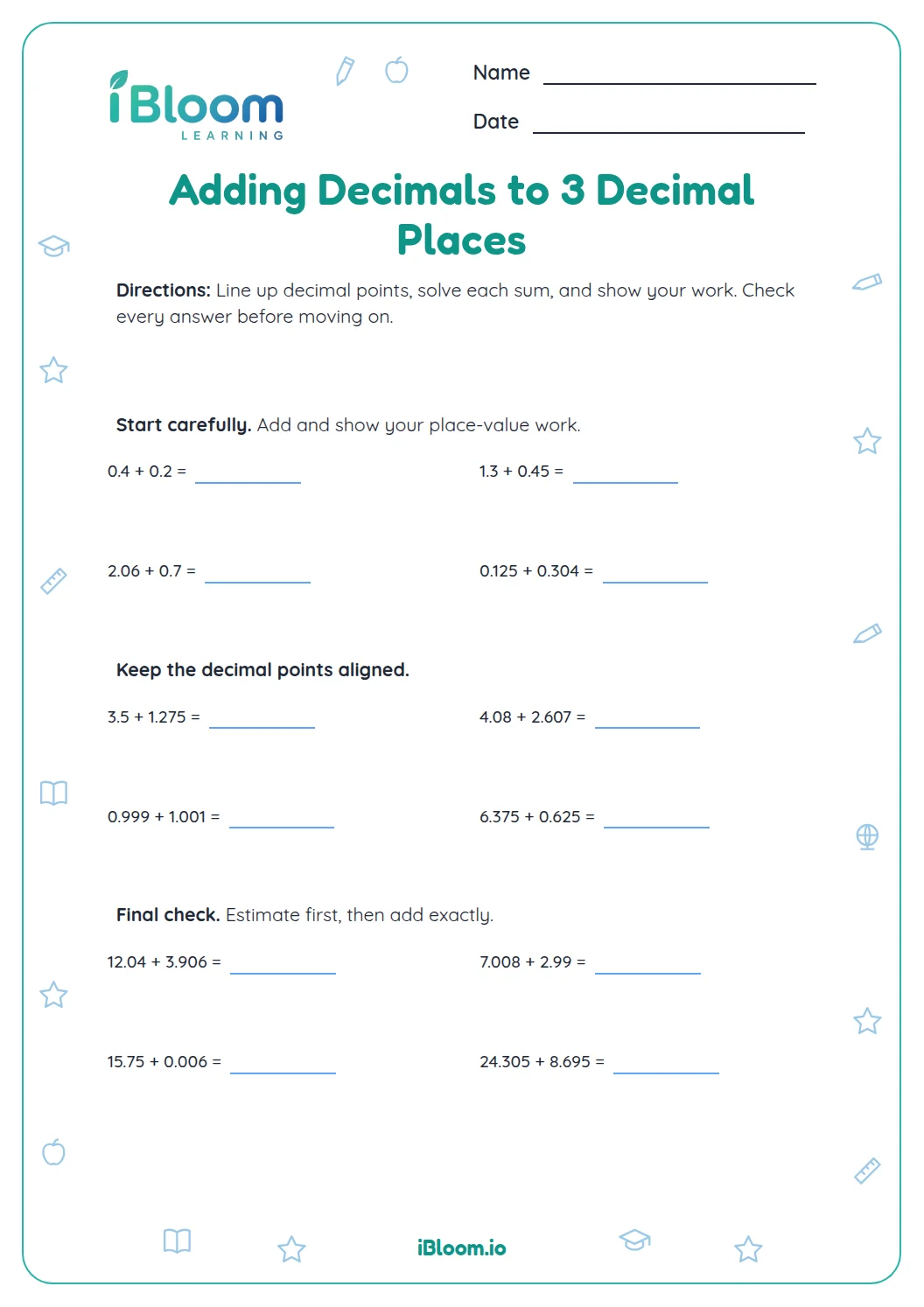
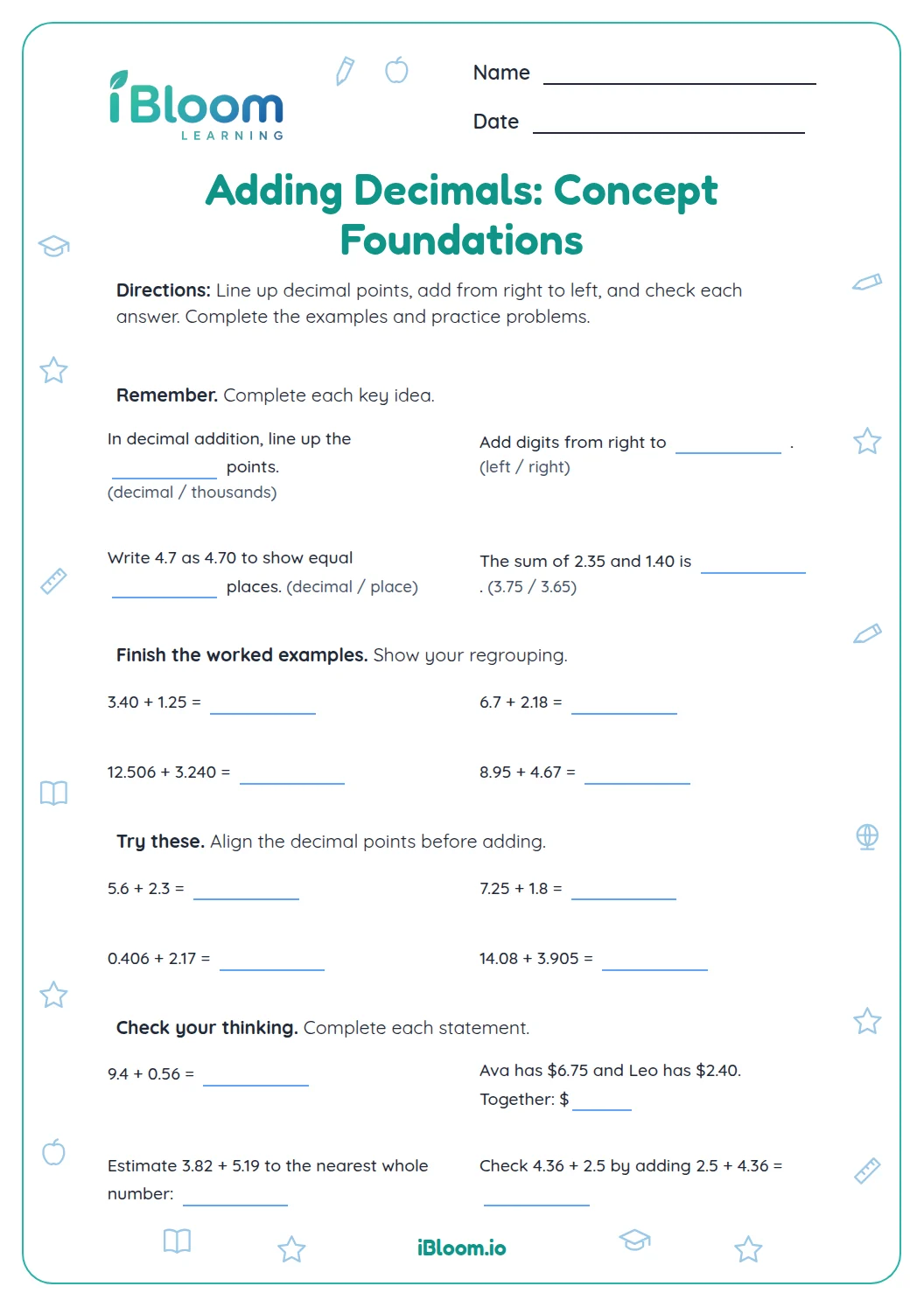
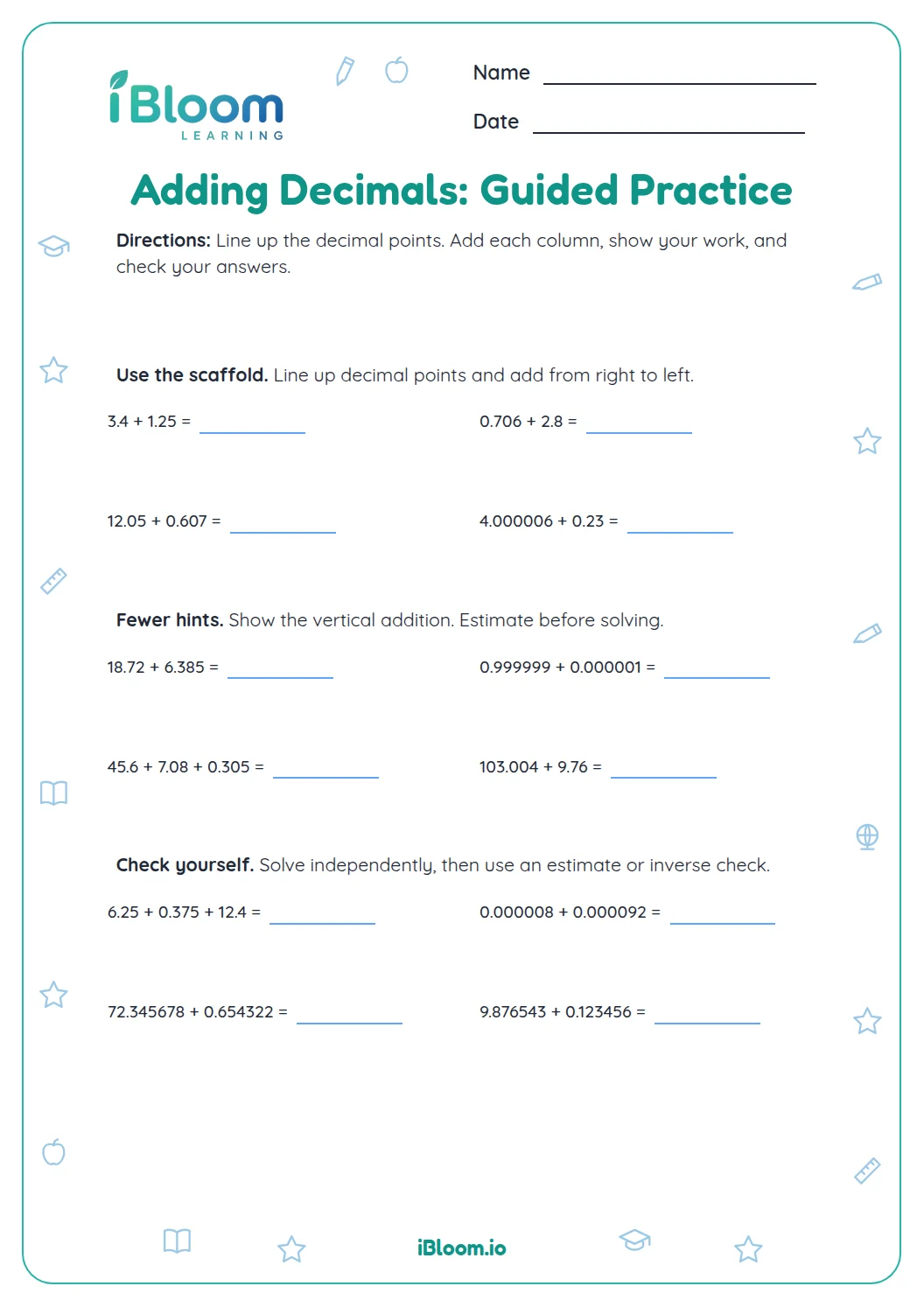
This free printable worksheet gives Grade 6 students structured practice with adding decimals with different numbers of decimal places. It includes 16 questions across 3 parts, with clear prompts and a separate answer key. The activities build accuracy by asking students to organize their work and check whether each result makes sense. It practices 6.NS.B.3.
Aligned to 6.NS.B.3
How can students solve adding decimals with different numbers of decimal places?
The decimal points mark the same units place even when the addends have different lengths. Add zeros to make matching places easy to see, then add by place value. Round the addends in a separate step when estimating.
For question 1, write 8.7 as 8.700. Then 8.700 + 3.245 = 11.945. The thousandths place is included in the sum.
- 1 8.700
- 2+ 3.245
- 3 11.945
What practice is on the sheet?
The worksheet has 16 questions in 3 short parts. Each part changes the way students practice, while keeping the same central skill.
How can students check an answer?
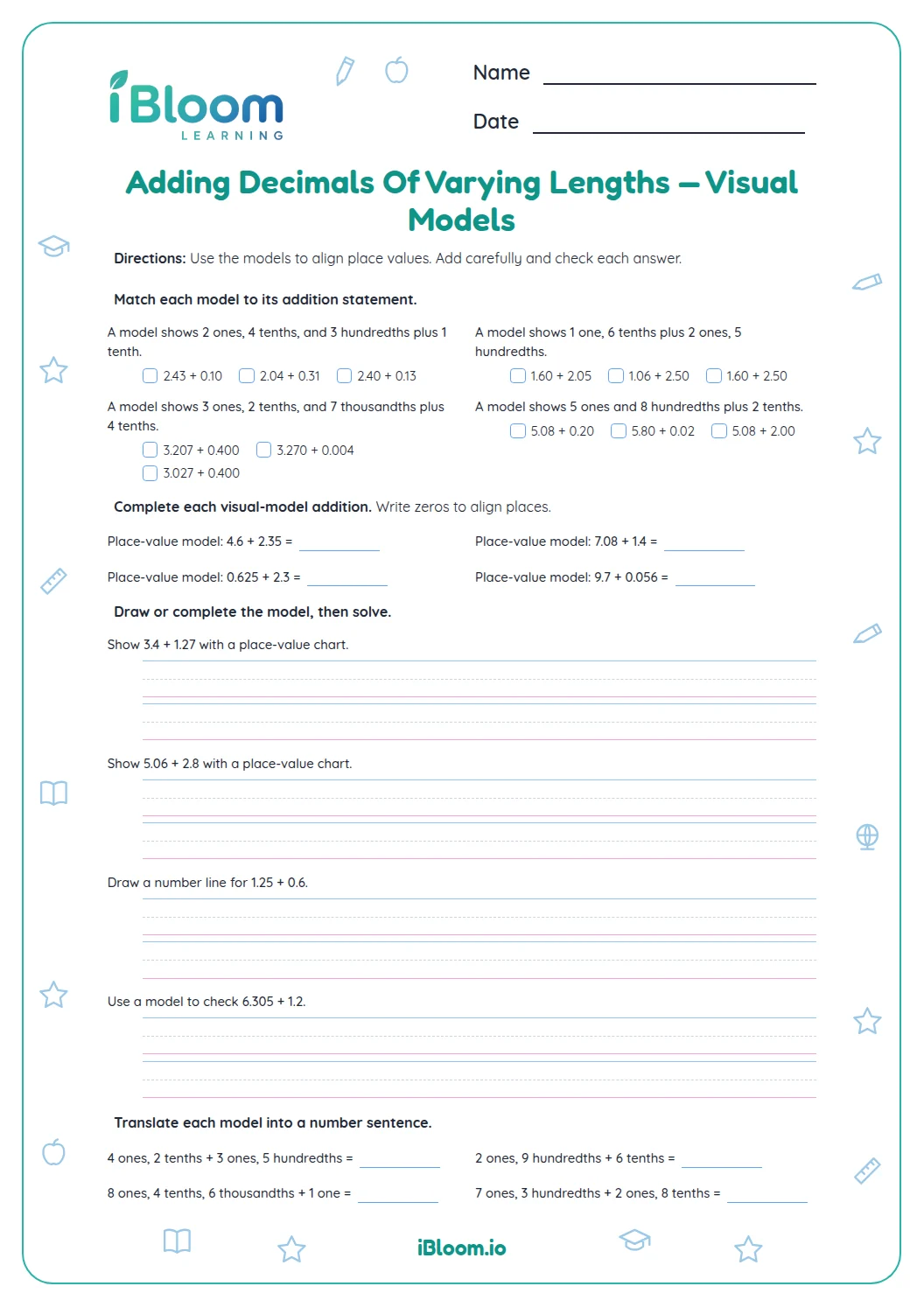
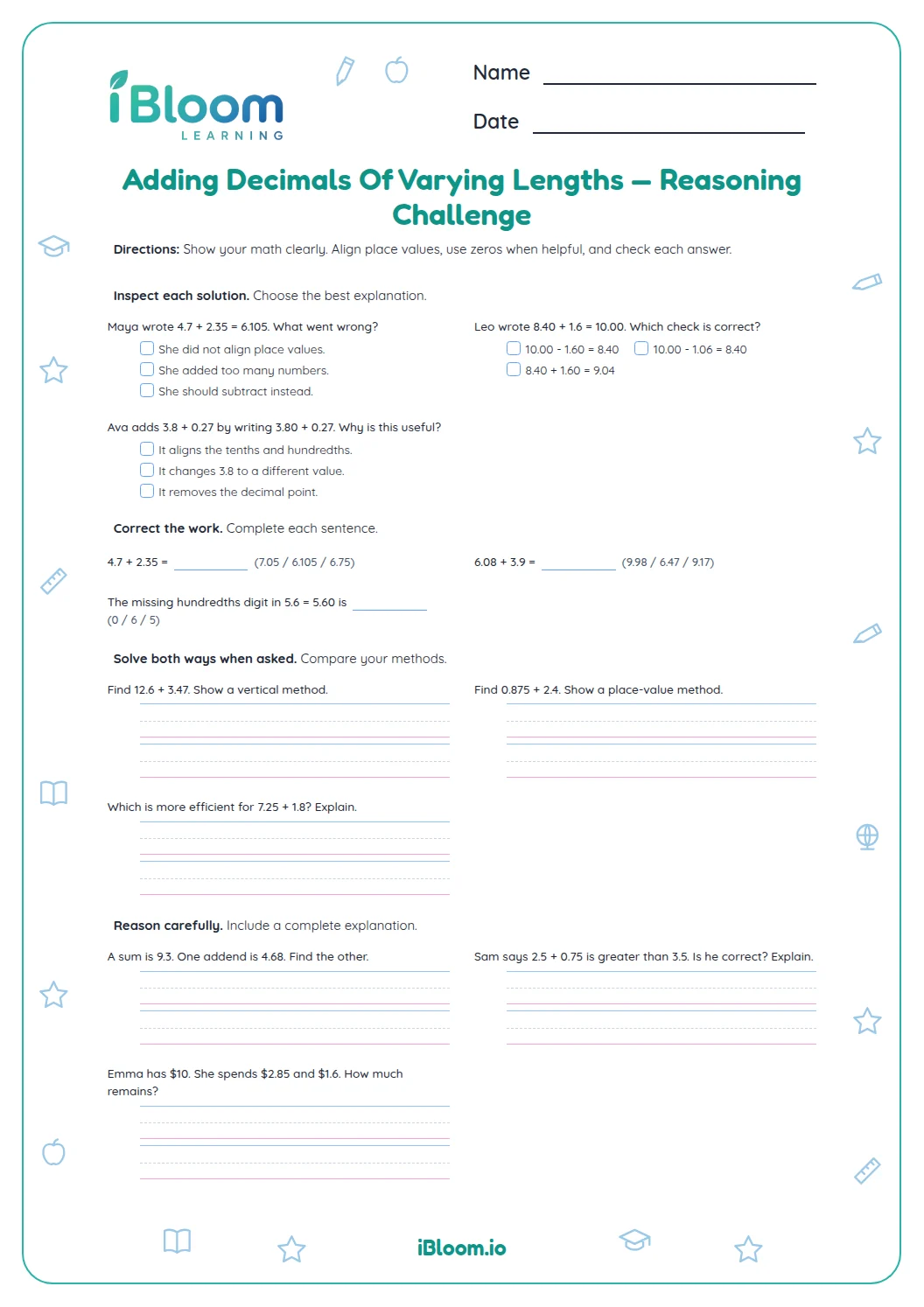
Estimate or reason about the size of the result before comparing it with the exact answer. For a model, first read the represented amount, then check that the equation matches it.
How to use the worksheet
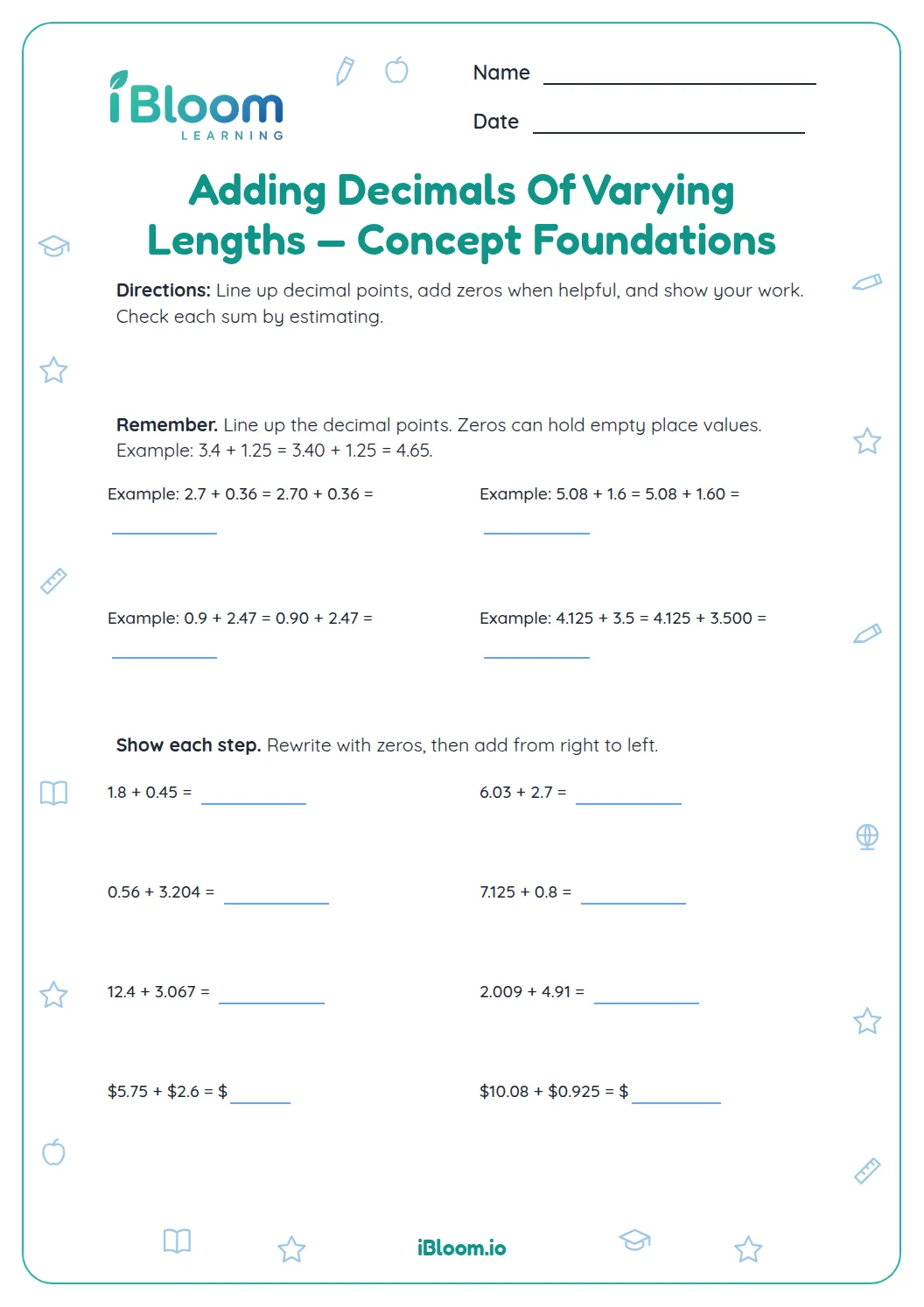
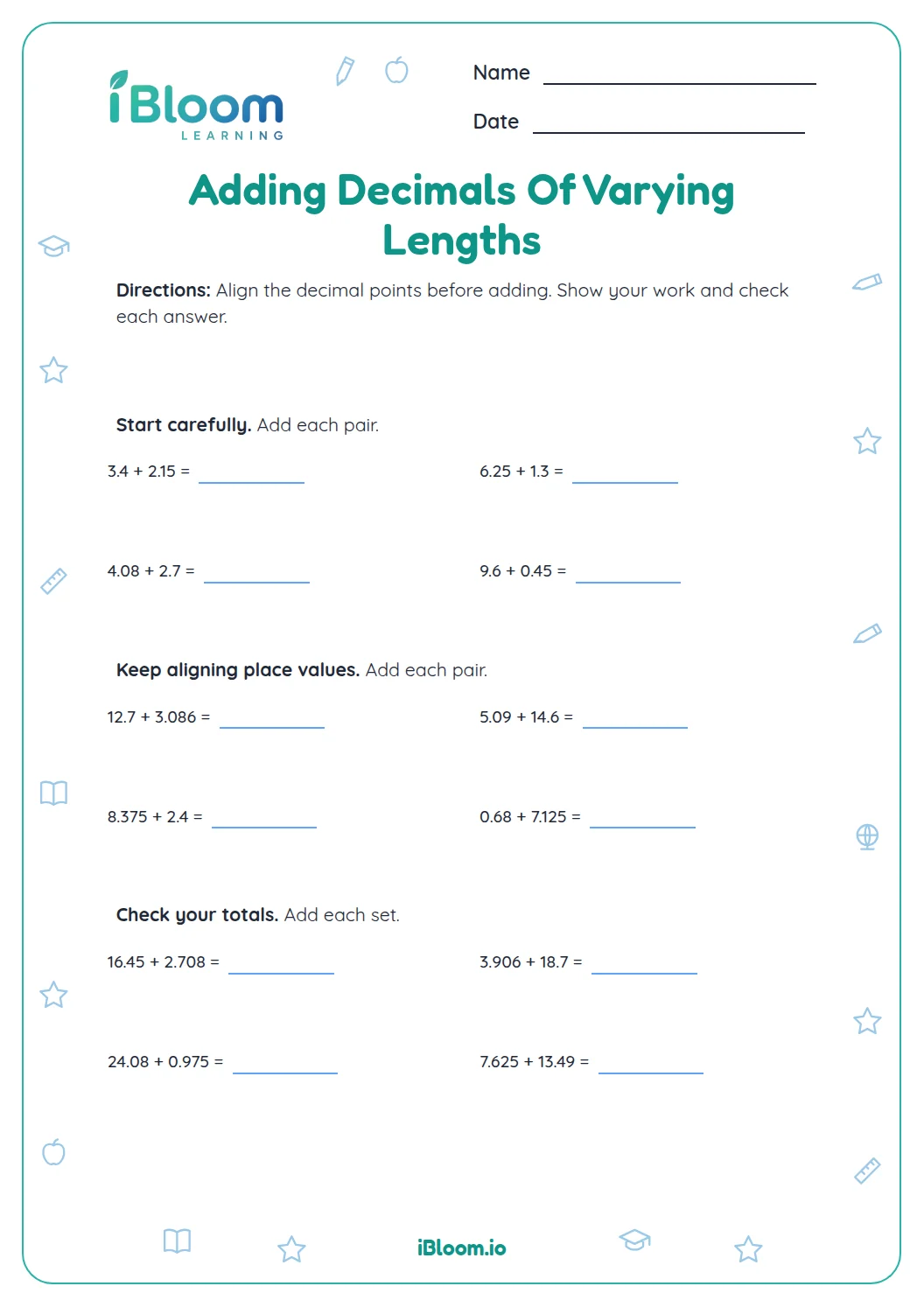
- 1Rewrite each addition problem with decimal points aligned.
- 2Use zeros as placeholders where a place is missing.
- 3In Part B, round each addend before adding.
- 4Include the requested measurement unit in Part C.
- 5Compare the exact answer with its estimate.
Mistakes to watch for
The mistake
Aligning the last digits instead of the decimal points.
The fix
Place decimal points in one vertical line.
The mistake
Dropping a place that is not written in one addend.
The fix
Use zeros as placeholders, such as 8.7 = 8.700.
The mistake
Rounding the exact sum instead of each addend for an estimate.
The fix
Round each addend first, then add the rounded values.
Common Core alignment
Fluently add, subtract, multiply, and divide multi-digit decimals.
On this sheet: The sheet builds accurate addition of decimals by aligning place values.
Show the official wordingHide the official wording
Fluently add, subtract, multiply, and divide multi-digit decimals using the standard algorithm for each operation.
What to practice next
Make more practice
Further reading
Questions parents and teachers ask
Why do decimal addends have different lengths?
A number such as 8.7 may be written with fewer decimal places than 3.245, but its value can also be written as 8.700. Adding zeros to the right of the last decimal digit keeps the value unchanged and makes each place easier to align.
Do zeros change a decimal’s value?
Zeros added to the right of the last nonzero decimal digit do not change the value: 8.7 and 8.700 are equal. These zeros act as placeholders during written addition, helping tenths, hundredths, and thousandths line up in the correct columns.
How does this sheet estimate a decimal sum?
For each estimate, round each addend to the nearest whole number and then add the rounded values. For example, 8.7 rounds to 9 and 3.245 rounds to 3, giving an estimate of 12. Keep that estimate separate from the exact sum.
How many decimal places should the exact answer have?
The exact sum may need as many decimal places as the most precise addend. For 8.7 + 3.245, write 8.7 as 8.700, then add to get 11.945. In a measurement story, include the unit used in the prompt.
What is the key alignment rule?
Keep decimal points in one vertical line. This places ones under ones, tenths under tenths, and thousandths under thousandths. Once the columns align, add from right to left and regroup as needed, just as with whole-number addition. Use the estimate to decide whether the exact result is reasonable.