

About this worksheet
This Grade 6 printable worksheet practices dividing decimals by one-digit decimal divisors. Students rewrite early problems as equivalent divisions with whole-number divisors, then solve a set of decimal quotients. One quotient repeats, so the key gives its exact mixed-number form. The page practices CCSS 6.NS.B.3 through decimal division and multiplication checks.
Aligned to 6.NS.B.3
What does divide by 1-digit decimals mean?
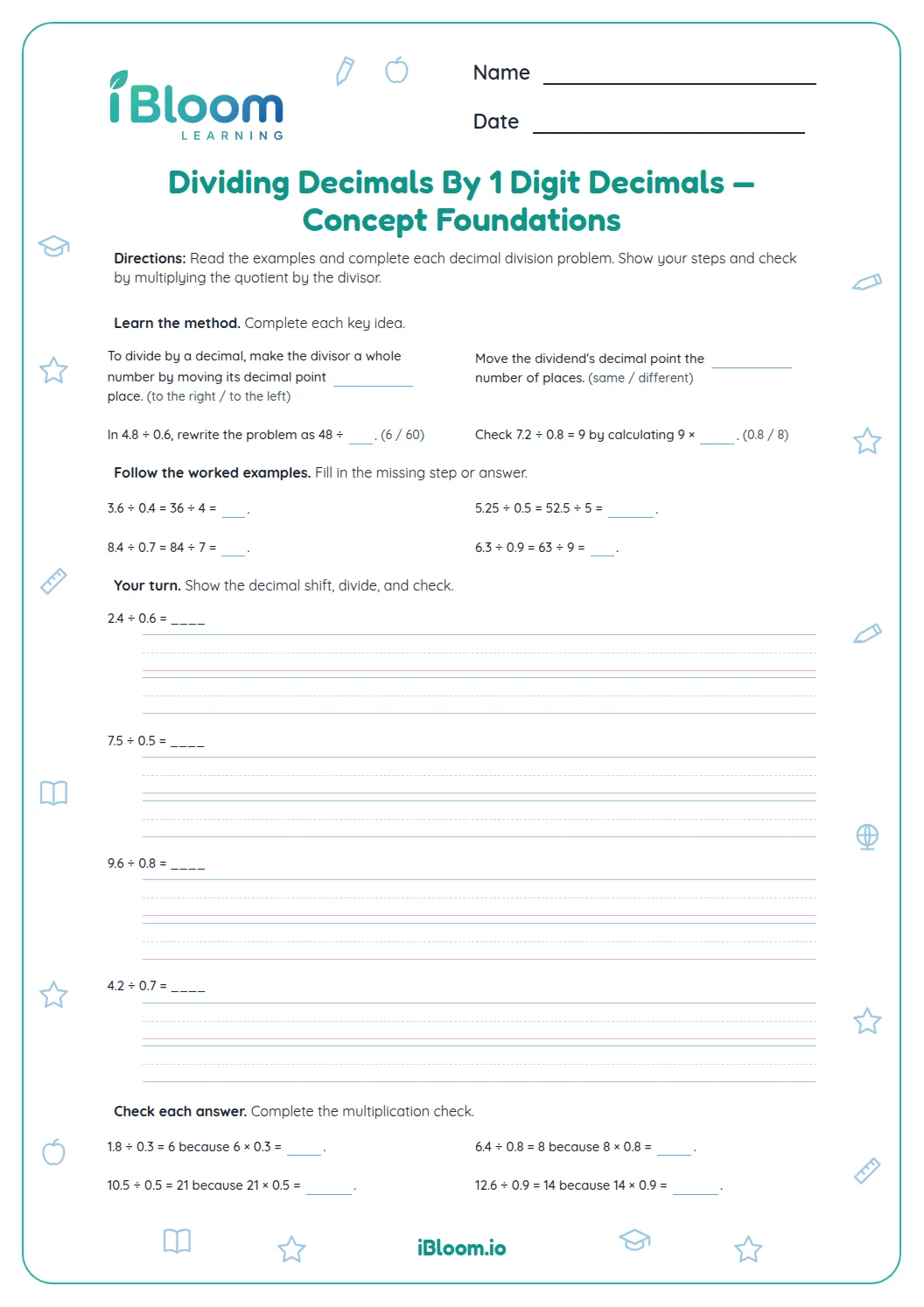
A decimal divisor can be made whole by multiplying both numbers in the division by the same power of ten. Since both numbers change by the same factor, the quotient stays the same.
How should students check a quotient?
For question 1, multiply 4.8 and 0.6 by 10. The equivalent division is 48 ÷ 6, so the quotient is 8.
- 14.8 ÷ 0.6 = 8
- 2Scale both numbers by 10: 48 ÷ 6
- 3The quotient stays 8.
What will students practice on this page?
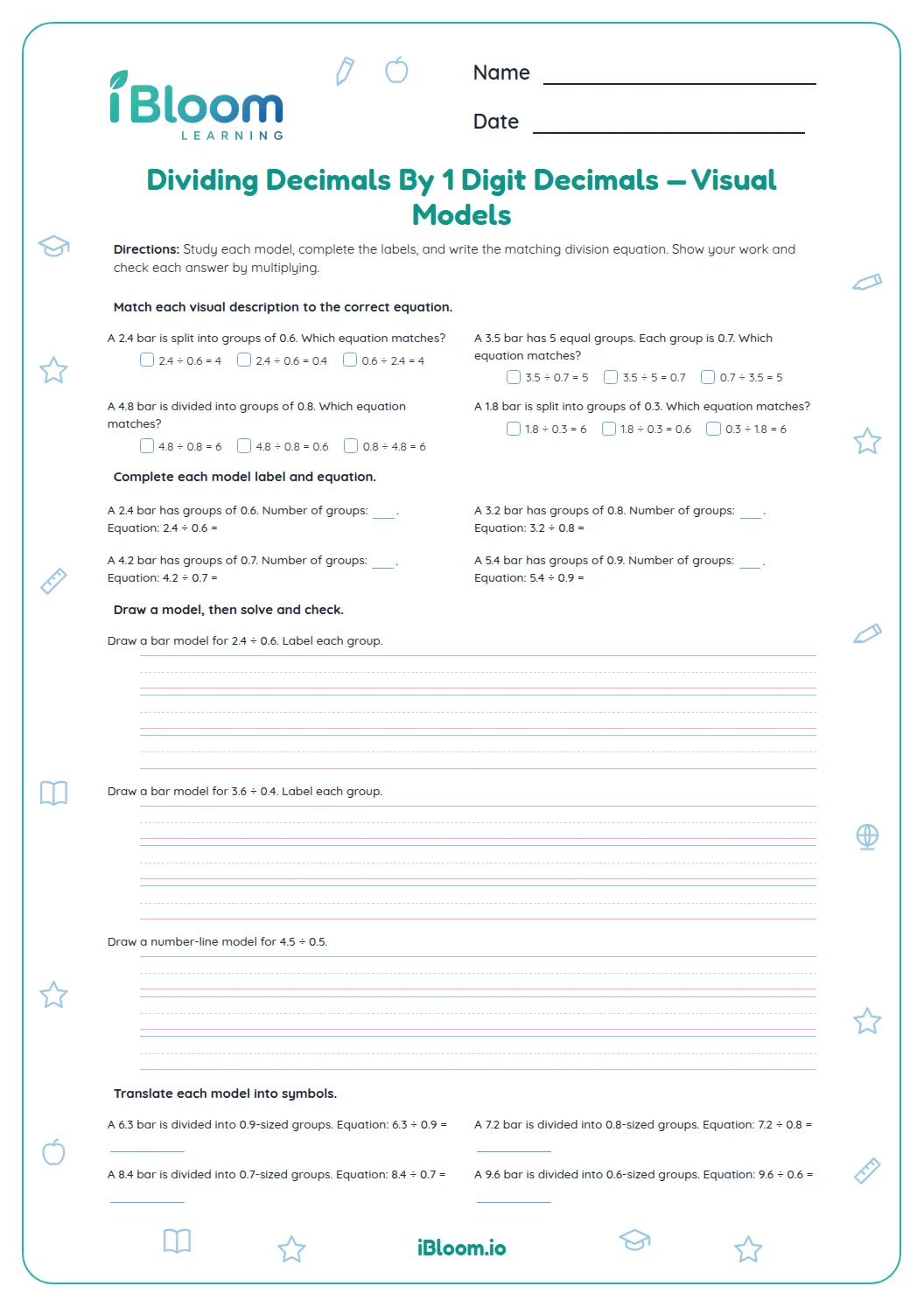
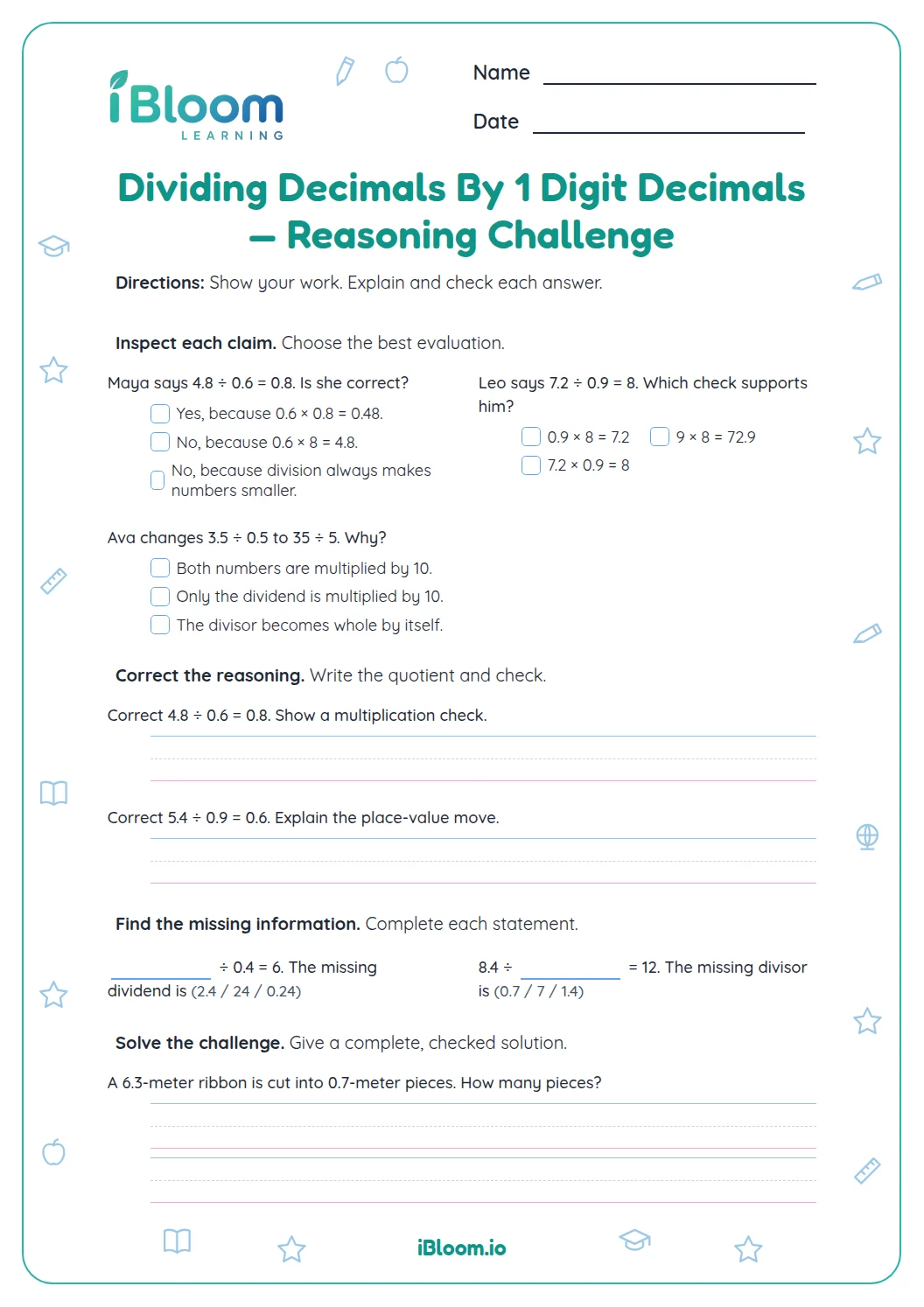
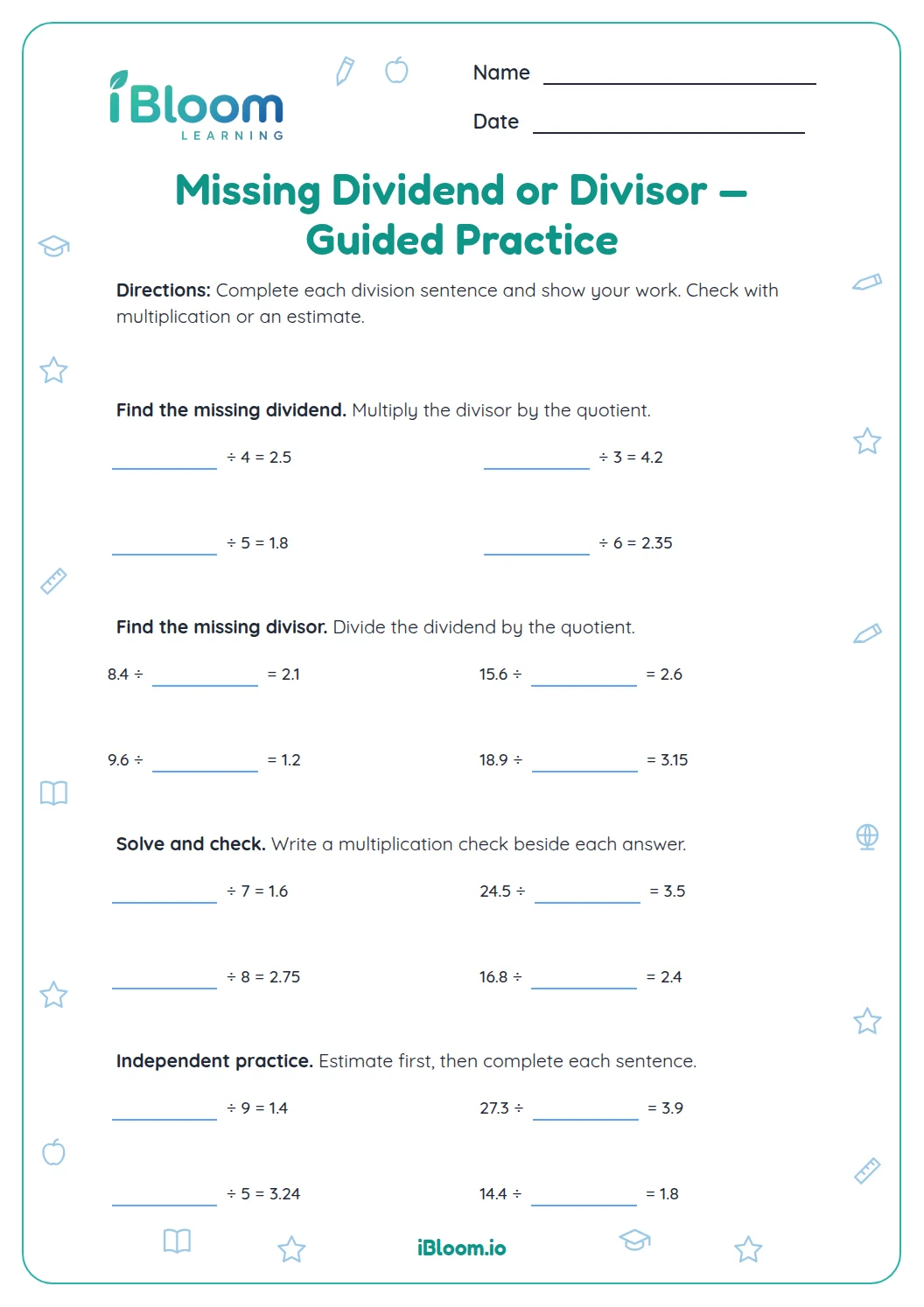
The first six items ask students to rewrite or reason about equivalent divisions. The next eight ask them to solve decimal quotients.
- Part 1: make decimal divisors whole and identify equivalent forms.
- Part 2: solve eight decimal division problems.
- The key gives 7 7/12 for the repeating quotient.
How to use this worksheet
- 1Count the decimal places in the divisor.
- 2Multiply both numbers by the matching power of ten.
- 3Rewrite the equivalent division with a whole-number divisor.
- 4Solve the original or equivalent equation.
- 5Multiply the quotient by the original divisor to check.
Common mistakes and quick fixes
The mistake
Scaling only the divisor.
The fix
Multiply the dividend by the same power of ten.
The mistake
Changing the quotient when rewriting an equivalent division.
The fix
Check that both numbers were scaled by the same factor.
The mistake
Rounding a repeating quotient without being asked.
The fix
Use an exact fraction, as in 7 7/12 for 6.825 ÷ 0.9.
Common Core alignment
This worksheet practices Grade 6 decimal division and place-value reasoning.
Use place value and the standard algorithm to divide multi-digit decimals.
On this sheet: Students solve decimal division problems using place value, equations, and checks.
Show the official wordingHide the official wording
Fluently add, subtract, multiply, and divide multi-digit decimals using the standard algorithm for each operation.
What to practice next
Make more practice
Further reading
Questions parents and teachers ask
What does this worksheet ask students to divide?
Students divide decimals by one-digit decimal divisors such as 0.6, 0.8, and 0.9. Early questions ask students to rewrite both numbers as an equivalent division with a whole-number divisor; later questions focus on solving. This makes the calculation easier to discuss and check together.
Why multiply both numbers by the same amount?
Scaling the dividend and divisor by the same power of ten keeps the quotient unchanged while making the divisor a whole number. For example, 4.8 ÷ 0.6 becomes 48 ÷ 6, and both equations have a quotient of 8. This makes the calculation easier to discuss and check together.
What is the exact answer to 6.825 ÷ 0.9?
The exact quotient is 7 7/12. Multiplying both numbers by 10 gives 68.25 ÷ 9, which equals 7.58333…; the fraction form keeps the repeating decimal exact without presenting a rounded calculator readout. This makes the calculation easier to discuss and check together.
How can students check decimal division?
Multiply the quotient by the original divisor. For 9.45 ÷ 0.9 = 10.5, calculate 10.5 × 0.9; the product is 9.45. This check helps catch errors made while scaling the divisor or placing the decimal point. This makes the calculation easier to discuss and check together.
Which part should students try first?
Start with the first part and rewrite each division so the divisor is a whole number. Then solve the second part and check the result by multiplication. The separate key gives the scaled forms and exact quotients for comparison. This makes the calculation easier to discuss and check together.