



About this worksheet
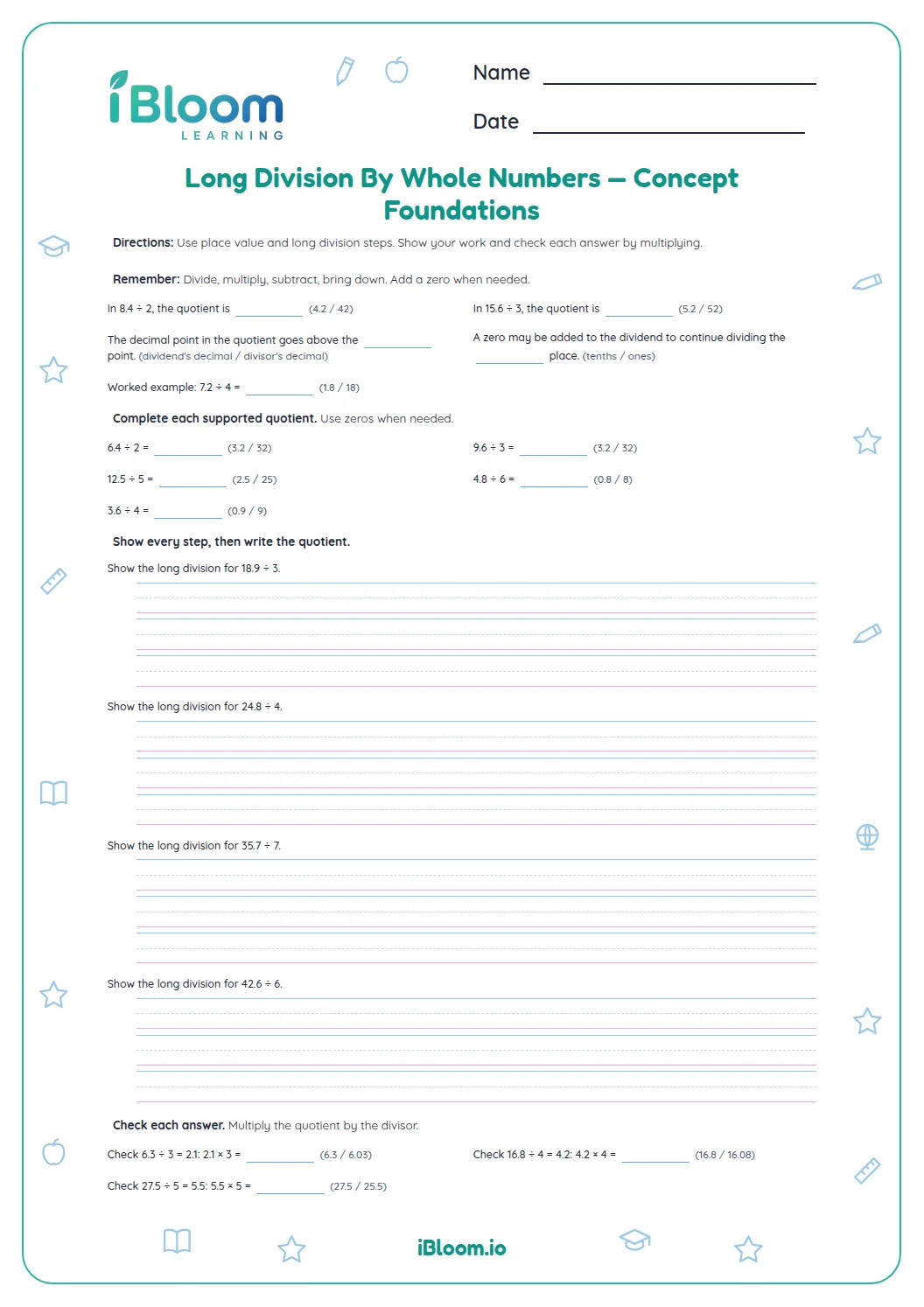
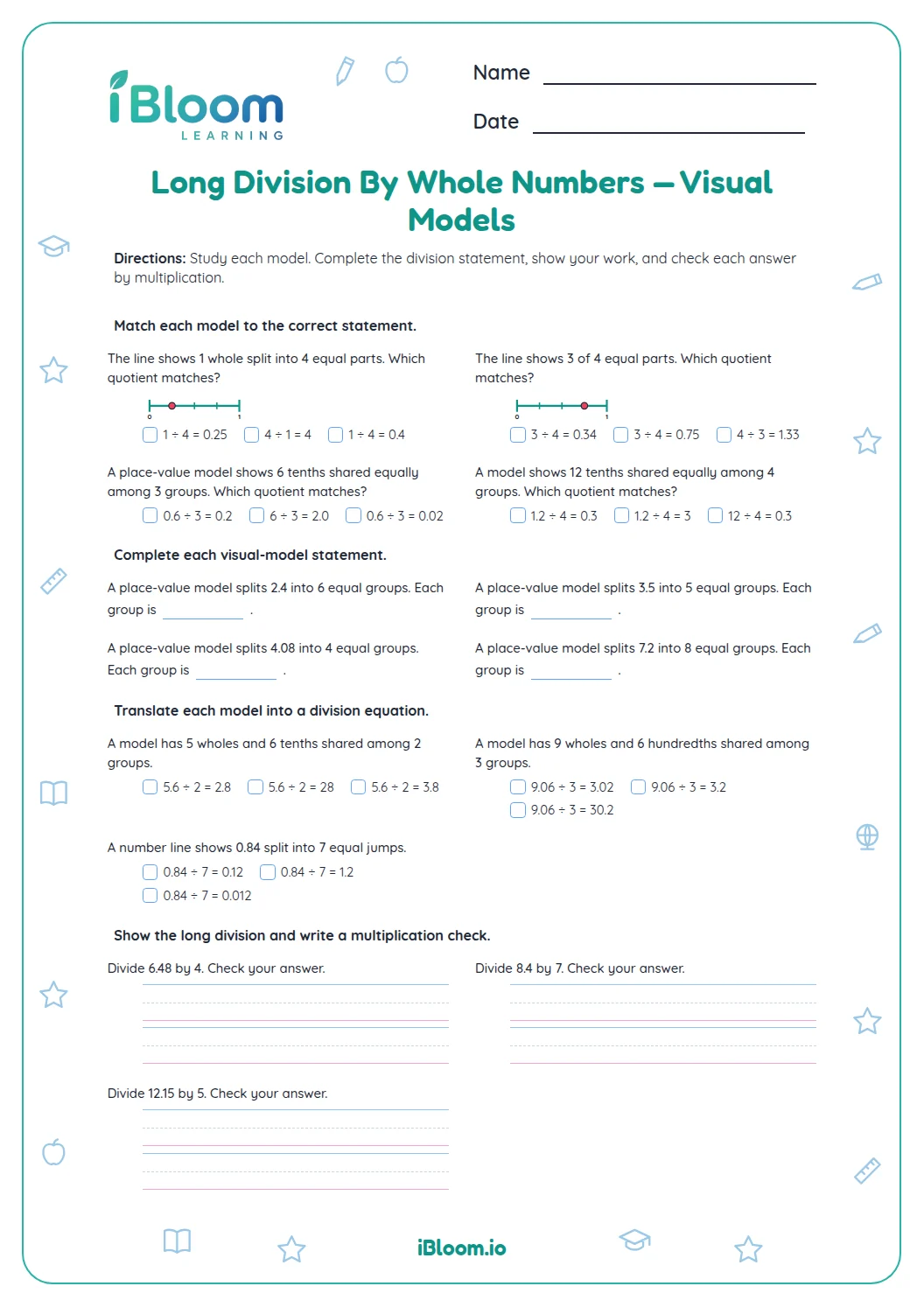
This Grade 6 worksheet builds decimal quotients from whole-number division. Students interpret tenths in a quotient, solve division facts that produce terminating decimals, and verify quotients with separate multiplication questions. The practice aligns with CCSS 6.NS.B.3 and includes a separate answer key.
Aligned to 6.NS.B.3
How do you solve dividing whole numbers and writing decimal quotients problems?
Keep the place values visible and work one operation at a time. For 7 ÷ 8, add decimal places to the dividend and continue dividing until the remainder is zero.
- 17 ÷ 8
- 2Write 7 as 7.000 and divide by 8
- 37 ÷ 8 = 0.875
- 4Check: 0.875 × 8 = 7
What does each part ask students to do?
Students begin with decimal quotients and place-value questions, then solve additional division facts and verify quotients with multiplication.
- Part A: Build a decimal quotient (4 questions)
- Part B: Study the quotient and check (5 questions)
- Part C: Write decimal quotients (5 questions)
- Part D: Check and extend (4 questions)
How can students check a decimal answer?
Use the inverse operation and estimate the size before accepting a result. Multiplication confirms that the decimal quotient returns the original whole-number dividend.
A steady way to work through the sheet
- 1Divide the whole-number dividend by the whole-number divisor.
- 2When a remainder remains, add a decimal point and zeroes to continue.
- 3Write each quotient to the needed place value.
- 4Multiply the quotient by the divisor to check.
- 5Compare the product with the original dividend.
Common decimal mistakes and fixes
The mistake
Moving a decimal point in only one number during division.
The fix
If the divisor is decimal, multiply both dividend and divisor by the same power of ten.
The mistake
Treating a trailing zero as a change in value.
The fix
Use a zero as a place-value holder: 0.7 and 0.70 name the same amount.
The mistake
Writing a correct quotient in the check space as well, or leaving the check blank.
The fix
Write the quotient in its own blank, then put the multiplication check in the separate check blank.
Common Core alignment
This worksheet practices Grade 6 decimal operations and the related place-value reasoning.
Fluently add, subtract, multiply, and divide multi-digit decimals using standard algorithms.
On this sheet: The questions practice decimal division with whole-number divisors and decimal quotients.
Show the official wordingHide the official wording
Fluently add, subtract, multiply, and divide multi-digit decimals using the standard algorithm for each operation.
What to practice next
Make more practice
Further reading
Questions parents and teachers ask
How many questions are on this worksheet?
This worksheet contains 18 questions arranged in 4 parts, plus a separate answer key. Each prompt has its own response space. Students can finish a part, check the matching key entries, and correct any decimal-place or operation errors before moving on.
What strategy does this worksheet practice?
Students use the inverse relationship between division and multiplication throughout this worksheet. When a remainder remains, add a decimal point and zeroes to continue. Write each quotient to the needed place value. The separate answer key lets an adult check the reasoning after each part.
Why does the worksheet include checking?
A check helps catch a misplaced decimal point or an arithmetic slip. Multiplying a quotient by its divisor should return the dividend, and an estimate helps show whether the result is a sensible size. Students can use both habits on the practice page.
Can students use zeros at the end of a decimal?
Yes. A zero at the end of a decimal can make place value easier to see without changing the amount, as in 0.7 = 0.70. This is useful when lining up decimal places for subtraction and when comparing equivalent amounts. The value stays unchanged.
How should the answer key be used?
Students can finish a part before checking it, then revisit any missed calculation and explain the correction. The key is on its own pages so it can be printed separately from the student worksheet. Its entries follow the same order as the practice problems.