
About this worksheet
This Grade 6 reasoning challenge practices division by one- and two-digit decimal divisors. Students solve six quotients and estimate their size, choose explanations for equivalent divisions and multiplication checks, then apply division to two measurement problems. Exact decimal quotients and estimates have separate blanks. The page practices CCSS 6.NS.B.3.
Aligned to 6.NS.B.3
What does divide and justify mean?
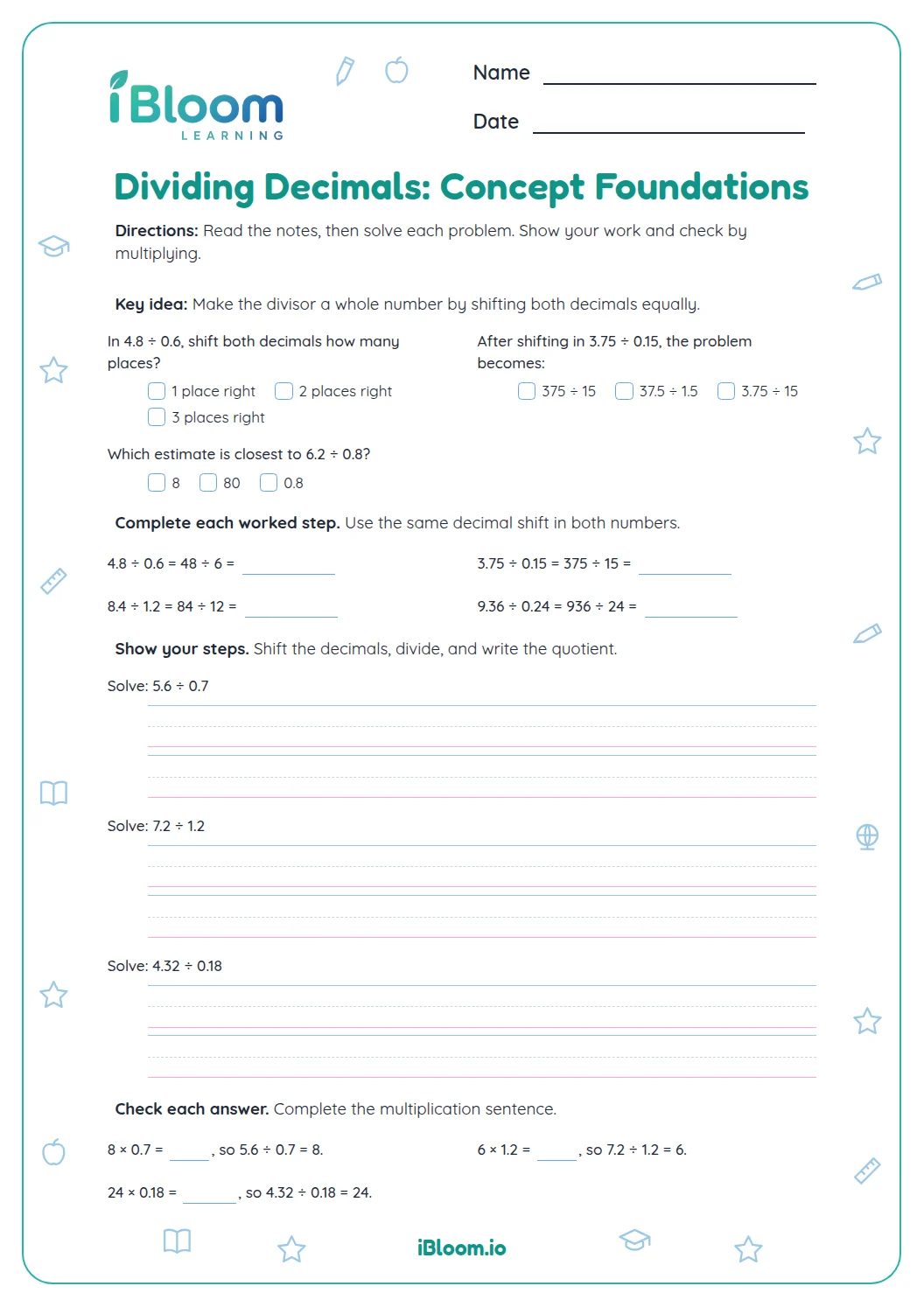
Decimal divisors can be made whole by multiplying both numbers in a division by the same power of ten. Estimation provides a reasonableness check, while multiplication can verify an exact quotient.
How should students check a quotient?
Question 1 has an exact quotient of 21 because 5.25 ÷ 0.25 = 525 ÷ 25. A nearby estimate is 20, and 21 × 0.25 returns 5.25.
- 15.25 ÷ 0.25 = 21
- 2A nearby estimate is 20.
- 3Check: 21 × 0.25 = 5.25.
What will students practice on this page?
The sheet has 14 questions in three parts: six quotient and estimate pairs, six reasoning choices, and two measurement applications with room for equations.
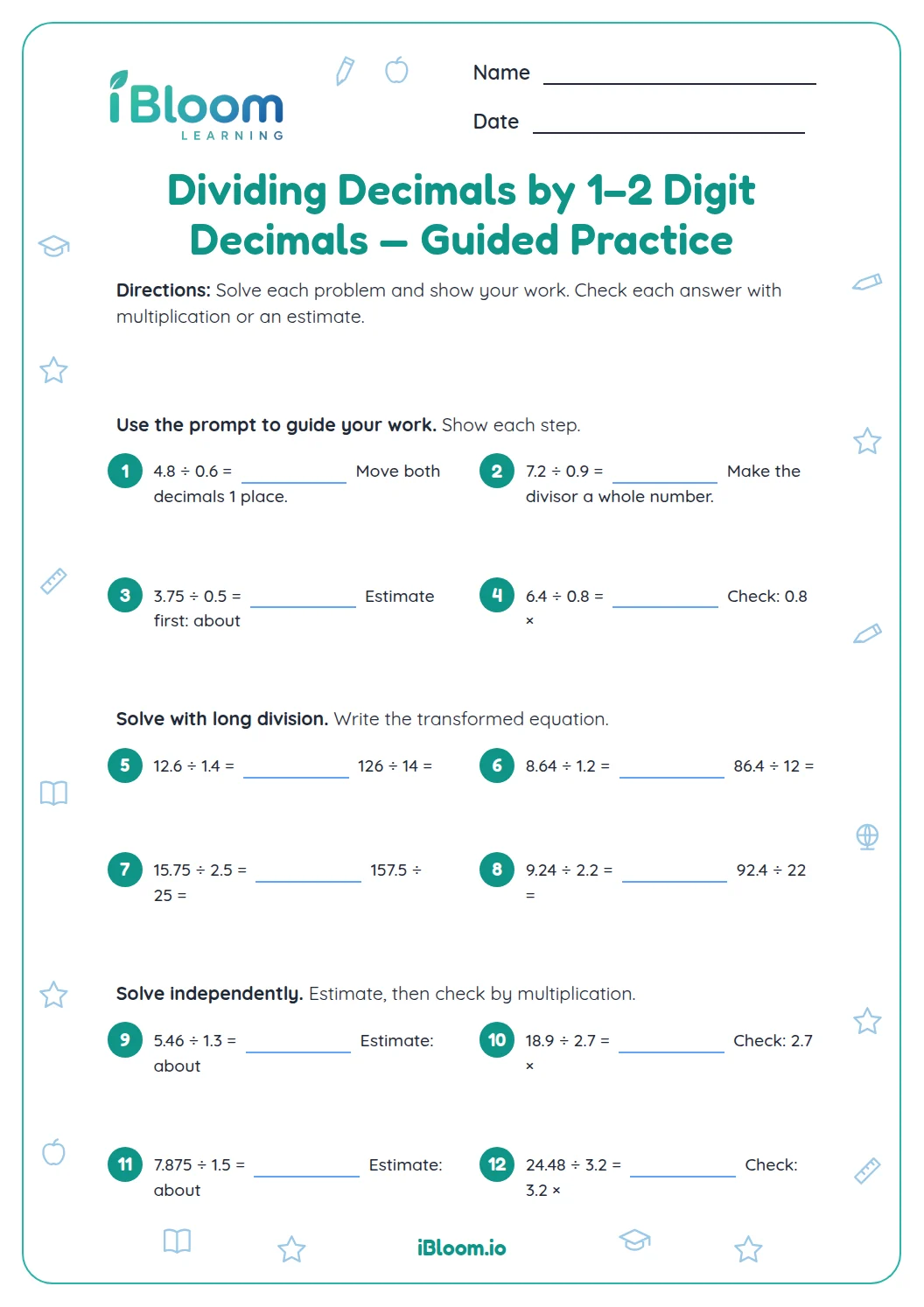
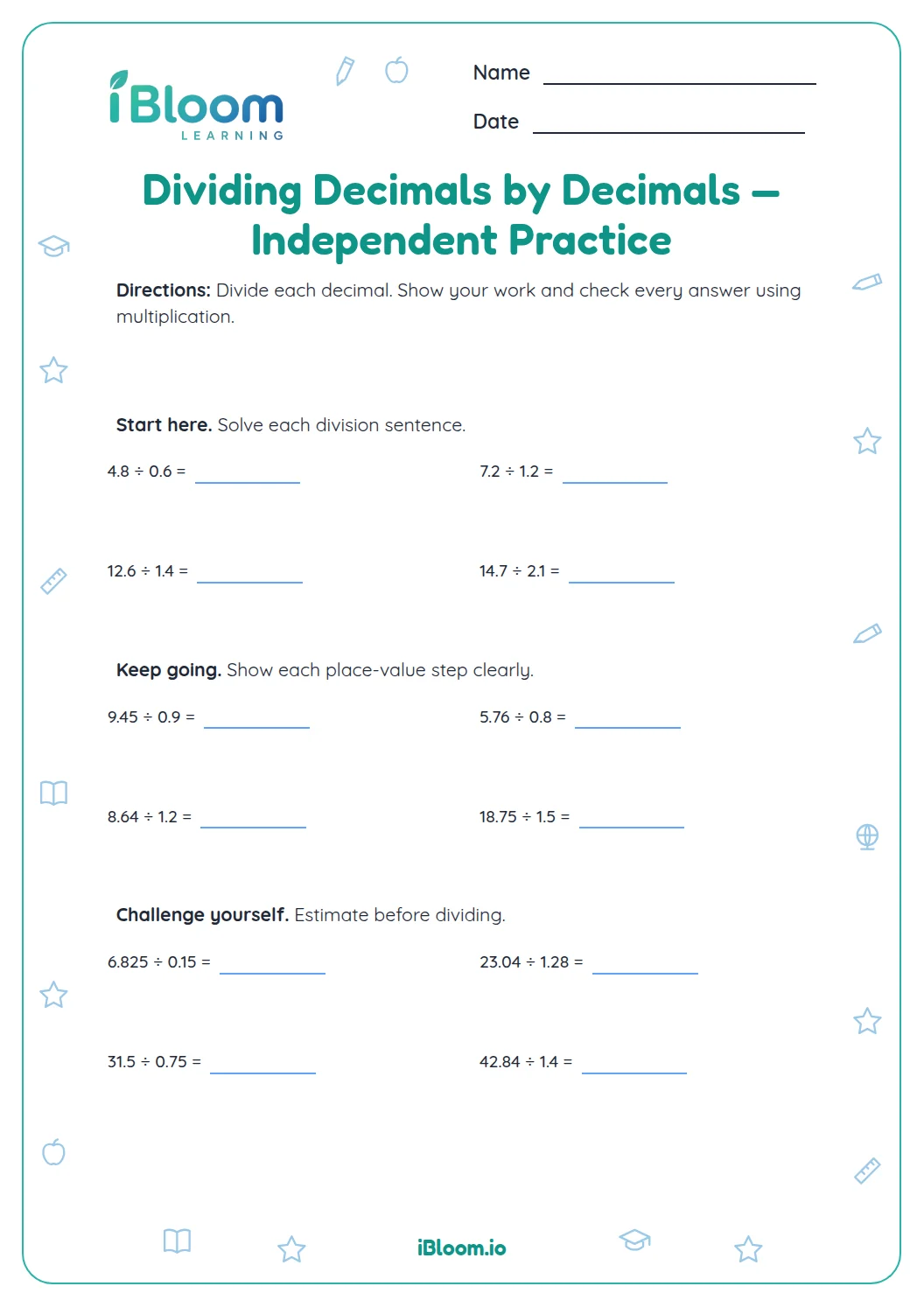
- Part 1: solve and estimate six quotients.
- Part 2: choose a scaling, estimate, or multiplication statement.
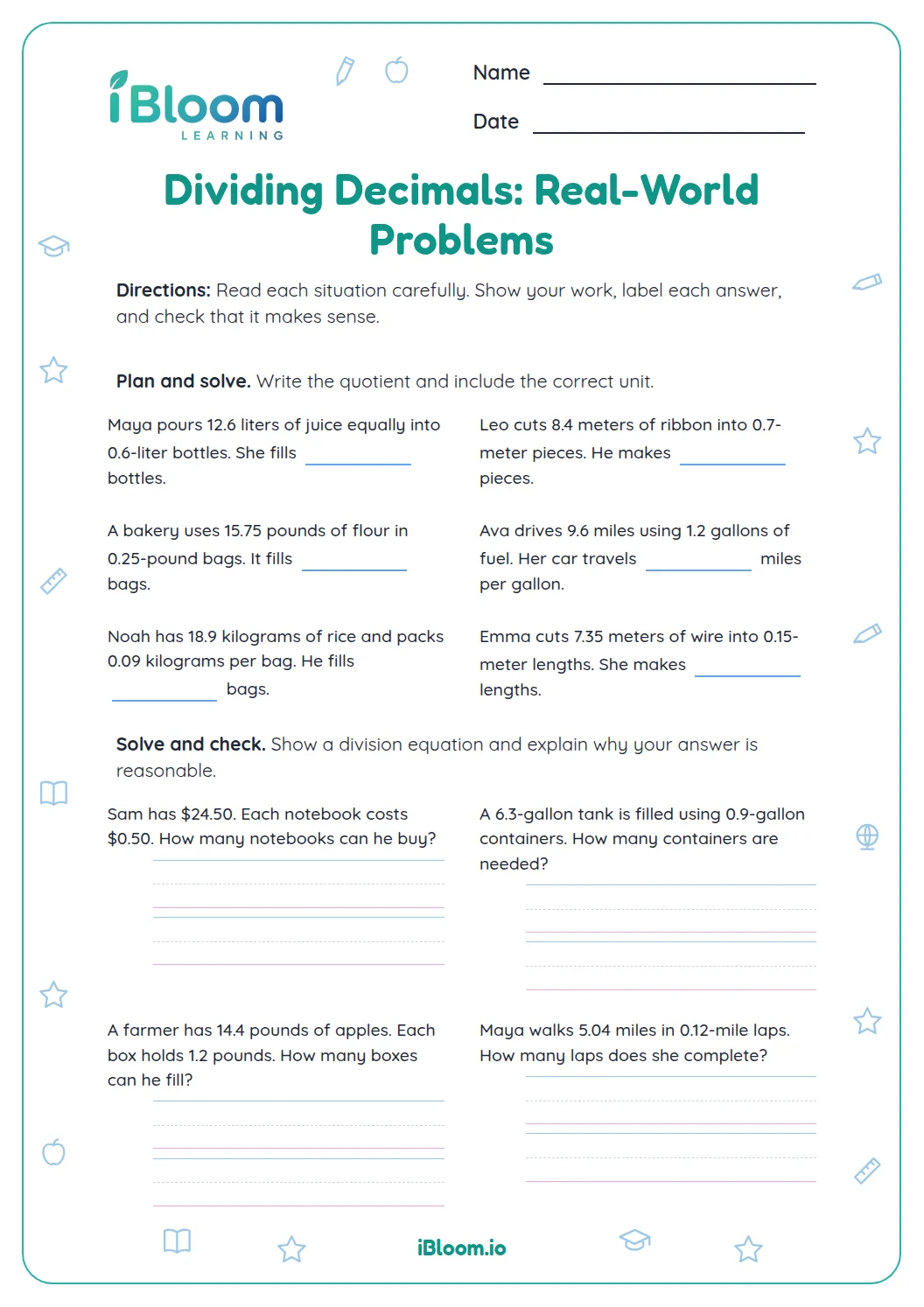
- Part 3: write and solve two measurement division equations.
How to use this worksheet
- 1Estimate each quotient with friendly values.
- 2Solve the exact division and record it separately from the estimate.
- 3For a scaled equation, name the same factor applied to both numbers.
- 4Check a quotient by multiplying by the original divisor.
- 5For the applications, divide the total amount by the amount in one group.
Common mistakes and quick fixes
The mistake
Scaling the divisor but not the dividend.
The fix
Apply the same power of ten to both numbers.
The mistake
Treating an estimate as the exact quotient.
The fix
Keep the estimate and exact answer in their separate blanks.
The mistake
Checking with a scaled divisor instead of the original divisor.
The fix
Multiply the quotient by the original decimal divisor.
Common Core alignment
This worksheet practices Grade 6 decimal division and place-value reasoning.
Use place value and the standard algorithm to divide multi-digit decimals.
On this sheet: Students solve decimal division problems using place value, equations, and checks.
Show the official wordingHide the official wording
Fluently add, subtract, multiply, and divide multi-digit decimals using the standard algorithm for each operation.
What to practice next
Make more practice
Further reading
Questions parents and teachers ask
What makes this decimal division worksheet a reasoning challenge?
Students solve quotients, make nearby estimates, choose explanations for scaling, and apply division to two measurement situations. The mix asks them to connect the calculation with a reason or a real quantity. This makes the calculation easier to discuss and check together.
How can students estimate a quotient before calculating?
Round the dividend and divisor to friendly values, then divide those values. For 5.25 ÷ 0.25, the exact result is 21, so an estimate near 20 is reasonable; the estimate is a check on scale, not a replacement for the exact answer.
Why can both numbers be scaled in a decimal division problem?
Multiplying the dividend and divisor by the same power of ten preserves the number of equal groups. For example, 6.3 ÷ 0.3 and 63 ÷ 3 both equal 21 because each number in the first expression was multiplied by 10.
What do the word problems ask students to find?
One situation asks how many 0.25-liter servings fit in 7.5 liters. The other asks how many 0.12-meter pieces can be cut from 6.72 meters. In each case, divide the total amount by the size of one group. Students can state the divisor and units before calculating.
How can students verify a decimal quotient?
Multiply the quotient by the original divisor and see whether the product returns the dividend. This check works for the standalone calculations and the measurement problems, where the quotient also needs to make sense as a number of groups. This makes the calculation easier to discuss and check together.