


About this worksheet
This Grade 6 worksheet connects dividing whole numbers by 10, 100, and 1,000 with place value. Students find each quotient, name the new value of the digits, and choose equations that match a stated shift. The questions use values through 900 and include decimal quotients where appropriate. The page practices CCSS 6.NS.B.3.
Aligned to 6.NS.B.3
What does whole numbers ÷ 10, 100, 1,000 mean?
Place-value tables make each starting number visible. Dividing by 10, 100, or 1,000 changes the unit represented by every digit, and the quotient shows the value after that shift.
How should students check a quotient?
Question 1 shows the relationship: 3,000 ÷ 10 = 300. The 3 thousands become 3 hundreds, and the quotient is 300.
- 1300 ÷ 10 = 30
- 23 hundreds become 3 tens.
- 3Use the table to track each digit’s place.
What will students practice on this page?
Eight items pair quotient and place-value statements, with tables on three representative shifts. Six more ask students to match a stated shift with a true division equation.
- Part 1: complete quotient and place-value pairs, using tables where provided.
- Part 2: finish four quotient and place-value pairs.
- Part 3: choose the equation that matches each shift.
How to use this worksheet
- 1Read the divisor and identify the number of place-value shifts.
- 2Divide the whole number to find the quotient.
- 3Name the new place of each digit.
- 4For choice questions, test the divisor and quotient in the equation.
- 5Use the answer key to check both entries in each pair.
Common mistakes and quick fixes
The mistake
Dividing by 100 but moving digits only one place.
The fix
Move two places for 100 and three places for 1,000.
The mistake
Confusing the quotient with the number of hundreds or ones.
The fix
Name the place-value unit in the prompt before writing the value.
The mistake
Choosing an equation with the right divisor but a wrong quotient.
The fix
Check that the division statement is true as well as matching the shift.
Common Core alignment
This worksheet practices Grade 6 decimal division and place-value reasoning.
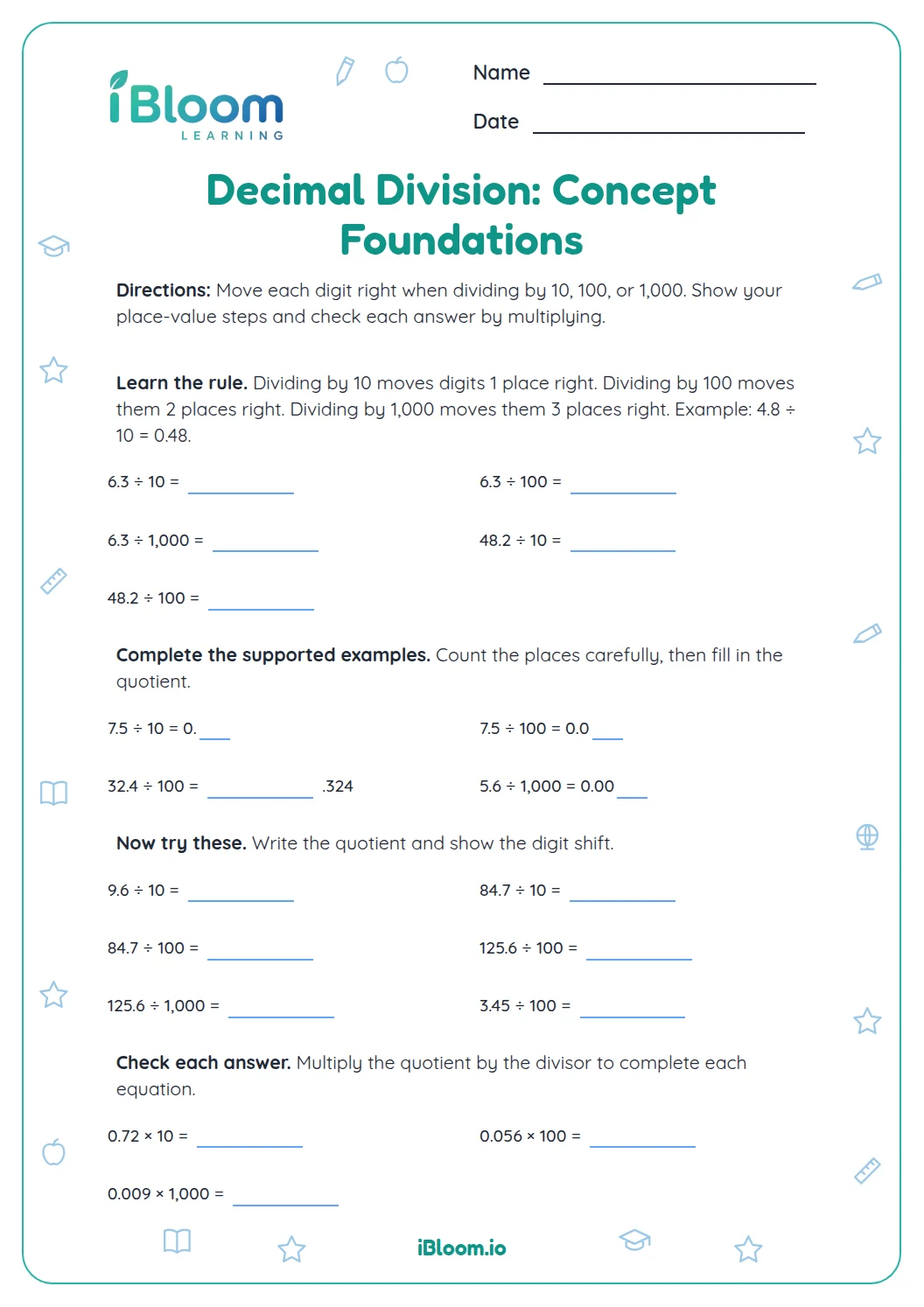
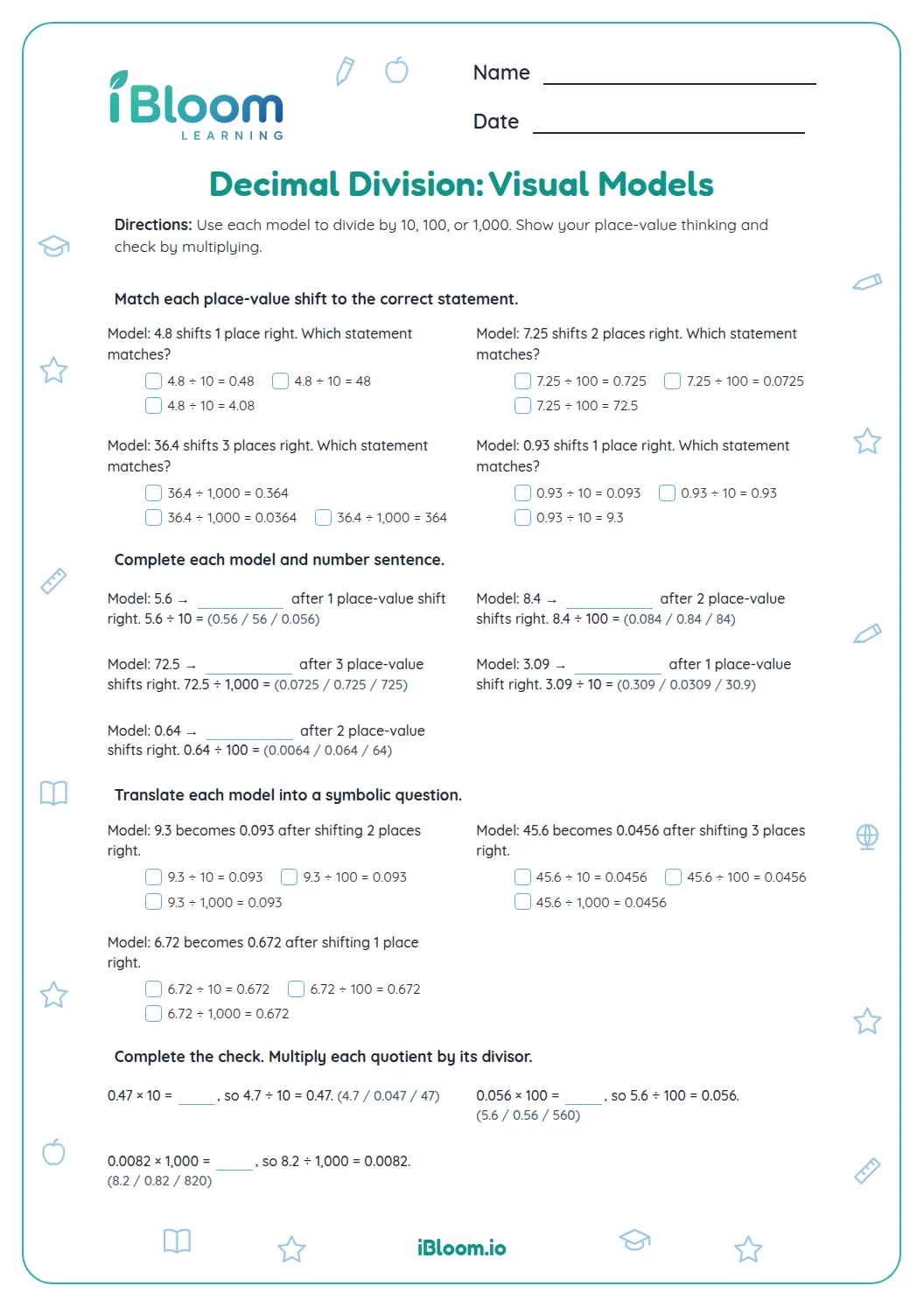
Use place value and the standard algorithm to divide multi-digit decimals.
On this sheet: Students solve decimal division problems using place value, equations, and checks.
Show the official wordingHide the official wording
Fluently add, subtract, multiply, and divide multi-digit decimals using the standard algorithm for each operation.
What to practice next
Make more practice
Further reading
Questions parents and teachers ask
What does the place-value practice show?
Students divide whole numbers by 10, 100, or 1,000 and connect the quotient to how digits change place value. The first part includes place-value tables; the later questions use equation choices. Students can compare the table with the written quotient. This makes the calculation easier to discuss and check together.
What happens to 3,000 when it is divided by 10?
The quotient is 300, or 3 hundreds. Each digit has a value one-tenth as large after division by 10, so the 3 moves from the thousands place to the hundreds place. This makes the calculation easier to discuss and check together.
Why does 275 ÷ 10 equal 27.5?
Dividing by 10 shifts each digit one place to the right in the place-value chart: 2 hundreds, 7 tens, and 5 ones become 2 tens, 7 ones, and 5 tenths. Those values total 27.5. This makes the calculation easier to discuss and check together.
How should a student use the answer key?
For the first section, compare both entries for each item: the quotient and the named place-value result. For the equation choices, check the divisor and quotient together; an equation is correct only when both match the stated shift. This makes the calculation easier to discuss and check together.
How long might this worksheet take?
About 20 minutes is a useful estimate. Students first complete eight quotient and place-value pairs, then select matching equations for six shifts. Ask them to name the place each digit moves to as they explain an answer. This makes the calculation easier to discuss and check together.