
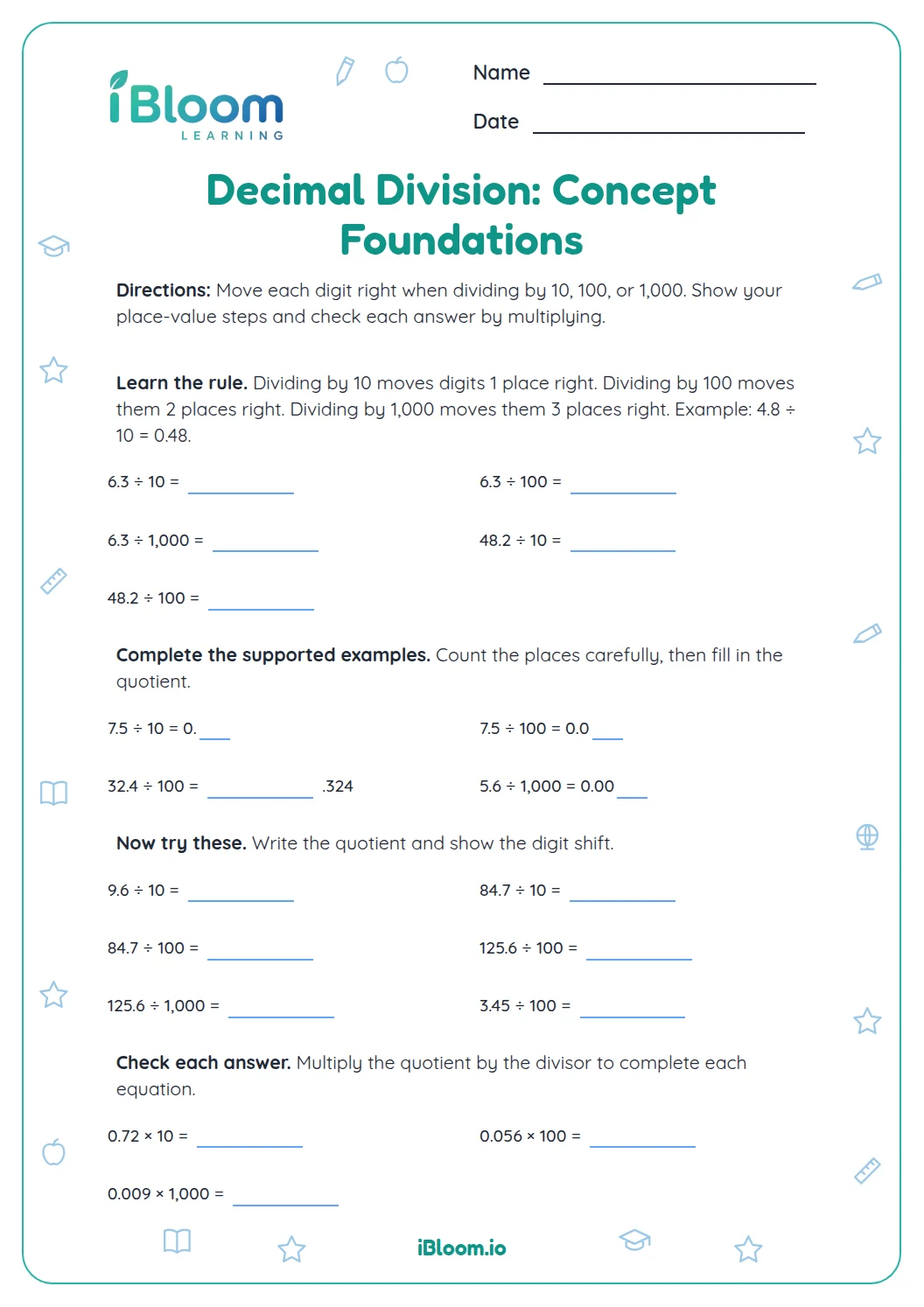
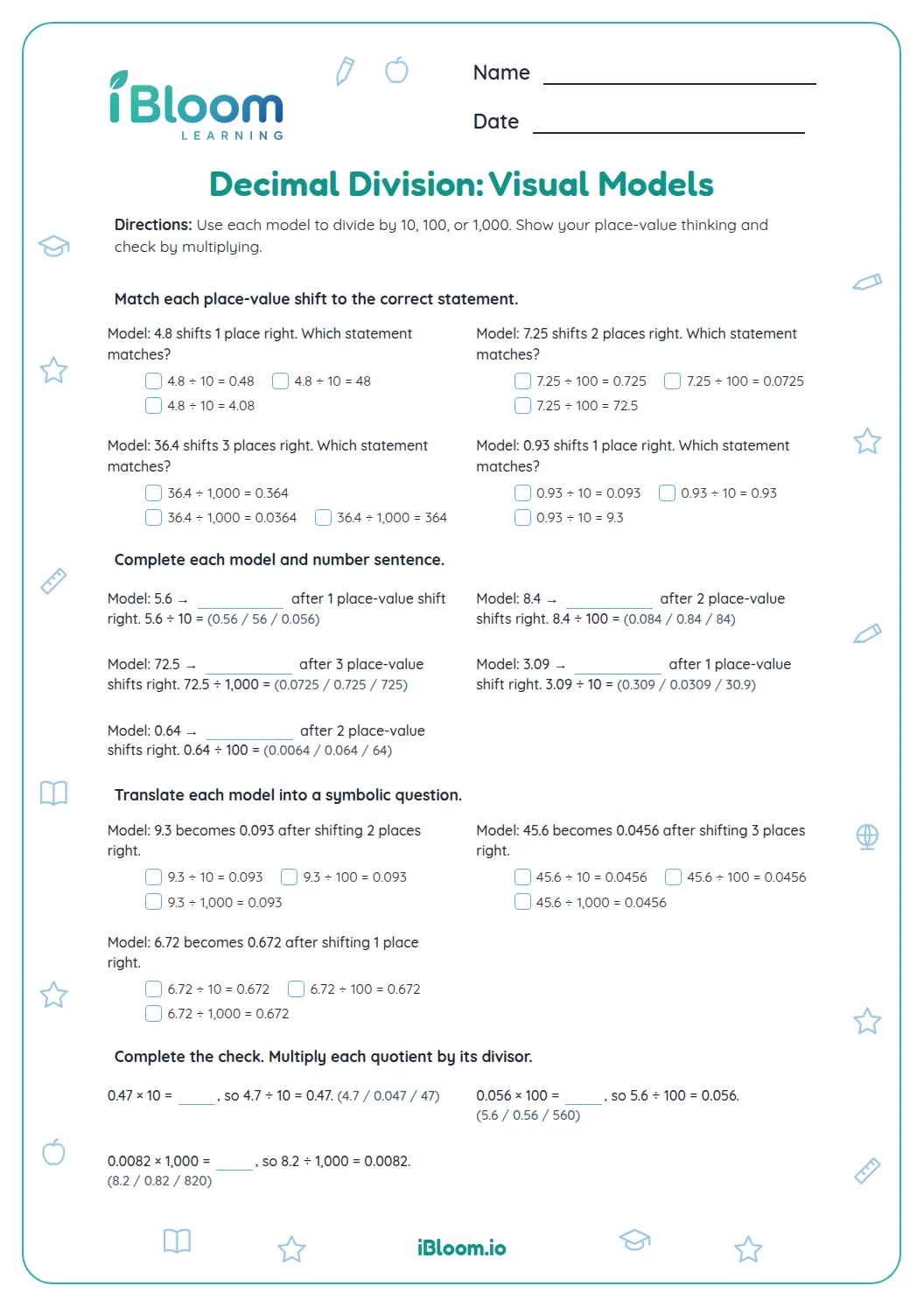
About this worksheet
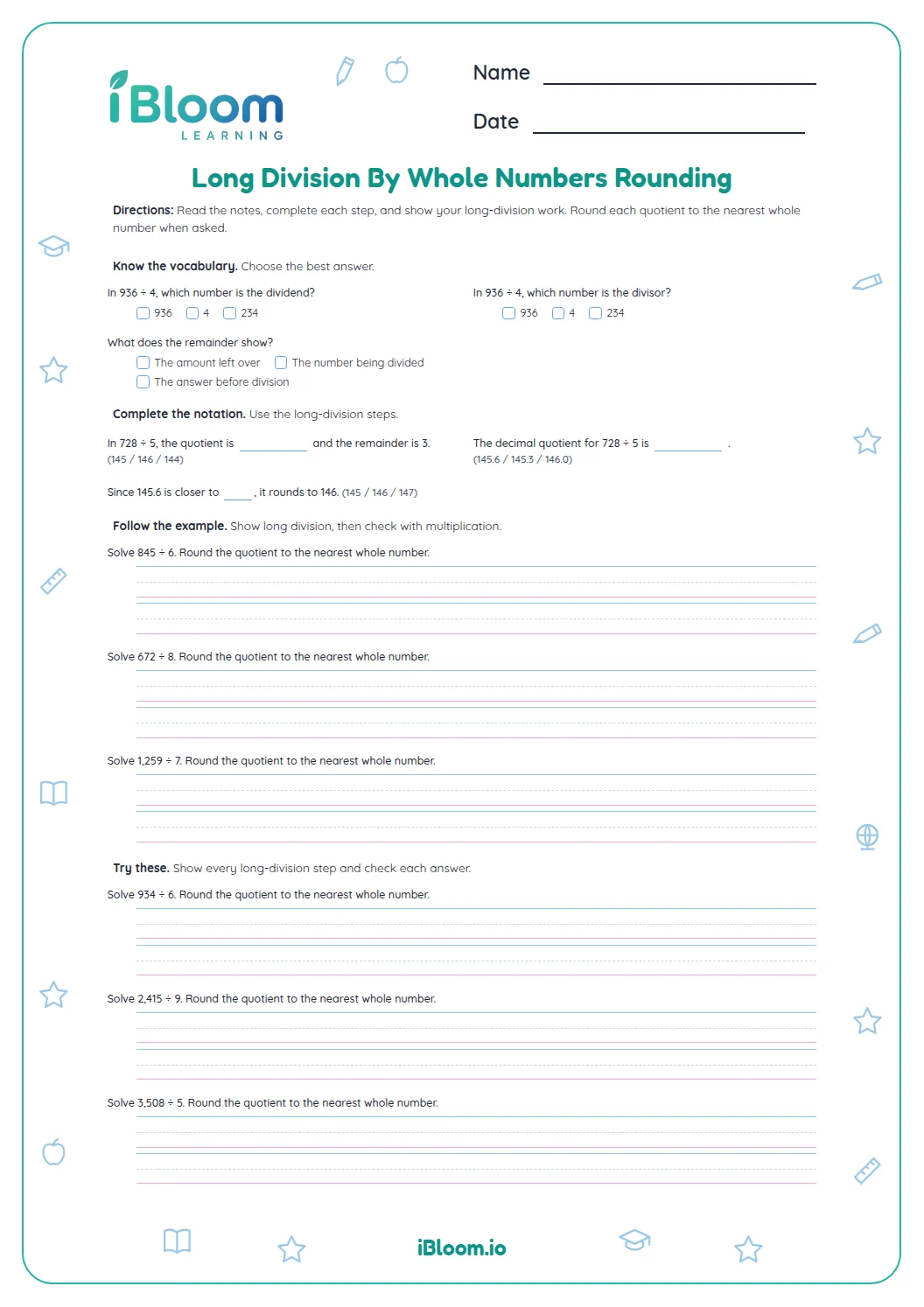
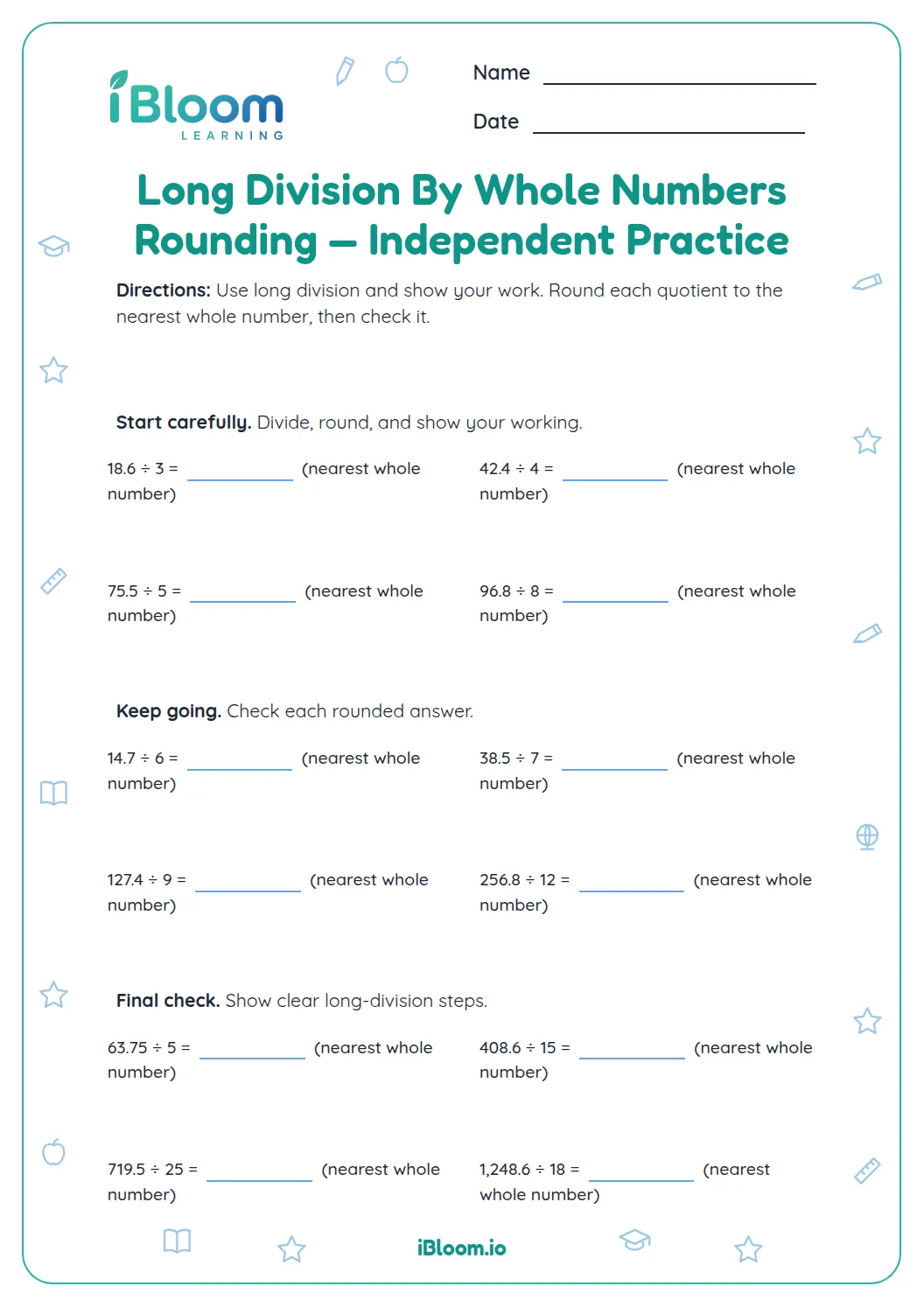
This Grade 6 worksheet practices decimal quotients from division by whole numbers and rounding to the nearest whole number. Students solve six direct problems, then use number-line models with six more quotients. Every item has a separate blank for the exact quotient and rounded value. The page practices CCSS 6.NS.B.3.
Aligned to 6.NS.B.3
What does long division and visual models mean?
Division may produce a decimal quotient even when both the dividend and divisor are whole numbers. Find that exact quotient before deciding which whole number is nearest.
How should students check a quotient?
For question 1, 6.4 ÷ 2 = 3.2. Since 3.2 is closer to 3 than to 4, the nearest whole number is 3.
- 16.4 ÷ 2 = 3.2
- 23.2 is closer to 3 than to 4.
- 3Nearest whole number: 3.
What will students practice on this page?
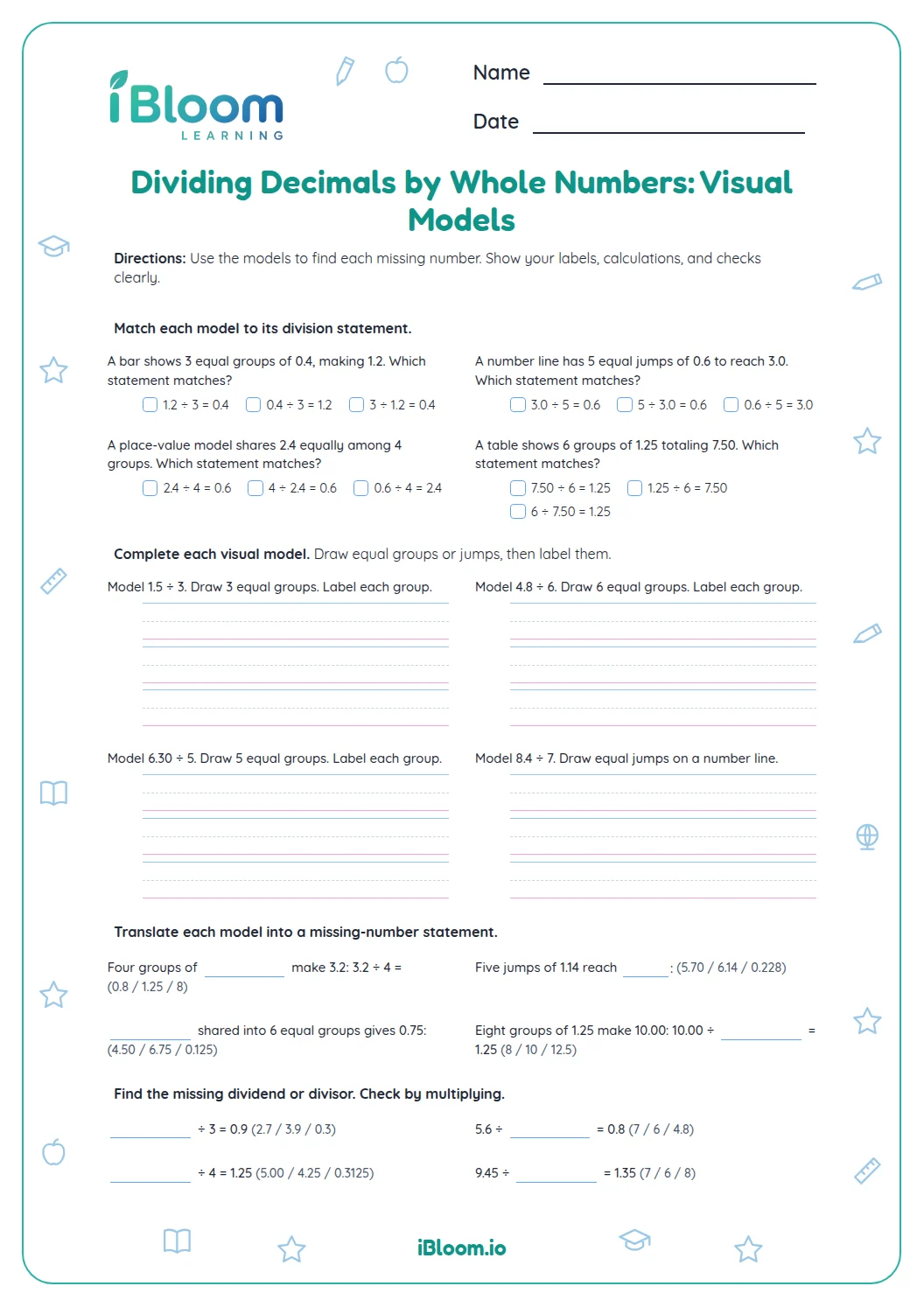
Six items ask for a quotient and rounded value directly. Six more pair the same work with number-line models that place quotients between whole numbers.
- Part 1: solve and round six decimal quotients.
- Part 2: use a number line, solve, and round six more.
- Each key response lists exact quotient first, rounded value second.
How to use this worksheet
- 1Divide to find the exact decimal quotient.
- 2Use multiplication to check the quotient if needed.
- 3For a number-line item, locate the quotient between whole numbers.
- 4Compare its distance to the neighboring whole numbers.
- 5Write the exact quotient and rounded value in separate blanks.
Common mistakes and quick fixes
The mistake
Rounding the dividend before dividing.
The fix
Find the exact quotient first, then round that result.
The mistake
Rounding 4.5 down.
The fix
At a halfway value, use the worksheet’s rule: round up to 5.
The mistake
Writing the rounded value in the exact quotient blank.
The fix
Record both numbers in their labeled spaces.
Common Core alignment
This worksheet practices Grade 6 decimal division and place-value reasoning.
Use place value and the standard algorithm to divide multi-digit decimals.
On this sheet: Students solve decimal division problems using place value, equations, and checks.
Show the official wordingHide the official wording
Fluently add, subtract, multiply, and divide multi-digit decimals using the standard algorithm for each operation.
What to practice next
Make more practice
Further reading
Questions parents and teachers ask
What skills are practiced on this rounding worksheet?
Students divide decimals by whole numbers, record exact quotients, and round those quotients to the nearest whole number. The second part adds number-line models so students can locate a quotient relative to the whole numbers around it. This makes the calculation easier to discuss and check together.
How do students round a quotient such as 3.64?
Look at the tenths digit. Since 3.64 is closer to 4 than to 3, its nearest whole number is 4. The worksheet asks students to keep the exact quotient in one blank and write the rounded result in another.
What does a number-line model help students see?
A number line shows where a quotient falls between neighboring whole numbers. For example, 4.5 is halfway between 4 and 5, so this worksheet uses the standard rule that a halfway value rounds up to 5. This makes the calculation easier to discuss and check together.
Why write the exact quotient before rounding?
Keeping both values makes the rounding decision visible. For 25.5 ÷ 6, the exact quotient is 4.25 and the nearest whole number is 4. Students can compare the decimal part with one-half before choosing the rounded value. This makes the calculation easier to discuss and check together.
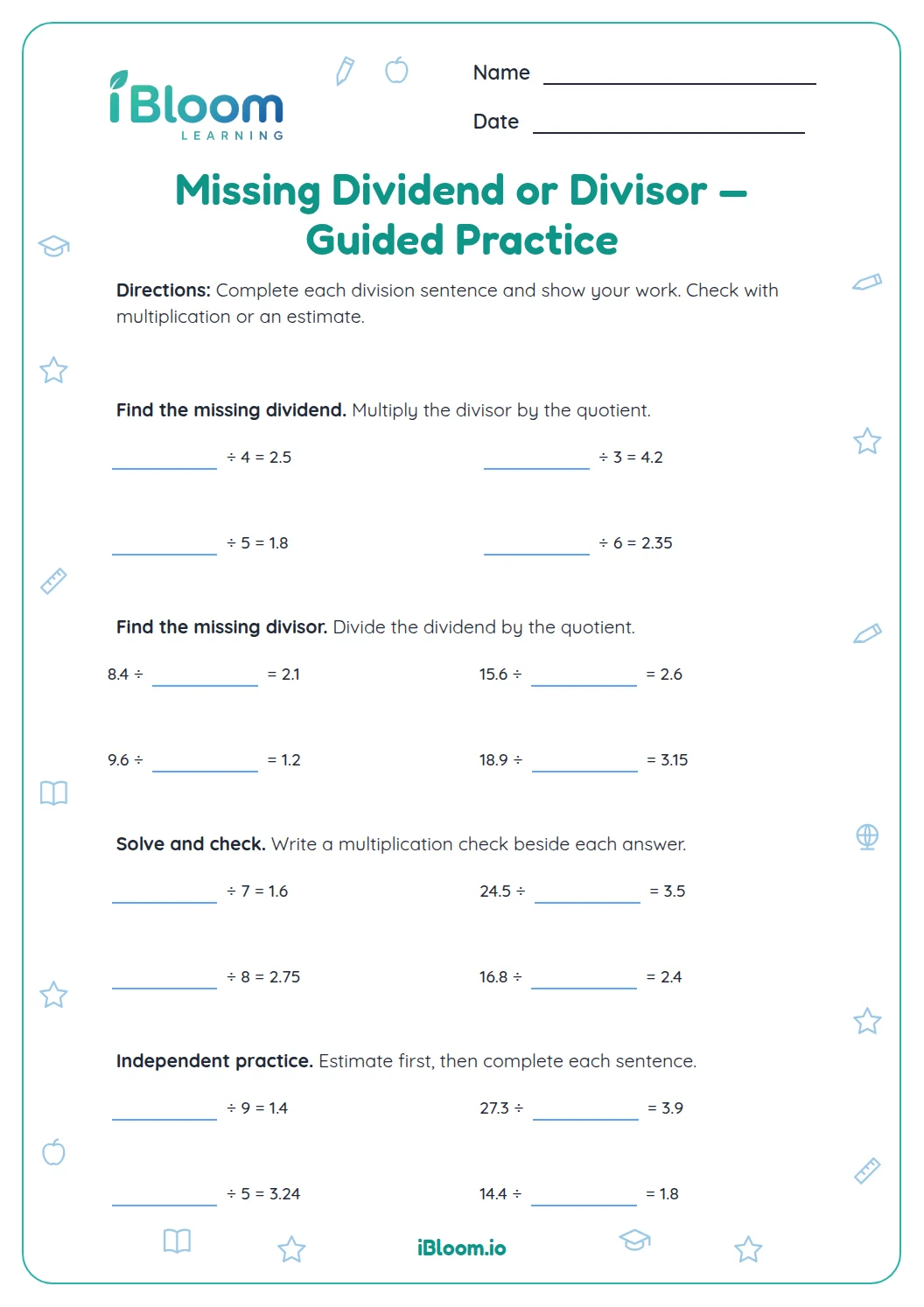
How can students check a division result?
Multiply the quotient by the divisor to see whether the product returns the dividend. If the quotient is 3.2 for 6.4 ÷ 2, then 3.2 × 2 = 6.4. After checking the exact result, round it as the prompt asks.