

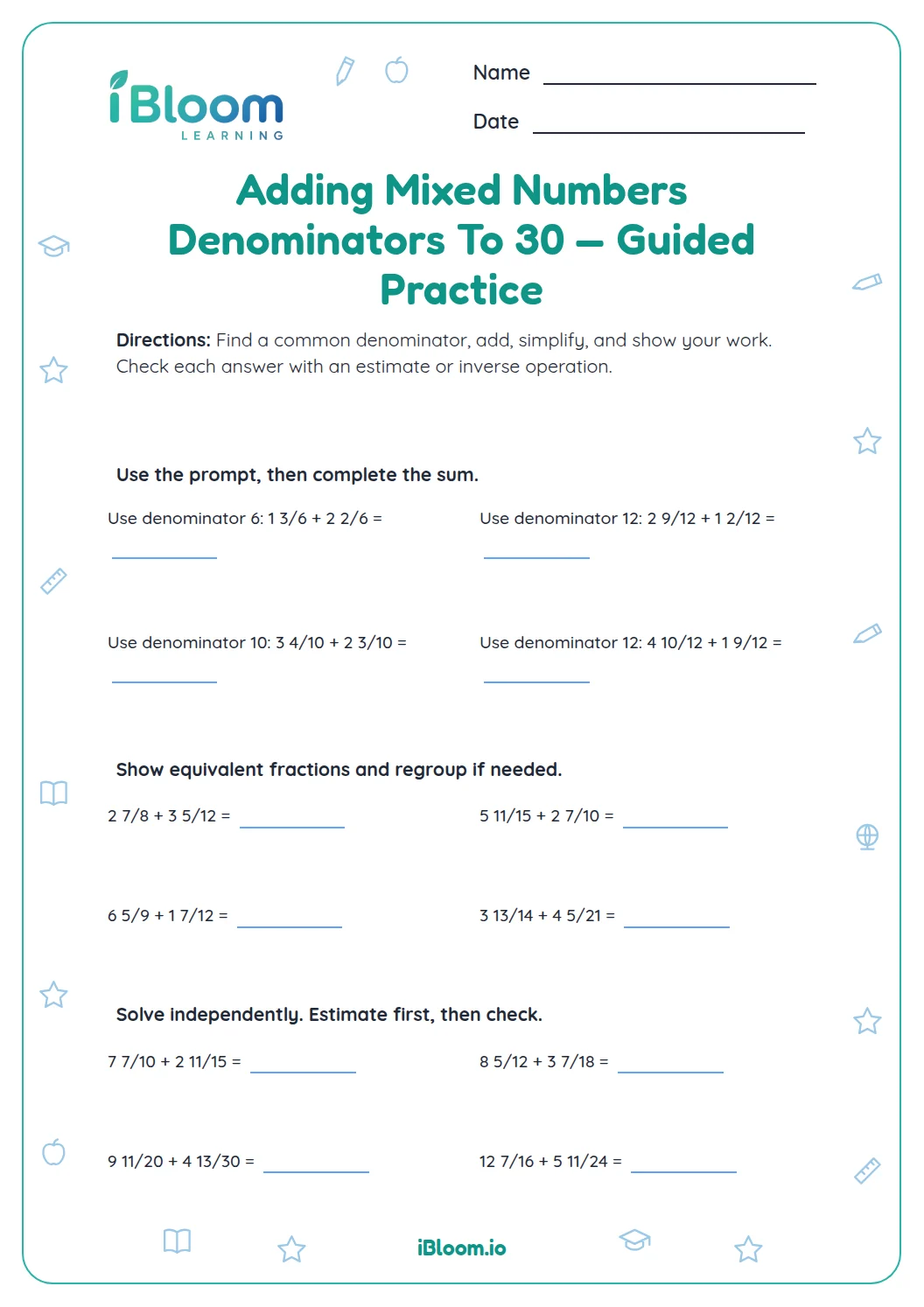


About this worksheet
This Grade 6 printable focuses on subtraction mixed numbers with unlike denominators. Across 16 questions, learners calculate, regroup, find missing numbers and use the operation in short contexts; the visual-model page also asks them to read and use fraction bars. The answer key follows the worksheet. Its common-denominator work aligns with Common Core 5.NF.A.1.
Aligned to 5.NF.A.1
How do common denominators help?
For example, the worksheet asks 9 2/7 − 4 5/6. Use denominator 42, rename 9 12/42 as 8 54/42, then subtract to get 4 19/42.
- 19 2/7 − 4 5/6
- 22/7 = 12/42 and 5/6 = 35/42
- 3Regroup: 8 54/42 − 4 35/42
- 4Answer: 4 19/42
How does regrouping change the calculation?
When the starting fraction is smaller, rename one whole from the first mixed number as fraction parts. After making equivalent fractions with a common denominator, subtract the numerators and whole numbers.
What is included on the pages?
The sheet has 16 subtraction questions, including direct calculations, missing-number problems, reasoning, and short applications. The answer key is printed separately.
What steps help solve each problem?
- 1Choose a common denominator for the fractional parts.
- 2Rewrite each fraction as an equivalent fraction.
- 3Subtract the numerators while keeping the common denominator.
- 4Rename one whole if the first fraction is too small.
- 5Combine the whole-number and fraction results, then simplify.
- 6Estimate to check that the mixed-number result is reasonable.
Common mistakes and quick fixes
The mistake
Changing the denominator when combining fractions.
The fix
Use equivalent fractions with one shared denominator; combine numerators only.
The mistake
Subtracting the smaller fraction numerator first without regrouping.
The fix
Rename one whole from the first mixed number before subtracting.
The mistake
Stopping before simplifying the final fraction.
The fix
Divide numerator and denominator by a shared factor when possible.
Common Core alignment
This worksheet practices fraction computation with unlike denominators.
Rewrite unlike fractions with equivalent fractions that share a denominator.
On this sheet: Each problem requires common denominators to add or subtract mixed numbers.
Show the official wordingHide the official wording
Add and subtract fractions with unlike denominators (including mixed numbers) by replacing given fractions with equivalent fractions in such a way as to produce an equivalent sum or difference of fractions with like denominators. For example, 2/3 + 5/4 = 8/12 + 15/12 = 23/12. (In general, a/b + c/d = (ad + bc)/bd.)
What to practice next
Make more practice
Further reading
Questions parents and teachers ask
Why do the fractions need a common denominator?
A common denominator makes both fractions name equal-sized parts. Once the pieces match, subtract their numerators and keep that denominator. Then combine the fractional result with the whole-number parts and simplify. The worked example on this page shows the conversion step.
When should a mixed-number problem be regrouped?
Regroup when the first fraction is smaller than the fraction being subtracted. Trade one whole from the first mixed number for equal fractional parts, then subtract using a common denominator. The subtraction example on this page shows the rename.
How can a student check a missing number?
Use the inverse operation to check the blank. Add the missing amount to the subtrahend when the starting number is unknown, or subtract the proposed subtrahend from the starting number when that is the blank. Confirm the original equation is true.
Are answers always written as mixed numbers?
When a result is greater than one whole, write it as a mixed number and reduce its fraction if possible. Keep a proper fraction by itself when the whole-number part is zero. Equivalent simplified forms may name the same value, but the key uses a clear standard form.
Does the printable include an answer key?
Yes. The answer key is on separate pages and gives a checked result for each of the 16 questions. Students can compare after completing the worksheet, then review any common-denominator or regrouping step that led to a different answer.