

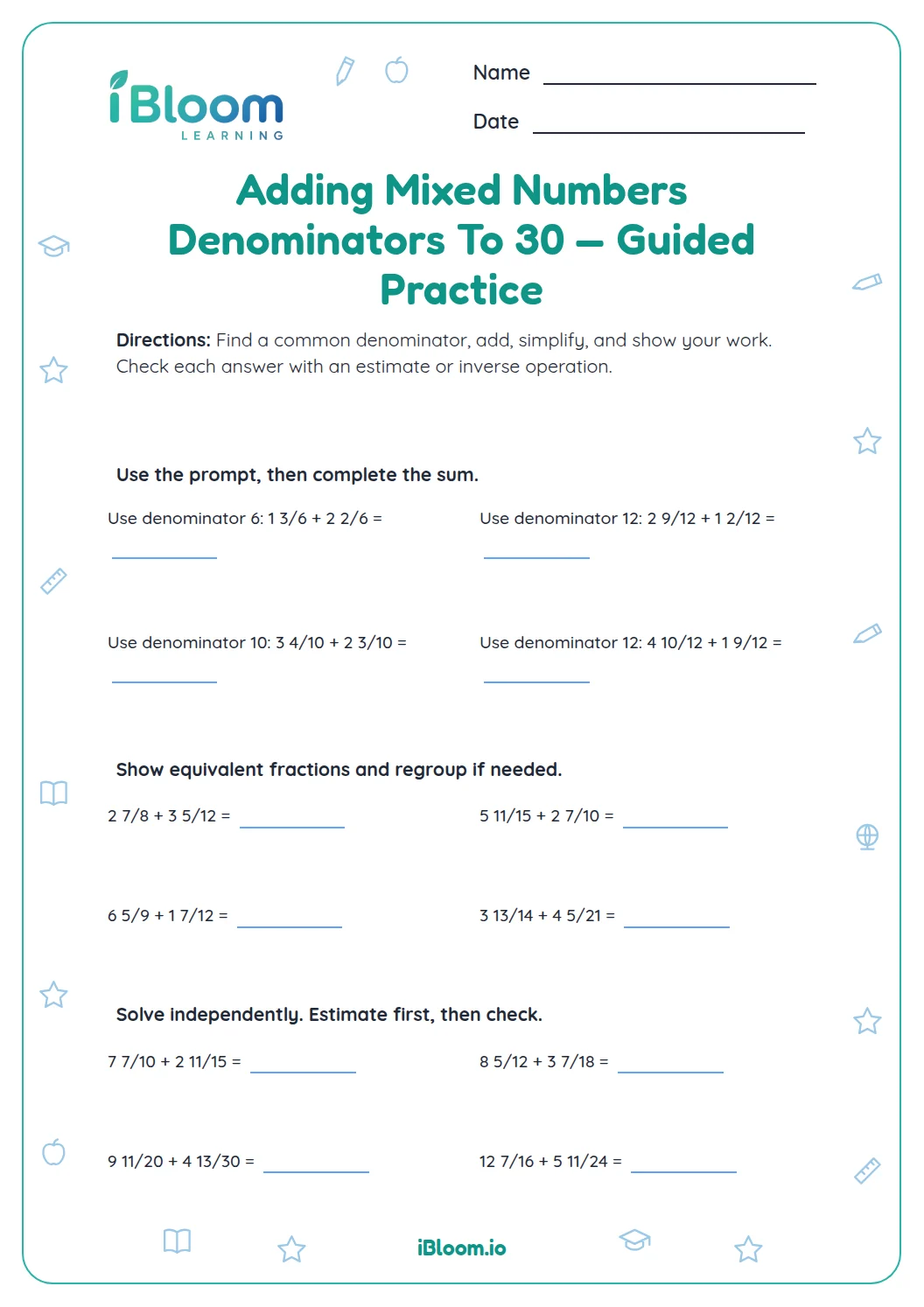


About this worksheet
This free printable Grade 6 worksheet gives students 16 questions on mixed-number subtraction. It moves from compute into explain your check, with a separate answer key. Children practice choosing common units, tracking whole groups and simplifying each result. The examples and checks are specific to this skill and align with Common Core 5.NF.B.7.
Aligned to 5.NF.B.7
How do you solve mixed-number subtraction problems?
Begin by identifying the size of the fractional parts. Use division: the quotient counts whole groups, and the remainder stays over the original denominator.
For example, 4 1/3 − 2 5/6 gives 1 1/2. Keep the whole-number and fractional steps visible, then simplify the fraction.
- 14 1/3 − 2 5/6 = ___
- 2Answer: 1 1/2
- 3Rename fractions with a common denominator.
- 4Subtract and simplify; add the difference back to check.
What does each part ask students to do?
The 16 questions progress through compute, check the reasoning, apply it, explain your check. The first part builds fluency; later parts ask students to apply or check the same skill.
- Part A: Compute — 6 questions
- Part B: Check the reasoning — 2 questions
- Part C: Apply it — 4 questions
- Part D: Explain your check — 4 questions
How can students check an answer?
Check a conversion by multiplying the whole-number quotient by the denominator and adding the remainder. The result should equal the original numerator.
How to use this worksheet
- 1Read the direction at the start of each part.
- 2Work one question at a time and show the fraction steps.
- 3Simplify every final fractional part.
- 4Check subtraction by adding back; check conversion by multiplying and adding the remainder.
- 5Use the answer key to find any step that needs another try.
Common mistakes and quick fixes
The mistake
Subtracting numerators and denominators separately.
The fix
Rename both fractions with the least common denominator, then subtract only the numerators.
The mistake
Forgetting to regroup when the first fractional part is smaller.
The fix
Trade one whole for a fraction equal to one whole, then subtract.
The mistake
Giving a result larger than the starting amount.
The fix
Estimate first: subtracting a positive amount must make the result smaller.
Common Core alignment
This worksheet practices fraction work described in the Common Core standard below.
Subtract fractions with unlike denominators by using equivalent fractions.
On this sheet: The worksheet practices fraction operations as subtraction across denominators.
Show the official wordingHide the official wording
Apply and extend previous understandings of division to divide unit fractions by whole numbers and whole numbers by unit fractions.
What to practice next
Make more practice
Further reading
Questions parents and teachers ask
What skill does this reasoning page practice?
It practices mixed-number subtraction through 16 questions that build from straightforward work to checks and applications. Students can show each step on the printed page, then compare with the separate answer key. The question formats are chosen to match the specific skill named in the worksheet title.
Why should students find a common denominator?
Fractions must name equal-sized parts before their numerators can be subtracted. Rewriting each fraction with an equivalent fraction preserves its value while making the pieces comparable. The practice set gives students repeated opportunities to identify a shared denominator and simplify the result.
How should a student check a subtraction answer?
Add the difference to the amount that was subtracted. The sum should equal the starting mixed number or fraction. If it does not, check the common denominator and any regrouping step, then simplify the final result. This reverse operation provides a quick way to catch a regrouping or arithmetic slip before marking the page.
What is included with the printable?
The page includes a student worksheet and a separate answer key. The key lists a concise answer for every question so an adult can check work or a student can review missed items after completing the practice. It is designed for independent review or adult guided practice.
Can students write equivalent answers?
Yes, when an answer represents the same value and is simplified as requested. For example, equivalent fractions name the same amount, though the worksheet key shows the simplest form for quick checking. Mixed-number answers should keep a proper fractional part.