





About this worksheet
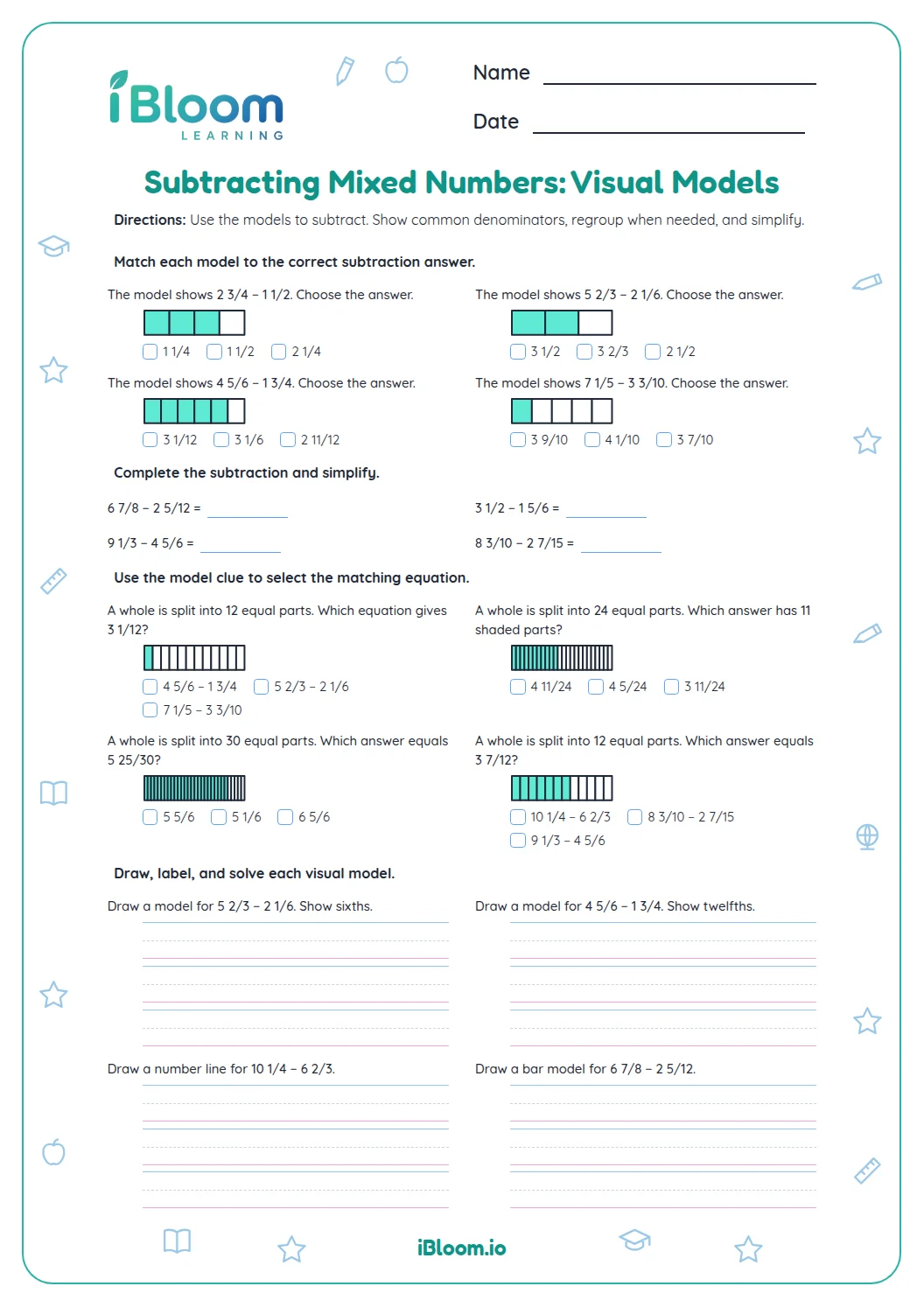
This free Grade 6 worksheet gives students 15 problems in subtracting mixed numbers with unlike denominators. It practices the equivalent-fraction method in CCSS 5.NF.A.1, including regrouping when needed. The two-page sheet moves through computation, a strategy check, and applied or reasoning questions; a two-page answer key follows.
Aligned to 5.NF.A.1
How do you subtract mixed numbers?
Find a least common denominator and rename both fractional parts. If the first fraction is smaller, trade one whole for parts of that denominator before subtracting.
Keep the value unchanged when renaming. Reduce the final fraction when its numerator and denominator share a factor.
- 1For 12 7/10 − 5 11/20, rename 7/10 as 14/20.
- 2Trade one whole: 11 34/20 − 5 11/20.
- 3Subtract: 6 23/20 = 7 3/20.
How can an estimate catch an error?
A subtraction result should be smaller than the starting amount, and adding the result back to the amount subtracted should recover the starting number.
Use exact common-denominator work to finish; estimation checks the result but does not replace the calculation.
What does the worksheet ask students to do?
The sheet has 15 questions across three parts. It starts with subtracting mixed numbers, then checks a method or claim, and finishes with independent reasoning or short applications.
- Part A: rename fractions and subtract, regrouping when needed.
- Part B: check an equivalent form or a common-denominator strategy.
- Part C: use the operation in a question or check a mathematical claim.
- The answer key follows the two worksheet pages.
A clear routine for subtracting mixed numbers
- 1Find a common denominator for both fractions.
- 2Rename each fraction with an equivalent fraction.
- 3If needed, trade one whole for denominator-sized parts.
- 4Subtract the numerators and whole numbers.
- 5Simplify, then check the size of the difference.
Common subtraction errors to watch for
The mistake
Subtracting numerators while the denominators are different.
The fix
Rename both fractions with the same denominator first.
The mistake
Subtracting a larger fraction from a smaller one without regrouping.
The fix
Trade one whole for equivalent fractional parts before subtracting.
The mistake
Leaving an improper fraction or an unreduced answer.
The fix
Rename improper fractions as mixed numbers and reduce when possible.
Common Core alignment
This worksheet practices adding or subtracting fractions with unlike denominators, including mixed numbers, by renaming them as equivalent fractions.
Add and subtract fractions with unlike denominators.
On this sheet: The computation items use equivalent fractions to produce like denominators before adding or subtracting.
Show the official wordingHide the official wording
Add and subtract fractions with unlike denominators (including mixed numbers) by replacing given fractions with equivalent fractions in such a way as to produce an equivalent sum or difference of fractions with like denominators. For example, 2/3 + 5/4 = 8/12 + 15/12 = 23/12. (In general, a/b + c/d = (ad + bc)/bd.)
What to practice next
Make more practice
Further reading
Questions parents and teachers ask
Why do the fractions need a common denominator?
The denominator names the size of each part. A common denominator gives both mixed numbers equal-sized parts, so the numerators can be combined accurately. For example, sixths and fourths can both be renamed as twelfths before the calculation. This worksheet practices that equivalent-fraction step in every computation.
When should a student regroup in subtraction?
Regroup when the fraction being subtracted is larger than the starting fractional part. Trade one whole for a fraction equal to one whole in the common denominator, then subtract. With twelfths, one whole becomes 12/12, and the mixed number keeps its value.
How can I check a subtraction result?
A difference should be less than the starting amount when a positive amount is subtracted. Add the difference back to the amount subtracted to see whether the starting number returns. The key lists the simplified answer for each problem, so students can check after showing their own work.
What is included in the printable?
The printable has 15 questions arranged in three parts over two worksheet pages, followed by a two-page answer key. It includes mixed-number subtraction with regrouping, an equivalent-form check, and short applications. Students can write their calculations beside each item.
How long might this worksheet take?
Plan for about 25 minutes, allowing time to write equivalent fractions and simplify. A student who is still learning to regroup may need longer to show each step. The worksheet is designed for pencil-and-paper practice, and the separate answer key can be used after the work is complete.
What does regrouping mean here?
Regrouping trades one whole for an equivalent fraction when the starting fractional part is too small to subtract. With twelfths, 5 1/12 can be renamed as 4 13/12. The value stays the same, but there are enough fractional parts to complete the subtraction.