


About this worksheet
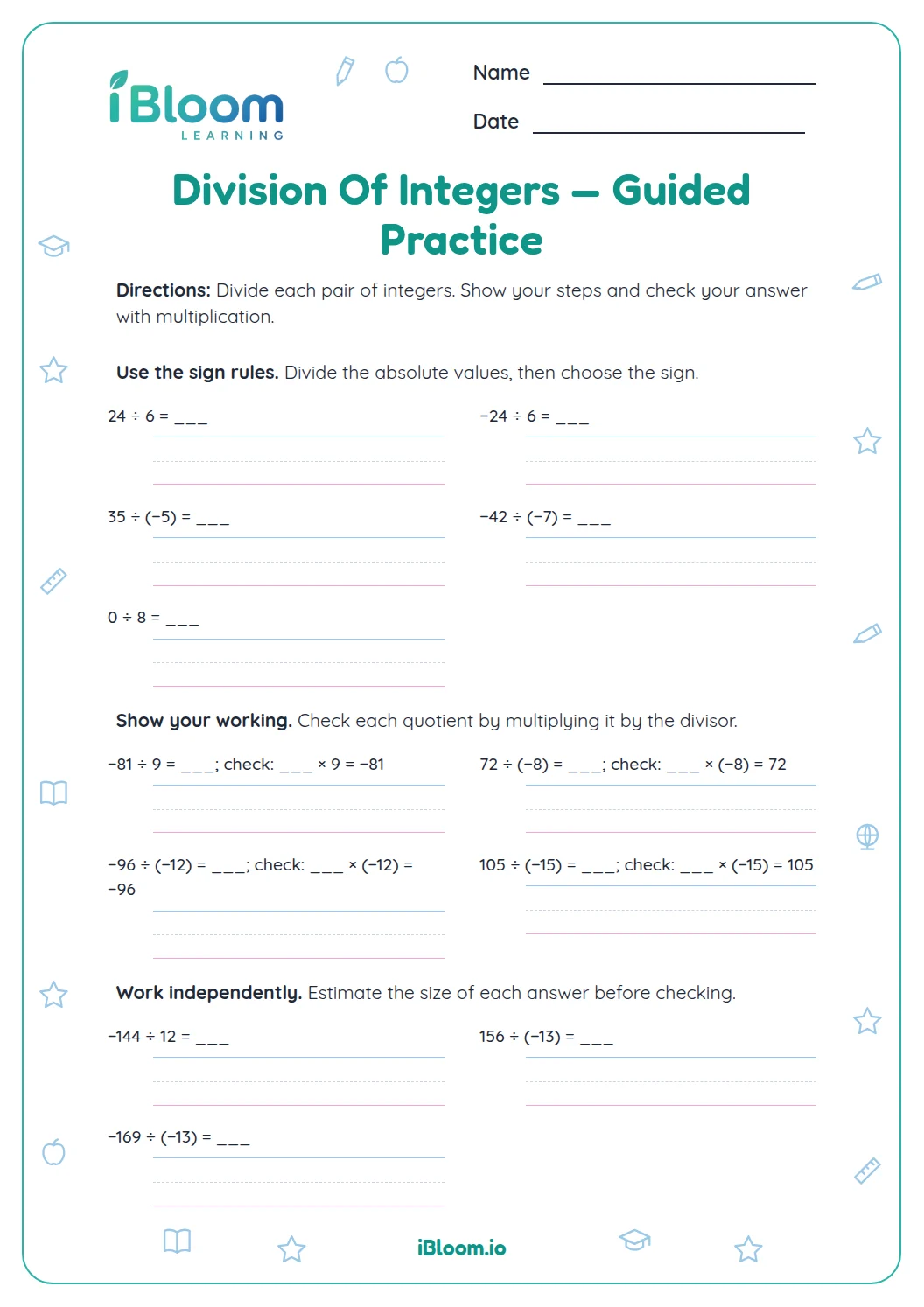
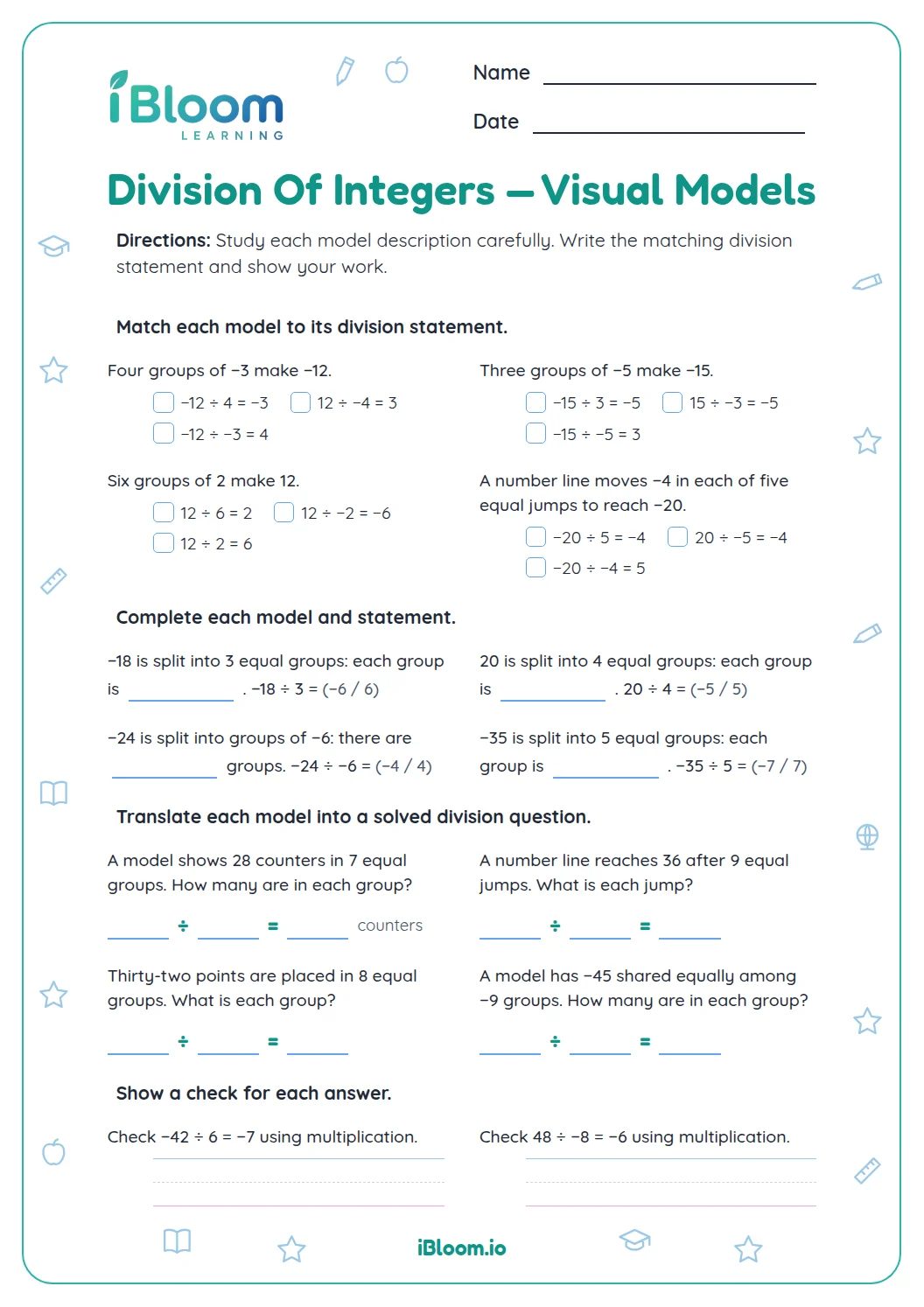
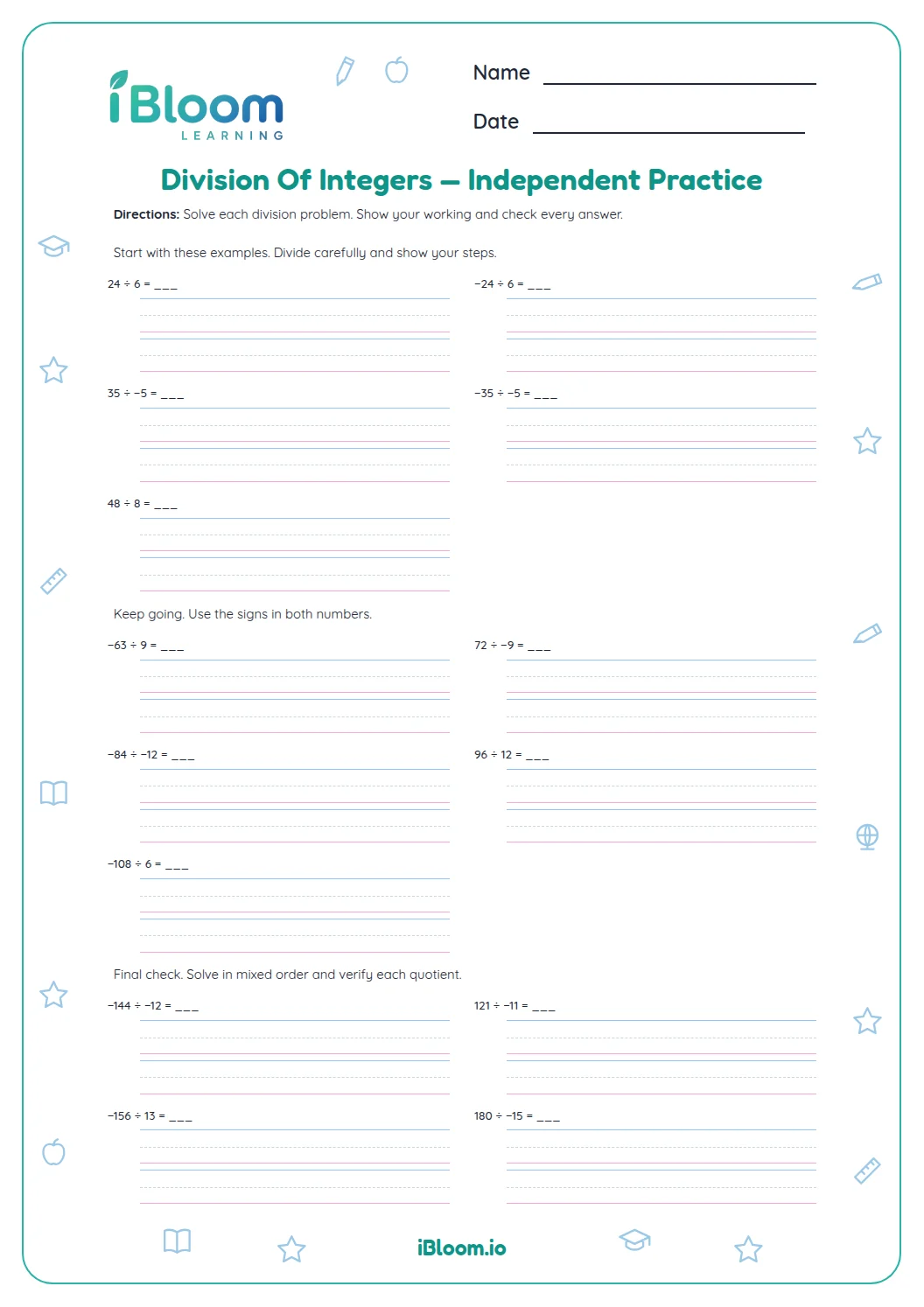
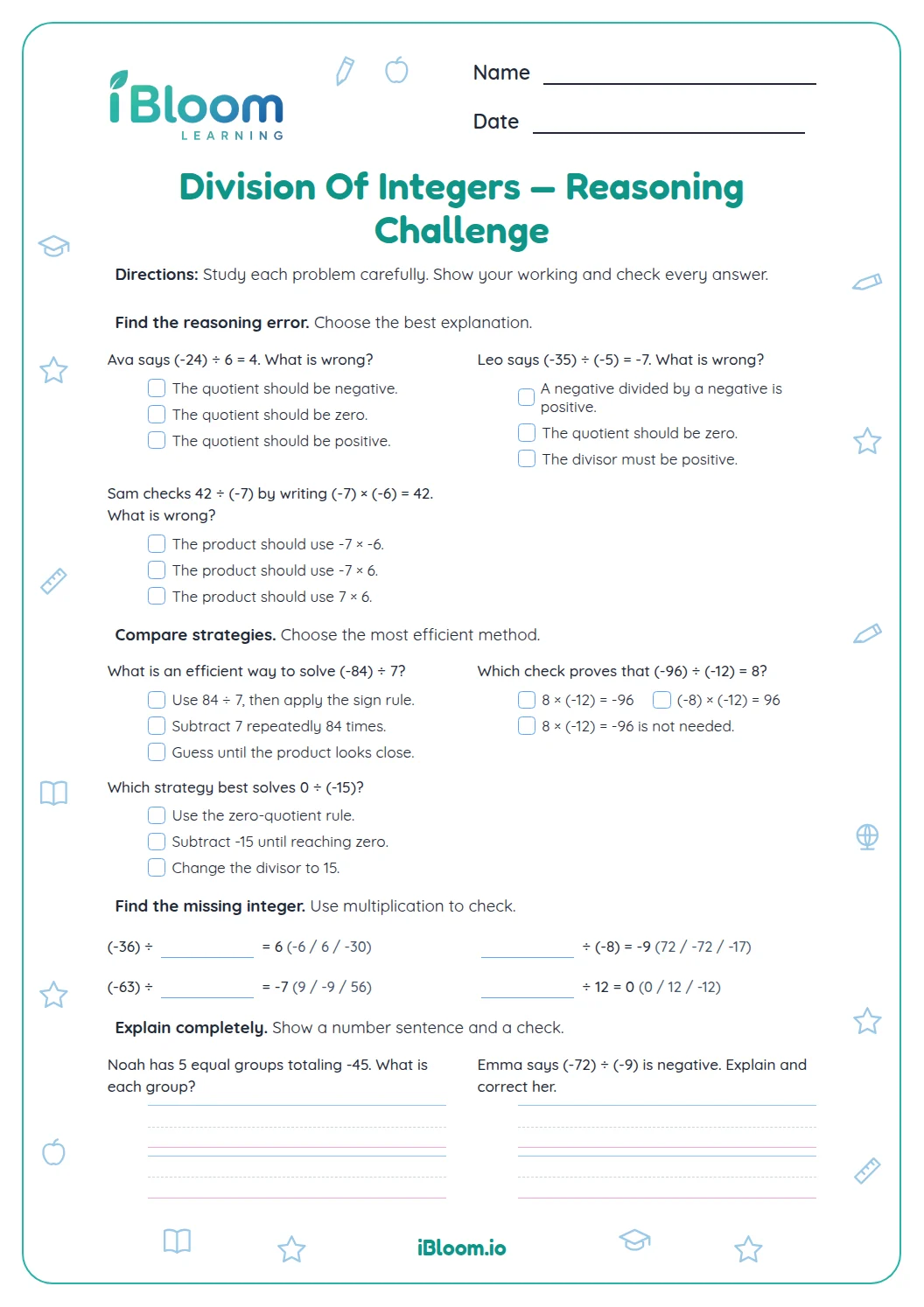
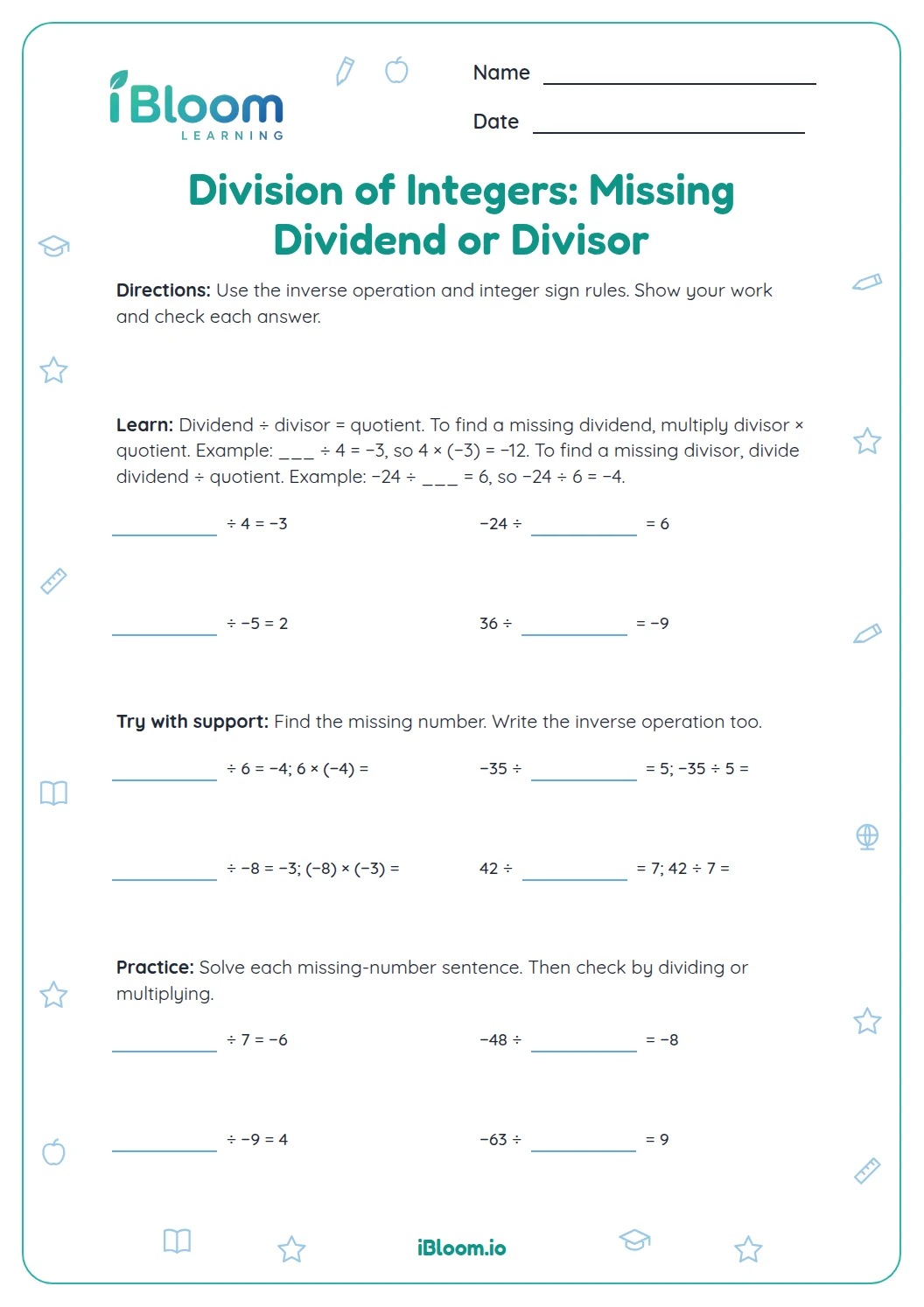
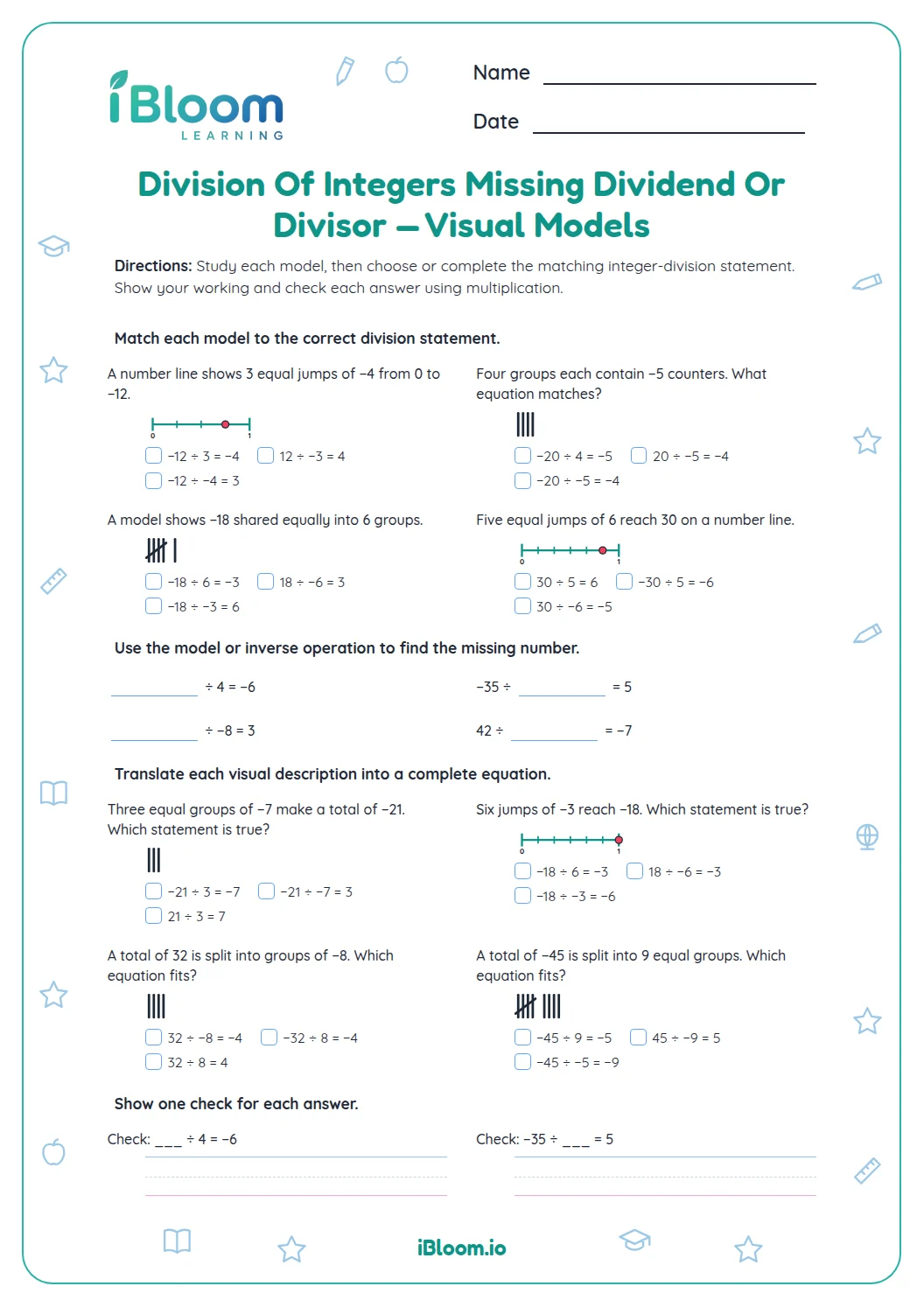
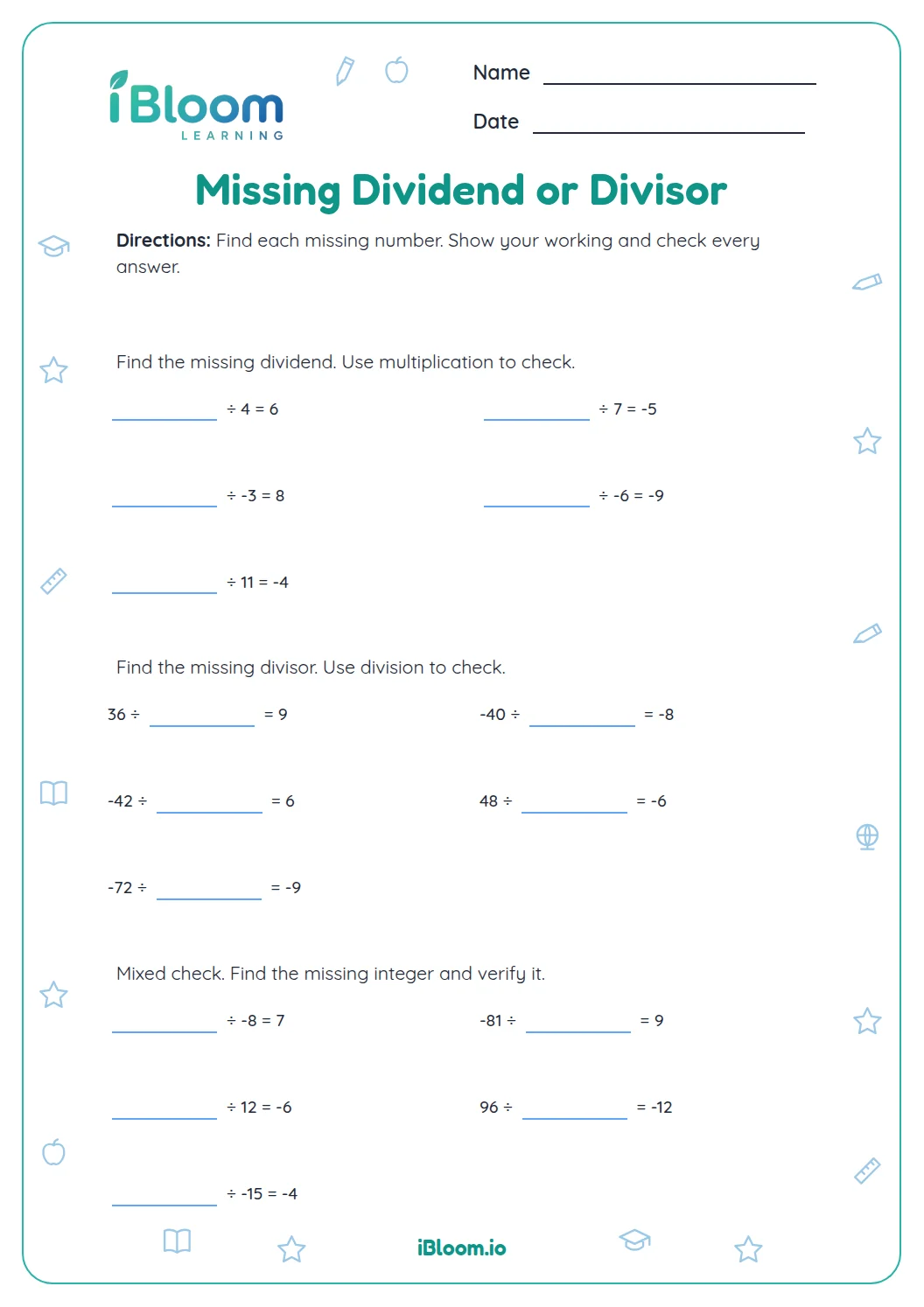
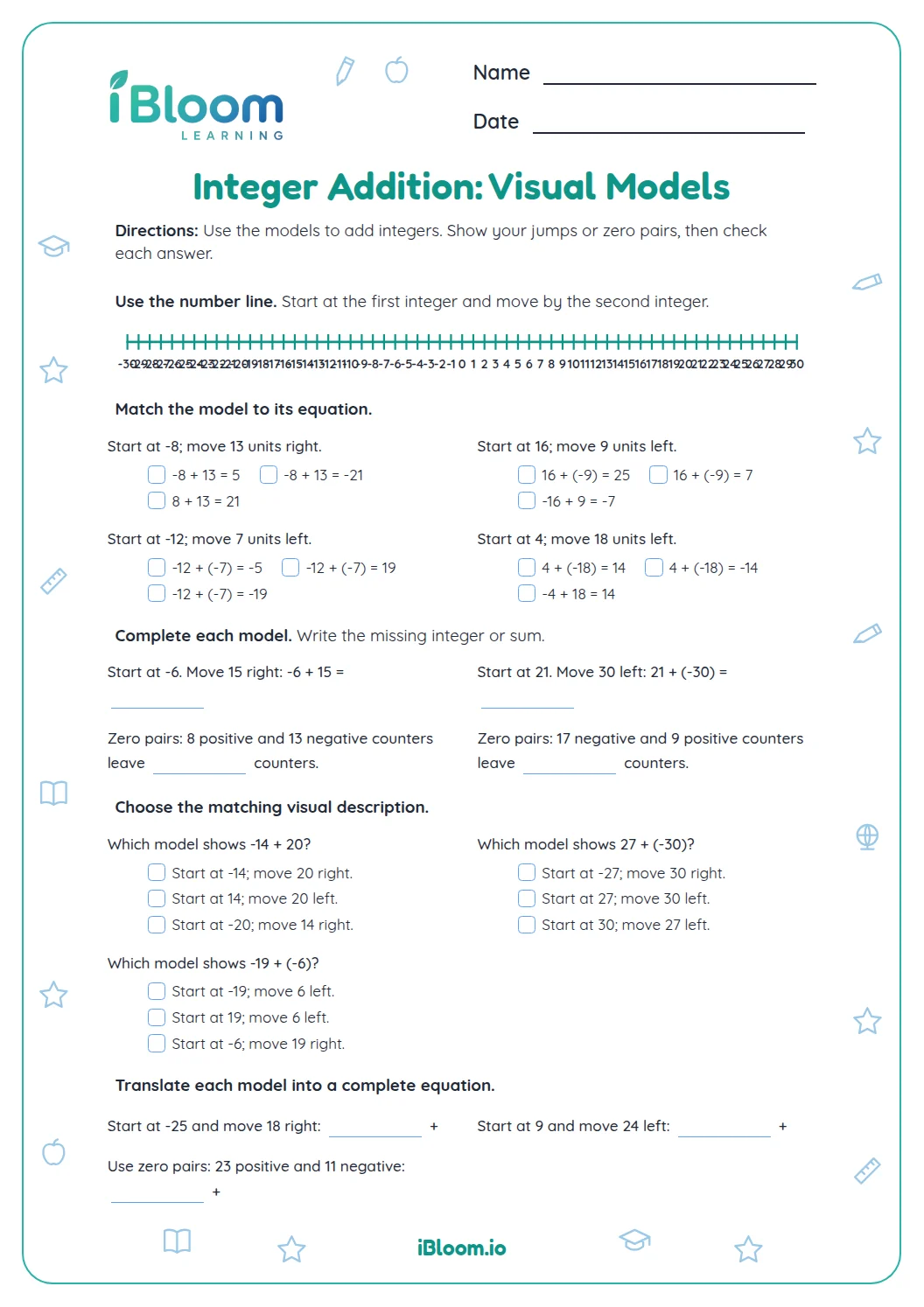
This printable worksheet introduces division with positive and negative integers. Students write quotients, complete multiplication checks in their own blanks, infer quotient signs from the signs of the factors, and apply division to score and elevation changes. The 16 questions are grouped into four parts with a separate answer key. The sign reasoning aligns with Common Core rational-number operations.
How can multiplication check an integer quotient?
Division and multiplication are inverse operations. After finding a quotient, multiply it by the divisor; the product should be the dividend. The first six items use one blank for the quotient and a second blank for the check factor.
- 1(−12) ÷ 3 = −4
- 2Check: −4 × 3 = −12
How do the signs determine the quotient?
Two integers with the same sign have a positive quotient. Integers with different signs have a negative quotient. The worksheet first asks students to name this pattern, then apply it to division expressions.
What changes when the integers are larger?
For larger facts, divide the absolute values first and then apply the sign rule. For example, (−56) ÷ 7 has magnitude 8 and a negative sign because the signs differ.
How does integer division describe a repeated change?
The final questions split a negative total change evenly across a number of rounds or intervals. A negative result describes a decrease in each equal interval.
How to solve integer division questions
- 1Divide the absolute values to find the quotient magnitude.
- 2Compare the signs of the dividend and divisor.
- 3Use a positive sign for matching signs and a negative sign for different signs.
- 4Write the quotient in its blank.
- 5Complete the check in its own blank by multiplying quotient × divisor.
Common integer division mistakes
The mistake
Giving every quotient a positive sign after dividing the magnitudes.
The fix
Compare the signs: different signs mean a negative quotient.
The mistake
Giving a negative quotient when both integers are negative.
The fix
Same signs make a positive quotient; check with multiplication.
The mistake
Checking with divisor × quotient but changing the sign of a factor.
The fix
Use the quotient and divisor exactly as written, then verify the dividend.
What to practice next
Make more practice
Further reading
Questions parents and teachers ask
What is (−12) ÷ 3?
The answer is −4. Divide 12 by 3 to get a magnitude of 4, then use a negative sign because the dividend and divisor have different signs. The check is −4 × 3 = −12, which returns the original dividend.
When is an integer quotient positive?
A quotient is positive when the dividend and divisor have the same sign. This includes a positive divided by a positive and a negative divided by a negative. Multiplication confirms the sign because two factors with the same sign produce a positive product.
When is an integer quotient negative?
A quotient is negative when the dividend and divisor have different signs. For example, (−35) ÷ 5 is −7. The worksheet asks students to use this sign pattern before completing larger division problems. Magnitude and sign are handled as two clear steps.
How do students check each quotient on the sheet?
Each of the first six questions has two separate blanks: one for the quotient and one for the factor in the multiplication check. Multiply the quotient by the divisor. The product must equal the dividend, including its sign. The answer key lists the two entries in blank order.
What do the word problems represent?
They describe a negative total change split into equal rounds or intervals. Dividing the total change by the number of equal intervals gives the amount of change each time. The negative sign tells the reader that the score or elevation decreases.