


About this worksheet
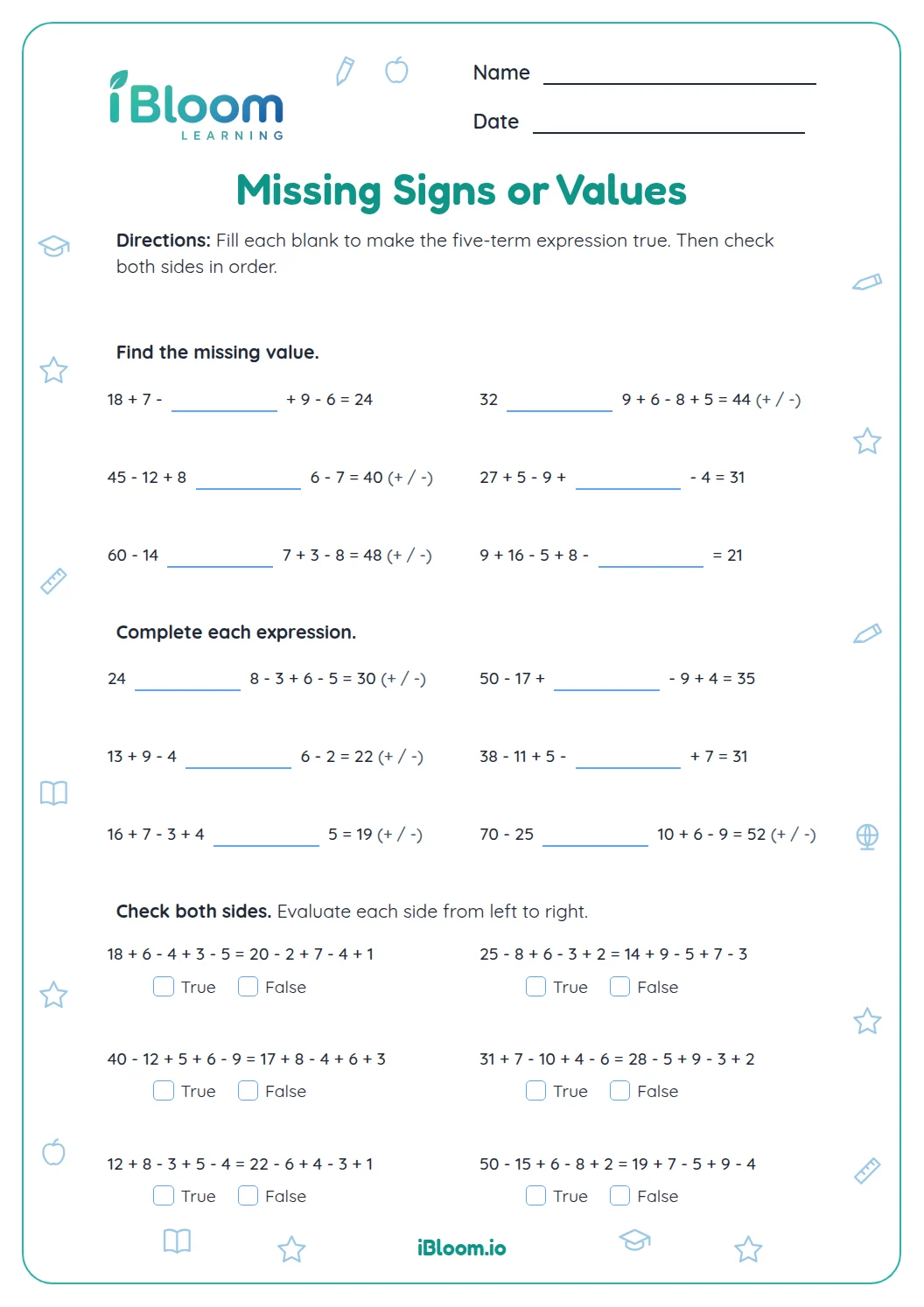
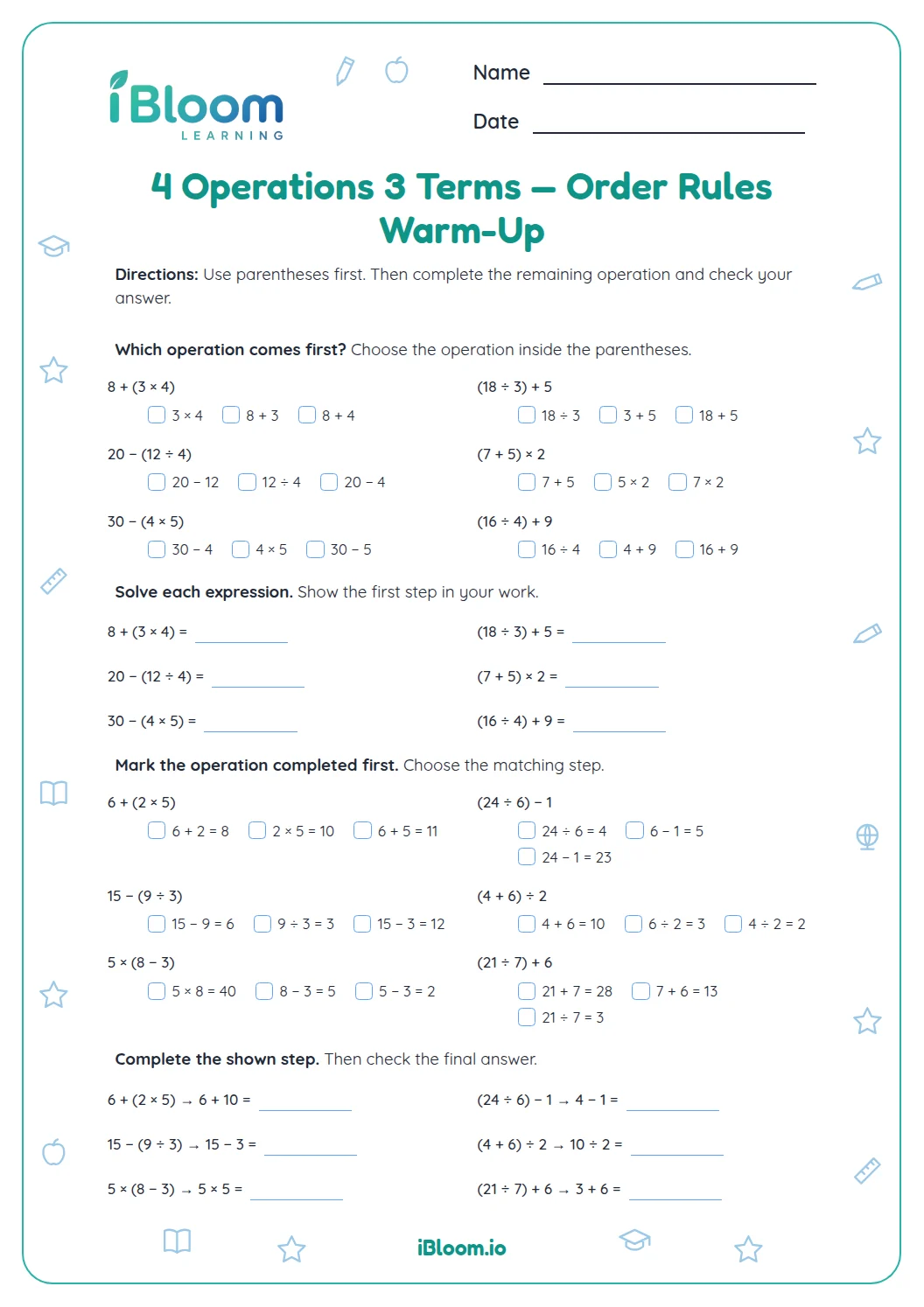
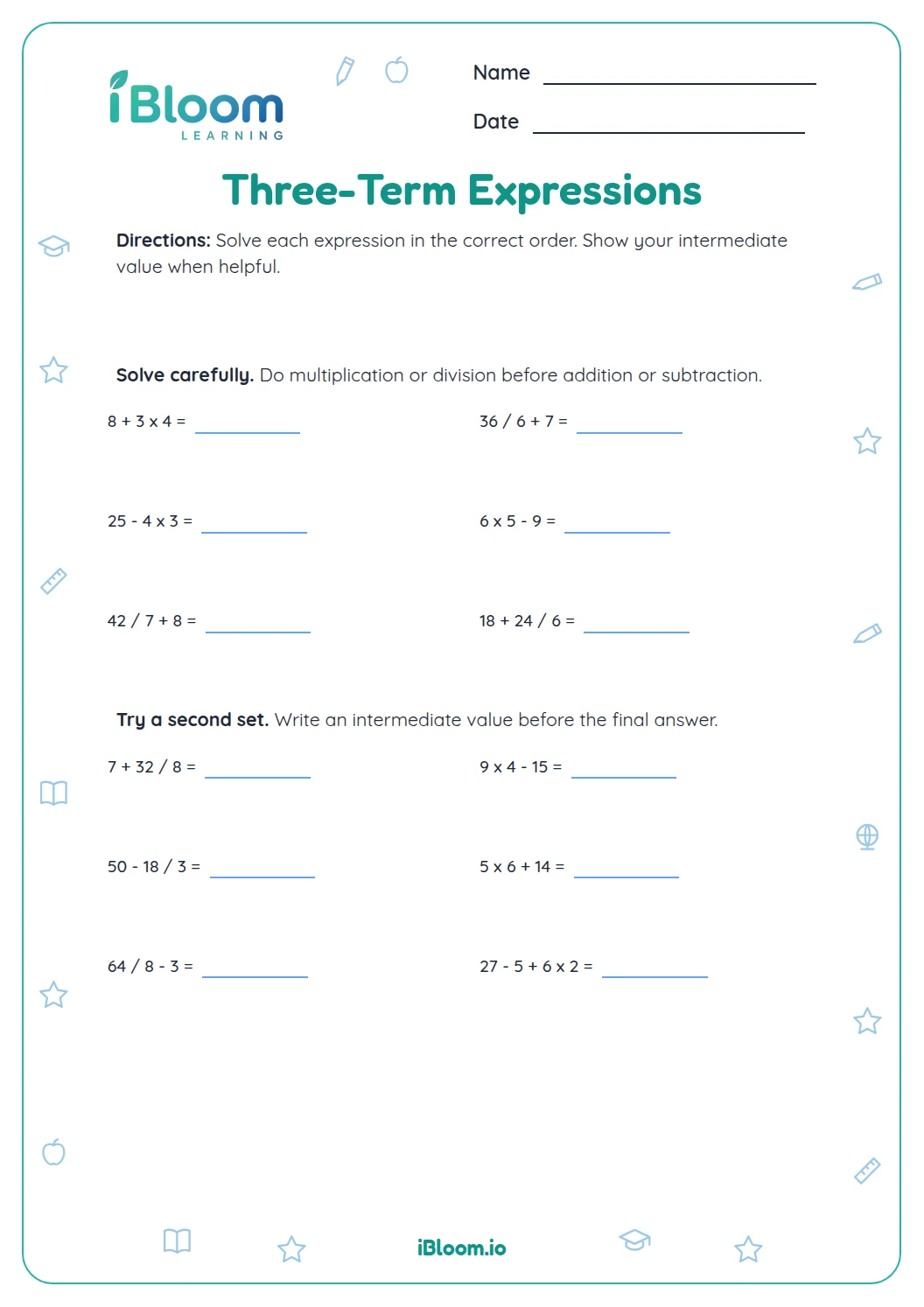
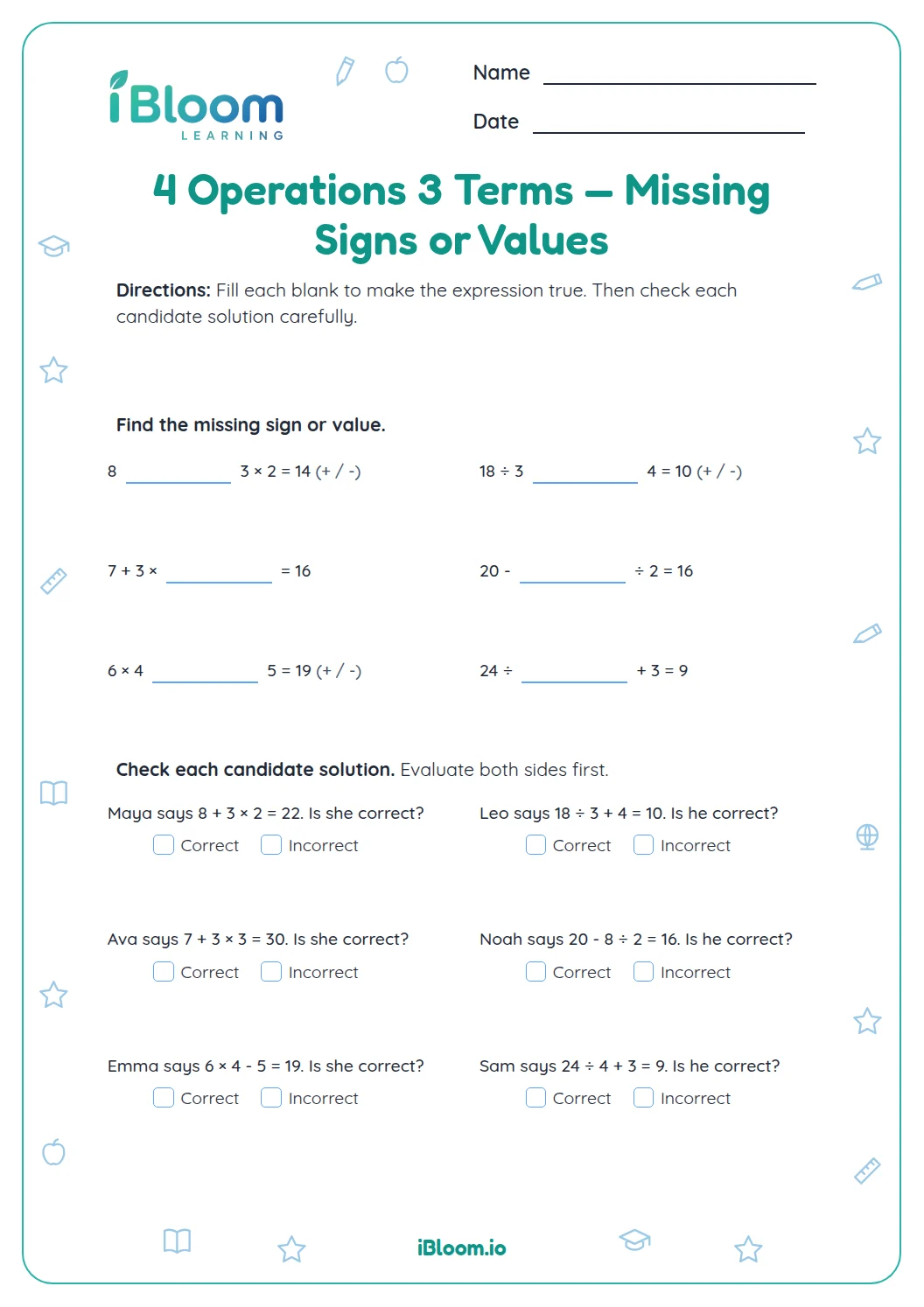
This printable worksheet turns five-term addition and subtraction expressions into step chains. Students fill in the next expression after one operation, so each arrow represents one calculation and no intermediate result is skipped. It is written for Grades 5–6. The 16 chains use positive whole numbers and include a separate answer key.
What does each arrow change?
These chains use addition and subtraction only. At each arrow, compute one operation from left to right, replace those two terms with their result, and copy the remaining signed terms.
- 135 − 14 + 6 − 10 + 8
- 235 − 14 = 21, so write 21 + 6 − 10 + 8.
- 3Then 21 + 6 = 27, giving 27 − 10 + 8. Continue one operation per arrow.
What kinds of questions are included?
Each of the 16 questions has one missing next expression. Complete one operation at a time; the answer key shows the expression that belongs after the arrow.
- Part A: Fill the missing step
- A separate answer key follows the worksheet pages.
How can students work through the page?
- 1Read the complete expression before starting.
- 2Compute only the first operation at the current step.
- 3Replace that part with its result and copy the untouched terms.
- 4Check that each arrow changes only one operation.
- 5Finish the arithmetic and compare every step with the key.
Common order-of-operations mistakes
The mistake
Doing more than one operation before writing the next step.
The fix
At each arrow, calculate one operation and copy the remaining terms.
The mistake
Changing a sign when copying the rest of the expression.
The fix
Keep every plus or minus sign with the term that follows it.
The mistake
Skipping an intermediate expression and jumping to the final value.
The fix
Write the new expression after each single operation, even when the arithmetic feels easy.
What to practice next
Make more practice
Questions parents and teachers ask
What does each arrow represent?
Each arrow shows one addition or subtraction completed. The result replaces the two numbers and sign for that operation, while the rest of the expression stays in the same order. This makes the calculation easy to follow and check. This keeps each line equivalent to the one before it and makes the arithmetic easy to audit.
Why does the chain keep the remaining terms?
The terms that have not been calculated still belong to the expression. Copy them with their signs so the next line has the same value as the line before it. Only the completed operation should change at each arrow. This keeps each line equivalent to the one before it and makes the arithmetic easy to audit.
How can I check a missing step?
Compare it with the expression immediately before it. One operation should be replaced by its result, and every other number and sign should remain unchanged. Then check that the following printed step follows correctly from your answer. This keeps each line equivalent to the one before it and makes the arithmetic easy to audit.
How many step chains are included?
There are 16 chains split into two parts. Each has one missing intermediate expression, and each chain shows the later steps so students can check that the missing line fits the sequence. This keeps each line equivalent to the one before it and makes the arithmetic easy to audit.
Does the worksheet show the final result too?
Yes. Each chain includes its final value after the missing step. Students can use that endpoint as a check, while still writing the intermediate expression requested in the blank. This keeps each line equivalent to the one before it and makes the arithmetic easy to audit.