


About this worksheet
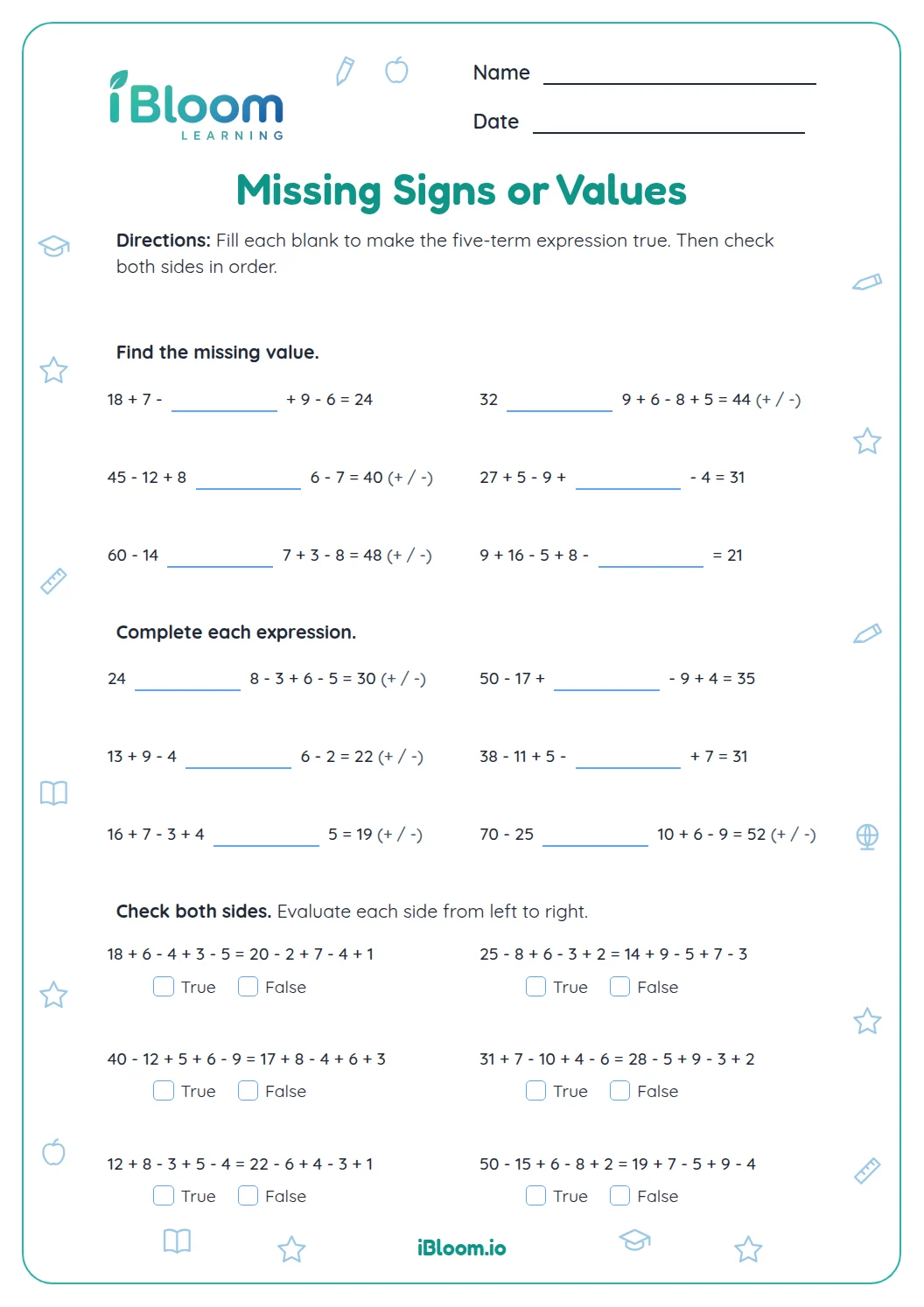
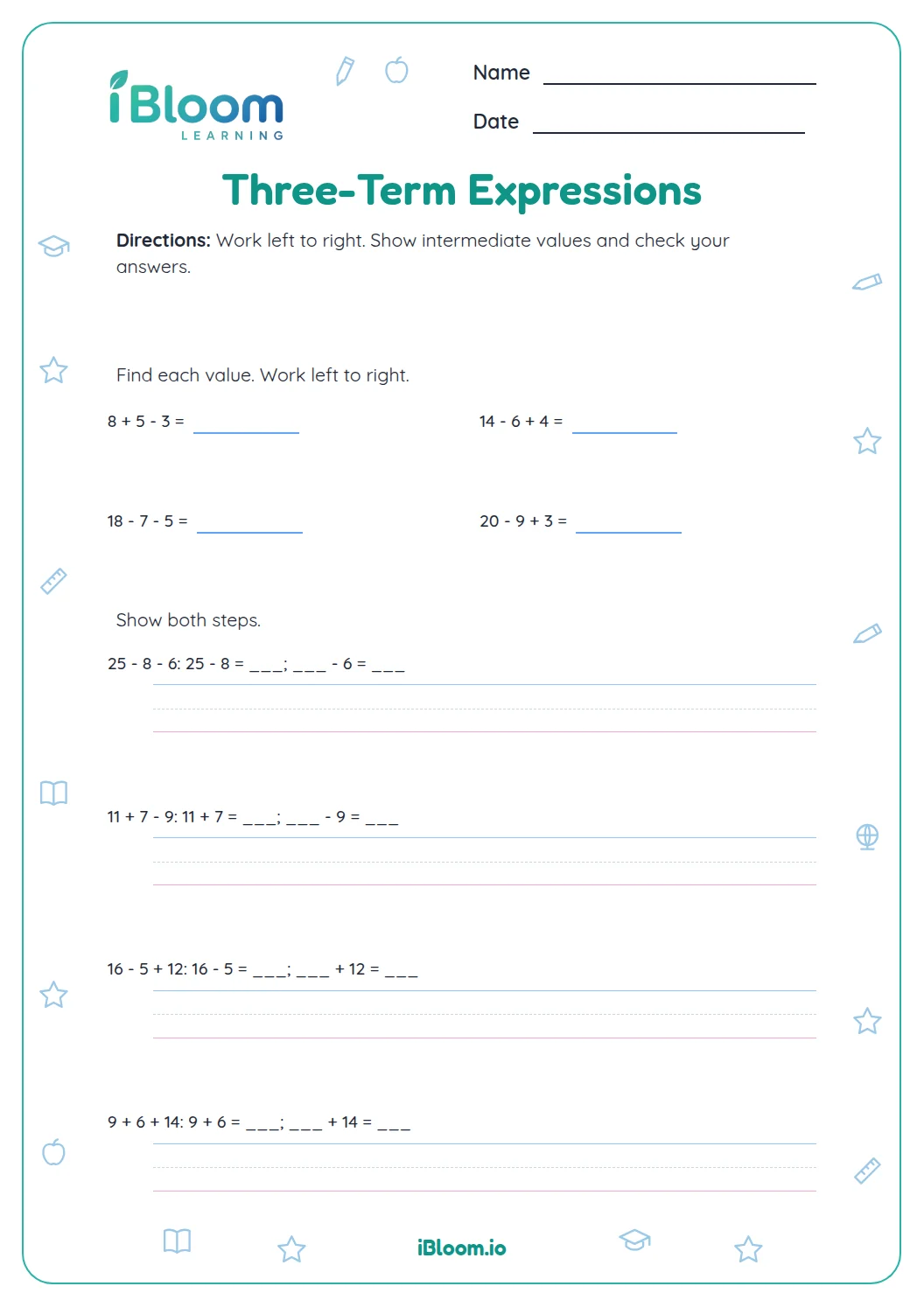
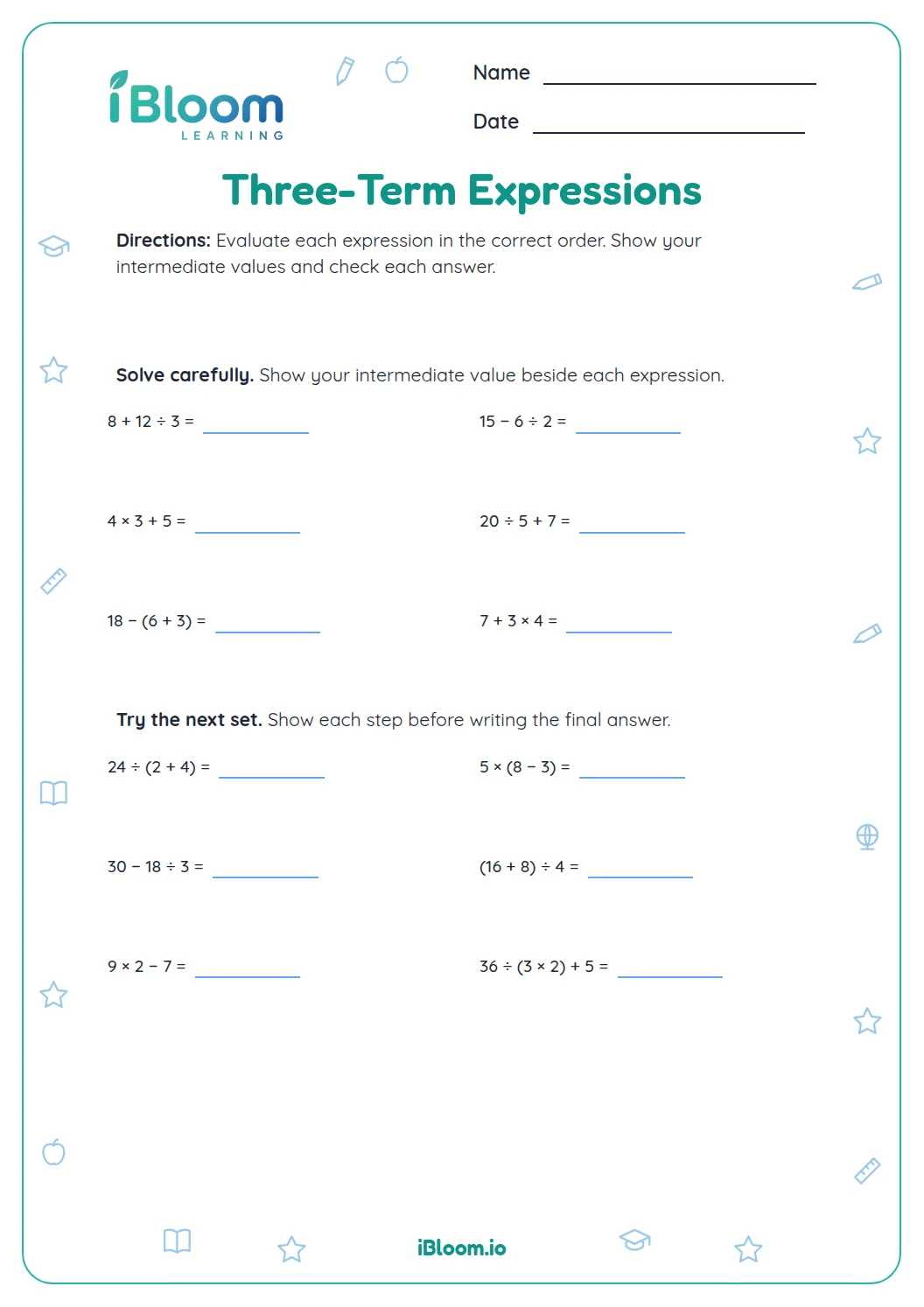
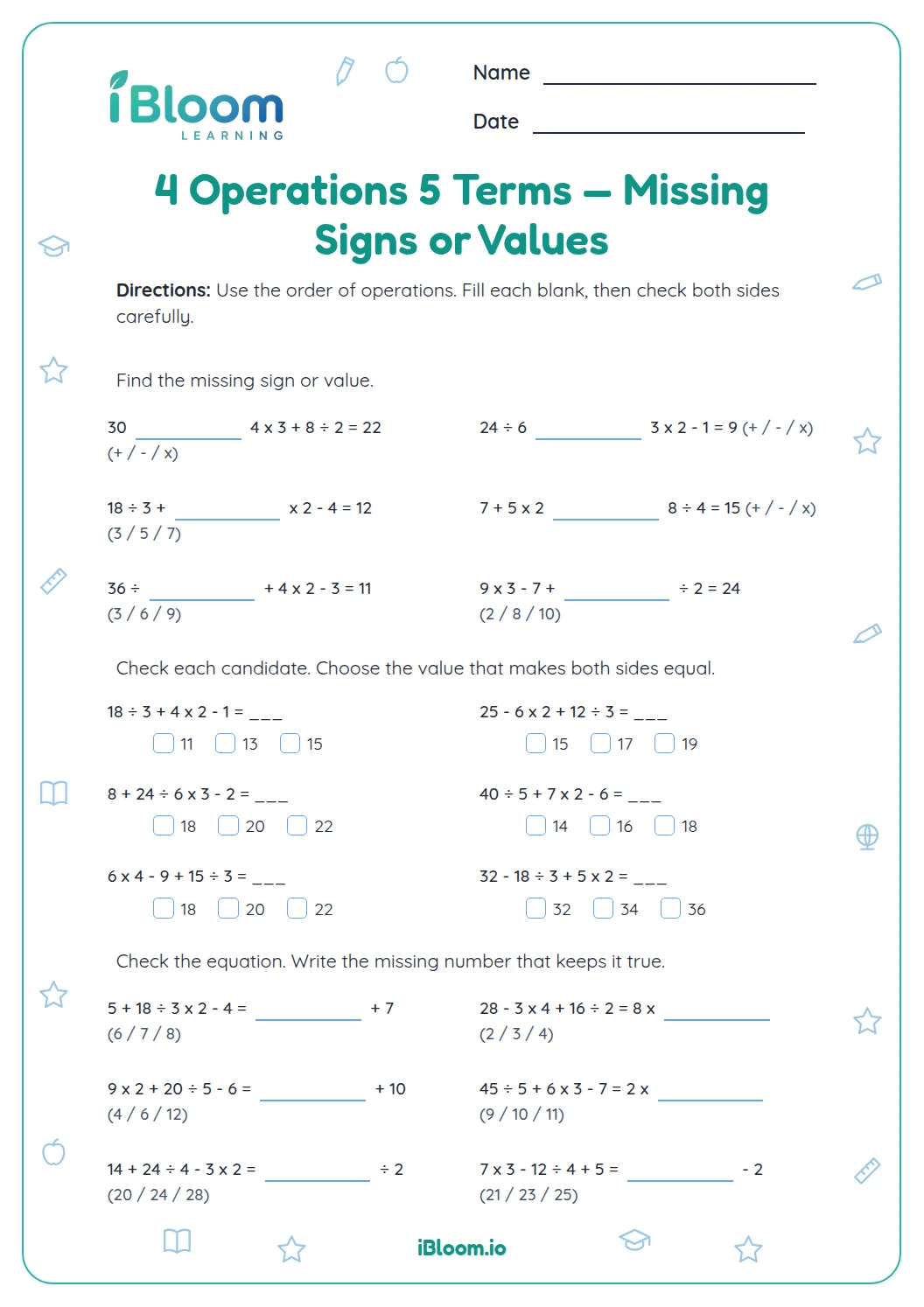
This Grades 5–6 printable focuses on addition and subtraction in five-term expressions. Students inspect eight worked examples for the first grouping or arithmetic error, including examples with correct work, then evaluate six expressions from left to right. The worksheet and answer key each use two pages and practice CCSS 5.OA.A.1.
Aligned to 5.OA.A.1
Which rule comes first?
Check the original expression, then compare the student’s first changed step with the operation rules. A later line may calculate correctly but follow an earlier mistake.
Evaluate one operation at a time and copy the remaining signs and numbers exactly. Multiplication and division share a level, as do addition and subtraction; within each level, move from left to right.
- 118 + 7 − 5 + 9 − 4
- 225 − 5 + 9 − 4
- 320 + 9 − 4
- 429 − 4
- 525
How can you check each answer?
Look for the earliest step that violates the order rule. A step can be arithmetically valid but applied to the wrong terms.
Return to the original expression and repeat the steps in order. This helps separate an arithmetic slip from a choice of operation that came too early.
What practice is included?
The sheet has 14 questions in two parts: eight checks of worked solutions and six expression evaluations. The worked examples include both incorrect and correct work. The separate answer key identifies each diagnosis and gives the evaluation results.
How to work through this sheet
- 1Read the original expression first.
- 2Check powers and grouping before other operations.
- 3Check multiplication and division from left to right.
- 4Check addition and subtraction from left to right.
- 5Name the first incorrect step rather than a later consequence.
- 6Evaluate the final set independently.
Common mistakes and quick fixes
The mistake
Adding or subtracting before multiplication or division
The fix
Complete multiplication or division before addition or subtraction.
The mistake
Combining nonadjacent terms
The fix
Move left to right within the priority level.
The mistake
Changing a sign while rewriting
The fix
Copy every plus and minus sign into the next line.
Common Core alignment
This worksheet practices evaluating numerical expressions and applying operation rules.
Evaluate numerical expressions by following operation symbols and grouping marks.
On this sheet: Students evaluate numerical expressions with grouping symbols.
Show the official wordingHide the official wording
Use parentheses, brackets, or braces in numerical expressions, and evaluate expressions with these symbols.
What to practice next
Make more practice
Further reading
Questions parents and teachers ask
How do I check addition and subtraction in a row?
Calculate from left to right. For 18 + 7 − 5, first 18 + 7 = 25, then 25 − 5 = 20. Do not group a later number with an earlier term if that changes the signs. Keep each sign attached to its term as you rewrite.
What does “first error” mean on this sheet?
It means the earliest step that changes the value incorrectly or combines terms in a way that ignores the signs. Check the student’s work line by line. A later correct calculation does not fix an earlier grouping error.
Can a student’s work be correct?
Yes. Questions 6–8 show correct left-to-right calculations. For example, 64 − 12 + 5 − 8 becomes 52, then 57, then 49. Verify the arithmetic and the order before selecting “Correct work.” Check both the order and each calculation before selecting “Correct work.”
How many problems are included?
There are 14 questions across two worksheet pages. Eight ask students to diagnose worked examples, and six ask them to evaluate expressions. The answer key has two pages and follows the question numbering so students can check each response.
Why does order matter for addition and subtraction?
Addition and subtraction have equal priority, so work from left to right. In 30 − 7 + 5 − 3, calculate 30 − 7 first, then add 5, then subtract 3. Rewriting each result helps prevent changing a plus or minus sign while calculating.