



About this worksheet
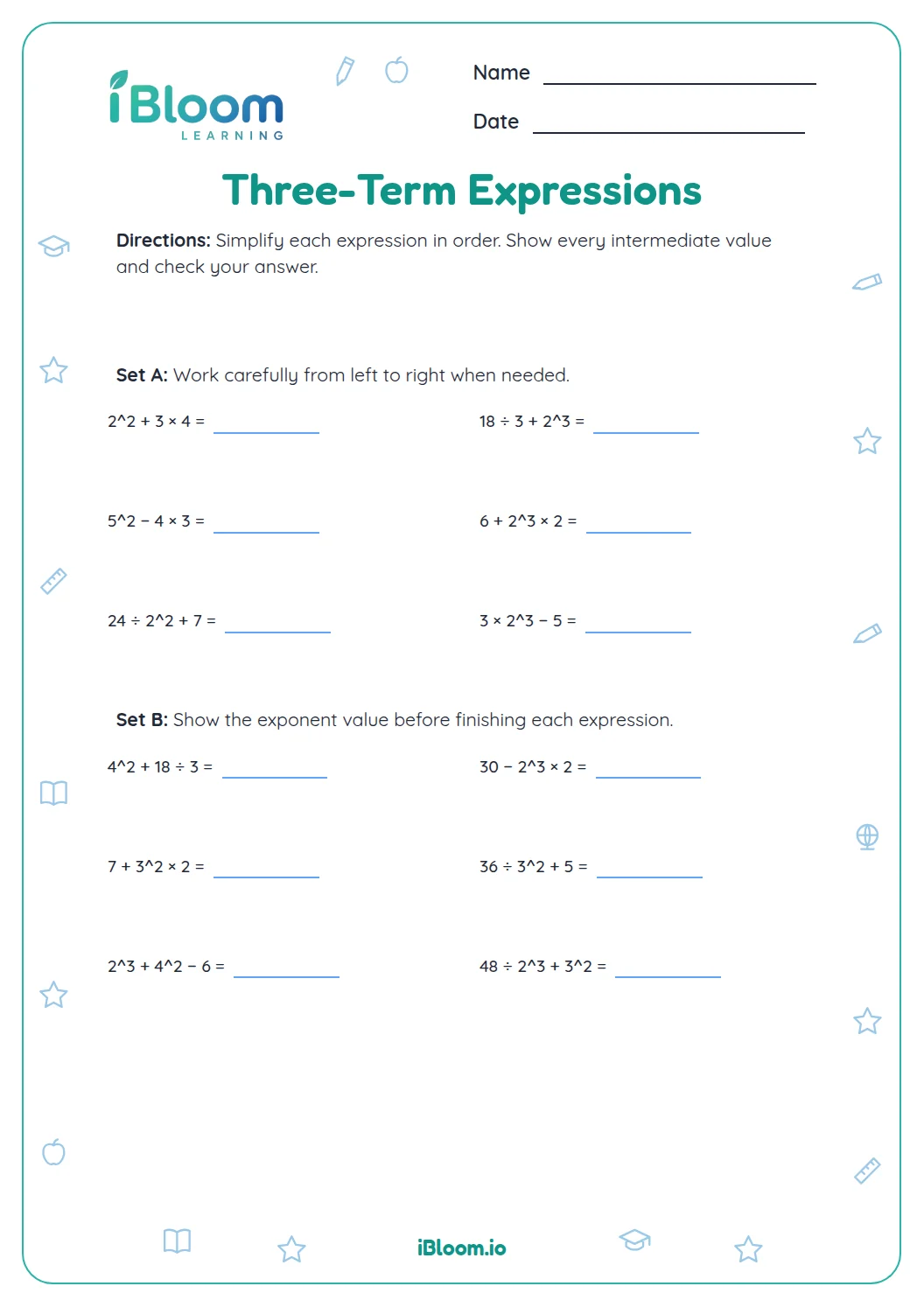
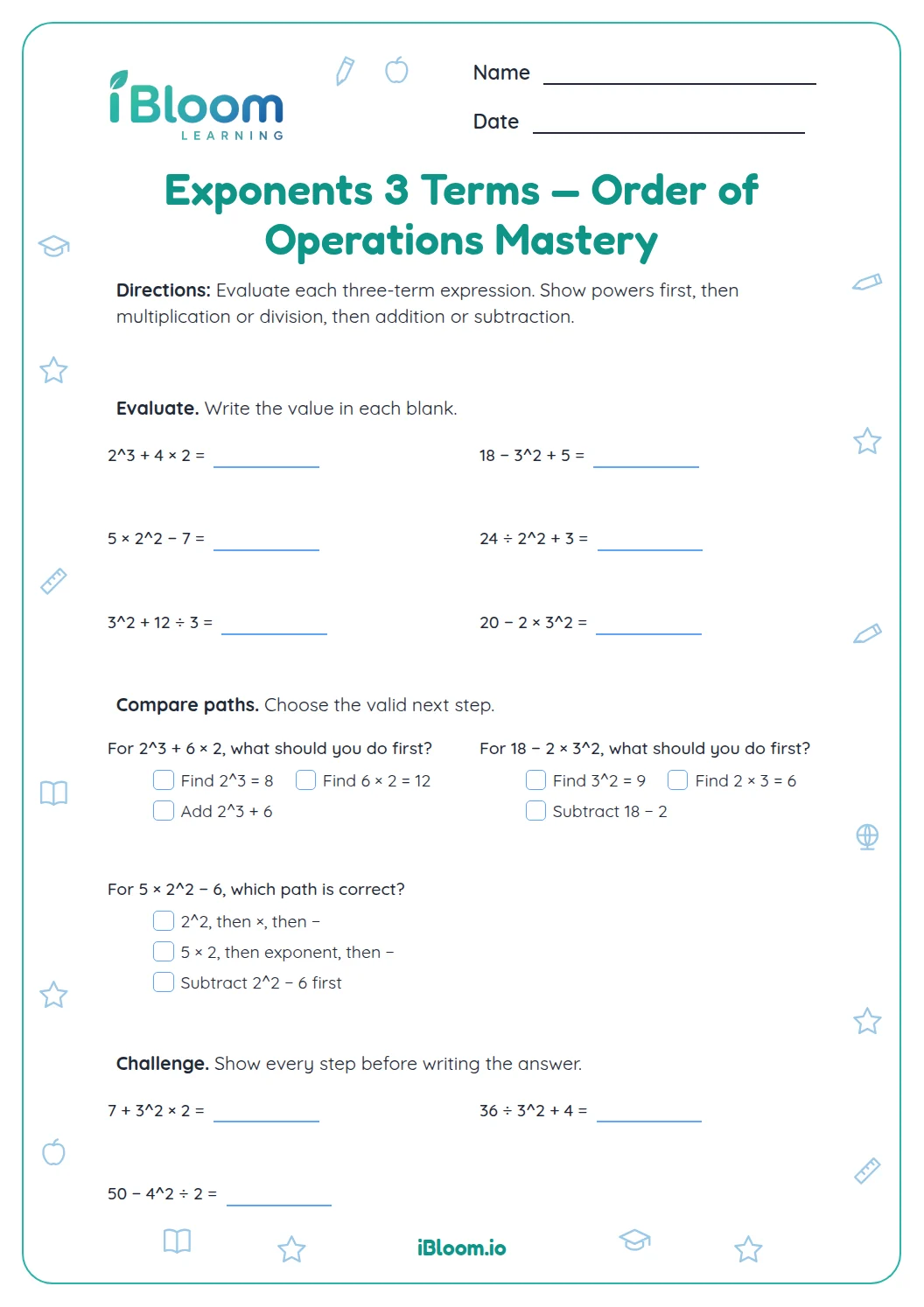
This worksheet gives Grades 5–6 students 20 equations that combine whole-number exponents with other operations. Students fill missing values, choose an operation sign, check true-or-false equations, and correct false expressions. Evaluate each exponent first, then follow multiplication and division before addition and subtraction. The key lists answers in question order, with powers printed as superscripts on the sheet.
Aligned to 6.EE.A.1
What order should students use?
First evaluate the power, then multiply or divide, then add or subtract. For 2³ + ___ × 3 = 23, the power is 8; the missing value is 5 because 8 + 5 × 3 = 23.
What does each part ask students to do?
Part A asks students to find missing values and operation signs. Part B asks them to evaluate complete equations and correct false candidates. Powers such as 2³ are printed with a raised exponent.
How can students test a missing sign?
Evaluate the power and any higher-priority multiplication or division first. Then test the possible sign in the remaining spot.
- 12³ + 5 × 3 = 8 + 15 = 23, so the missing operation is ×.
How can students check a correction?
Substitute the proposed number or sign, evaluate the full expression in order, and compare it with the stated result.
How to use this worksheet
- 1Evaluate every exponent first.
- 2Complete multiplication and division from left to right.
- 3Complete addition and subtraction from left to right.
- 4For a missing sign, test each operation choice.
- 5Substitute the answer and compare both sides.
Common mistakes and quick fixes
The mistake
Adding before multiplying.
The fix
Evaluate powers, then multiplication or division, before addition or subtraction.
The mistake
Treating 2³ as 2 × 3.
The fix
Read 2³ as three factors of 2: 2 × 2 × 2.
The mistake
Changing the printed target instead of the blank.
The fix
Keep the given result fixed and test the missing value or sign.
Common Core alignment
This sheet practices evaluating numerical expressions that include whole-number exponents.
Evaluate numerical expressions that include whole-number exponents.
On this sheet: The expressions include whole-number powers and require evaluating them with other operations.
Show the official wordingHide the official wording
Write and evaluate numerical expressions involving whole-number exponents.
What to practice next
Make more practice
Further reading
Questions parents and teachers ask
How many questions are on this worksheet?
There are 20 numbered questions on the student pages. They are grouped into 2 sections, and the answer key uses the same question numbers. The practice moves from missing-number and sign equations to evaluation and corrections, so an adult can check progress without searching through a separate list.
How should students work through the questions?
Read each raised number as a power, such as 2³ = 2 × 2 × 2. Evaluate powers first, then multiplication or division, and finally addition or subtraction. For a blank sign, try the listed operations in the original equation and check the result.
What does the answer key include?
The key lists each missing value, operation sign, true-or-false choice, and corrected expression. Students can compare their order of steps as well as the final number, especially on items that require both a power and multiplication or division. The worked examples also remind students to compare the evaluated expression with the target printed on its right.
How long should this practice take?
Plan for about 20 minutes, with more time if students write every step. The exponents: missing signs or values worksheet questions are short enough to pause after each section, compare one result with the key, and then return to any item that needs another calculation.
Can I use this for homework?
Yes. Print the student pages separately from the key if students should work independently. Ask them to keep the power evaluation and operation order visible; that gives you a useful way to discuss a missed answer and lets students correct their own work after checking the key.