

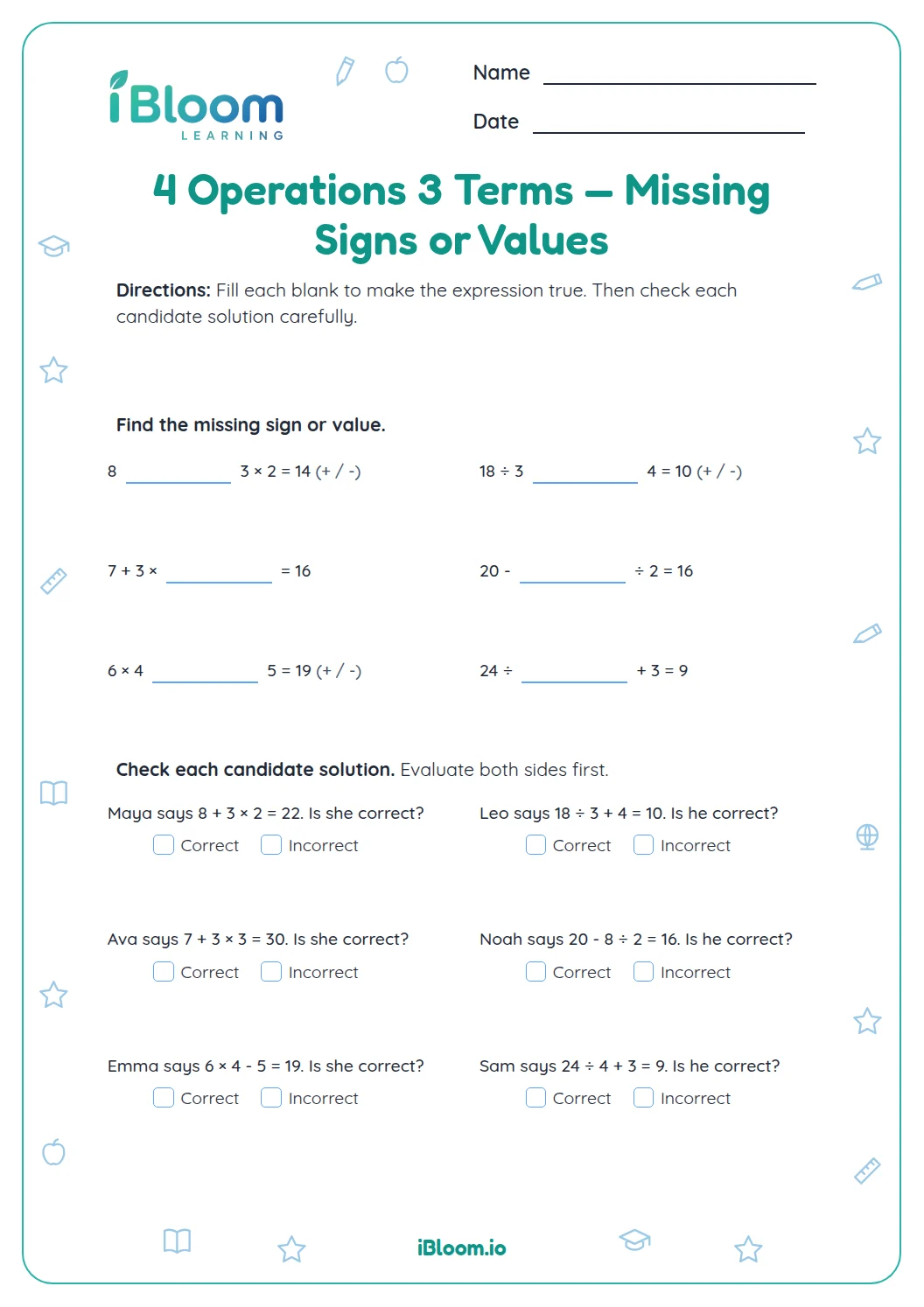


About this worksheet
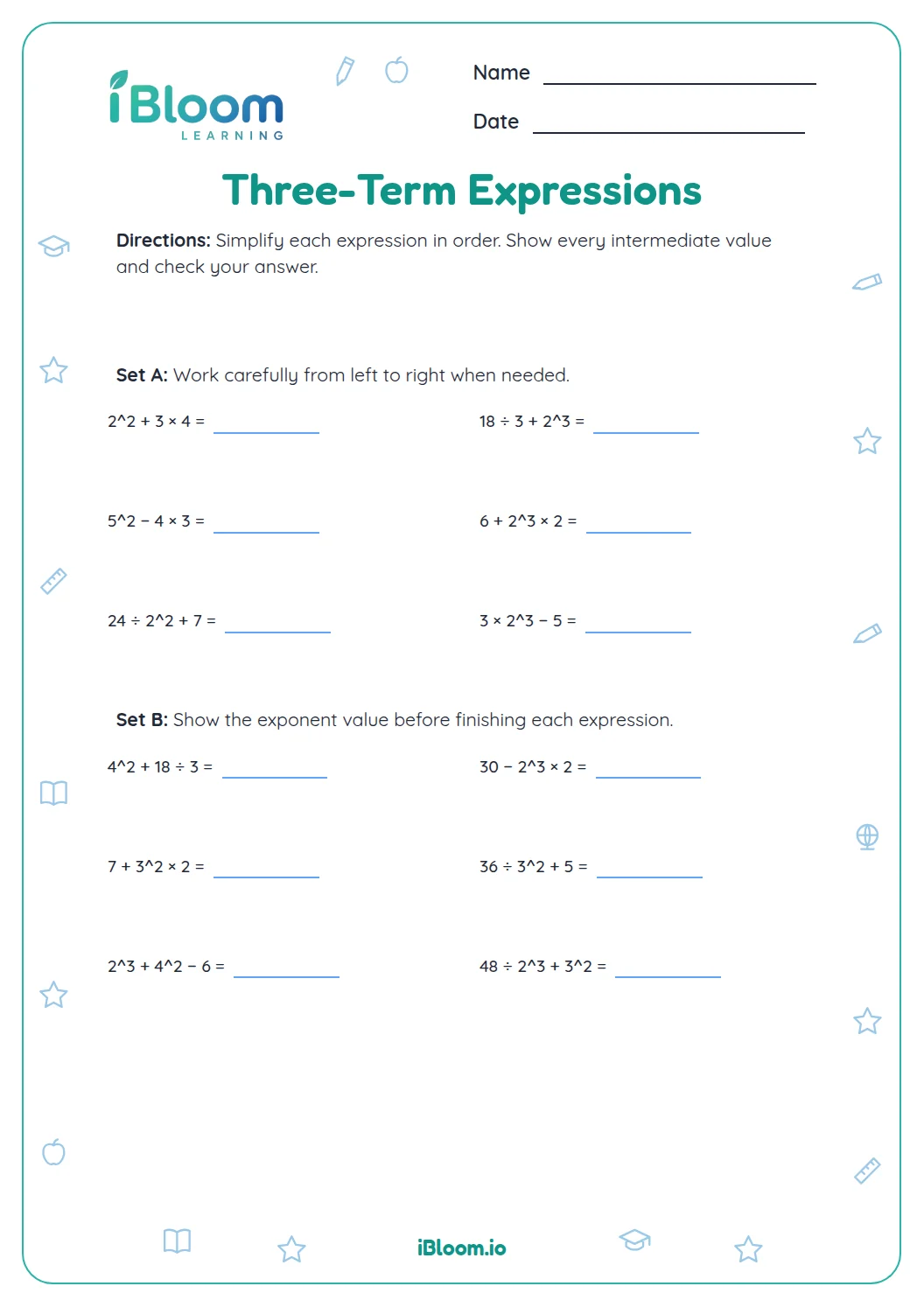
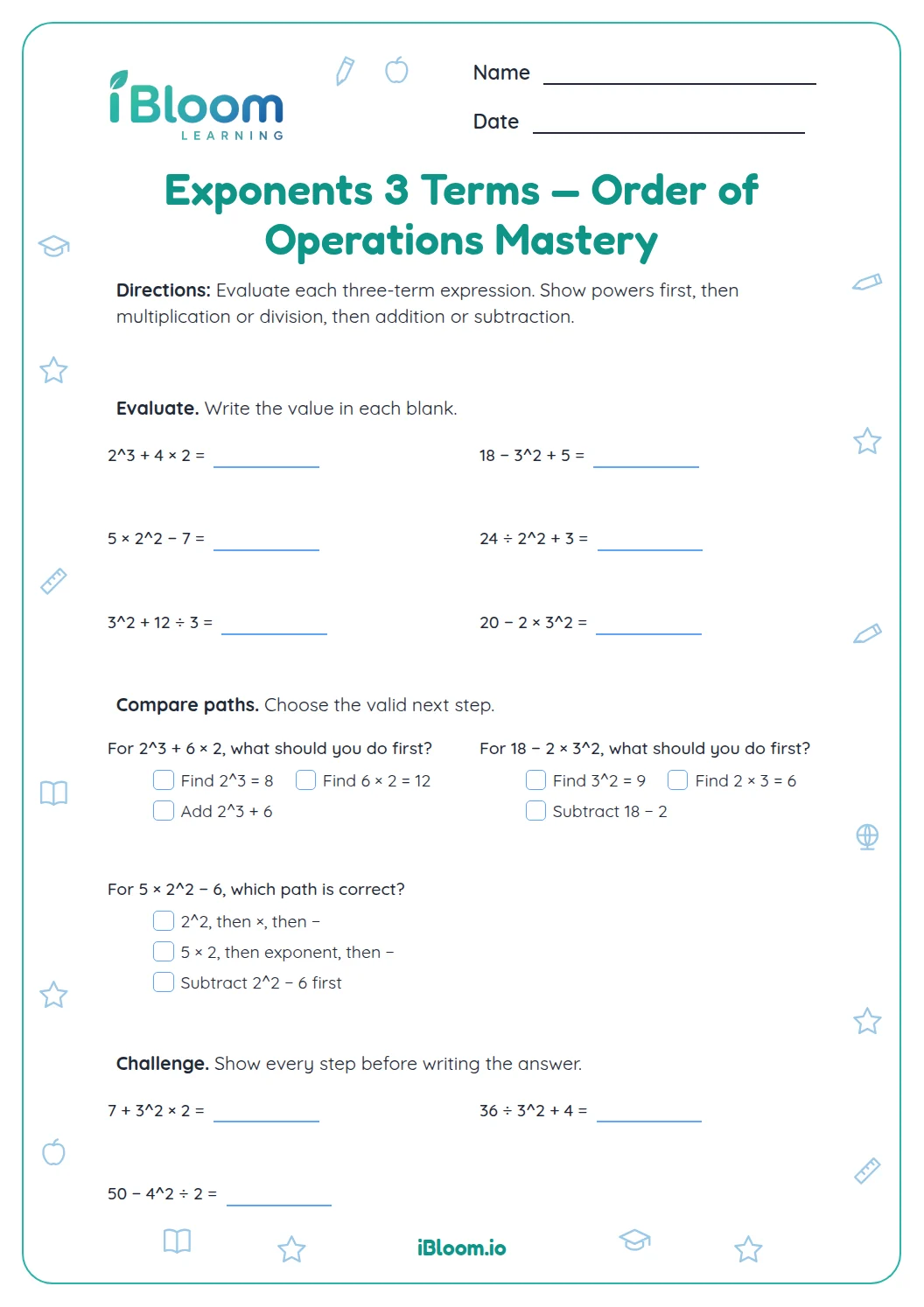
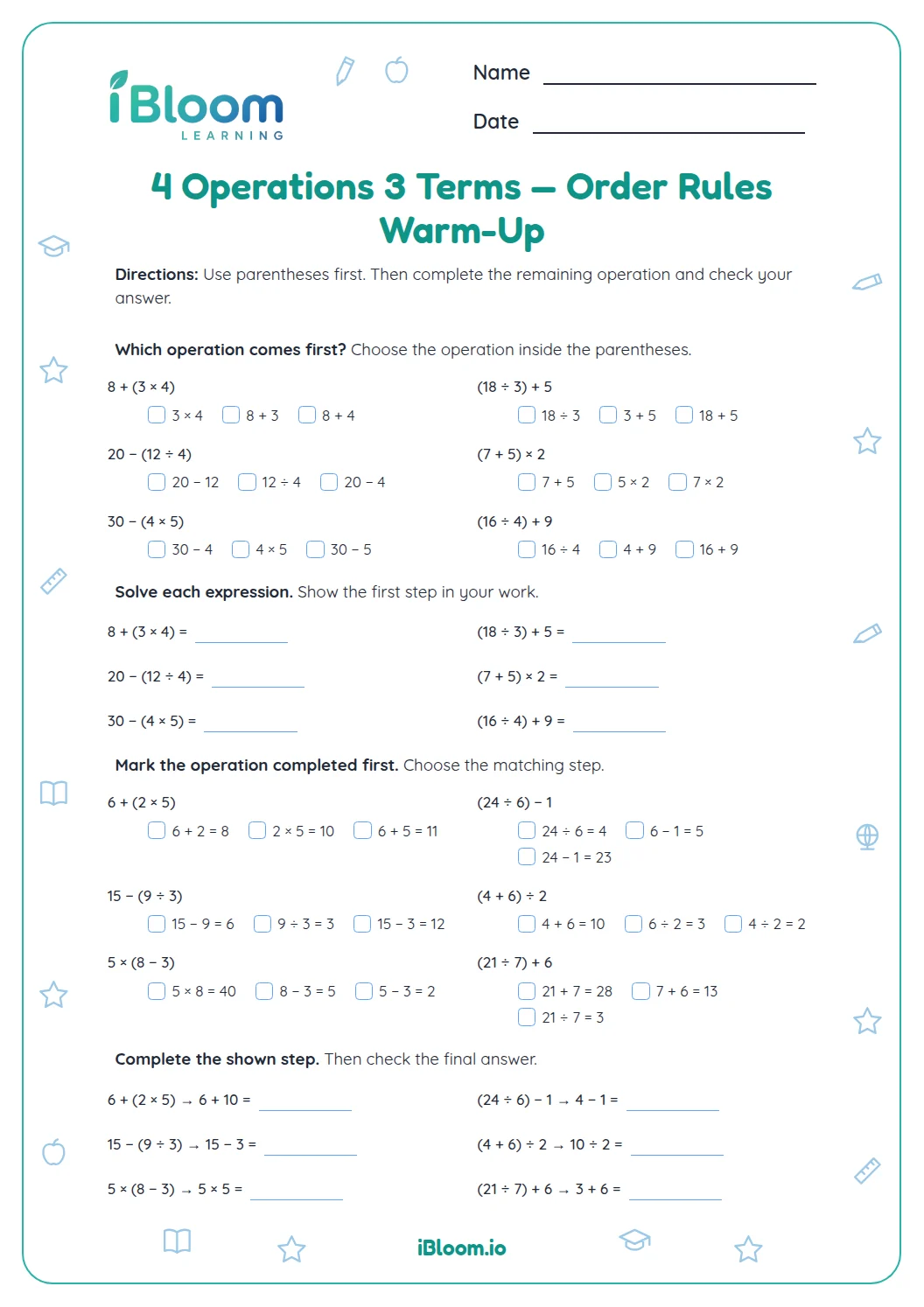
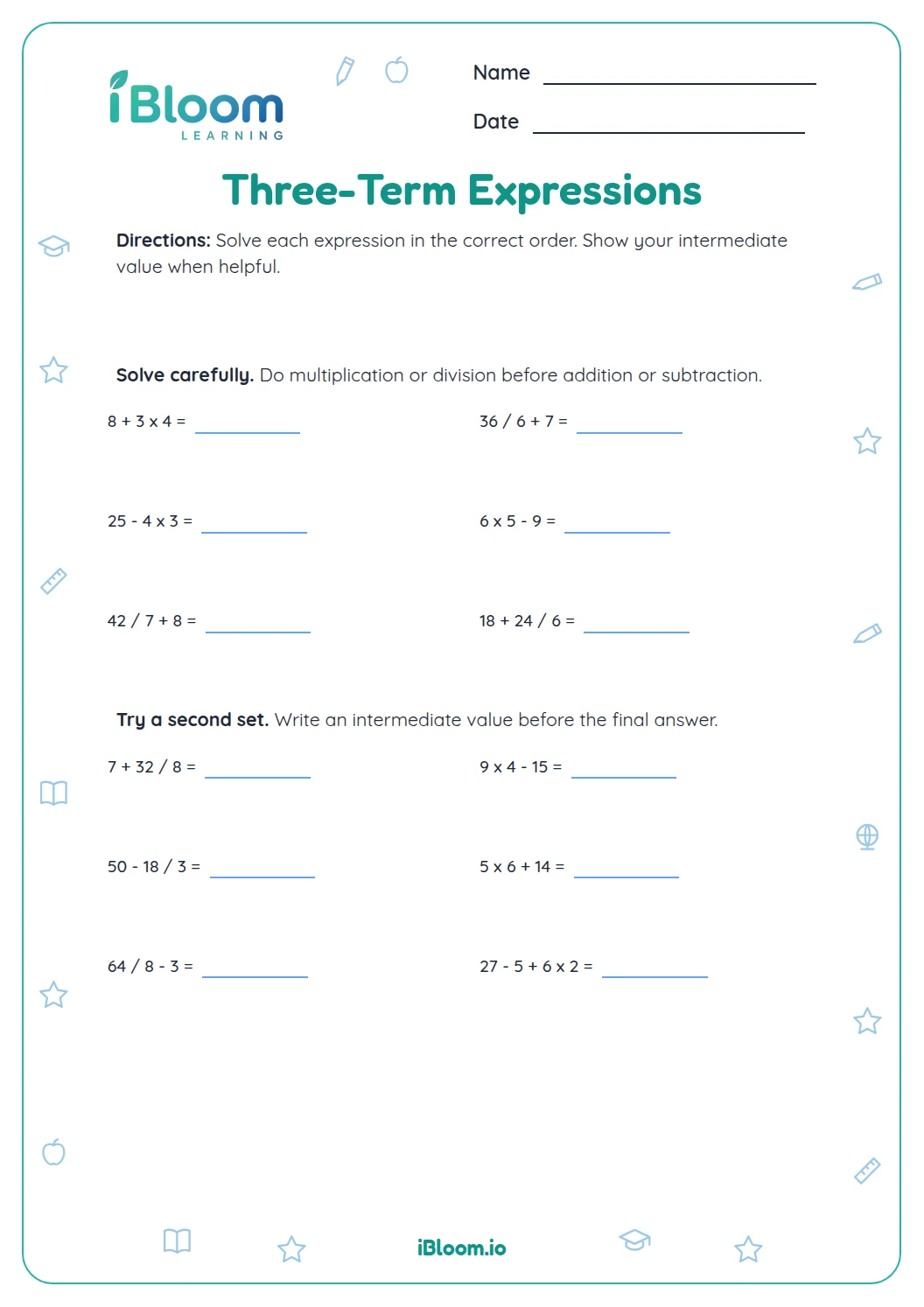
This two-page printable gives Grades 5–6 practice evaluating three-term expressions with whole-number exponents, multiplication or division, and addition or subtraction. Students find the values of 12 expressions, then write the immediate next expression in four step chains. The answer key shows both the operation completed and the work that remains. The exponent practice aligns with Common Core 6.EE.A.1.
Aligned to 6.EE.A.1
Which operation comes first?
Evaluate powers first. Next, multiply and divide from left to right; then add and subtract from left to right. Rewrite the expression after each operation so no unfinished part disappears.
- 12³ + 6 × 2
- 28 + 6 × 2
- 38 + 12
What will students solve?
Questions 1–12 ask for each expression’s value. Questions 13–16 ask for the next expression after one operation, so the answer is not the final value.
How can students check each step?
Compare neighboring lines: only the chosen operation should be evaluated, and every other number and operation should stay in place. When the expression reaches one value, check the arithmetic once more.
How to use this worksheet
- 1Read the expression and identify any exponent.
- 2Evaluate each power before the other operations.
- 3Complete multiplication and division from left to right.
- 4Finish addition and subtraction from left to right.
- 5For questions 13–16, stop after one operation and write the remaining expression.
Common order-of-operations mistakes
The mistake
Adding before multiplying in 8 + 6 × 2.
The fix
Multiply 6 × 2 first, then add 8.
The mistake
Reading 2³ as 2 × 3.
The fix
Use three factors of 2: 2 × 2 × 2 = 8.
The mistake
Putting only the final value in a next-step blank.
The fix
Evaluate one operation, then copy the operations that remain.
Common Core alignment
Students evaluate expressions with whole-number exponents and follow the order of operations.
Evaluate numerical expressions involving whole-number exponents.
On this sheet: Students evaluate expressions with whole-number exponents and follow the order of operations.
Show the official wordingHide the official wording
Write and evaluate numerical expressions involving whole-number exponents.
What to practice next
Make more practice
Further reading
Questions parents and teachers ask
What order should students use for these expressions?
Evaluate powers first, then multiplication and division from left to right, followed by addition and subtraction from left to right. For question 1, 2³ + 6 × 2 becomes 8 + 6 × 2, then 8 + 12, and finally 20. Rewriting helps preserve each unfinished operation.
What does an exponent mean?
An exponent tells how many times to use the base as a factor. In question 1, 2³ means 2 × 2 × 2, which equals 8. It does not mean 2 multiplied by 3. The worksheet uses superscript powers and asks students to evaluate expressions containing them.
Why does division sometimes come before multiplication?
Multiplication and division have equal priority, so work from left to right. For example, in 18 ÷ 3 + 2², evaluate the power and division before adding: 18 ÷ 3 + 4 becomes 6 + 4. Follow the expression’s order whenever both operations appear.
What belongs in the last four answers?
Write the expression immediately after completing one operation. For 2³ + 6 × 2 → 8 + 6 × 2, the next line is 8 + 12. The final value, 20, comes later, so it does not answer that particular blank.
Does the worksheet include an answer key?
Yes. The separate answer key gives the values for questions 1–12 and the immediate next expressions for questions 13–16. Students can compare one line at a time, then finish simplifying each expression to check the arithmetic and operation order. Use the printed examples to review the method.