Add First, Then Subtract (Numbers 1 To 20) worksheet for Class 1

Lesson-Wise Builder
A premium AI tool that creates syllabus-aligned questions and worksheets for any lesson in seconds.
Using addition to solve subtraction within 20 means turning a subtraction fact into a missing-addend question. For 13 - 6, think “6 plus what equals 13?” The missing addend is 7, so the difference is also 7. The activity makes this relationship visible by asking the learner to complete the addition sentence first and then use the same number in the subtraction sentence.
What the Add-First Strategy Asks the Learner to Do
Each visible item begins with a subtraction question. Under it, the learner sees a related addition sentence with one empty box, followed by the original subtraction sentence with another empty box. The first examples are 13 - 6, 13 - 10 and 18 - 2; a fourth item begins with 19 - 5. The learner finds the missing addend in the addition fact and then copies that value as the difference.
This is a two-step thinking routine, but it uses one relationship. The same three numbers belong to both equations. For 13 - 6 = 7, the related addition check is 6 + 7 = 13. Addition and subtraction are inverse operations because one can undo or check the other.
Why Addition Can Solve a Subtraction Fact
A subtraction sentence has a whole, a known part and a missing part. In 13 - 6 = 7, 13 is the whole, 6 is the known part and 7 is the missing part or difference. Addition joins the two parts: 6 + 7 = 13. If the addition sentence is true, it checks the subtraction sentence.
The formal words are minuend, subtrahend and difference. A Class 1 learner can first say “whole, known part and missing part.” A number bond or fact triangle can show the same three-number relationship. The language may change, but the mathematical structure stays the same.
A Step-by-Step Missing-Addend Method
- Circle the whole. In 13 - 6, the starting whole is 13.
- Name the known part. The amount being subtracted is 6.
- Write the related addition question. Ask 6 + ? = 13.
- Count up or recall a fact. Count from 6 to 13 or use the known fact 6 + 7 = 13.
- Use the missing addend as the difference. Write 13 - 6 = 7.
- Check all three numbers. Both equations should use 6, 7 and 13.
A learner can count up with fingers, counters, a number line or a twenty frame. As the relationship becomes familiar, the child can use mental maths facts within 20. The goal is accurate reasoning before faster recall.
Worked Examples From the Activity
Find 13 - 6
Think 6 + ? = 13. Count up from 6: 7, 8, 9, 10, 11, 12, 13. There are seven counts, so the missing addend is 7. Then 13 - 6 = 7. Check: 6 + 7 = 13.
Find 13 - 10
Think 10 + ? = 13. Count 11, 12, 13, which is three more. The missing addend is 3, so 13 - 10 = 3. Check: 10 + 3 = 13.
Find 18 - 2
Think 2 + ? = 18. The missing addend is 16 because 2 + 16 = 18. Therefore 18 - 2 = 16. A number bond can show 18 as the whole with parts 2 and 16.
Find 19 - 5
Think 5 + ? = 19. The missing addend is 14 because 5 + 14 = 19. Therefore 19 - 5 = 14. Check that the same three numbers appear in both facts.
Counting Up and Counting Back
Counting back starts at the whole and moves backward by the subtrahend. Counting up starts at the known part and moves forward to the whole. Both can find a correct difference, but counting up is especially useful when it connects to a known addition fact or when the numbers are close. For 13 - 10, counting up three steps is direct.
Let the learner compare methods. For 15 - 8, count back eight steps or ask 8 + ? = 15. The missing addend is 7. A child who can explain both methods has flexible subtraction thinking rather than one memorised routine.
Parent and Teacher Guidance
Practice at Home
Make a whole group of objects, hide or separate one part, and ask how many more are needed to rebuild the whole. Say the matching addition and subtraction sentences aloud. If the child is stuck, ask “What number do we start adding from?” instead of giving the difference.
Small-Group and Classroom Practice
Use number cards to build fact families. Place the whole card above two part cards, then ask learners to write one addition and one subtraction fact. Invite partners to compare counting up, counting back and known-fact strategies. Observe whether each child keeps the whole fixed and uses the same three numbers.
Support for a Learner Who Guesses
Cover the final subtraction box and focus on the addition equation. Provide a number line or counters so the child can count from the known part to the whole. After the missing addend is found, uncover the subtraction box and ask why the same value belongs there.
Common Mistakes and Corrections
- Reversing the order: identify the whole before writing either equation.
- Counting past the whole: mark the target number on the number line and stop there.
- Forgetting the starting number: count jumps rather than counting the starting point as a jump.
- Using the whole as the missing addend: check that the two parts combine to make the whole.
- Copying a different number into the subtraction box: compare the same three numbers in both equations.
- Guessing the difference: prove it by adding the difference back to the subtrahend.
Practice Ideas and Related Concepts
Create pairs of equations such as 8 + 7 = 15 and 15 - 8 = 7. Leave one value blank and ask the learner to explain which role it plays. Draw number bonds, use fact triangles, or place three number cards into whole-and-part positions. Keep quantities within 20 so the practice stays aligned with the activity.
Related next concepts include missing parts, complete fact families, addition checks for subtraction, and simple word problems. A story such as “There were 15 counters and 8 were moved away” can be checked by asking “8 plus how many makes 15?” This connects symbols, quantities and language.
Continue with related iBloom practice
- review Class 1 addition facts to 20: Builds the addition facts used to reason backwards in the worksheet.
- review the addition and subtraction relationship to 20: Builds the inverse-operation reasoning used to solve the worksheet.
Frequently Asked Questions
What does add first then subtract mean?
Write or solve the related addition sentence first. The missing addend becomes the difference in the subtraction sentence.
Why does the missing addend equal the difference?
Both describe the same missing part of the whole. In 6 + 7 = 13 and 13 - 6 = 7, the missing part is 7.
When is counting up useful?
It is useful when a learner knows addition facts or when moving from the known part to the whole takes only a few clear steps.
How can a child check a subtraction answer?
Add the difference to the subtrahend. If the result equals the original whole, the related facts agree.
What should follow subtraction within 20?
Continue with missing-part number bonds, complete fact families and short addition-and-subtraction word problems using the same number range.
More practice for this grade
More Math worksheets
.webp)
Free Add First, Then Subtract (Numbers 1 to 10) Worksheets for Class 1
Looking for class 1 math help? Download free, interactive add first, then subtract (numbers 1 to 10) worksheets. AI-personalized and Common Core-aligned. Practice math with iBloom.
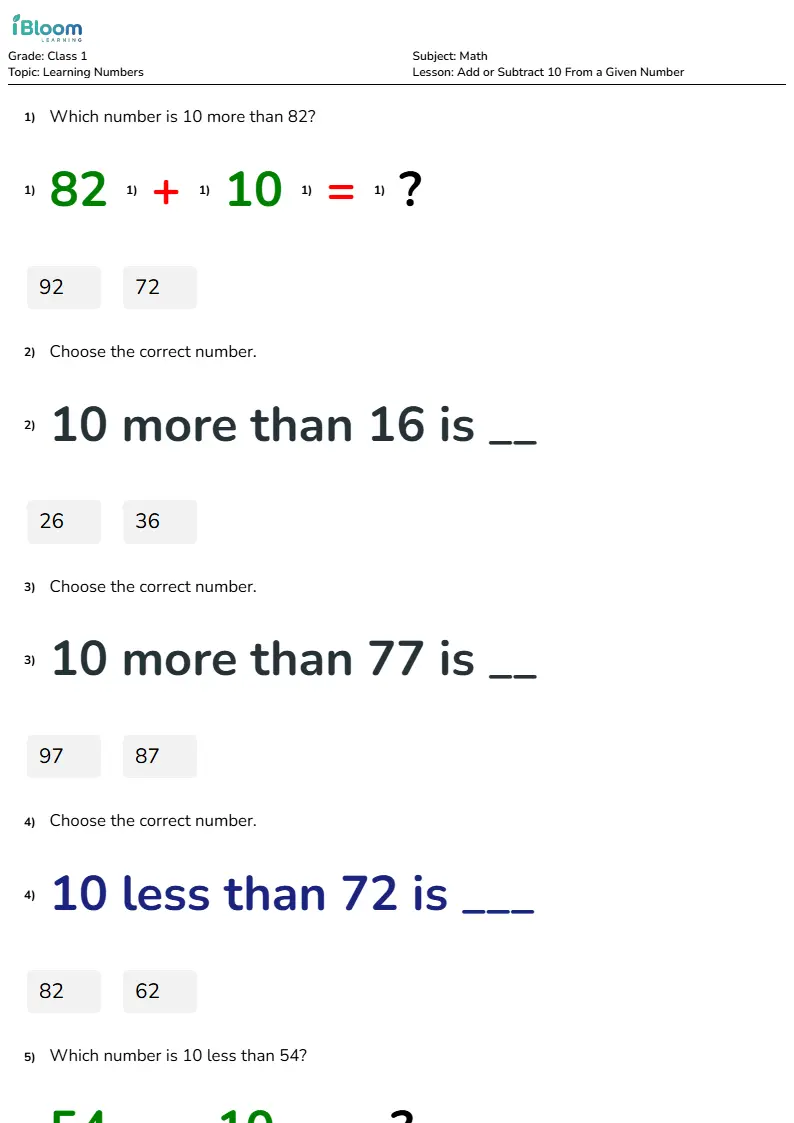
Free Add or Subtract 10 From a Given Number Worksheets for Class 1
Looking for class 1 math help? Download free, interactive add or subtract 10 from a given number worksheets. AI-personalized and Common Core-aligned. Practice math with iBloom.
.webp)
Free Adding in Any Order (Numbers 1 to 10) Worksheets for Class 1
Looking for class 1 math help? Download free, interactive adding in any order (numbers 1 to 10) worksheets. AI-personalized and Common Core-aligned. Practice math with iBloom.
.webp)
Free Adding in Any Order (Numbers 1 to 20) Worksheets for Class 1
Looking for class 1 math help? Download free, interactive adding in any order (numbers 1 to 20) worksheets. AI-personalized and Common Core-aligned. Practice math with iBloom.
.webp)
Free Addition Facts (1 to 10) Worksheets for Class 1
Looking for class 1 math help? Download free, interactive addition facts (1 to 10) worksheets. AI-personalized and Common Core-aligned. Practice math with iBloom.
.webp)
Free Addition Facts (1 to 15) Worksheets for Class 1
Looking for class 1 math help? Download free, interactive addition facts (1 to 15) worksheets. AI-personalized and Common Core-aligned. Practice math with iBloom.
.webp)
Free Addition Facts (1 to 20) Worksheets for Class 1
Looking for class 1 math help? Download free, interactive addition facts (1 to 20) worksheets. AI-personalized and Common Core-aligned. Practice math with iBloom.
.webp)
Free Addition Facts (1 to 5) Worksheets for Class 1
Looking for class 1 math help? Download free, interactive addition facts (1 to 5) worksheets. AI-personalized and Common Core-aligned. Practice math with iBloom.
.webp)
Free Addition on Number Line (Numbers 1 to 10) Worksheets for Class 1
Looking for class 1 math help? Download free, interactive addition on number line (numbers 1 to 10) worksheets. AI-personalized and Common Core-aligned. Practice math with iBloom.
.webp)
Free Addition on Number Line (Numbers 1 to 20) Worksheets for Class 1
Looking for class 1 math help? Download free, interactive addition on number line (numbers 1 to 20) worksheets. AI-personalized and Common Core-aligned. Practice math with iBloom.
.webp)
Ten-Frame Addition Worksheet for Class 1
Help Class 1 children model addition within 10 on ten frames, compare coloured groups, count the total, and write matching addition sentences.
.webp)
Free Addition Using Ten Frames (Numbers 1 to 20) Worksheets for Class 1
Looking for class 1 math help? Download free, interactive addition using ten frames (numbers 1 to 20) worksheets. AI-personalized and Common Core-aligned. Practice math with iBloom.
.webp)
Free Addition with Three Numbers (1 to 10) Worksheets for Class 1
Looking for class 1 math help? Download free, interactive addition with three numbers (1 to 10) worksheets. AI-personalized and Common Core-aligned. Practice math with iBloom.
.webp)
Free Addition with Three Numbers (1 to 20) Worksheets for Class 1
Looking for class 1 math help? Download free, interactive addition with three numbers (1 to 20) worksheets. AI-personalized and Common Core-aligned. Practice math with iBloom.
.webp)
Free Addition Word Problems Using Frames (Numbers 1 to 10) Worksheets for Class 1
Looking for class 1 math help? Download free, interactive addition word problems using frames (numbers 1 to 10) worksheets. AI-personalized and Common Core-aligned. Practice math with iBloom.
.webp)
Addition Frames Word Problems | Class 1
Help Class 1 children read addition stories, identify the start, added amount and total, model numbers to 20 with frames, and write number sentences.
.webp)
Number Line Addition Word Problems Class 1
Teach Class 1 children to solve addition stories within 10 by finding the start, making forward hops on a number line and writing the number sentence.
.webp)
Free Addition Word Problems Using Number Line (Numbers 1 to 20) Worksheets for Class 1
Looking for class 1 math help? Download free, interactive addition word problems using number line (numbers 1 to 20) worksheets. AI-personalized and Common Core-aligned. Practice math with iBloom.
.webp)
Free Addition Word Problems Using Objects (Numbers 1 to 10) Worksheets for Class 1
Looking for class 1 math help? Download free, interactive addition word problems using objects (numbers 1 to 10) worksheets. AI-personalized and Common Core-aligned. Practice math with iBloom.
.webp)
Free Addition Word Problems Using Objects (Numbers 1 to 20) Worksheets for Class 1
Looking for class 1 math help? Download free, interactive addition word problems using objects (numbers 1 to 20) worksheets. AI-personalized and Common Core-aligned. Practice math with iBloom.
.webp)
Free Addition Word Problems with Three Numbers (Numbers 1 to 10) Worksheets for Class 1
Looking for class 1 math help? Download free, interactive addition word problems with three numbers (numbers 1 to 10) worksheets. AI-personalized and Common Core-aligned. Practice math with iBloom.
.webp)
Free Addition Word Problems with Three Numbers (Numbers 1 to 20) Worksheets for Class 1
Looking for class 1 math help? Download free, interactive addition word problems with three numbers (numbers 1 to 20) worksheets. AI-personalized and Common Core-aligned. Practice math with iBloom.
.webp)
Free Addition Word Problems with Three Numbers Using Frames (1 to 10) Worksheets for Class 1
Looking for class 1 math help? Download free, interactive addition word problems with three numbers using frames (1 to 10) worksheets. AI-personalized and Common Core-aligned. Practice math with iBloom.
.webp)
Free Addition Word Problems with Three Numbers Using Frames (1 to 20) Worksheets for Class 1
Looking for class 1 math help? Download free, interactive addition word problems with three numbers using frames (1 to 20) worksheets. AI-personalized and Common Core-aligned. Practice math with iBloom.