Addition Word Problems Using Number Line (Numbers 1 To 10) worksheet for Class 1

Lesson-Wise Builder
A premium AI tool that creates syllabus-aligned questions and worksheets for any lesson in seconds.
Addition word problems using a number line for Class 1 combine a short joining story with a visual path from the starting amount to the total. A child reads the story, finds the amount at the start, identifies how many more are added, makes that many forward hops and writes the matching number sentence. Keep every worked total at 10 or less for this skill.
About the worked examples: The stories below are optional teaching examples created for this guide. They do not describe or promise a populated problem set on the activity page.
What this number-line skill means
An addition story describes two amounts being joined or an amount increasing. The first amount gives the start. The amount that joins it tells the child how many forward hops to make. The number where the final hop lands is the sum or total.
For the story Ria has 3 apples and gets 2 more, start at 3 and make 2 forward hops: 3 to 4 is one hop, and 4 to 5 is the second hop. The landing number is 5, so the number sentence is 3 + 2 = 5.
Vocabulary for addition stories within 10
| Word or phrase | Meaning in this skill | What the child does |
|---|---|---|
| Start | The amount present before more are added | Place a finger or pencil on that number |
| First addend | The first number being added | Use it as the starting point when modelling the story |
| Added amount | How many join the starting group | Make one forward hop for each added item |
| Second addend | The second number in the addition sentence | Use it to count the hops |
| Plus sign | The symbol + means add or join | Write it between the two addends |
| Equals sign | The symbol = shows that both sides have the same value | Write it before the total |
| Sum or total | The amount after the groups are joined | Read the number at the landing point |
| Altogether or in all | Phrases that may ask for the joined total | Check the whole story before choosing addition |
Clue words can help, but one word alone does not decide the operation. Ask what is happening: is a group joining or increasing, and is the unknown the final total?
How to read an addition word problem
- Read: Read the complete story aloud, including what must be found.
- Retell: Say the story in simple words: There were some. More came. We need the total.
- Find the numbers: Identify the starting amount and the amount that is added.
- Check the action: Confirm that the story joins groups or adds more rather than takes away.
- Plan the model: Choose the start number and the number of forward hops.
Words such as more, joined, altogether, in all and total often appear in addition stories. Still, the child should explain the action instead of hunting for a single keyword.
How to add with forward hops
- Point to the first addend. This is the starting position.
- Look at the second addend. This tells how many hops to make.
- Move one tick to the right for each hop.
- Count the movements, not the tick where the pencil starts.
- Say the number at the final landing point.
- Write the first addend + second addend = sum.
For 4 + 3, place the pencil on 4. The first hop lands on 5, the second on 6 and the third on 7. The answer is 7. Counting 4 as the first hop would land one number too early.
A child may draw small arcs above the line or move a counter from tick to tick. Each arc or movement must begin on one numbered mark and end on the next.
Worked addition stories from 1 to 10
Example 1: Apples
Ria has 3 apples. Her father gives her 2 more apples. How many apples does she have altogether?
- Start: 3
- Added amount: 2
- Forward hops: 3 → 4 → 5
- Number sentence: 3 + 2 = 5
- Answer in words: Ria has 5 apples altogether.
Example 2: Balloons
There are 4 red balloons. Three blue balloons join them. How many balloons are there in all?
- Start: 4
- Added amount: 3
- Forward hops: 4 → 5 → 6 → 7
- Number sentence: 4 + 3 = 7
- Answer in words: There are 7 balloons in all.
Example 3: Birds
Two birds sit on a wall. Five more birds arrive. How many birds are on the wall now?
- Start: 2
- Added amount: 5
- Forward hops: 2 → 3 → 4 → 5 → 6 → 7
- Number sentence: 2 + 5 = 7
- Answer in words: There are 7 birds on the wall.
Example 4: Pencils
A box holds 6 pencils. A child puts 2 more pencils into the box. How many pencils are there now?
- Start: 6
- Added amount: 2
- Forward hops: 6 → 7 → 8
- Number sentence: 6 + 2 = 8
- Answer in words: There are 8 pencils in the box.
Example 5: Marbles
Aman has 7 marbles. He receives 3 more marbles. How many marbles does he have altogether?
- Start: 7
- Added amount: 3
- Forward hops: 7 → 8 → 9 → 10
- Number sentence: 7 + 3 = 10
- Answer in words: Aman has 10 marbles altogether.
Connect the story to the number sentence
The story, number line and equation should show the same relationship. In 4 balloons and 3 more balloons, the first addend is 4, the second addend is 3 and the sum is 7. The number line starts at 4, shows three forward hops and lands on 7. The equation 4 + 3 = 7 records that model.
The plus sign does not mean the answer comes next; it means the two addends are being joined. The equals sign does not mean now calculate; it says the value on one side is the same as the value on the other side.
Should a child start with the larger addend?
When first connecting a story to a number line, model the story order so the starting group is clear. After the child understands the relationship, counting on from the larger addend can be a useful efficiency. For example, 2 + 5 and 5 + 2 both total 7, but the child should still be able to explain which amount came first in the story.
Common number-line mistakes
- Counting the starting tick as hop one: A hop is a movement to the next mark. Start on the first addend before counting.
- Moving left: For these joining stories, addition increases the amount, so move right.
- Making the wrong number of hops: Match each hop to one unit in the second addend.
- Starting at zero automatically: Start at the first addend unless the chosen model deliberately builds the whole amount from zero.
- Landing between marks: One hop should end exactly on the next numbered tick.
- Using the landing number as an addend: The landing point is the sum, not another number to add.
- Ignoring the story action: Do not choose addition only because the word more appears. Retell what changed.
- Copying a number incorrectly: Compare the written equation with the two amounts in the story.
How to check the answer
- Does the starting point match the amount present first?
- Does the number of hops match the amount added?
- Do all hops move one space to the right?
- Does the landing point match the written sum?
- Does the final total make sense for a joining story?
- Can the child answer with a number and the story object, such as 7 balloons?
If one part disagrees, correct that step rather than restarting automatically. For 5 + 4, four hops from 5 must land on 9. A landing point of 8 usually means the starting tick was counted as a hop or only three movements were made.
Parent guide for number-line practice
Begin with real objects before drawing the number line. Place 3 toy blocks on the table, add 2 more and count the total. Then mark 3 on a paper number line and make two forward hops. Finally write 3 + 2 = 5. This connects the story, action, visual model and equation.
Keep practice brief. Tell one oral story, let the child retell it and ask three prompts: Where will you start? How many hops will you make? Where did you land? If the child counts the starting tick, move a counter physically to show that counting begins after movement.
Ask the child to explain the answer instead of racing through many examples. A correct explanation of one story gives more information than several guessed totals.
Teacher ideas for Class 1
Model one joining story with objects and a large floor or board number line. During guided practice, ask learners to point to the starting amount before anyone hops. Let partners compare a story, model and number sentence and identify whether all three agree.
- Lesson starter: Act out a group of 3 children joined by 2 more and record 3 + 2 = 5.
- Small group: Give each learner a counter and a number line to 10. Read an oral story and pause after each decision.
- Maths centre: Pair story cards with number-line drawings and equations, using teacher-created materials that match the same within-10 skill.
- Exit prompt: Show 4 + 3 and ask the child to point to the start, demonstrate the hops and name the sum.
- Error discussion: Display an incorrect model that starts at 4 but counts 4 as the first hop. Ask learners to explain and repair it.
Observe the specific step that needs support: understanding the story, selecting the start, counting hops, reading the landing point or writing the number sentence. This keeps feedback focused.
Related iBloom practice
- Addition Word Problems Using Number Line lesson for Class 1 supports the same story-to-model idea.
- Addition on Number Line worksheet for Class 1 focuses on the forward-hop model without changing the number range.
- Addition Word Problems Using Objects worksheet for Class 1 offers a concrete model before the number line.
- Addition Using Ten Frames worksheet for Class 1 shows the same small-number addition with a different visual model.
Frequently Asked Questions
What is a number line for Class 1?
A number line places numbers in order along a line. For addition, a child can begin at an addend and use forward hops to see how the total increases.
Why do we move right for addition?
On a standard number line, values increase from left to right. A joining story adds units, so each unit moves the position one mark to the right.
Which number should the child start on?
To model the story directly, start on the first amount named before more are added. The second amount tells how many hops to make.
Does the starting tick count as a hop?
No. Place the pencil on the starting tick first. Count one only when the pencil moves to the next tick.
How many hops are needed for 4 + 3?
Start at 4 and make three hops: land on 5, then 6, then 7. The sum is 7.
What do altogether and in all mean?
They often ask for the total after groups are joined. Read the whole story to confirm that addition fits.
What is the difference between an addend and the sum?
An addend is one of the numbers being joined. The sum is the total after addition. In 3 + 2 = 5, 3 and 2 are addends and 5 is the sum.
What if a child hops left?
Return to the story action. If more objects join, the amount increases. Point to the next larger number on the right and model one forward hop.
When can a child stop using a number line?
Use it while it helps the child explain the addition. Gradually invite the child to predict the sum first and use the line to check. There is no need to remove a useful model on a fixed schedule.
More practice for this grade
More Math worksheets
.webp)
Free Add First, Then Subtract (Numbers 1 to 10) Worksheets for Class 1
Looking for class 1 math help? Download free, interactive add first, then subtract (numbers 1 to 10) worksheets. AI-personalized and Common Core-aligned. Practice math with iBloom.
.webp)
Use Addition to Solve Subtraction to 20 | Class 1
Help Class 1 learners solve subtraction within 20 by finding the missing addend first, then checking each difference with the related addition fact.
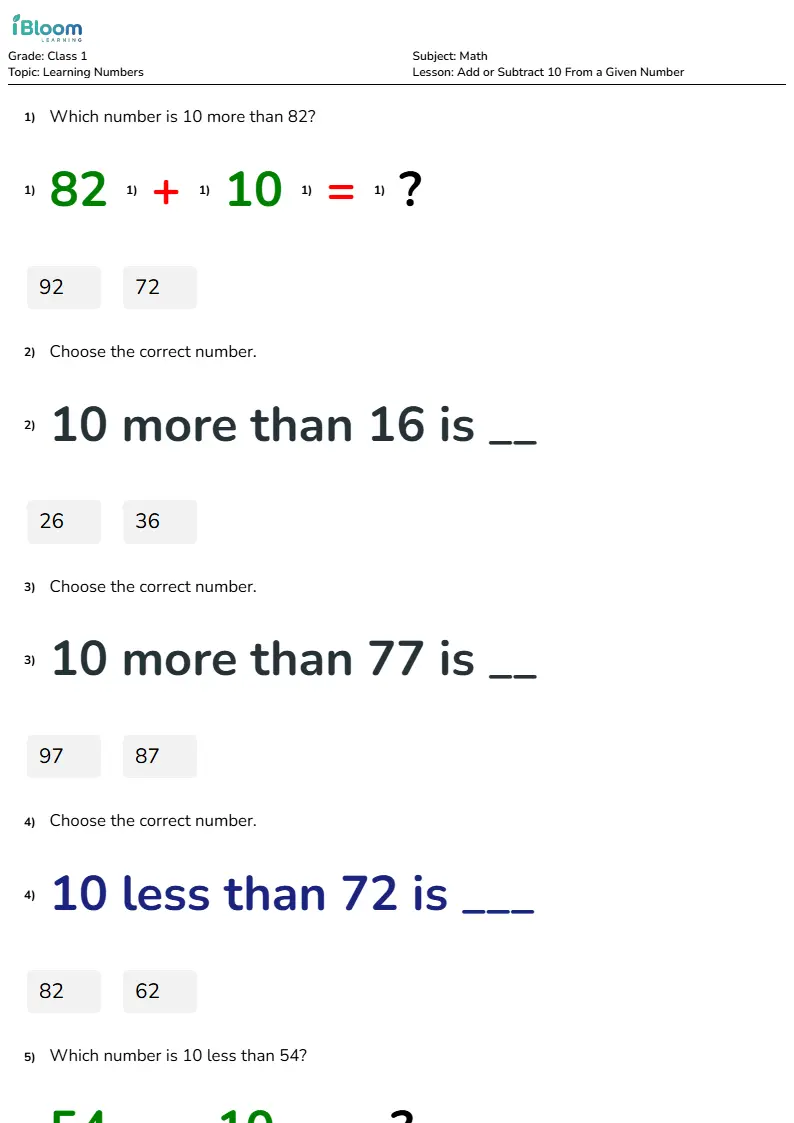
Free Add or Subtract 10 From a Given Number Worksheets for Class 1
Looking for class 1 math help? Download free, interactive add or subtract 10 from a given number worksheets. AI-personalized and Common Core-aligned. Practice math with iBloom.
.webp)
Free Adding in Any Order (Numbers 1 to 10) Worksheets for Class 1
Looking for class 1 math help? Download free, interactive adding in any order (numbers 1 to 10) worksheets. AI-personalized and Common Core-aligned. Practice math with iBloom.
.webp)
Free Adding in Any Order (Numbers 1 to 20) Worksheets for Class 1
Looking for class 1 math help? Download free, interactive adding in any order (numbers 1 to 20) worksheets. AI-personalized and Common Core-aligned. Practice math with iBloom.
.webp)
Free Addition Facts (1 to 10) Worksheets for Class 1
Looking for class 1 math help? Download free, interactive addition facts (1 to 10) worksheets. AI-personalized and Common Core-aligned. Practice math with iBloom.
.webp)
Free Addition Facts (1 to 15) Worksheets for Class 1
Looking for class 1 math help? Download free, interactive addition facts (1 to 15) worksheets. AI-personalized and Common Core-aligned. Practice math with iBloom.
.webp)
Free Addition Facts (1 to 20) Worksheets for Class 1
Looking for class 1 math help? Download free, interactive addition facts (1 to 20) worksheets. AI-personalized and Common Core-aligned. Practice math with iBloom.
.webp)
Free Addition Facts (1 to 5) Worksheets for Class 1
Looking for class 1 math help? Download free, interactive addition facts (1 to 5) worksheets. AI-personalized and Common Core-aligned. Practice math with iBloom.
.webp)
Free Addition on Number Line (Numbers 1 to 10) Worksheets for Class 1
Looking for class 1 math help? Download free, interactive addition on number line (numbers 1 to 10) worksheets. AI-personalized and Common Core-aligned. Practice math with iBloom.
.webp)
Free Addition on Number Line (Numbers 1 to 20) Worksheets for Class 1
Looking for class 1 math help? Download free, interactive addition on number line (numbers 1 to 20) worksheets. AI-personalized and Common Core-aligned. Practice math with iBloom.
.webp)
Ten-Frame Addition Worksheet for Class 1
Help Class 1 children model addition within 10 on ten frames, compare coloured groups, count the total, and write matching addition sentences.
.webp)
Free Addition Using Ten Frames (Numbers 1 to 20) Worksheets for Class 1
Looking for class 1 math help? Download free, interactive addition using ten frames (numbers 1 to 20) worksheets. AI-personalized and Common Core-aligned. Practice math with iBloom.
.webp)
Free Addition with Three Numbers (1 to 10) Worksheets for Class 1
Looking for class 1 math help? Download free, interactive addition with three numbers (1 to 10) worksheets. AI-personalized and Common Core-aligned. Practice math with iBloom.
.webp)
Free Addition with Three Numbers (1 to 20) Worksheets for Class 1
Looking for class 1 math help? Download free, interactive addition with three numbers (1 to 20) worksheets. AI-personalized and Common Core-aligned. Practice math with iBloom.
.webp)
Free Addition Word Problems Using Frames (Numbers 1 to 10) Worksheets for Class 1
Looking for class 1 math help? Download free, interactive addition word problems using frames (numbers 1 to 10) worksheets. AI-personalized and Common Core-aligned. Practice math with iBloom.
.webp)
Addition Frames Word Problems | Class 1
Help Class 1 children read addition stories, identify the start, added amount and total, model numbers to 20 with frames, and write number sentences.
.webp)
Free Addition Word Problems Using Number Line (Numbers 1 to 20) Worksheets for Class 1
Looking for class 1 math help? Download free, interactive addition word problems using number line (numbers 1 to 20) worksheets. AI-personalized and Common Core-aligned. Practice math with iBloom.
.webp)
Free Addition Word Problems Using Objects (Numbers 1 to 10) Worksheets for Class 1
Looking for class 1 math help? Download free, interactive addition word problems using objects (numbers 1 to 10) worksheets. AI-personalized and Common Core-aligned. Practice math with iBloom.
.webp)
Free Addition Word Problems Using Objects (Numbers 1 to 20) Worksheets for Class 1
Looking for class 1 math help? Download free, interactive addition word problems using objects (numbers 1 to 20) worksheets. AI-personalized and Common Core-aligned. Practice math with iBloom.
.webp)
Free Addition Word Problems with Three Numbers (Numbers 1 to 10) Worksheets for Class 1
Looking for class 1 math help? Download free, interactive addition word problems with three numbers (numbers 1 to 10) worksheets. AI-personalized and Common Core-aligned. Practice math with iBloom.
.webp)
Free Addition Word Problems with Three Numbers (Numbers 1 to 20) Worksheets for Class 1
Looking for class 1 math help? Download free, interactive addition word problems with three numbers (numbers 1 to 20) worksheets. AI-personalized and Common Core-aligned. Practice math with iBloom.
.webp)
Free Addition Word Problems with Three Numbers Using Frames (1 to 10) Worksheets for Class 1
Looking for class 1 math help? Download free, interactive addition word problems with three numbers using frames (1 to 10) worksheets. AI-personalized and Common Core-aligned. Practice math with iBloom.
.webp)
Free Addition Word Problems with Three Numbers Using Frames (1 to 20) Worksheets for Class 1
Looking for class 1 math help? Download free, interactive addition word problems with three numbers using frames (1 to 20) worksheets. AI-personalized and Common Core-aligned. Practice math with iBloom.