Addition Word Problems Using Frames (Numbers 1 To 20) worksheet for Class 1

Lesson-Wise Builder
A premium AI tool that creates syllabus-aligned questions and worksheets for any lesson in seconds.
Addition word problems with frames ask a Class 1 child to read a short story, identify two quantities that join, represent those quantities, and find a total no greater than 20. The arithmetic may be familiar, but the child must connect words, objects, a visual model, and a number sentence.
Use the Addition Word Problems with Frames activity for focused practice. Ask the child to explain the story before placing counters or writing an equation. A correct explanation shows whether the model represents the situation rather than a guess based on two visible numbers.
Read the story before choosing an operation
Read the complete problem once without touching the numbers. Ask the child to name the people or objects and tell what happened. On the second reading, identify the quantities and the question.
A useful retelling follows a short pattern: “There were some at the start. More joined. We need to find how many there are now.” The child can use different words, but the action should stay clear.
Questions that slow down guessing
- Who or what is the story about?
- How many were there at the beginning?
- How many more joined or were added?
- Does the question ask for the new total?
Find the start, added amount, and total
Label the first quantity start. Label the group that joins add. The combined amount is the total. These labels help a child keep the story roles separate even when the sentences change order.
For example, “Mina had 6 beads. Her brother gave her 4 more. How many beads does Mina have now?” has a start of 6, an added amount of 4, and a total of 10. The story action joins the two groups.
A frame or equation should show the same roles. If a child writes 10 + 4 = 6, return to the story labels and ask which number describes the starting beads.
Represent the joining action with a frame
A frame organises counters into marked spaces. Place one counter in one space. Show the starting quantity first, then place the added counters. Count all filled spaces to find the total.
The exact frame layout in a task can vary. A child can use the available frame, draw a simple five-frame or ten-frame on paper, or arrange counters in clear rows. The model should represent the story; this guidance does not assume a specific on-screen control.
Keep the two parts visible
Use two counter colours when that helps: one colour for the starting group and one for the group that joins. The colours are a checking aid. The total still comes from counting all counters together.
Use ten as a helpful landmark
A ten-frame has two rows of five spaces. For totals above 10, use two ten-frames or one full frame with extra counters beside it. A full frame represents 10, which makes teen totals easier to see.
Consider 7 + 5. Place seven counters, then add three of the five counters to complete 10. Two counters remain, so the total is 12. The equation stays 7 + 5 = 12; the make-10 step changes the representation, not the story quantities.
For a small total such as 4 + 3, a five-frame and extra spaces may be enough. Choose a layout that keeps each counter visible and prevents double counting.
Write a number sentence that matches the story
After building the model, write the starting amount, a plus sign, the added amount, an equals sign, and the total. Read the equation aloud: “Six plus four equals ten.”
The plus sign records the joining action. The equals sign says that both sides have the same value. It does not mean “write the answer next” without regard to the story.
Add the object name to the final response
If the story asks about books, write “17 books” after solving 12 + 5 = 17. The object name reconnects the calculation with the question and helps a child notice an answer copied from the wrong problem.
Worked addition stories within 20
Four apples and three more
Ravi has 4 apples. His aunt gives him 3 more. The start is 4 and the added amount is 3. Place four counters in a frame, add three, and count seven filled spaces. The number sentence is 4 + 3 = 7. Ravi has 7 apples.
Seven crayons and six more
A box holds 7 crayons. A child puts in 6 more. Show seven counters, then add six. Complete 10 with three of the new counters and place the other three beyond 10. The number sentence is 7 + 6 = 13.
Nine shells and four more
Leela collects 9 shells and finds 4 more. Add one counter to make 10, then place the remaining three. The model shows 13 counters, so 9 + 4 = 13.
Twelve books and five more
A shelf has 12 books. A teacher adds 5 books. Show one full group of 10 and two extra counters, then add five. Count 17 in all. The equation is 12 + 5 = 17.
Eight balloons and eight more
A room has 8 balloons. Eight more balloons arrive. Use two colours to show the two equal groups. Fill 10 spaces and place the remaining six on the second frame. The total is 16, so 8 + 8 = 16.
Understand the action words in the story
Addition stories may say “joined,” “gave more,” “found,” “arrived,” “altogether,” or “in all.” These phrases can point toward joining, but one keyword cannot decide the operation by itself. Read what happens to the quantities.
The word “more” can appear in different questions. “Five more birds arrived” describes joining. “How many more birds?” may ask for a comparison. Ask the child to describe the action before selecting a sign.
A child can retell the story in a strong home language first, then connect the meaning with the English terms start, add, total, plus, and equals.
Decide why addition fits
Addition fits when separate quantities join and the question asks for the combined total. Draw a quick before-and-after sketch: the starting group appears first, a second group arrives, and the final picture contains both groups.
Compare this with a taking-away story, where the final group becomes smaller. The numbers alone do not choose the operation. The action and the question do.
Do not add every number you see
A story may include a label such as Table 4 or a child’s age. Use only quantities that describe the objects in the joining action. Ask what each number counts before writing the equation.
Parent guidance for a short home session
- Read one story aloud and ask the child to retell it.
- Label the start and added amount.
- Build the two parts with safe counters or a drawn frame.
- Count the total and write the equation.
- Ask the child to answer with the object name.
Model one problem, then let the child try a similar story. If reading causes the difficulty, read the words and let the child handle the quantities. If the addition causes the difficulty, lower the numbers while keeping the story structure.
Useful counters include buttons, blocks, bottle caps, or pegs that are safe for the child. Move each counter into a frame space so the child can track it.
Teacher and tutor guidance
Observe story comprehension, modelling, calculation, and equation writing as separate steps. A child may add 7 and 5 from memory yet fail to identify those values in a story. Another child may understand the story but need counters to calculate the total.
In a small group, read one problem and let children compare two frame models. Ask which model matches the start and added amount. Children should explain an error before correcting it.
Useful feedback prompts
- Show where the starting group appears in your frame.
- Point to the counters that represent the added amount.
- Read your number sentence and match each number to the story.
- Tell why your total answers the question.
Common errors and focused responses
The child adds without reading
Cover the numbers for the first reading. Ask the child to describe the joining action, then reveal the quantities.
The frame has the wrong number of counters
Match each part of the model with a story label. Rebuild the starting group before adding the second group.
The child counts empty spaces
State that counters represent objects. Trace the filled spaces and count each counter once.
The total appears in an addend position
Read the equation aloud and ask which number means “how many now.” Move that value after the equals sign.
The child chooses subtraction
Draw the group before and after more objects arrive. The final picture contains both groups, so the operation joins them.
The child gives a bare number
Return to the question and add the object name: 13 crayons, 17 books, or 16 balloons.
Check the model, equation, and answer
Use a three-part check. First, compare the frame with the story quantities. Second, recount the filled spaces. Third, read the equation and final sentence.
The total in a joining story should not be smaller than either addend. If 12 books receive 5 more, an answer of 7 does not fit the action. This size check catches some mistakes before a full recount.
A child can verify a frame total with a number line or a second counter arrangement. Two methods that reach the same total provide a useful check.
Check progress across several skills
Give four short tasks on different days: retell a story, label start and add, build a frame model, and write the matching number sentence. Record the exact step that needs support.
Remove counters after the child can explain the frame and calculate small totals without losing the story meaning. Keep visual support for teen totals if it helps the child see 10 and the extra ones. Move beyond 20 after the child handles two-addend stories within the current range.
Continue with verified iBloom practice
- Addition Word Problems with Frames lesson for the paired lesson route.
- Addition Using Ten Frames 1-20 worksheet for frame-based calculation practice.
- Addition Word Problems Using Objects 1-20 worksheet for a concrete representation.
- Addition Word Problems Using a Number Line 1-20 worksheet for another visual strategy.
- Addition Facts 1-20 worksheet for calculation fluency after story modelling.
Frequently Asked Questions
Does a frame have to appear in one exact layout?
No. A frame can use five or ten organised spaces, and two frames can represent totals above 10. The model must keep one counter per space and match the story quantities.
Should a child look for addition keywords?
Action words can help, but the child should read what happens and what the question asks. The meaning of the story determines the operation.
Why can my child add numbers but struggle with stories?
Story problems combine reading, quantity roles, modelling, and calculation. Check each step separately to find the source of the difficulty.
Should the frame come before the equation?
For a learner who needs visual support, build the story first and write the equation from the model. The child can move toward mental or written methods after the connection is secure.
Can we use objects instead of drawn counters?
Yes. Safe movable objects can represent the story quantities. Arrange them in clear rows or frame spaces so each object is counted once.
How can a child check the final answer?
Compare the model with the story, recount the counters, read the equation, and answer with the object name.
More practice for this grade
More Math worksheets
.webp)
Free Add First, Then Subtract (Numbers 1 to 10) Worksheets for Class 1
Looking for class 1 math help? Download free, interactive add first, then subtract (numbers 1 to 10) worksheets. AI-personalized and Common Core-aligned. Practice math with iBloom.
.webp)
Use Addition to Solve Subtraction to 20 | Class 1
Help Class 1 learners solve subtraction within 20 by finding the missing addend first, then checking each difference with the related addition fact.
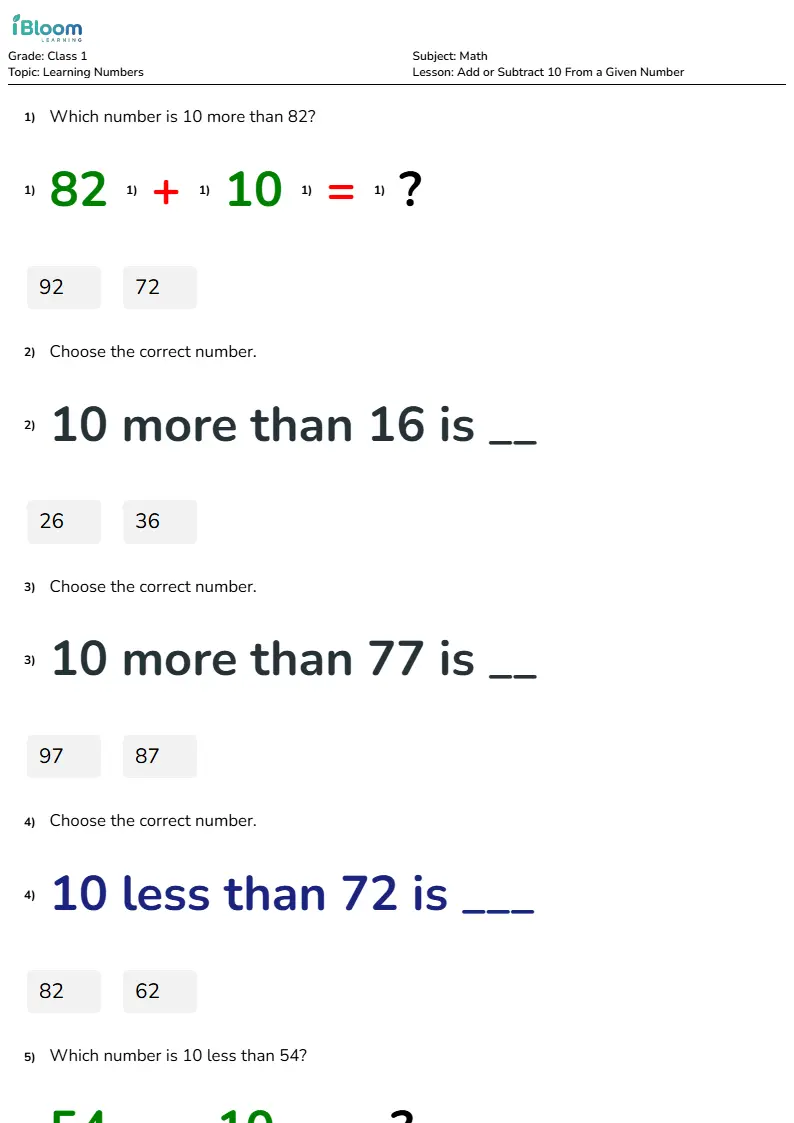
Free Add or Subtract 10 From a Given Number Worksheets for Class 1
Looking for class 1 math help? Download free, interactive add or subtract 10 from a given number worksheets. AI-personalized and Common Core-aligned. Practice math with iBloom.
.webp)
Free Adding in Any Order (Numbers 1 to 10) Worksheets for Class 1
Looking for class 1 math help? Download free, interactive adding in any order (numbers 1 to 10) worksheets. AI-personalized and Common Core-aligned. Practice math with iBloom.
.webp)
Free Adding in Any Order (Numbers 1 to 20) Worksheets for Class 1
Looking for class 1 math help? Download free, interactive adding in any order (numbers 1 to 20) worksheets. AI-personalized and Common Core-aligned. Practice math with iBloom.
.webp)
Free Addition Facts (1 to 10) Worksheets for Class 1
Looking for class 1 math help? Download free, interactive addition facts (1 to 10) worksheets. AI-personalized and Common Core-aligned. Practice math with iBloom.
.webp)
Free Addition Facts (1 to 15) Worksheets for Class 1
Looking for class 1 math help? Download free, interactive addition facts (1 to 15) worksheets. AI-personalized and Common Core-aligned. Practice math with iBloom.
.webp)
Free Addition Facts (1 to 20) Worksheets for Class 1
Looking for class 1 math help? Download free, interactive addition facts (1 to 20) worksheets. AI-personalized and Common Core-aligned. Practice math with iBloom.
.webp)
Free Addition Facts (1 to 5) Worksheets for Class 1
Looking for class 1 math help? Download free, interactive addition facts (1 to 5) worksheets. AI-personalized and Common Core-aligned. Practice math with iBloom.
.webp)
Free Addition on Number Line (Numbers 1 to 10) Worksheets for Class 1
Looking for class 1 math help? Download free, interactive addition on number line (numbers 1 to 10) worksheets. AI-personalized and Common Core-aligned. Practice math with iBloom.
.webp)
Free Addition on Number Line (Numbers 1 to 20) Worksheets for Class 1
Looking for class 1 math help? Download free, interactive addition on number line (numbers 1 to 20) worksheets. AI-personalized and Common Core-aligned. Practice math with iBloom.
.webp)
Ten-Frame Addition Worksheet for Class 1
Help Class 1 children model addition within 10 on ten frames, compare coloured groups, count the total, and write matching addition sentences.
.webp)
Free Addition Using Ten Frames (Numbers 1 to 20) Worksheets for Class 1
Looking for class 1 math help? Download free, interactive addition using ten frames (numbers 1 to 20) worksheets. AI-personalized and Common Core-aligned. Practice math with iBloom.
.webp)
Free Addition with Three Numbers (1 to 10) Worksheets for Class 1
Looking for class 1 math help? Download free, interactive addition with three numbers (1 to 10) worksheets. AI-personalized and Common Core-aligned. Practice math with iBloom.
.webp)
Free Addition with Three Numbers (1 to 20) Worksheets for Class 1
Looking for class 1 math help? Download free, interactive addition with three numbers (1 to 20) worksheets. AI-personalized and Common Core-aligned. Practice math with iBloom.
.webp)
Free Addition Word Problems Using Frames (Numbers 1 to 10) Worksheets for Class 1
Looking for class 1 math help? Download free, interactive addition word problems using frames (numbers 1 to 10) worksheets. AI-personalized and Common Core-aligned. Practice math with iBloom.
.webp)
Number Line Addition Word Problems Class 1
Teach Class 1 children to solve addition stories within 10 by finding the start, making forward hops on a number line and writing the number sentence.
.webp)
Free Addition Word Problems Using Number Line (Numbers 1 to 20) Worksheets for Class 1
Looking for class 1 math help? Download free, interactive addition word problems using number line (numbers 1 to 20) worksheets. AI-personalized and Common Core-aligned. Practice math with iBloom.
.webp)
Free Addition Word Problems Using Objects (Numbers 1 to 10) Worksheets for Class 1
Looking for class 1 math help? Download free, interactive addition word problems using objects (numbers 1 to 10) worksheets. AI-personalized and Common Core-aligned. Practice math with iBloom.
.webp)
Free Addition Word Problems Using Objects (Numbers 1 to 20) Worksheets for Class 1
Looking for class 1 math help? Download free, interactive addition word problems using objects (numbers 1 to 20) worksheets. AI-personalized and Common Core-aligned. Practice math with iBloom.
.webp)
Free Addition Word Problems with Three Numbers (Numbers 1 to 10) Worksheets for Class 1
Looking for class 1 math help? Download free, interactive addition word problems with three numbers (numbers 1 to 10) worksheets. AI-personalized and Common Core-aligned. Practice math with iBloom.
.webp)
Free Addition Word Problems with Three Numbers (Numbers 1 to 20) Worksheets for Class 1
Looking for class 1 math help? Download free, interactive addition word problems with three numbers (numbers 1 to 20) worksheets. AI-personalized and Common Core-aligned. Practice math with iBloom.
.webp)
Free Addition Word Problems with Three Numbers Using Frames (1 to 10) Worksheets for Class 1
Looking for class 1 math help? Download free, interactive addition word problems with three numbers using frames (1 to 10) worksheets. AI-personalized and Common Core-aligned. Practice math with iBloom.
.webp)
Free Addition Word Problems with Three Numbers Using Frames (1 to 20) Worksheets for Class 1
Looking for class 1 math help? Download free, interactive addition word problems with three numbers using frames (1 to 20) worksheets. AI-personalized and Common Core-aligned. Practice math with iBloom.