Comparing Objects (1 10) worksheet for LKG

Lesson-Wise Builder
A premium AI tool that creates syllabus-aligned questions and worksheets for any lesson in seconds.
Comparing Objects from 1 to 10 in LKG
Comparing objects means looking at two groups and deciding which group has more, which has fewer, or whether both groups contain the same number. On this Comparing Objects 1-10 worksheet for LKG, children work with picture groups rather than isolated numerals. They count visible objects, compare the two quantities, and then choose a group or respond Yes or No.
The inspected activity stays focused on quantities from 1 to 10. Its pictures include vegetables, cups and bottles, sharks and peacocks, and butterflies and birds. The objects change, but the maths question remains the same: How many are in each group, and how do the groups compare? This direct picture-to-quantity work is useful for an India LKG learner who is still building steady counting and comparison language.
Adults who want to teach the idea before independent practice can open the paired Comparing Objects 1-10 lesson. The worksheet and lesson use the same exact topic, so the child can move from explanation to practice without changing skills.
What the Worksheet Asks Children to Do
The visible page uses four clear comparison formats. It presents learner prompts, and children do not need comparison symbols to begin.
- Choose the group with more objects: in the first prompt, Group A shows five onions and Group B shows three carrots. The child counts both picture groups before choosing.
- Choose the group with more items: the wording changes from objects to items, but the counting process stays the same.
- Decide whether two groups are equal: the child answers Yes or No after checking whether both groups have the same count.
- Decide whether one group is less than another: the child answers Yes or No after comparing the two totals.
Before a child selects an answer, ask: “What is the first group?”, “What is the second group?”, and “How did you compare them?” These prompts keep the task about quantity instead of colour, object type, picture size, or the amount of space a row occupies.
Words Children Need for Quantity Comparison
Use the words below in complete spoken sentences. A child can first explain in a familiar home language and then repeat the key maths sentence in English. The goal is to connect a word to a counted quantity, not to memorise a definition alone.
| Word | Child-friendly meaning | Useful sentence frame |
|---|---|---|
| Group | A collection of objects being counted together. | “I will count this group first.” |
| More | A group has a larger number of objects. | “This group has more because I counted ___.” |
| Fewer | A group has a smaller number of countable objects. | “This group has fewer objects.” |
| Less | A common comparison word meaning a smaller amount. With countable objects, adults can also model the word fewer. | “The first number is less than the second number.” |
| Equal | Both groups have the same count. | “The groups are equal because both have ___.” |
| Same number | The pictures may look different, but their totals match. | “They are different objects with the same number.” |
| Compare | Look at two quantities and explain how they relate. | “I counted both groups so I can compare them.” |
Equal does not mean the pictures must be identical. A group of leaves and a group of beads can be equal when both groups contain the same number. This distinction helps children attend to quantity rather than appearance.
A Reliable Count, Pair and Compare Method
- Look at both groups. Name the objects and identify the two separate collections.
- Count the first group once. Point to each picture, move a finger in one direction, and say one number for one object.
- Count the second group once. Use the same slow method and say the final total aloud.
- Pair the groups if the answer is not clear. Match one object from the first group to one object from the second. A leftover object shows that one group has more; no leftovers after complete matching shows equal groups.
- Say a comparison sentence. Use more, fewer, less, equal, or same number before selecting the worksheet response.
- Check once. Recount or rearrange the objects. The answer should remain the same even if the pictures are spaced differently.
One-to-one matching is especially helpful when one row looks longer or uses larger pictures. It shows why visual size and spacing cannot replace counting. If a child loses track, cover each counted picture with a small counter, or ask the child to trace an imaginary line from left to right.
Children who need more counting practice can first use Learn to Count from 1 to 10, then return to the comparison page and apply the same one-number-for-one-object routine.
How Parents Can Practise with Everyday Objects
Use objects already available at home: buttons, pencils, spoons, blocks, bottle caps, toy cars, or fruit pieces. Make two small groups, ask the child to touch and count each group, and then ask one comparison question. Keep the first practice short and stop after the child can explain one answer clearly.
- “Which group has more? Show me how you counted.”
- “Which group has fewer? Can you pair the objects?”
- “Do the groups have the same number? How do you know?”
- “Can you move one object so the groups become equal?”
In a multilingual Indian home, let the child describe the idea in the home language first. Then repeat the core English words together: more, fewer, less, equal, same number. Understanding the quantity should come before perfect wording.
If the child guesses the bigger-looking group, spread one collection far apart and place the other close together. Count and pair them. This simple contrast shows that the amount of space does not decide how many objects there are.
How Teachers Can Use the Activity
Use the worksheet after a short demonstration with counters or classroom objects. Model one question aloud: name the groups, count each group, pair one-to-one if needed, and finish with a comparison sentence. Do not model every item; leave room to observe each child's process.
- Small group: give each child two collections to count and compare before opening the picture task.
- Maths centre: place two bowls of counters beside the worksheet so children can rebuild a picture comparison.
- Partner talk: one child counts while the other checks that every object is counted once; then they switch roles.
- Quick formative check: ask “How do you know?” and listen for a count, a one-to-one match, or a clear comparison sentence.
- Mixed readiness: use smaller groups and lined-up objects for support; use scattered pictures, equal groups, or three collections for extension.
The LKG maths worksheet collection provides nearby practice, but keep the teaching sequence narrow: count accurately, compare picture groups, and only then compare written numerals.
Common Comparison Mistakes and Helpful Prompts
- The child counts one picture twice.
- Ask the child to point, cover, or move past each picture after saying its number.
- The child skips a picture.
- Start at one edge and follow a consistent path. For scattered groups, mark each counted object with a finger or counter.
- The child chooses the row that looks longer.
- Rearrange both groups into rows or pairs and ask whether moving an object changed the number.
- The child chooses the group with larger pictures.
- Say, “We are comparing how many, not how big.” Then count both groups.
- The child mixes up more, fewer, and less.
- Use a sentence frame with the counted totals: “___ has more; ___ has fewer.” Repeat with new objects.
- The child thinks equal groups must contain the same object.
- Build two groups with different objects but matching totals, then pair them one-to-one.
- The child changes an answer after the groups move.
- Recount and ask, “Did we add or remove anything?” This separates arrangement from quantity.
Correct one process at a time. A prompt such as “Point to each one” or “Make pairs” is more useful than giving the comparison answer.
Fresh Practice Examples
These examples use new objects and question stems rather than the inspected worksheet items.
- Place four buttons and six blocks in two groups. Ask the child to count, pair, and finish: “The group with more objects is ___.”
- Make one group of five beads and one group of five leaves. Ask: “Do these groups have equal numbers? Prove it with pairs.”
- Set out seven crayons and three spoons. Ask: “Which collection has fewer? What did you count?”
- Draw two groups, then swap their positions. Ask whether left and right changed the quantities.
- Use objects of different sizes but matching totals. Ask the child to compare how many rather than how big.
- Ask the child to create a new more-or-fewer question for an adult and check the adult's reasoning.
After each response, ask for one explanation. A full sentence reveals whether the child compared the quantities or only guessed from the picture.
Next Steps After Comparing Picture Groups
When the child can count each group, compare accurately, and explain the answer, extend the same idea gradually.
- Ask for a group with one more or one fewer object.
- Add or remove objects until two unequal groups become equal.
- Compare three groups and order them from least to most.
- Show the counted totals as numerals and compare the numerals from 1 to 10.
- Introduce comparison symbols only after the words and quantities are secure.
Use Which Is More and Which Is Less for focused language practice. Then move to Comparing Numbers 1-10 when the child is ready to connect picture quantities with written numerals.
Frequently Asked Questions
What does comparing objects from 1 to 10 mean?
It means counting two small groups and deciding which has more, which has fewer, or whether their totals are equal. The groups contain no more than ten objects.
Should a child compare by looking or by counting?
A quick look can help form an idea, but the child should count or match one-to-one to check. Picture size and spacing can be misleading.
How can I explain fewer and less?
For countable objects, “fewer objects” is a clear phrase. Children may also see “less than” in a question. Connect both expressions to the smaller counted quantity rather than teaching them as unrelated rules.
Does equal mean the objects must look the same?
No. Equal groups have the same number. The colours, sizes, or types of objects can be different.
What should I do if the child keeps losing count?
Arrange the objects in a row, point to each one, and cover or move each counted object. Return to scattered pictures after the one-to-one count is steady.
When is the child ready to compare written numbers?
Move to numerals when the child can count the picture groups accurately, explain more or fewer, and recognise equal totals without relying on layout.
More practice for this grade
More Math worksheets
.webp)
Free Comparing Numbers (1-10) Worksheets for Lkg
Looking for lkg math help? Download free, interactive comparing numbers (1-10) worksheets. AI-personalized and Common Core-aligned. Practice math with iBloom.
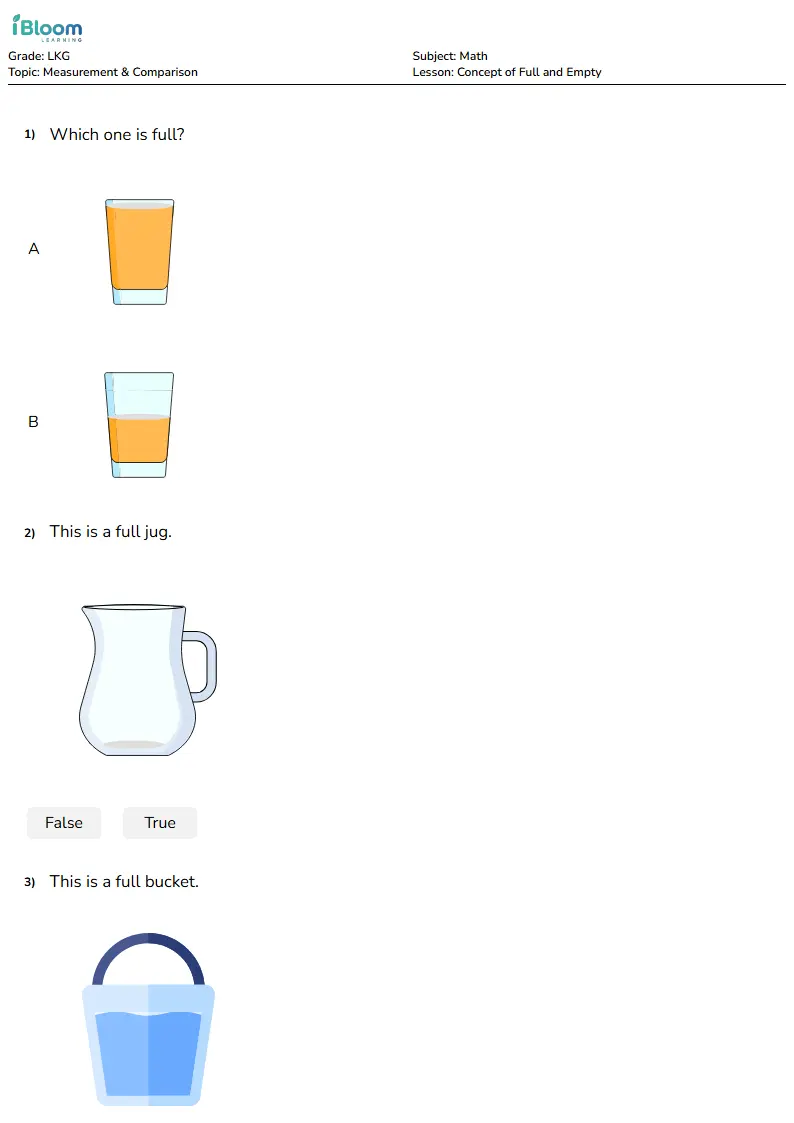
Full and Empty Worksheets for LKG
Full and empty worksheets for LKG and kindergarten with black-and-white practice, real-object examples, and answer guidance.
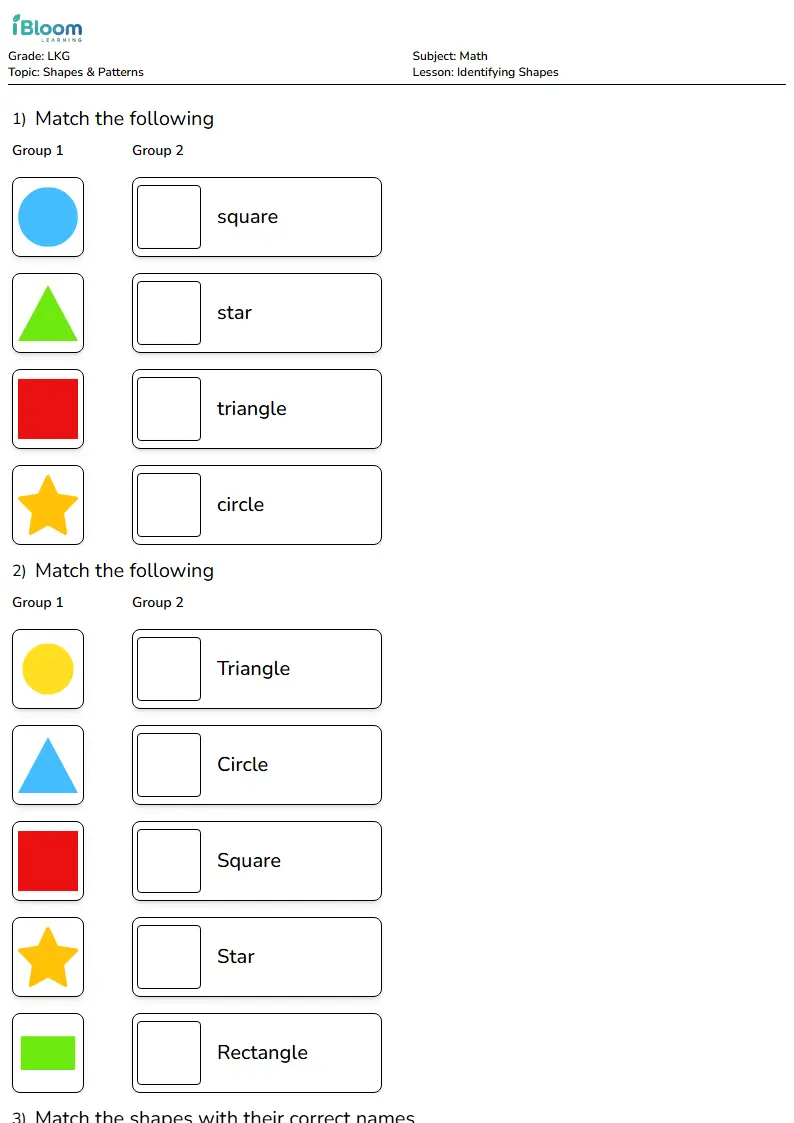
Free Identifying Shapes Worksheets for Lkg
Looking for lkg math help? Download free, interactive identifying shapes worksheets. AI-personalized and Common Core-aligned. Practice math with iBloom.
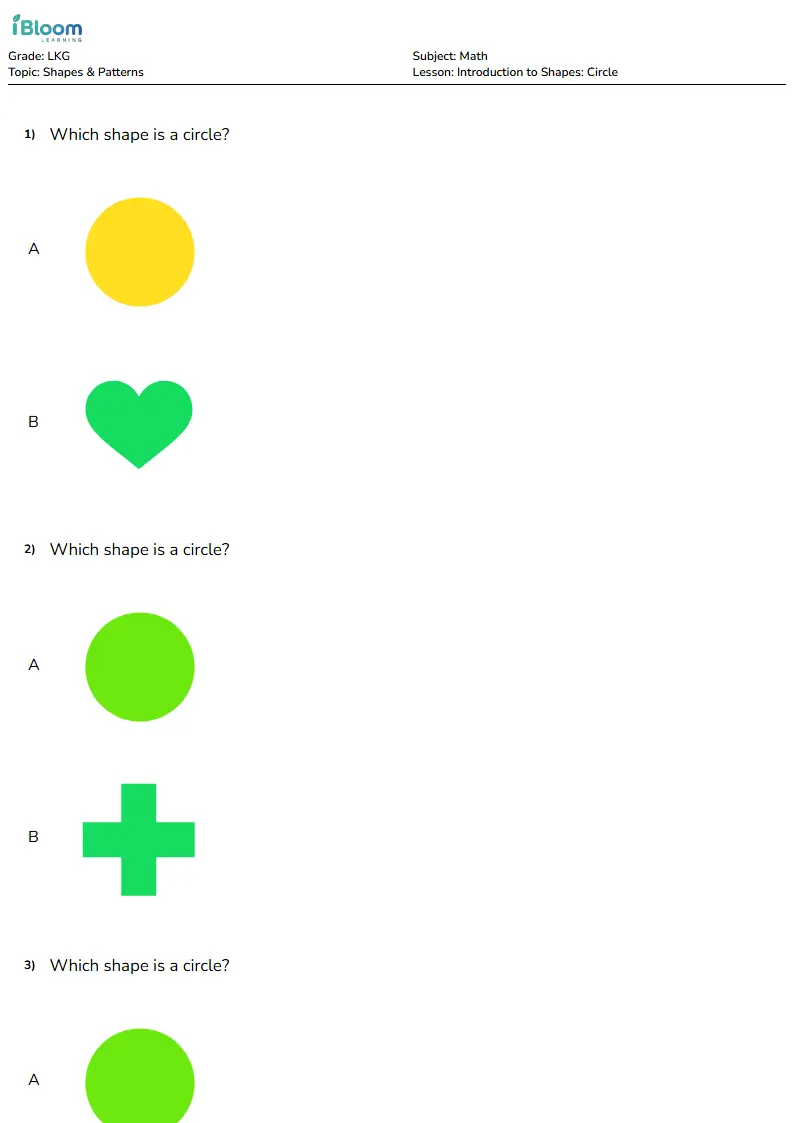
Circle Shape Recognition Worksheet for LKG
Help LKG children identify a circle among picture choices, notice its curved boundary and no corners, and practise shape talk at home or in class.
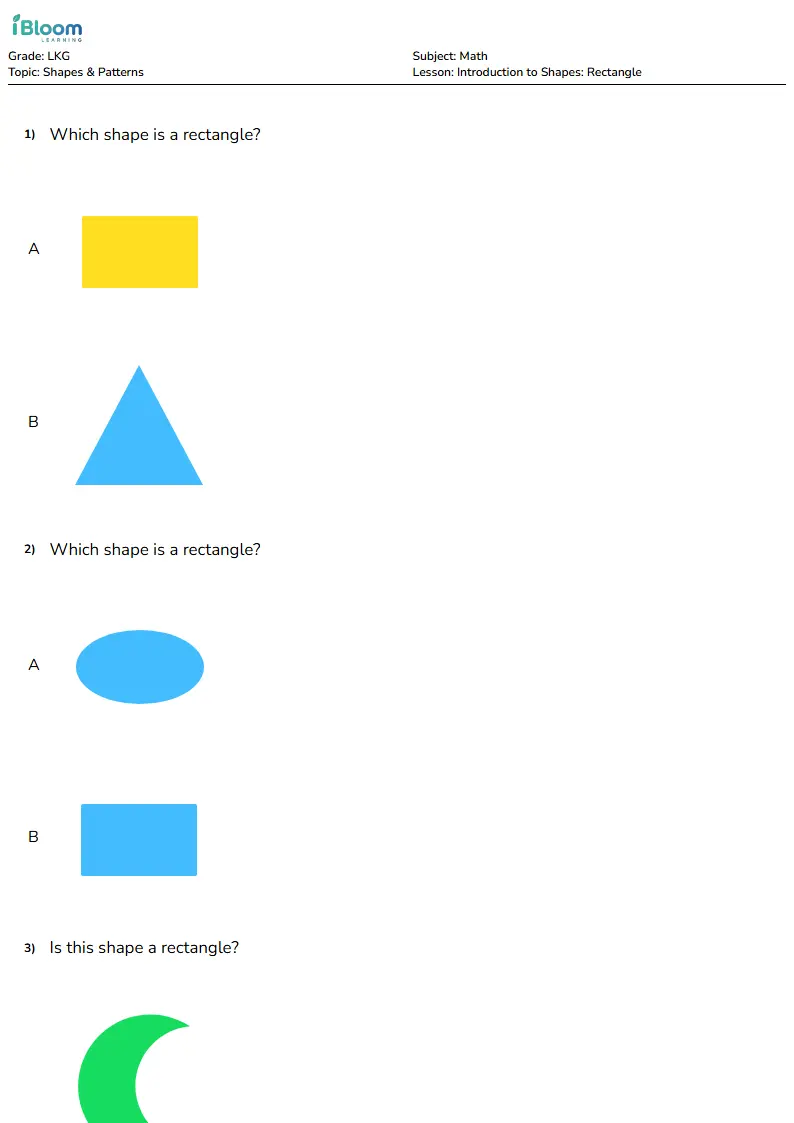
Free Introduction to Shapes: Rectangle Worksheets for Lkg
Looking for lkg math help? Download free, interactive introduction to shapes: rectangle worksheets. AI-personalized and Common Core-aligned. Practice math with iBloom.
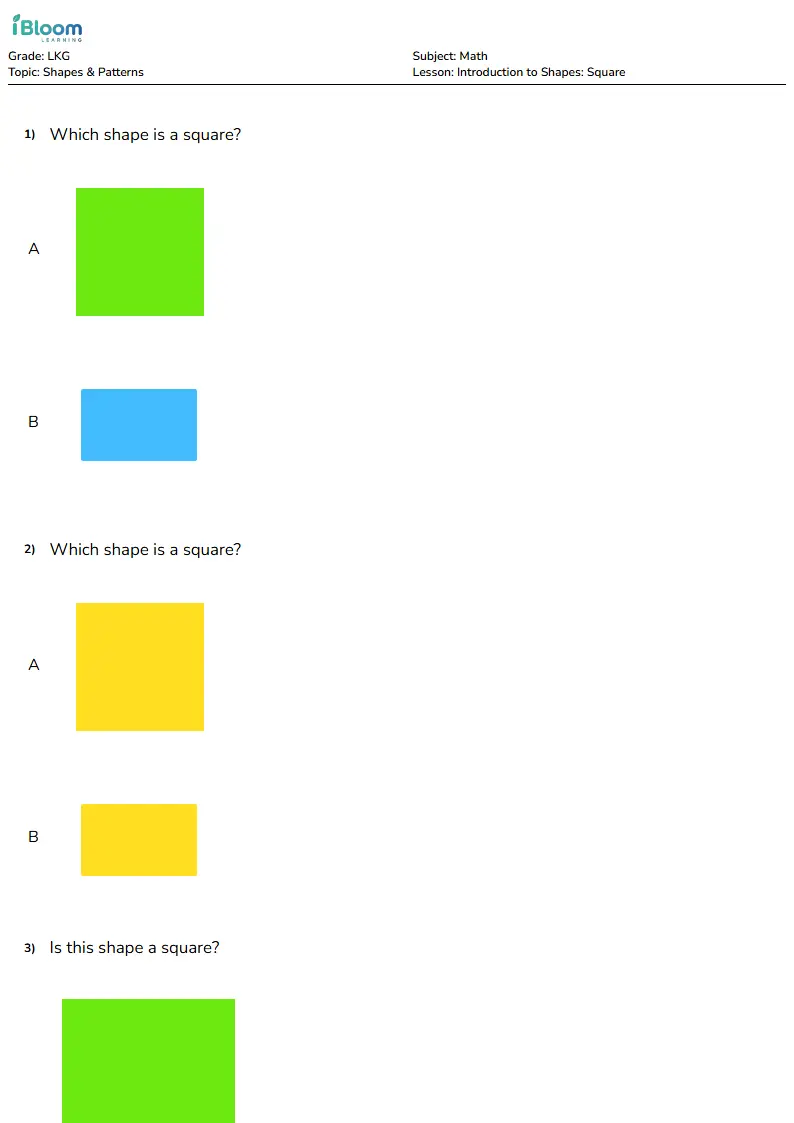
Square Shape Recognition Practice for LKG
Help LKG children recognise a square by its four equal sides and four corners, compare shapes, and find square objects through guided practice.
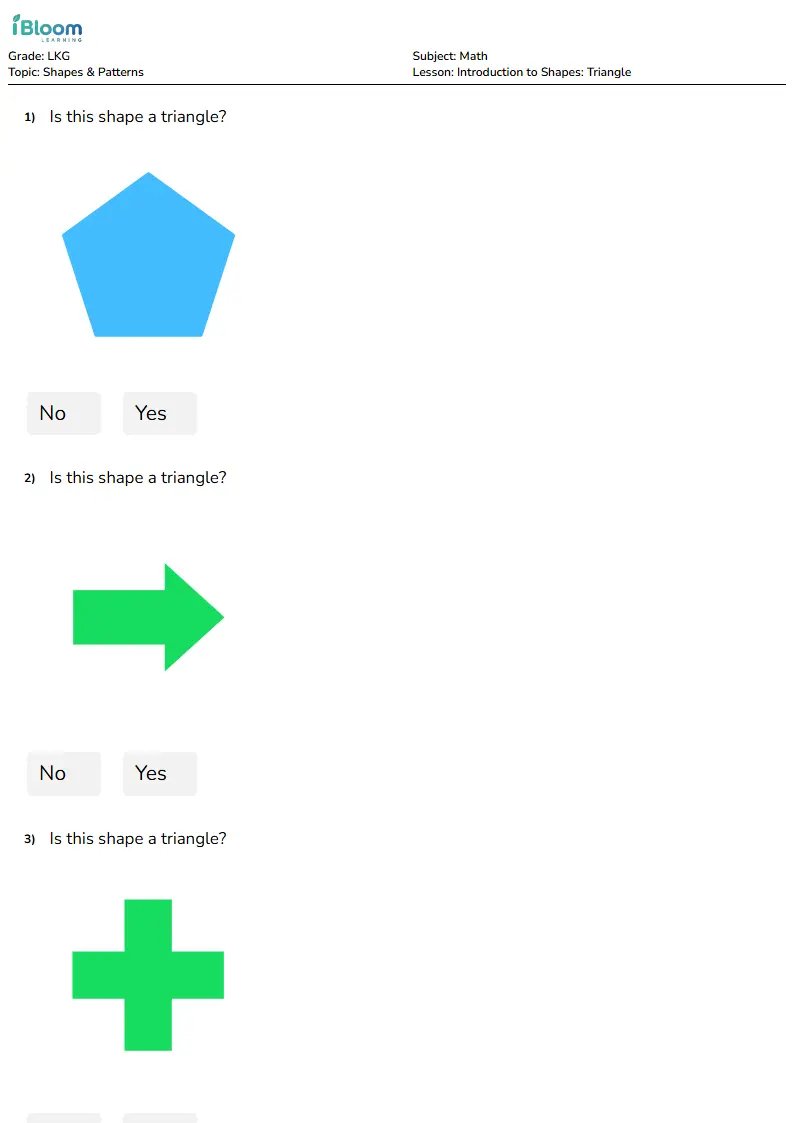
Free Introduction to Shapes: Triangle Worksheets for Lkg
Looking for lkg math help? Download free, interactive introduction to shapes: triangle worksheets. AI-personalized and Common Core-aligned. Practice math with iBloom.
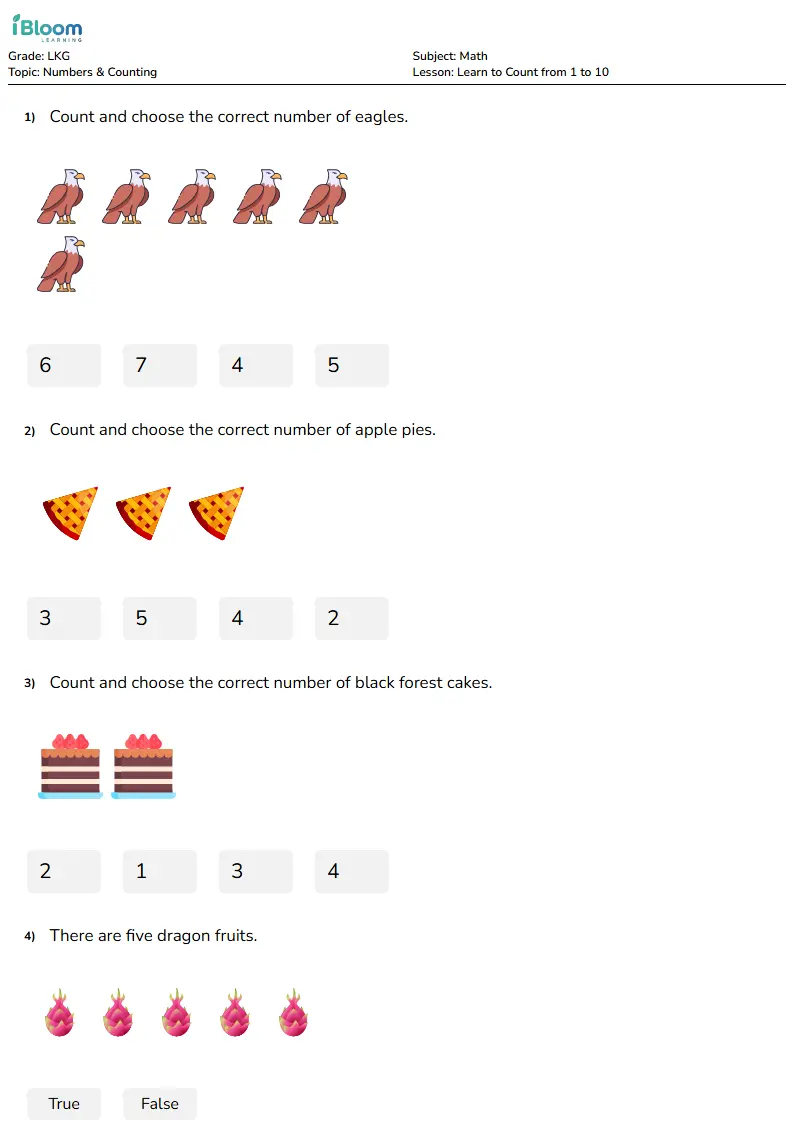
Free Learn to Count from 1 to 10 Worksheets for Lkg
Looking for lkg math help? Download free, interactive learn to count from 1 to 10 worksheets. AI-personalized and Common Core-aligned. Practice math with iBloom.

Count from 1 to 20 Worksheet for LKG
Help LKG children count from 1 to 20, match numbers to quantities, fill sequence gaps, and practise teen numbers with clear parent and teacher guidance.
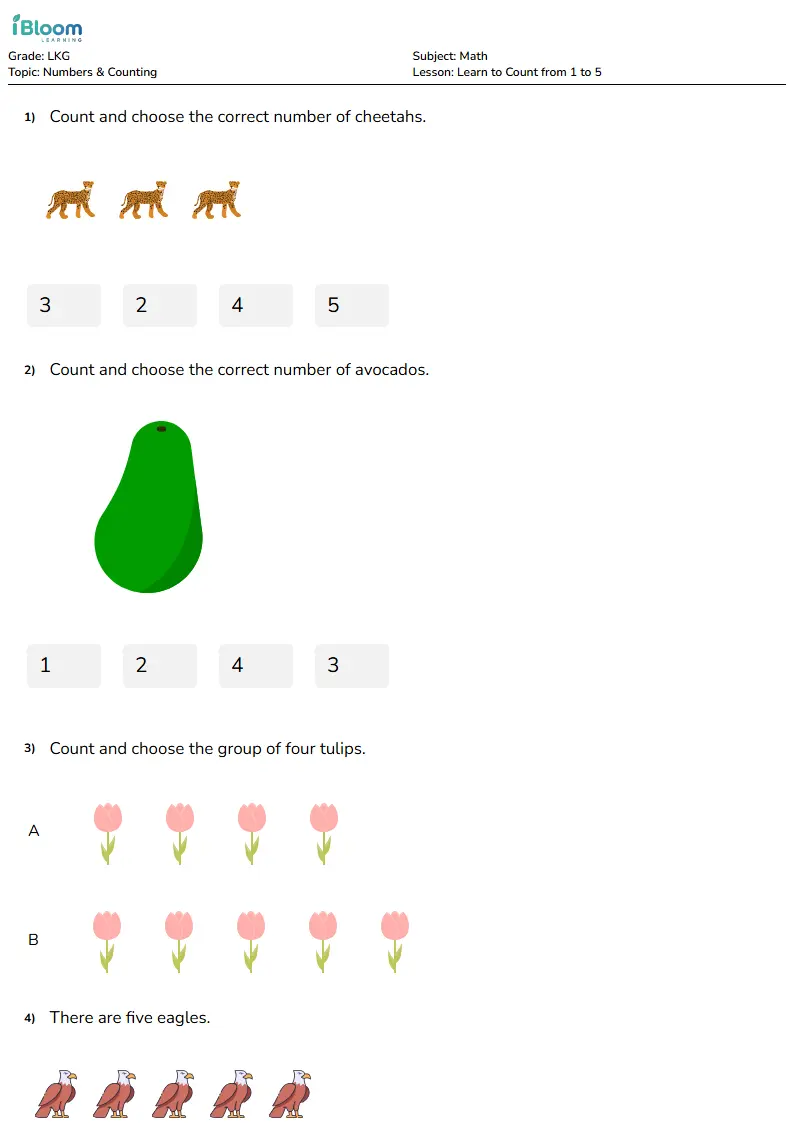
Free Learn to Count from 1 to 5 Worksheets for Lkg
Looking for lkg math help? Download free, interactive learn to count from 1 to 5 worksheets. AI-personalized and Common Core-aligned. Practice math with iBloom.
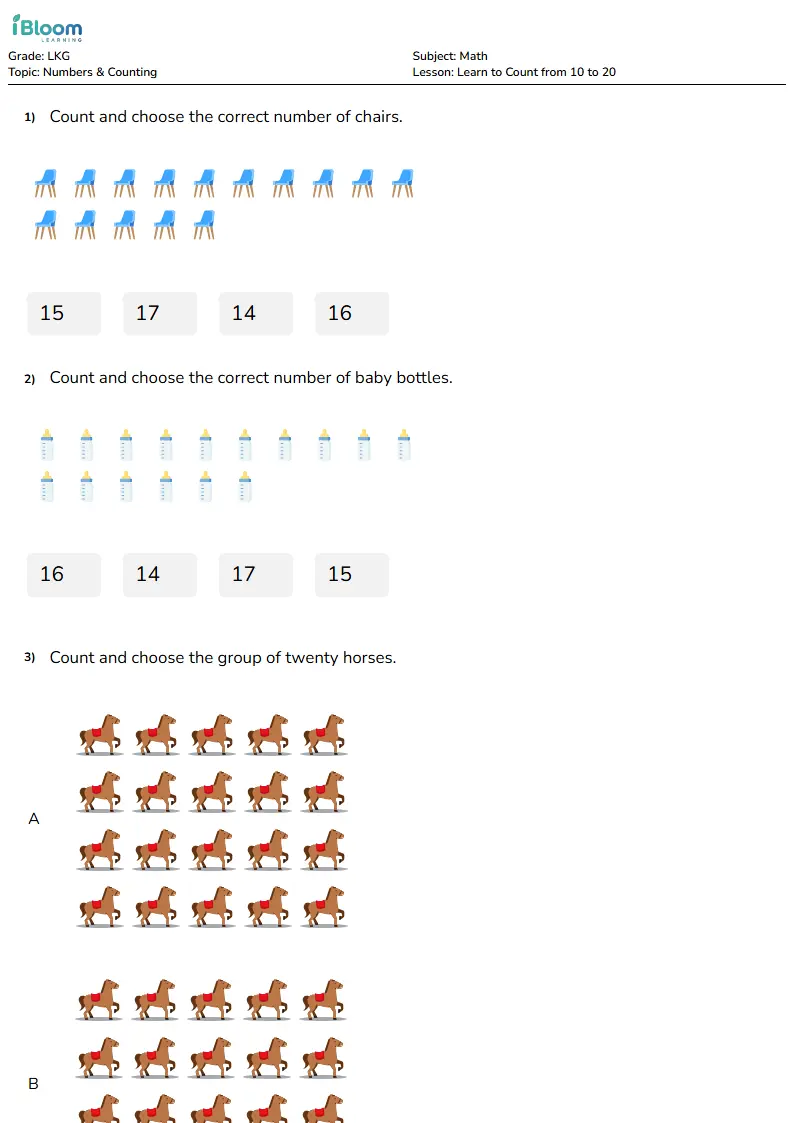
Free Learn to Count from 10 to 20 Worksheets for Lkg
Looking for lkg math help? Download free, interactive learn to count from 10 to 20 worksheets. AI-personalized and Common Core-aligned. Practice math with iBloom.
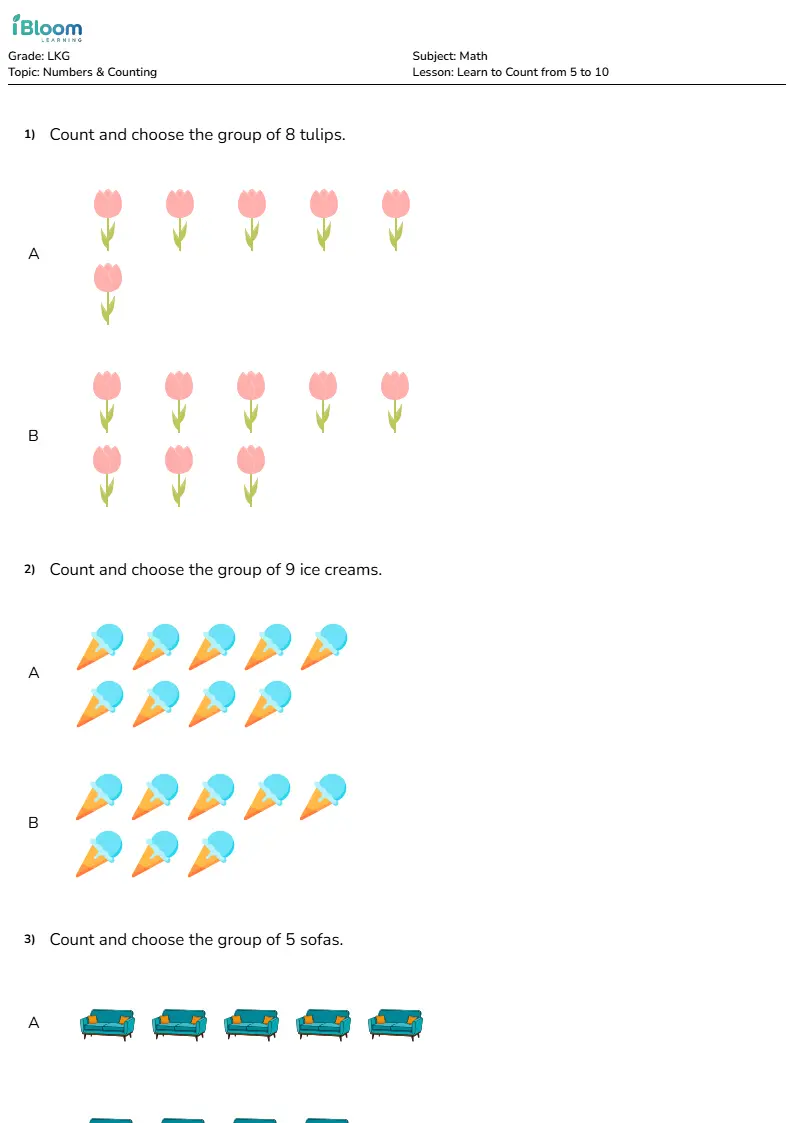
Free Learn to Count from 5 to 10 Worksheets for Lkg
Looking for lkg math help? Download free, interactive learn to count from 5 to 10 worksheets. AI-personalized and Common Core-aligned. Practice math with iBloom.
.webp)
Free Number Recognition (1-10) Worksheets for Lkg
Looking for lkg math help? Download free, interactive number recognition (1-10) worksheets. AI-personalized and Common Core-aligned. Practice math with iBloom.
.webp)
Number Recognition 1-3 Practice for LKG
Help LKG children recognise, name, match and write 1, 2 and 3 through visual activities, object counting, and short home or classroom practice.
.webp)
Free Number Recognition (1-5) Worksheets for Lkg
Looking for lkg math help? Download free, interactive number recognition (1-5) worksheets. AI-personalized and Common Core-aligned. Practice math with iBloom.
.webp)
Free Number Recognition (1-6) Worksheets for Lkg
Looking for lkg math help? Download free, interactive number recognition (1-6) worksheets. AI-personalized and Common Core-aligned. Practice math with iBloom.
.webp)
Free Number Recognition (1-7) Worksheets for Lkg
Looking for lkg math help? Download free, interactive number recognition (1-7) worksheets. AI-personalized and Common Core-aligned. Practice math with iBloom.
.webp)
Free Number Recognition (1-8) Worksheets for Lkg
Looking for lkg math help? Download free, interactive number recognition (1-8) worksheets. AI-personalized and Common Core-aligned. Practice math with iBloom.
.webp)
Free Number Recognition (1-9) Worksheets for Lkg
Looking for lkg math help? Download free, interactive number recognition (1-9) worksheets. AI-personalized and Common Core-aligned. Practice math with iBloom.
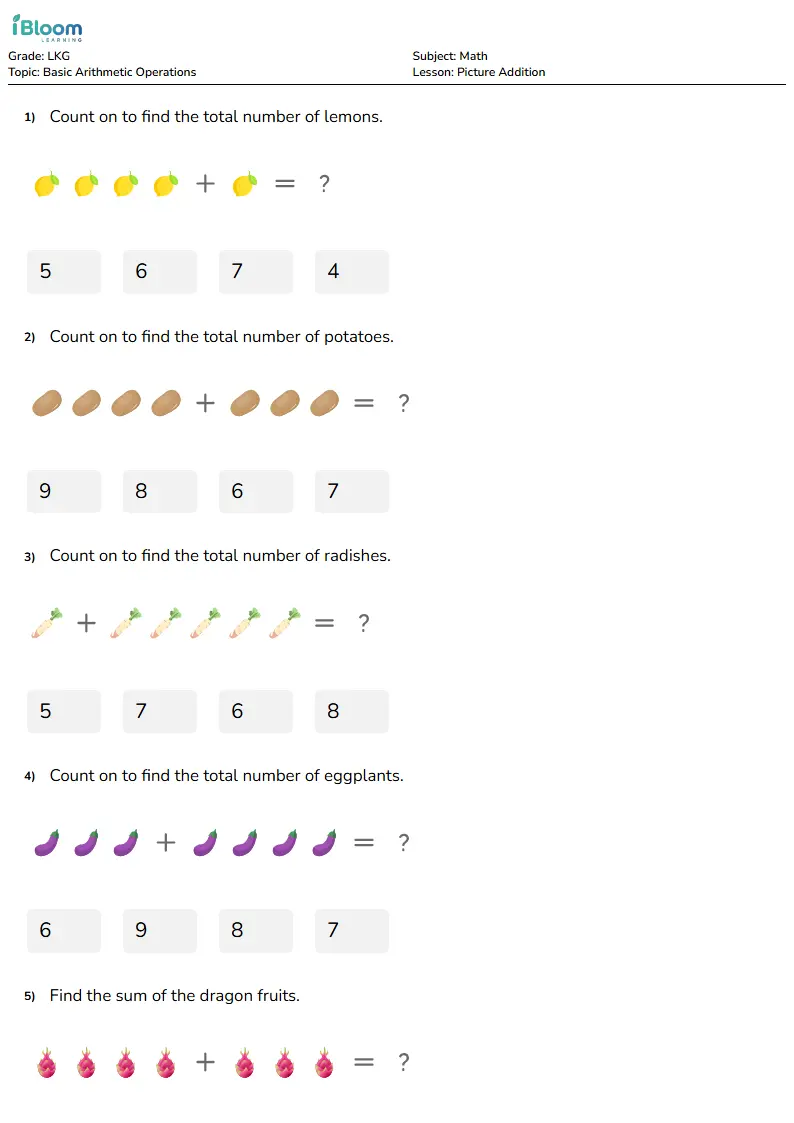
Free Picture Addition Worksheets for Lkg
Looking for lkg math help? Download free, interactive picture addition worksheets. AI-personalized and Common Core-aligned. Practice math with iBloom.
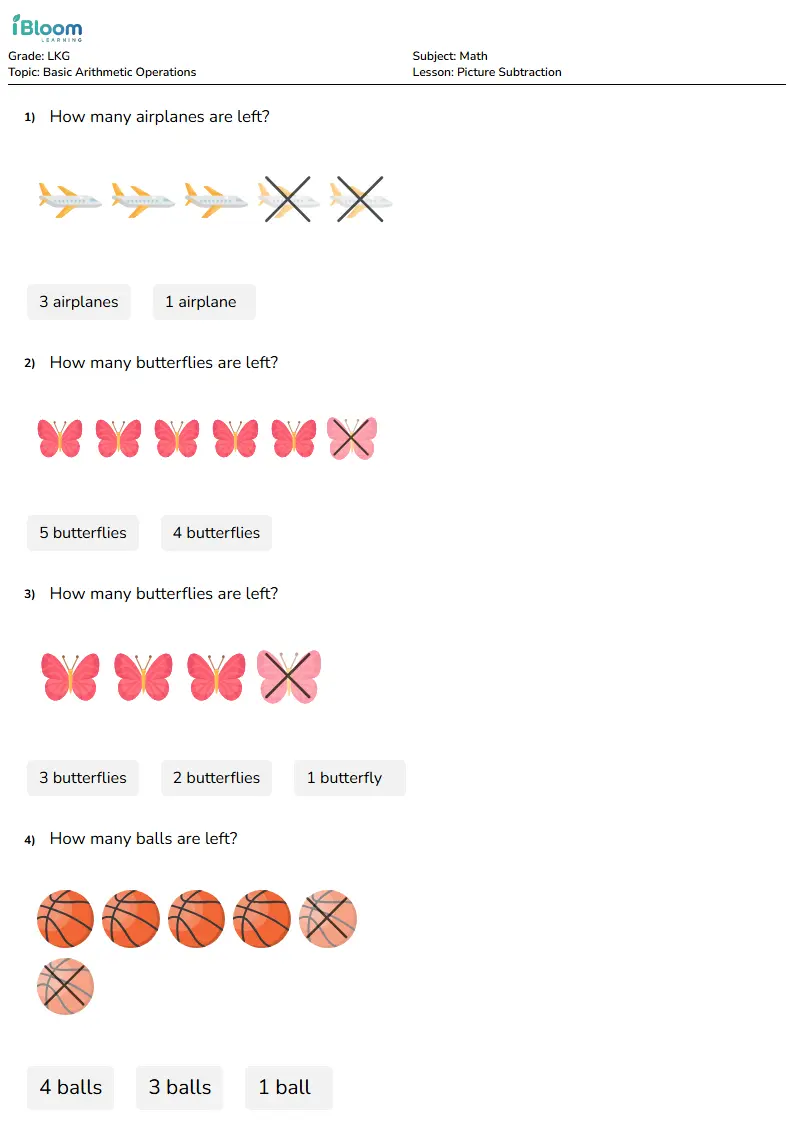
Free Picture Subtraction Worksheets for Lkg
Looking for lkg math help? Download free, interactive picture subtraction worksheets. AI-personalized and Common Core-aligned. Practice math with iBloom.
.webp)
Simple Addition to 5 for LKG | Practice Worksheet
Help LKG children combine two small groups and find totals up to 5 using objects, drawings, number sentences, and short guided practice.
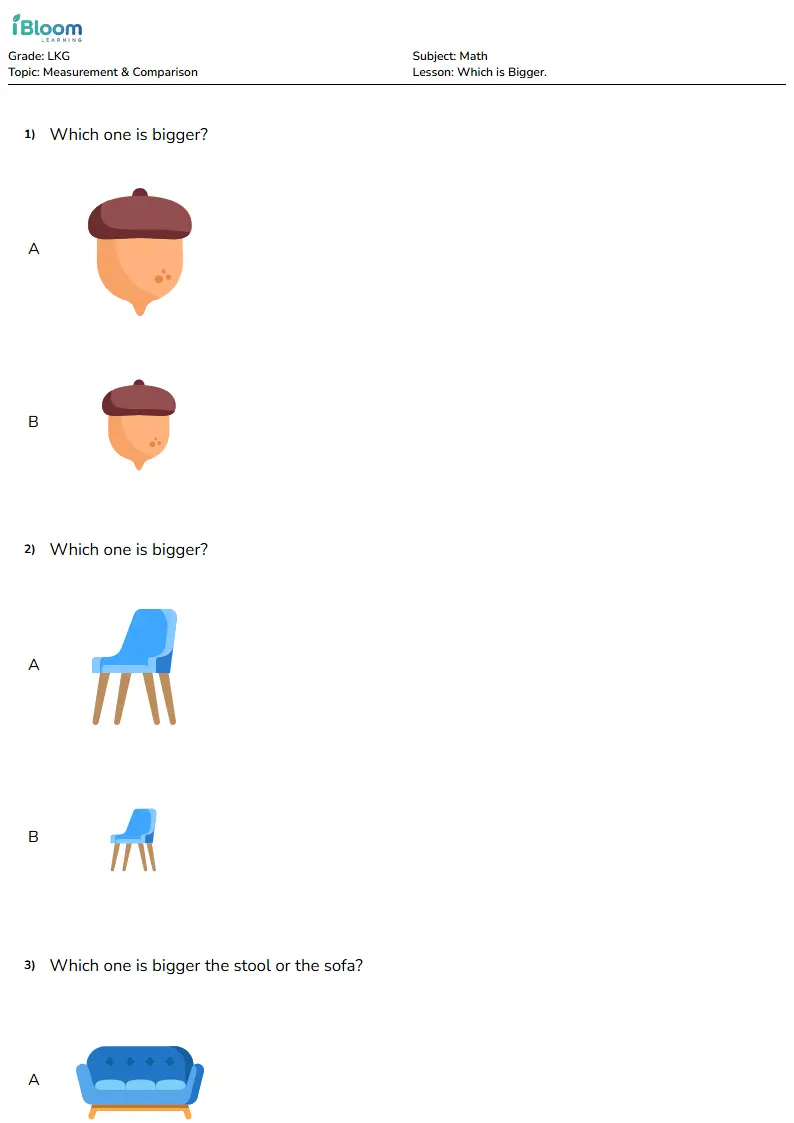
Free Which is Bigger. Worksheets for Lkg
Looking for lkg math help? Download free, interactive which is bigger. worksheets. AI-personalized and Common Core-aligned. Practice math with iBloom.
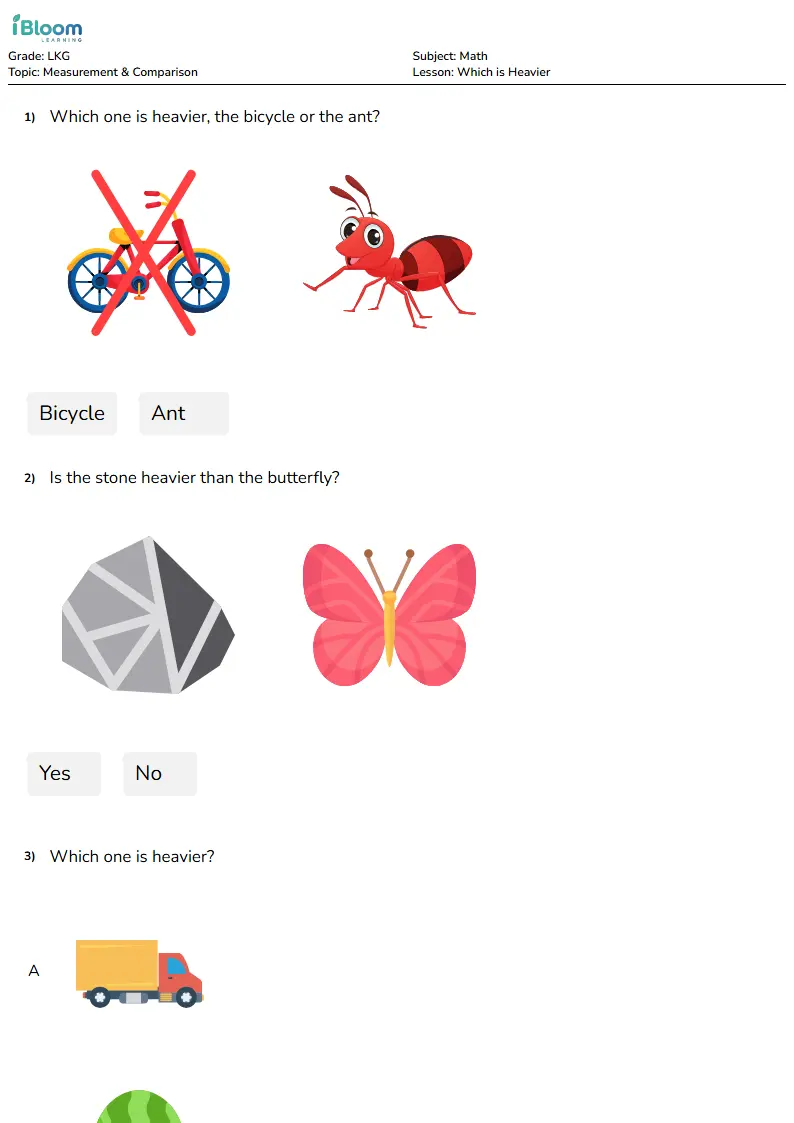
Free Which is Heavier Worksheets for Lkg
Looking for lkg math help? Download free, interactive which is heavier worksheets. AI-personalized and Common Core-aligned. Practice math with iBloom.