Learn To Count From 1 To 20 worksheet for LKG

Lesson-Wise Builder
A premium AI tool that creates syllabus-aligned questions and worksheets for any lesson in seconds.
Counting from 1 to 20 asks an LKG child to say the numbers in a stable order, connect each count word with one object, and understand that the final number names the total. A child may recite the sequence from memory yet still need practice with objects, mixed numeral cards, or teen numbers.
Use the Count from 1 to 20 worksheet as one short practice point. Ask the child to point, count, match, and explain. These actions show more than a fast chant because you can see where the child loses the sequence or the objects.
Build a steady number sequence from 1 to 20
Place number cards in a row and invite the child to touch each card while saying its name. Mix the cards after one successful attempt. Rebuilding the row checks whether the child knows the order rather than the position of a card on the table.
Start from different points too. Say, “Begin at 7 and keep counting until 14,” or show 16 and ask for the next number. A child who can continue from a given number has a firmer sequence than a child who must restart at 1 each time.
Sequence prompts
- Put 9, 10 and 11 in order.
- Continue 13, 14, 15, __, __.
- Find the number that comes before 18.
- Stop when you reach 20.
Count each object once
One-to-one counting means that the child gives one count word to one object. Let the child move each button or block into a new space while counting. The movement marks which objects have been counted and prevents a second count of the same item.
Rows are easier than scattered groups, so begin with a tidy line and then change the arrangement. For a scattered group, the child can move objects, point in a planned path, or separate counted objects from the rest.
Connect the final count with the total
After the child counts a group, ask, “How many are there?” The child should use the final count word as the total. If the count ends at 14, the group contains 14 objects. Recount only when the child lost track or wants to check.
Reverse the task by showing a numeral card and asking the child to build that quantity. A card marked 17 should lead to a group of 17 counters. Switching between numeral and quantity strengthens the connection between the written symbol and the amount.
Recognise numbers in mixed order
Counting in order does not prove that a child recognises each numeral. Show cards such as 4, 12, 7, 19 and 10 in a mixed set. Ask the child to name one card, find a named card, and match it with a group.
Give extra attention to pairs that look or sound close. A child may confuse 6 and 9, reverse the digits in 12, or read 20 as 2. Place the two cards side by side and let the child describe the visible difference before trying again.
Make sense of 11 through 20
Teen numbers can feel like a long new list after 10. Build each number with a group of ten and some extra counters. For 13, make one group of ten and add three. For 18, keep the group of ten and add eight. The child still counts the full set, but the grouping makes the quantity easier to track.
Use the spoken names with the written numerals. Say thirteen while pointing to 13, then ask the child to build thirteen objects. Repeat with numbers that cause hesitation rather than rehearsing the whole range after every mistake.
Find missing, before, and after numbers
A number line with one blank checks sequence knowledge in a focused way. Start with a gap near the beginning, such as 4, 5, __, 7. Move to teen-number gaps after the child handles smaller numbers, such as 14, __, 16.
Ask before-and-after questions with a visible number line first. The child can point to 17, look one place left for 16, and one place right for 18. Remove the visual support after several accurate attempts.
Count first, then write the numeral
Separate counting knowledge from pencil control. Let the child count a group and choose the correct numeral card before asking for written work. A large model, finger tracing, and one careful copy give the child a clear path into numeral formation.
For a teen number, ask the child to say the number and look at the model before writing both digits. Compare the result with the card. If the digits are reversed, model one new attempt rather than filling a row with repeated corrections.
Worked counting examples
Eight buttons
Place eight buttons in a line. The child moves each button while saying 1 through 8, then selects the numeral 8. Ask for the total after the last button has moved.
Thirteen blocks
Make a group of ten blocks and a second group of three. Count the complete collection to 13 and match it with the numeral card. Mix the blocks afterward and recount to show that spacing does not change the total.
Seventeen counters
Give the child 17 counters and a card marked 17. The child builds the quantity, checks it by moving each counter, and explains how the last count confirms the total.
A sequence gap
Show 11, 12, __, 14, 15. Let the child point and count through the row. The missing number is 13 because it comes after 12 and before 14.
A full set of twenty
Arrange two groups of ten objects. Count the first group, continue through the second group, and stop at 20. Ask the child to find the numeral 20 without returning to the start of the number-card row.
A short parent routine at home
- Choose one goal, such as counting objects or ordering teen numbers.
- Model one example and say each action aloud.
- Let the child try two or three examples.
- Ask, “How did you keep track?” or “How do you know the total?”
- Finish with one example the child can explain.
Use objects that are safe to handle: blocks, spoons, crayons, pegs, or toy cars. A short session with one correction gives you clearer evidence than a long session in which the child becomes tired. Return to the same goal on another day with a different set of objects.
A child may know the number sequence in another language before learning the English number names. Let the child show the quantity first, then connect the quantity with the English word and numeral.
Teacher and tutor guidance
Check sequence, numeral recognition, one-to-one counting, and cardinality as separate skills. Record the exact point where the child needs help. A learner who says 1 through 20 may still count one object twice. Another learner may count objects with care but hesitate when shown 16 in isolation.
For a small group, give each child a different number card and a basket of counters. Children build their quantities, check a partner’s group, and explain one correction. Use fewer objects for a child who loses track, then extend the range after the counting path becomes stable.
Quick observation prompts
- Can the child continue from 8 without restarting at 1?
- Does the child touch or move each object once?
- Can the child state the total without recounting?
- Can the child find a teen numeral in mixed order?
Common counting mistakes and useful responses
The child skips a number
Slow the count and use a number line. Point to each numeral while speaking, then try the same short section without the line.
The child counts an object twice
Move each counted object into a separate space. For a picture, mark a clear starting point and follow one direction across the group.
The child can recite but cannot build a quantity
Choose one numeral card and make its group together. Repeat with a nearby number so the child connects symbols with different totals.
The child stops at 10
Practise 10, 11 and 12 as a small bridge. Add one counter at a time and name the new total before extending farther.
The child confuses 12 and 20
Place both cards beside their object groups. Say each name, compare the digits, and ask which card belongs with two groups of ten.
The child guesses the total
Ask the child to show the counting path. A moved-object method or a steady pointing path gives the child a way to check rather than guess.
Counting games with a clear learning goal
- Missing card: Build 1 to 20, hide one card, and ask the child to name the gap.
- Number hunt: Choose a numeral and find the matching card in a mixed set.
- Build the group: Draw a number card and count that many blocks.
- Count and move: Move one peg or counter for each spoken number.
- Partner check: One person builds a quantity and the other checks the total.
Keep the goal visible. A card-order game checks sequence, while a build-the-group game checks quantity. Choose the game that matches the child’s current difficulty.
Check progress without a long test
Use four brief tasks on different days: count aloud to 20, order mixed numeral cards, count a scattered group, and build a quantity from a numeral. The child shows secure understanding when the count stays in order, each object receives one count word, and the final count becomes the stated total.
Extend beyond 20 after the child handles the range in more than one format. If one skill remains weak, keep the range smaller and change the activity instead of adding larger numbers.
Continue with verified iBloom practice
- Learn to Count from 1 to 20 lesson for the paired lesson route.
- Count from 1 to 10 worksheet when the child needs a smaller range.
- Count from 10 to 20 worksheet for focused teen-number practice.
- Number Recognition 1-10 worksheet for numeral identification in a smaller range.
- Comparing Numbers 1-10 worksheet after the child can count and recognise smaller quantities.
Frequently Asked Questions
Should an LKG child count to 20 from memory?
Oral recall forms one part of the skill. The child should also count objects, recognise numerals, and connect the last count word with the total.
Why does my child skip teen numbers?
The names from 11 to 19 add a new stretch to the sequence. Practise two or three neighbouring numbers with cards and objects before joining the whole sequence.
Should we correct every numeral-writing mistake?
Choose one clear correction. Let the child compare the written numeral with a model and make one new attempt after counting the matching quantity.
Can we practise without special materials?
Yes. Use safe household objects such as spoons, crayons, blocks, or pegs. Counted objects should be easy to move or point to.
How can I tell whether the child understands the total?
Ask “How many?” after the count. The child should repeat the final count word as the total without starting again when the counting path was accurate.
Which skill should come next?
Strengthen numeral recognition and quantity matching within 20, then introduce comparison, simple joining, or a larger counting range when the child is ready.
More practice for this grade
More Math worksheets
.webp)
Free Comparing Numbers (1-10) Worksheets for Lkg
Looking for lkg math help? Download free, interactive comparing numbers (1-10) worksheets. AI-personalized and Common Core-aligned. Practice math with iBloom.
.webp)
Comparing Objects 1-10 Worksheet for LKG
Help LKG children compare picture groups from 1 to 10 using more, fewer, less and equal, with clear counting tips for parents and teachers in India.
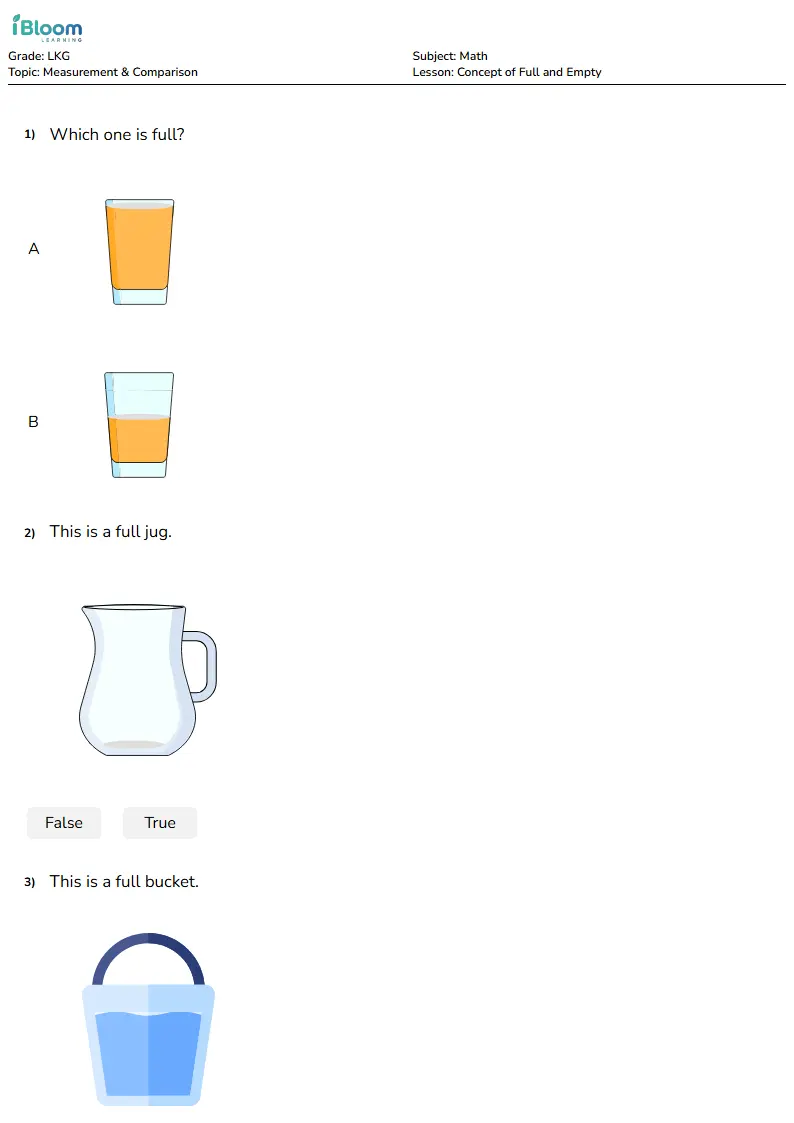
Full and Empty Worksheets for LKG
Full and empty worksheets for LKG and kindergarten with black-and-white practice, real-object examples, and answer guidance.
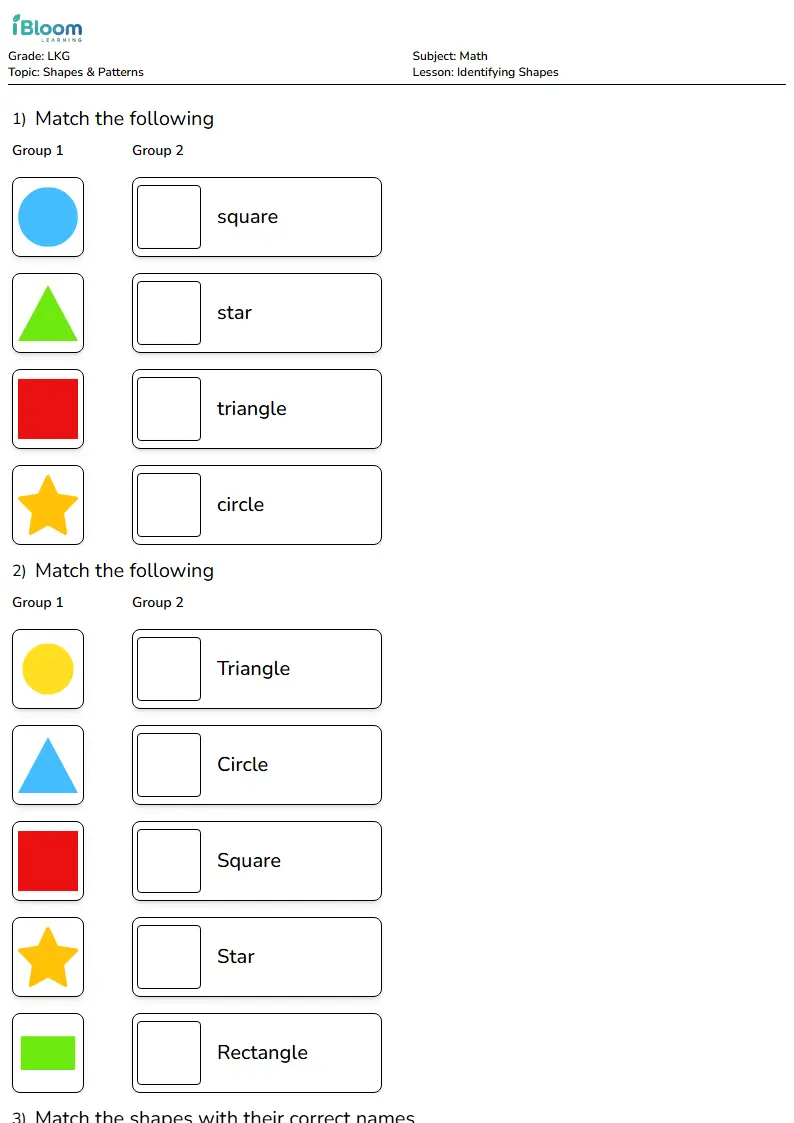
Free Identifying Shapes Worksheets for Lkg
Looking for lkg math help? Download free, interactive identifying shapes worksheets. AI-personalized and Common Core-aligned. Practice math with iBloom.
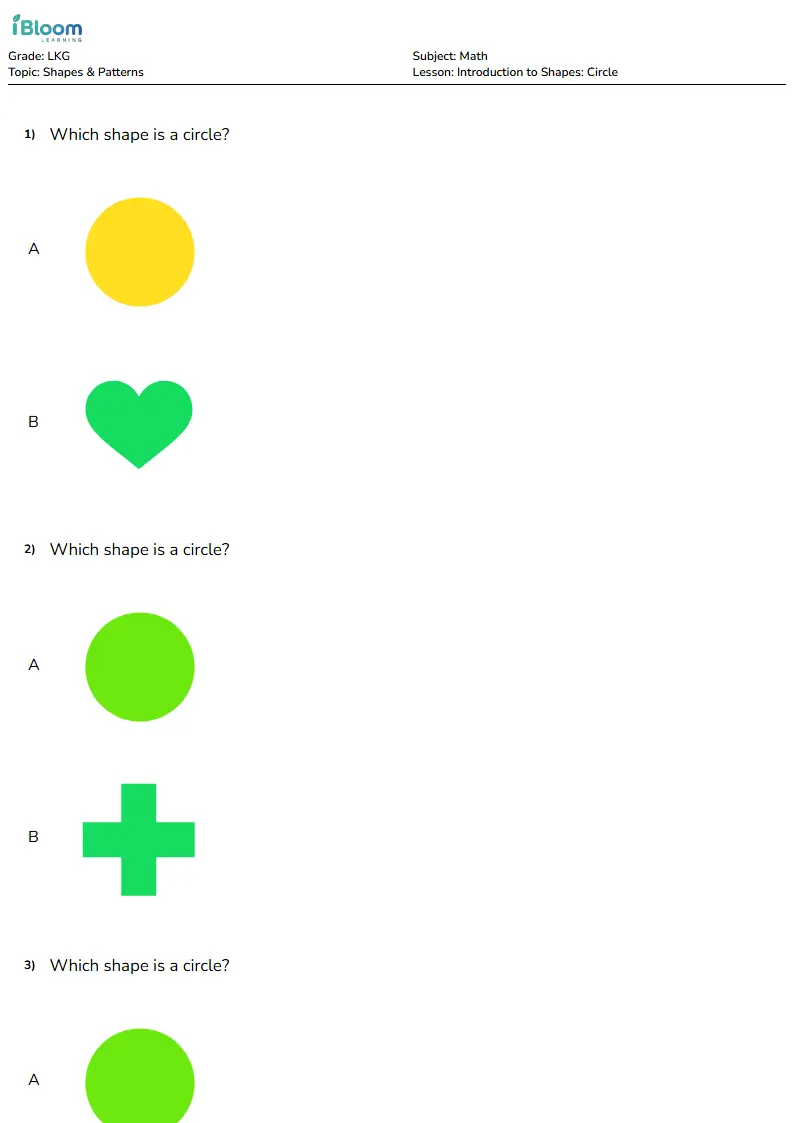
Circle Shape Recognition Worksheet for LKG
Help LKG children identify a circle among picture choices, notice its curved boundary and no corners, and practise shape talk at home or in class.
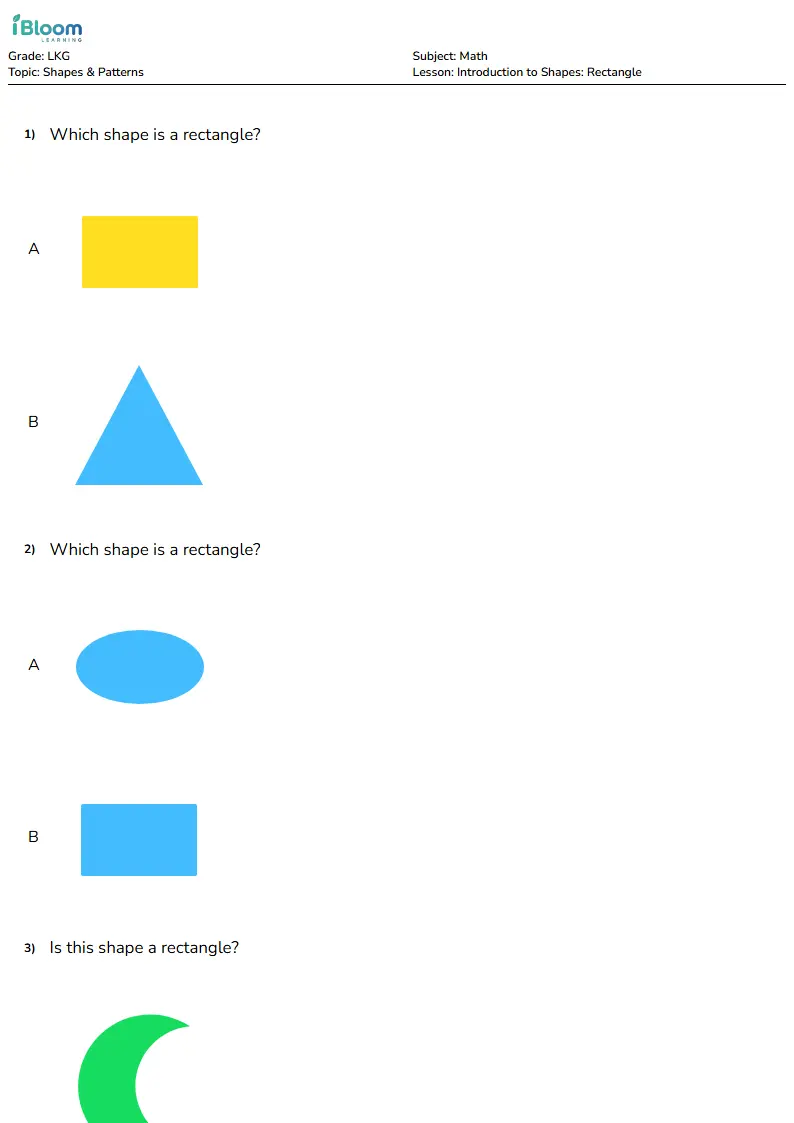
Free Introduction to Shapes: Rectangle Worksheets for Lkg
Looking for lkg math help? Download free, interactive introduction to shapes: rectangle worksheets. AI-personalized and Common Core-aligned. Practice math with iBloom.
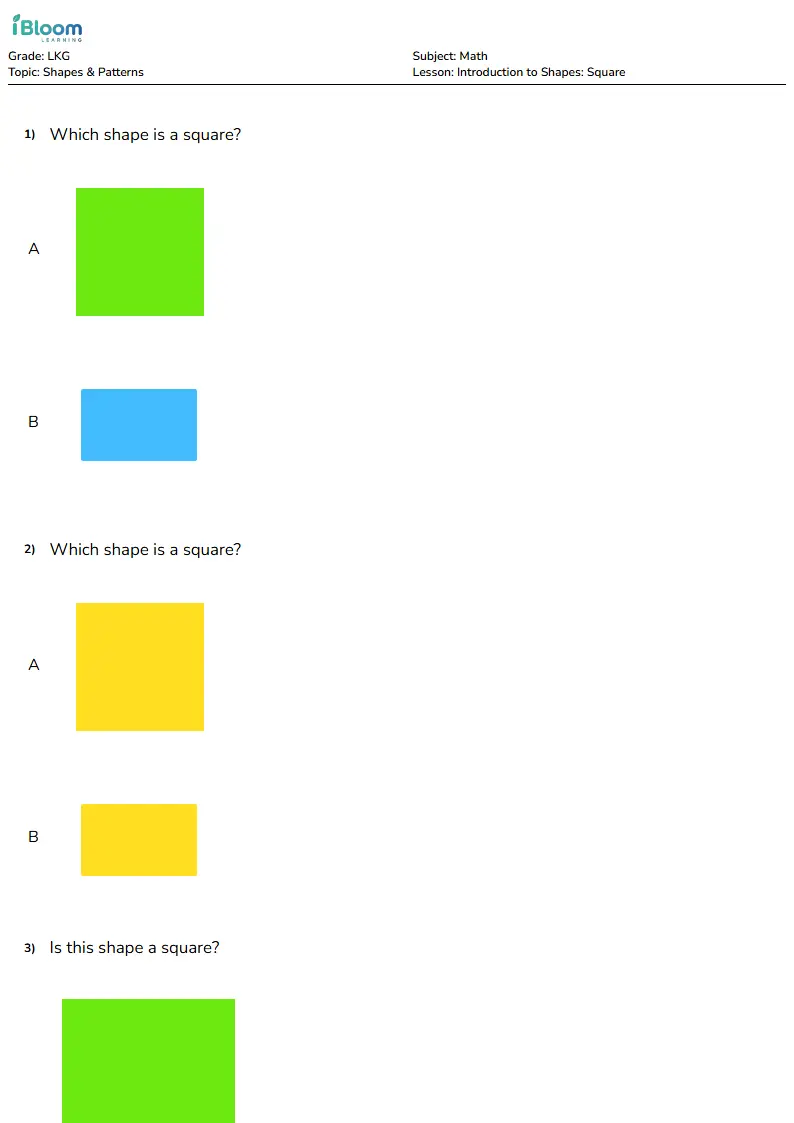
Square Shape Recognition Practice for LKG
Help LKG children recognise a square by its four equal sides and four corners, compare shapes, and find square objects through guided practice.
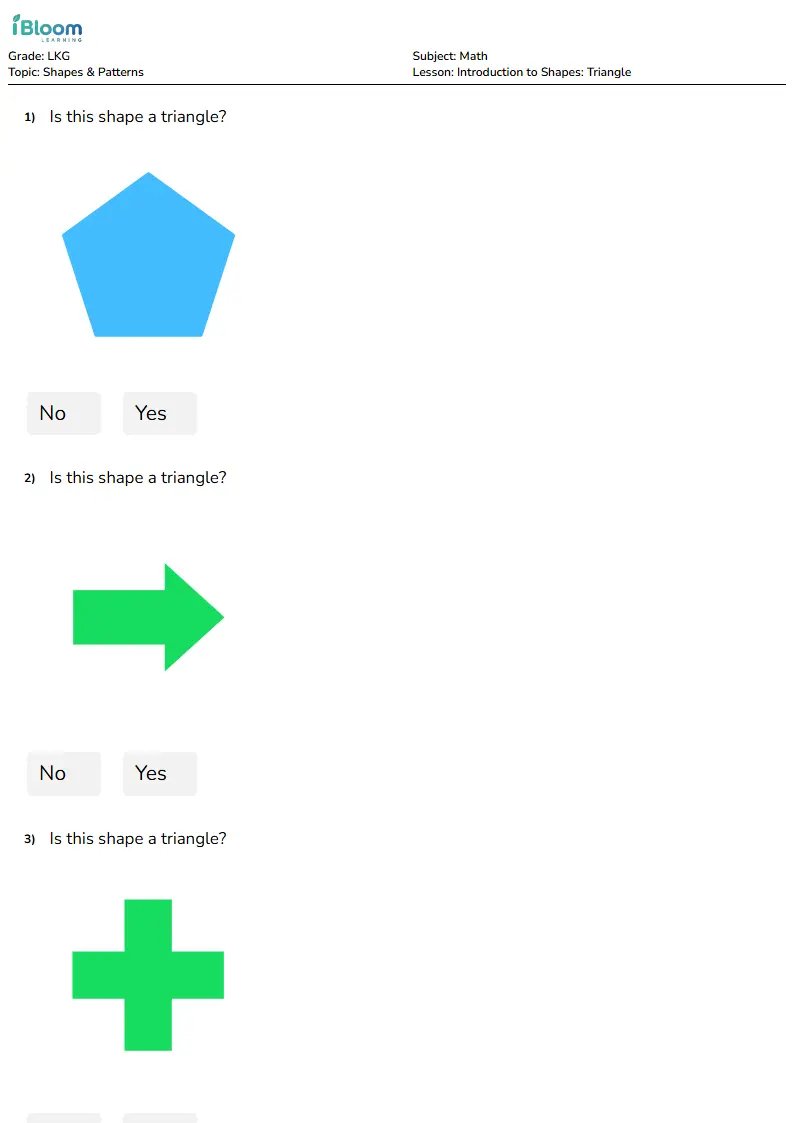
Free Introduction to Shapes: Triangle Worksheets for Lkg
Looking for lkg math help? Download free, interactive introduction to shapes: triangle worksheets. AI-personalized and Common Core-aligned. Practice math with iBloom.
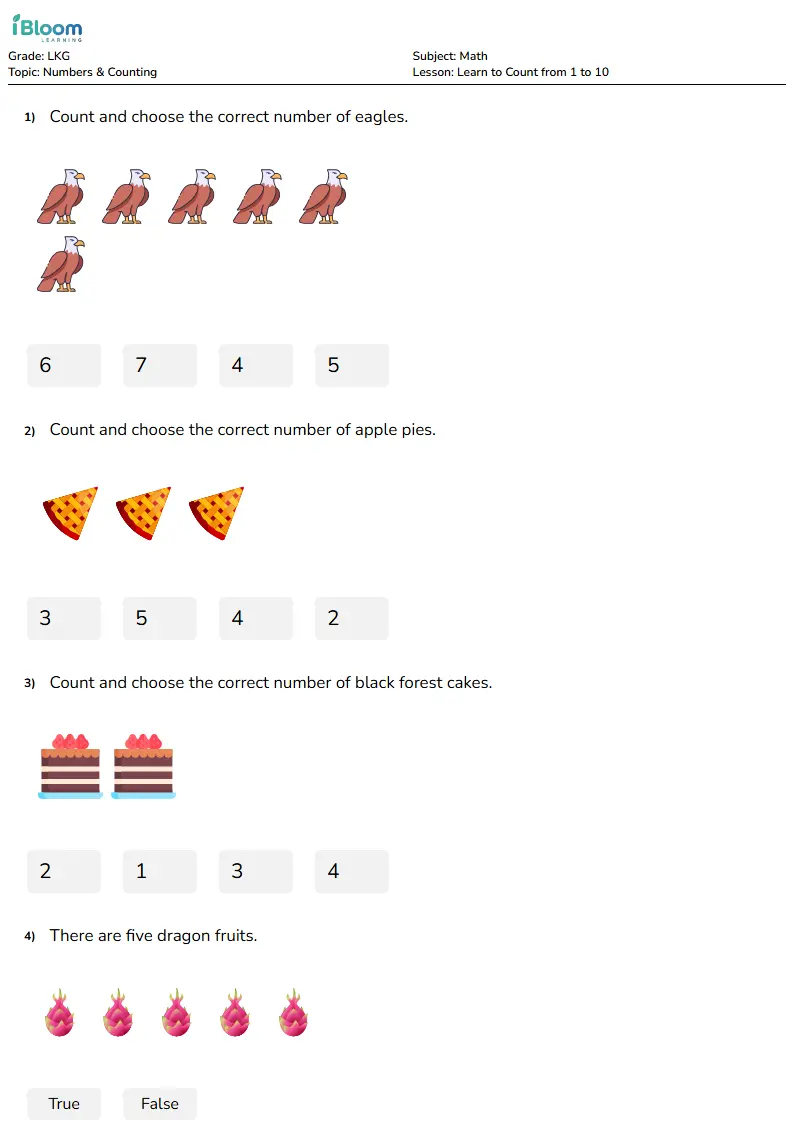
Free Learn to Count from 1 to 10 Worksheets for Lkg
Looking for lkg math help? Download free, interactive learn to count from 1 to 10 worksheets. AI-personalized and Common Core-aligned. Practice math with iBloom.
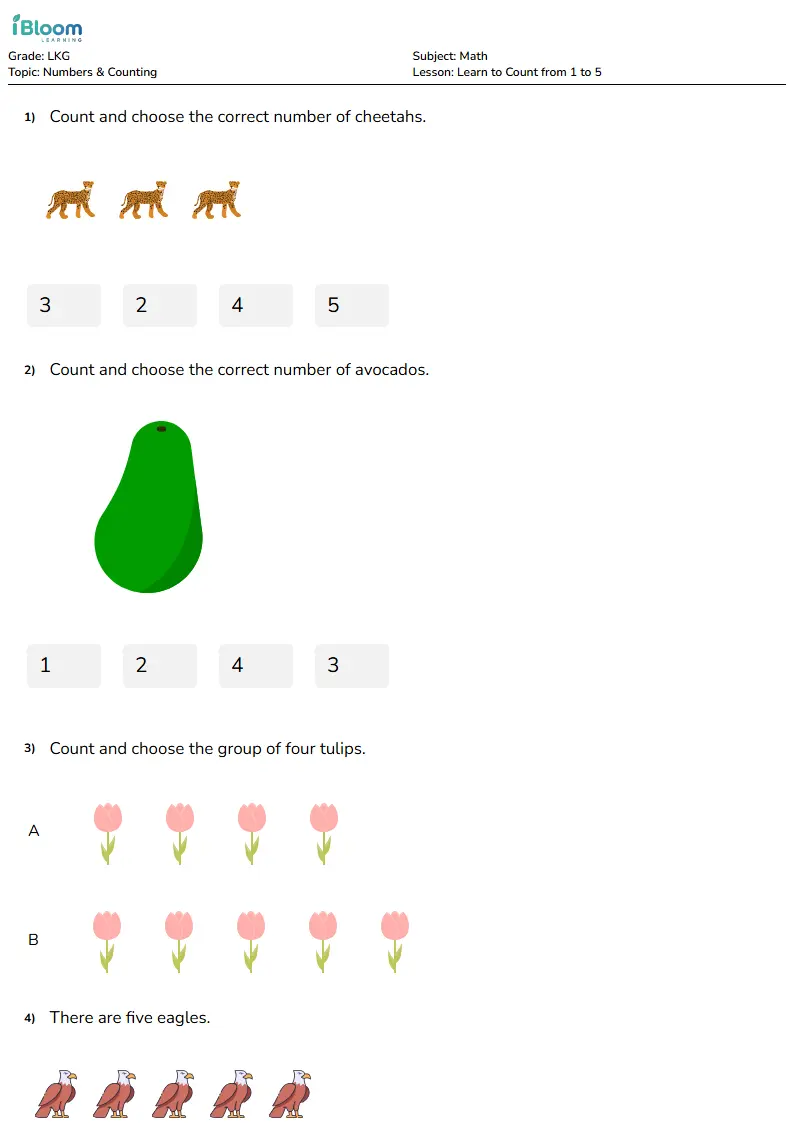
Free Learn to Count from 1 to 5 Worksheets for Lkg
Looking for lkg math help? Download free, interactive learn to count from 1 to 5 worksheets. AI-personalized and Common Core-aligned. Practice math with iBloom.
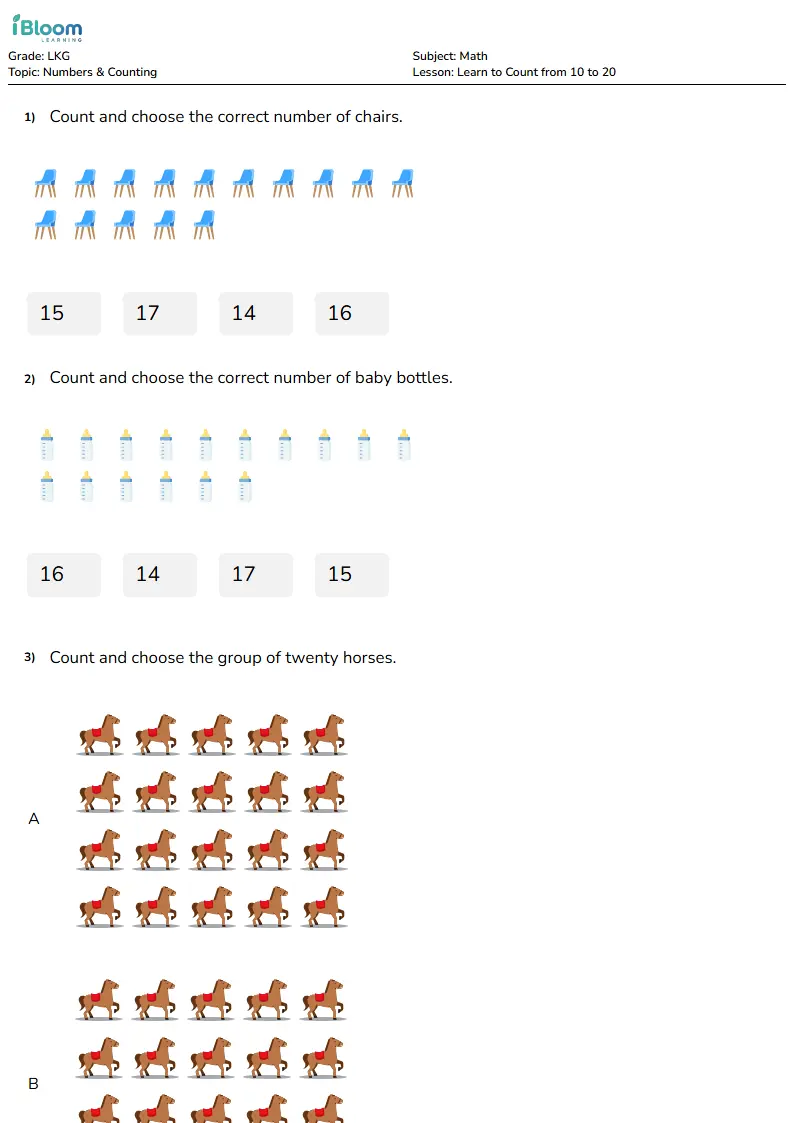
Free Learn to Count from 10 to 20 Worksheets for Lkg
Looking for lkg math help? Download free, interactive learn to count from 10 to 20 worksheets. AI-personalized and Common Core-aligned. Practice math with iBloom.
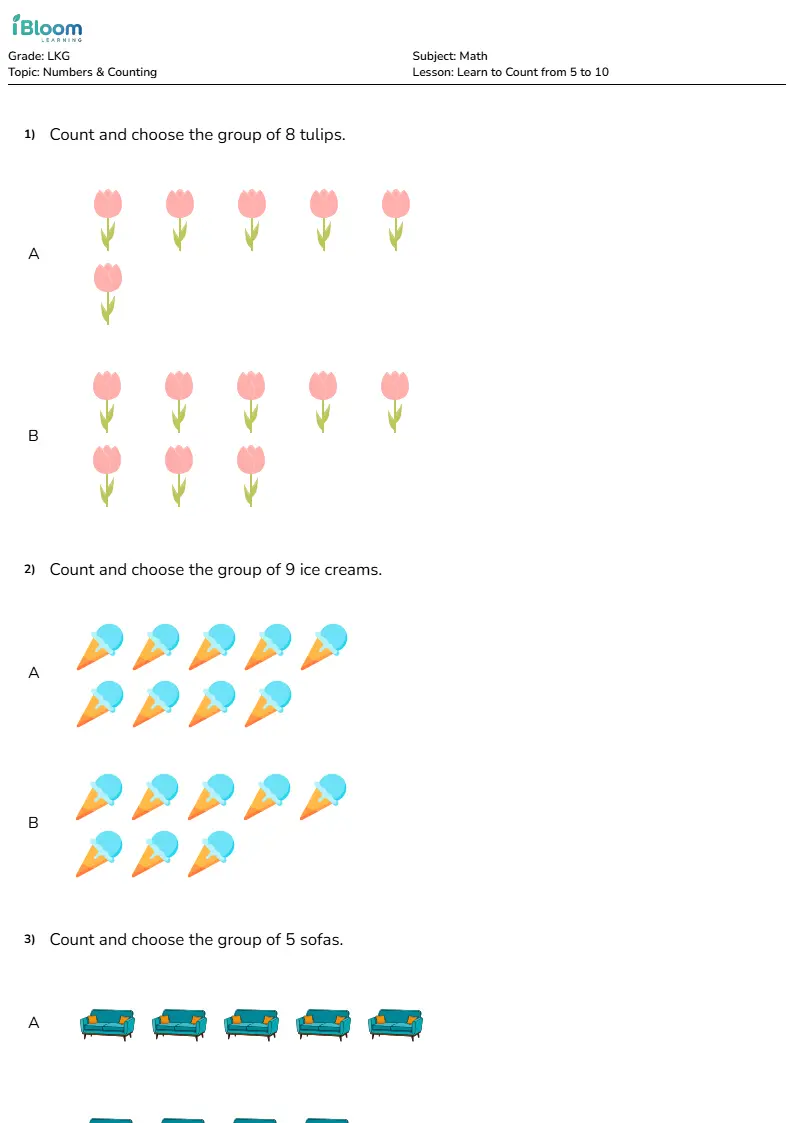
Free Learn to Count from 5 to 10 Worksheets for Lkg
Looking for lkg math help? Download free, interactive learn to count from 5 to 10 worksheets. AI-personalized and Common Core-aligned. Practice math with iBloom.
.webp)
Free Number Recognition (1-10) Worksheets for Lkg
Looking for lkg math help? Download free, interactive number recognition (1-10) worksheets. AI-personalized and Common Core-aligned. Practice math with iBloom.
.webp)
Number Recognition 1-3 Practice for LKG
Help LKG children recognise, name, match and write 1, 2 and 3 through visual activities, object counting, and short home or classroom practice.
.webp)
Free Number Recognition (1-5) Worksheets for Lkg
Looking for lkg math help? Download free, interactive number recognition (1-5) worksheets. AI-personalized and Common Core-aligned. Practice math with iBloom.
.webp)
Free Number Recognition (1-6) Worksheets for Lkg
Looking for lkg math help? Download free, interactive number recognition (1-6) worksheets. AI-personalized and Common Core-aligned. Practice math with iBloom.
.webp)
Free Number Recognition (1-7) Worksheets for Lkg
Looking for lkg math help? Download free, interactive number recognition (1-7) worksheets. AI-personalized and Common Core-aligned. Practice math with iBloom.
.webp)
Free Number Recognition (1-8) Worksheets for Lkg
Looking for lkg math help? Download free, interactive number recognition (1-8) worksheets. AI-personalized and Common Core-aligned. Practice math with iBloom.
.webp)
Free Number Recognition (1-9) Worksheets for Lkg
Looking for lkg math help? Download free, interactive number recognition (1-9) worksheets. AI-personalized and Common Core-aligned. Practice math with iBloom.
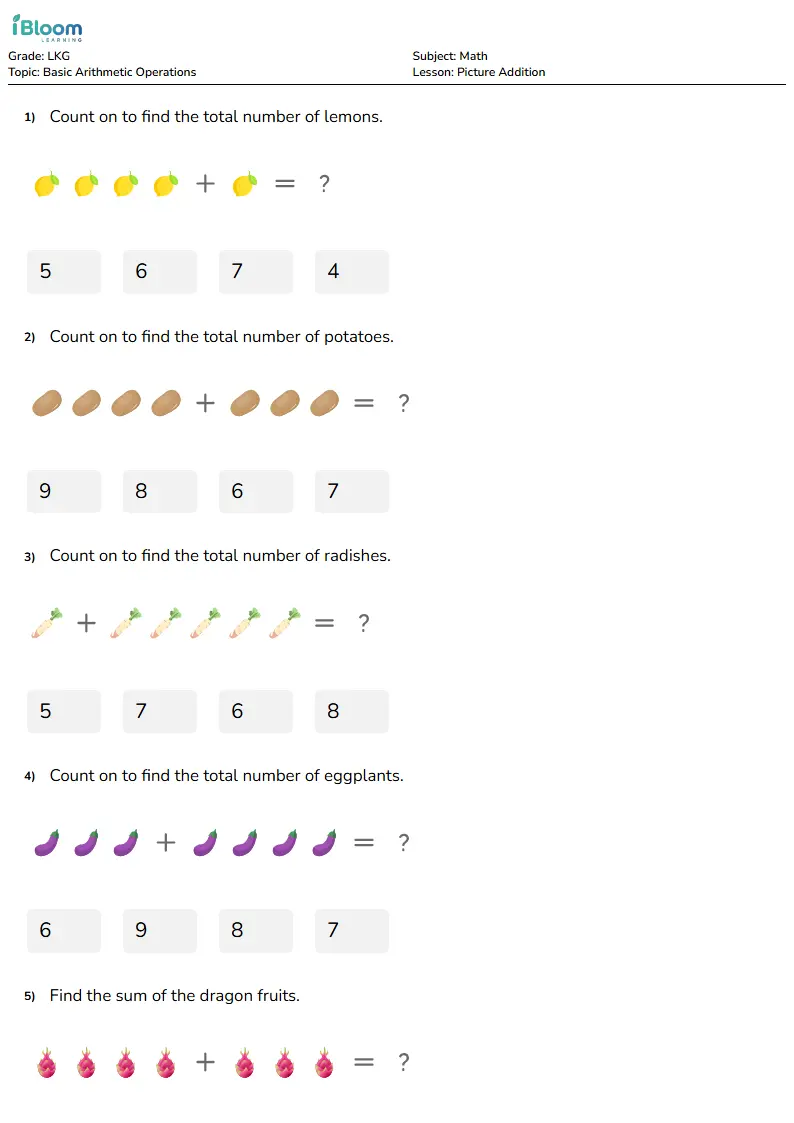
Free Picture Addition Worksheets for Lkg
Looking for lkg math help? Download free, interactive picture addition worksheets. AI-personalized and Common Core-aligned. Practice math with iBloom.
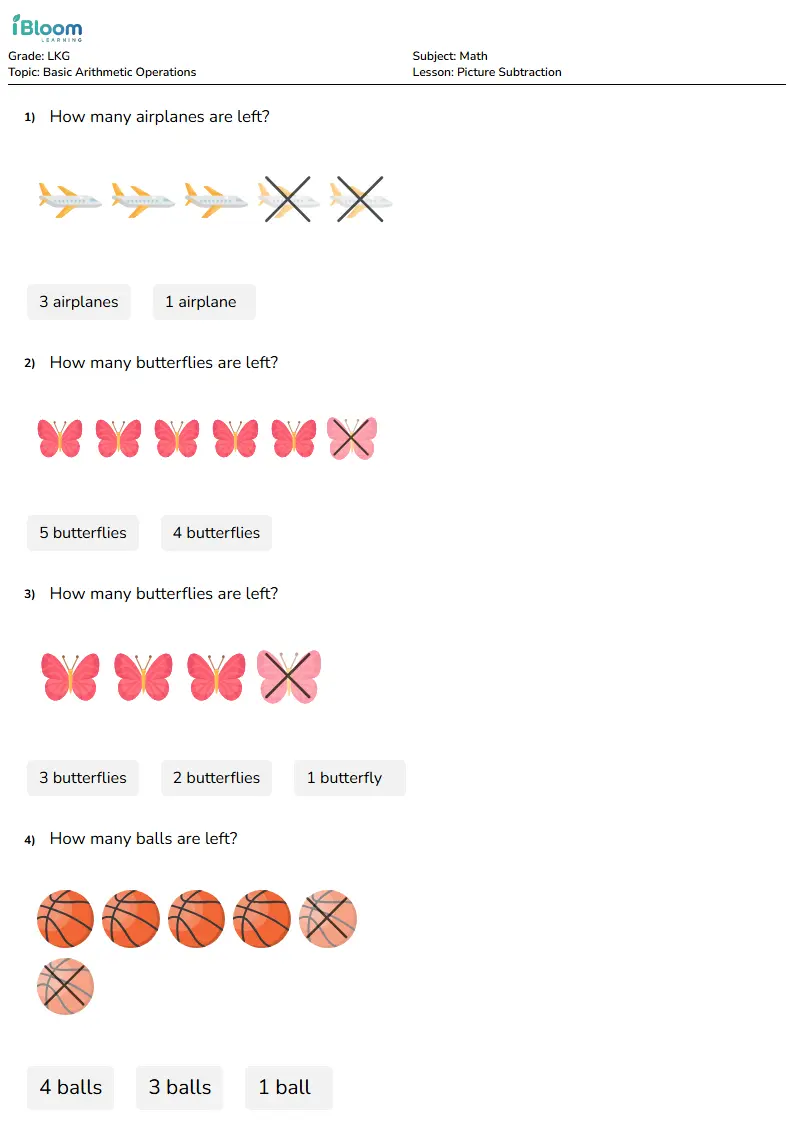
Free Picture Subtraction Worksheets for Lkg
Looking for lkg math help? Download free, interactive picture subtraction worksheets. AI-personalized and Common Core-aligned. Practice math with iBloom.
.webp)
Simple Addition to 5 for LKG | Practice Worksheet
Help LKG children combine two small groups and find totals up to 5 using objects, drawings, number sentences, and short guided practice.
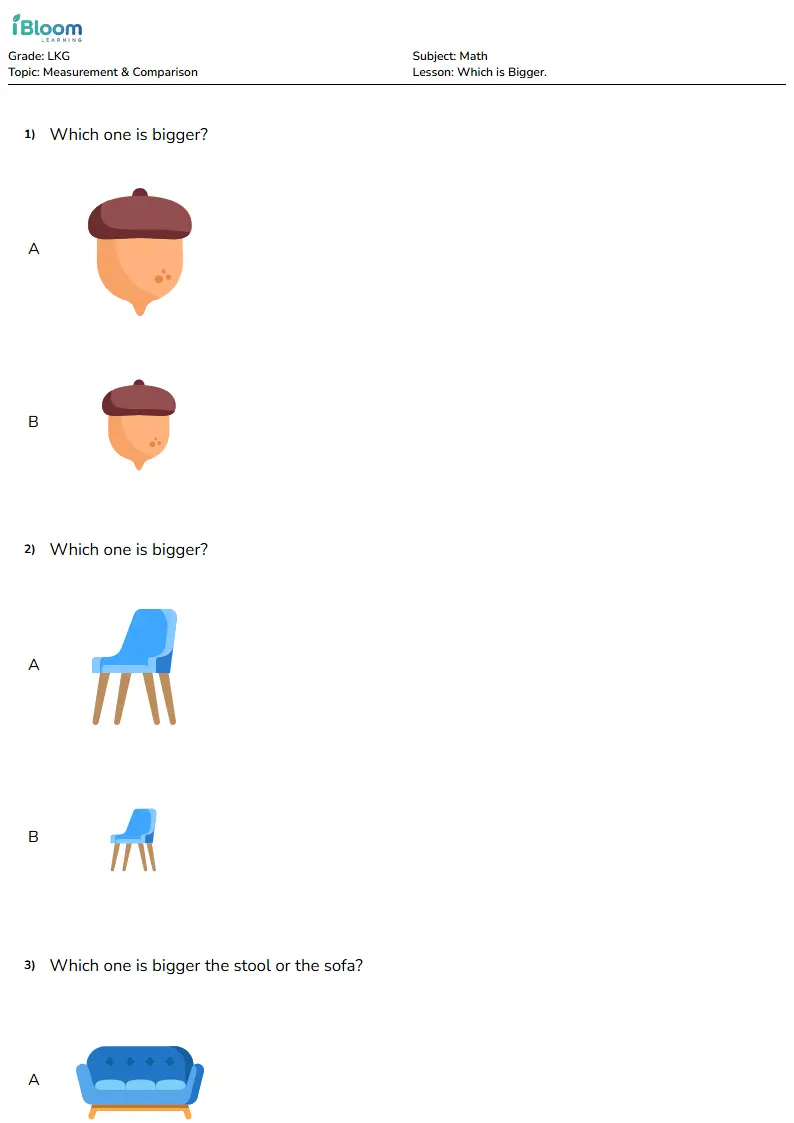
Free Which is Bigger. Worksheets for Lkg
Looking for lkg math help? Download free, interactive which is bigger. worksheets. AI-personalized and Common Core-aligned. Practice math with iBloom.
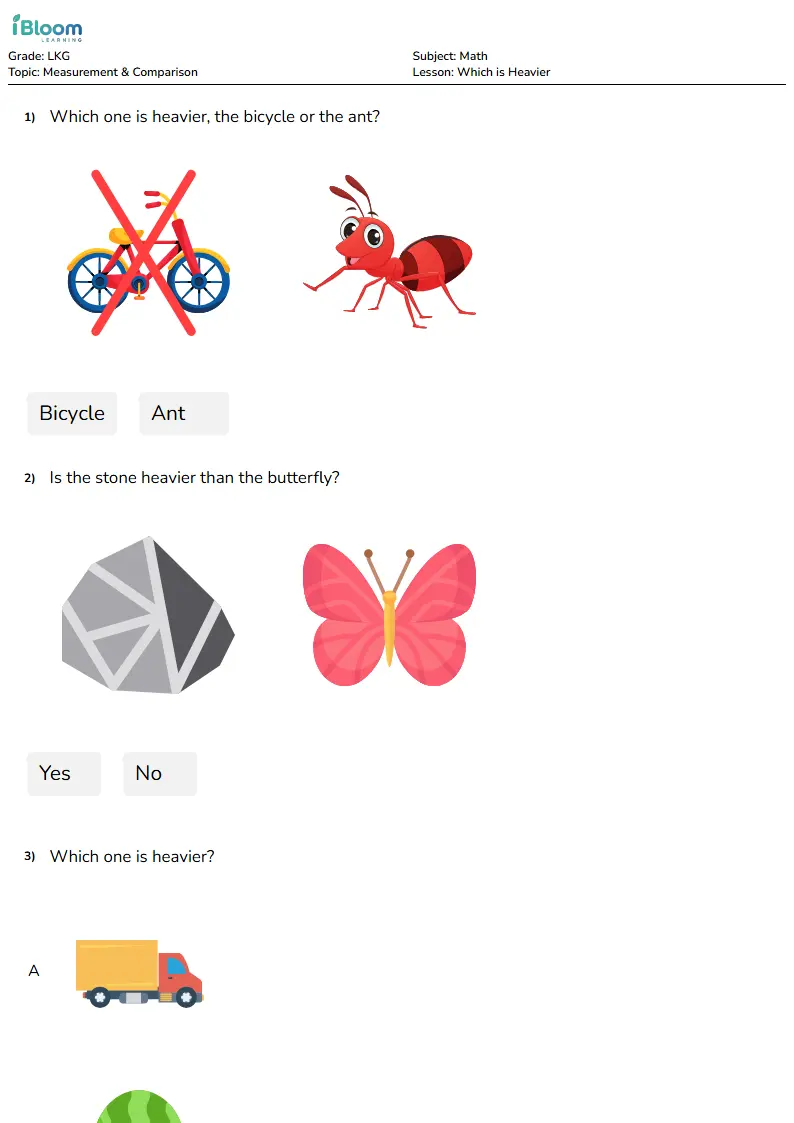
Free Which is Heavier Worksheets for Lkg
Looking for lkg math help? Download free, interactive which is heavier worksheets. AI-personalized and Common Core-aligned. Practice math with iBloom.