Identifying Circles worksheet for UKG
Lesson-Wise Builder
A premium AI tool that creates syllabus-aligned questions and worksheets for any lesson in seconds.
Identifying circles for UKG means checking a shape's boundary and deciding whether it is a circle. In this activity, learners answer true-or-false picture statements and choose a circle from multiple-choice shapes. A useful answer names the clue: a circle is a closed flat shape with a continuous curved boundary, no straight sides, and no corners.
What makes a shape a circle?
Trace around the boundary with a finger. A circle curves all the way around and closes without a gap. It has no corners and no straight sections. Size, colour, and position do not change the shape: a small blue circle and a large red circle still share the same attributes.
How to solve the true-or-false circle questions
- Read or listen to the statement, "This is a circle."
- Trace the pictured boundary with your eyes or finger.
- Look for straight sides or corners.
- Choose true only when the boundary stays curved and closed all the way around.
- Explain one clue before moving on.
In the verified activity, a square should be marked false and a circle should be marked true. The purpose is not to memorise where the buttons appear; it is to inspect each new picture.
How to answer which shape is a circle
Scan every option before choosing. Eliminate a star, square, triangle, or rectangle when its straight sides or corners are visible. Then check that the remaining option has one continuous curved boundary. In the observed multiple-choice item, the circle appears beside a non-circle choice, so the learner must compare attributes rather than colour.
Circle versus square
A square is closed, but it has four straight sides and four corners. A circle is also closed, but its boundary is curved and it has no corners. Trace both shapes and pause at each square corner; the contrast makes the true-or-false decision easier to explain.
Circle versus other shapes
A star has points and straight sections. A triangle has three straight sides and three corners. A rectangle has four straight sides. An oval is curved and has no corners, but it looks stretched rather than equally round. These comparisons help a child reject a choice for a specific reason instead of saying only that it "looks different."
Find circular faces in everyday objects
Look at a plate, clock face, button, circular lid, wheel face, or the flat face of a coin. Name the circular part rather than claiming the whole object is a flat circle. A ball is a three-dimensional sphere, although its outline in a simple picture may look circular.
Recognise circles despite changes in appearance
Show outline and filled circles in several colours and sizes. Move or turn the cards. Ask what stayed the same. This prevents children from learning that only a particular blue shape or a particular large picture counts as a circle.
Build clear shape explanations
Model sentences such as, "This is a circle because the edge curves all the way around," and, "This is not a circle because it has corners." A child may explain first in a home language, then repeat the key words circle, curved, straight, and corner in English.
Parent guidance for short circle practice
Use two or three shape cards for about five minutes. Ask one true-or-false question, one multiple-choice question, and one object hunt. If the child guesses, say, "Trace the boundary and tell me about corners," rather than naming the answer. Finish after one independent explanation.
Teacher and tutor guidance
Use circle and not-circle cards for a quick warm-up. In a small group, separate recognition from vocabulary: first ask the child to point to a circle, then ask for its name, and finally ask for a reason. This shows whether the difficulty is visual discrimination, word recall, or explaining attributes.
Common circle-recognition mistakes
- Choosing by colour: compare two shapes in the same colour.
- Calling a square a circle: count and touch the square's corners.
- Calling a star a circle: trace its points and straight sections.
- Confusing a circle and oval: place clear examples side by side and describe the stretched outline.
- Calling a ball a circle: distinguish the flat picture or face from the solid object.
- Guessing too quickly: inspect every answer choice before selecting one.
Practice ideas for circle recognition
- Sort cards into circle and not-circle groups.
- Draw three shapes and ask an adult to find the circle.
- Make a circle with string and compare it with a shape that has corners.
- Trace around a lid and describe the new outline.
- Create one true-or-false statement and one multiple-choice question.
Related shape concepts
A circle is a two-dimensional or flat shape. Learning straight and curved lines, closed shapes, sides, and corners supports accurate recognition. After circles are secure, compare squares, triangles, rectangles, and ovals, then discuss how a flat circle differs from a solid sphere.
Continue with related iBloom practice
- Identifying Circles lesson for UKG
- Learning 2D Shapes worksheet for UKG
- Learning 2D Shapes lesson for UKG
Frequently Asked Questions
Does a circle have corners or straight sides?
No. Its closed boundary curves continuously and has no corners or straight sections.
Is a square a circle?
No. A square has four straight sides and four corners, so the true-or-false answer is false.
Is a ball a circle?
A ball is a three-dimensional sphere. A flat drawing or circular face can look like a circle, so name the part being discussed.
Why use both true-or-false and multiple-choice questions?
True or false checks one pictured claim. Multiple choice asks the learner to compare several options and apply the same attributes.
More practice for this grade
More Math worksheets
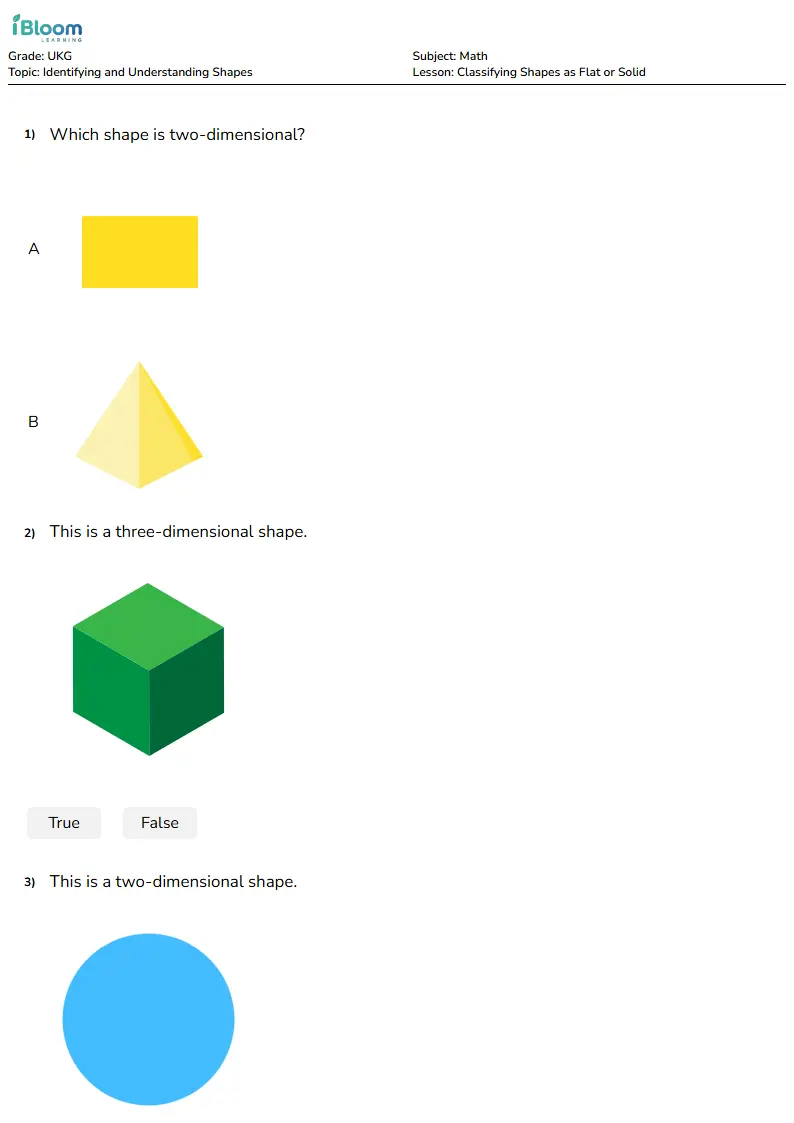
Free Classifying Shapes as Flat or Solid Worksheets for Ukg
Looking for ukg math help? Download free, interactive classifying shapes as flat or solid worksheets. AI-personalized and Common Core-aligned. Practice math with iBloom.
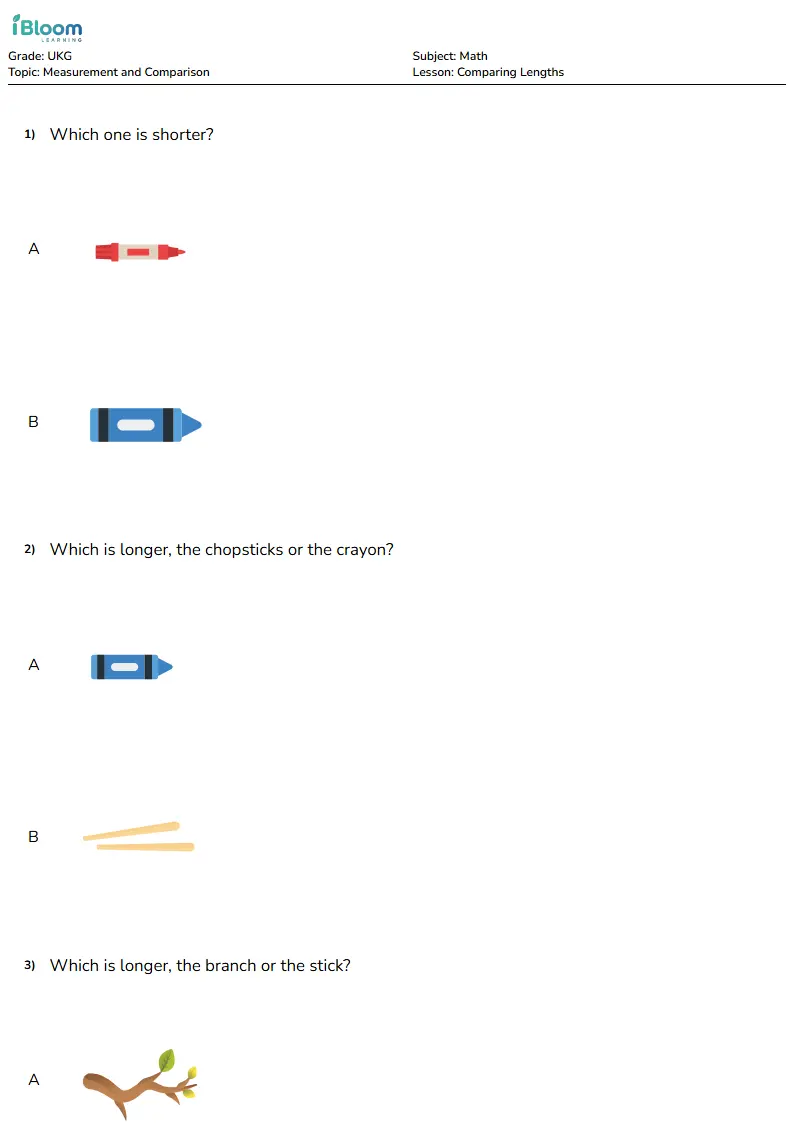
Comparing Lengths Worksheet for UKG
Help UKG learners compare pictured objects by length, choose which is longer or shorter, explain the visual clue, and build careful measurement language.
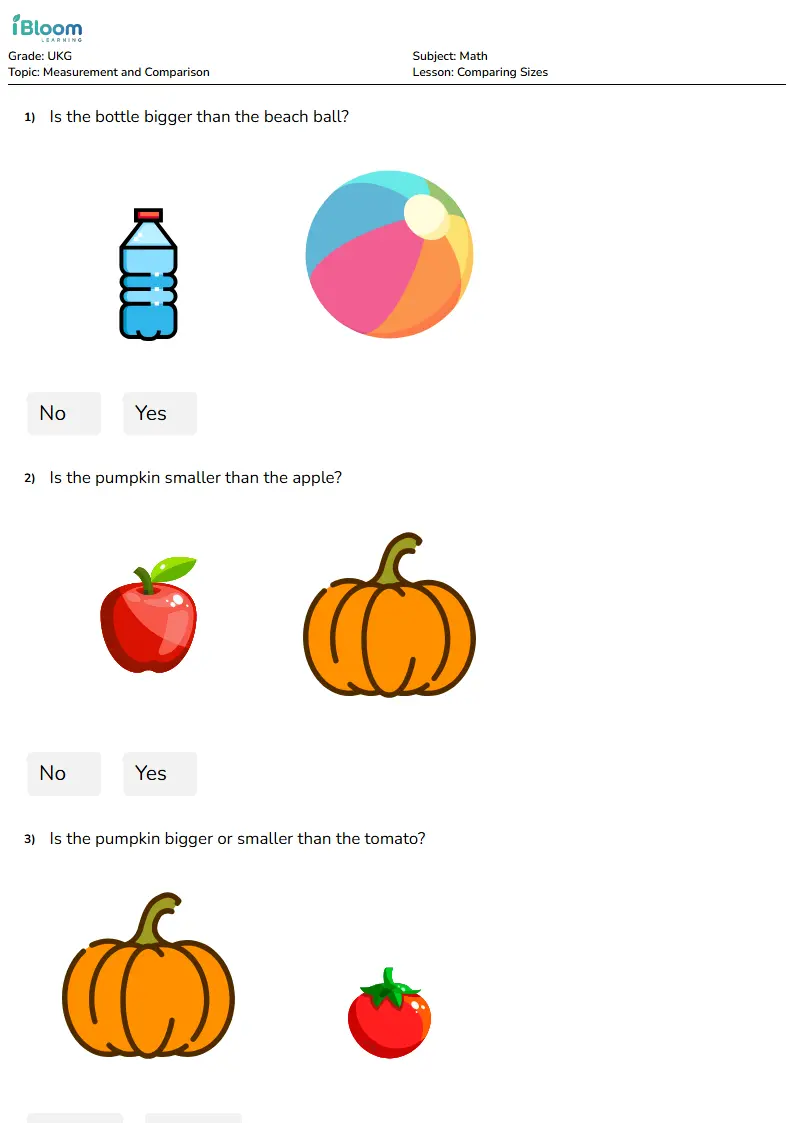
Free Comparing Sizes Worksheets for Ukg
Looking for ukg math help? Download free, interactive comparing sizes worksheets. AI-personalized and Common Core-aligned. Practice math with iBloom.
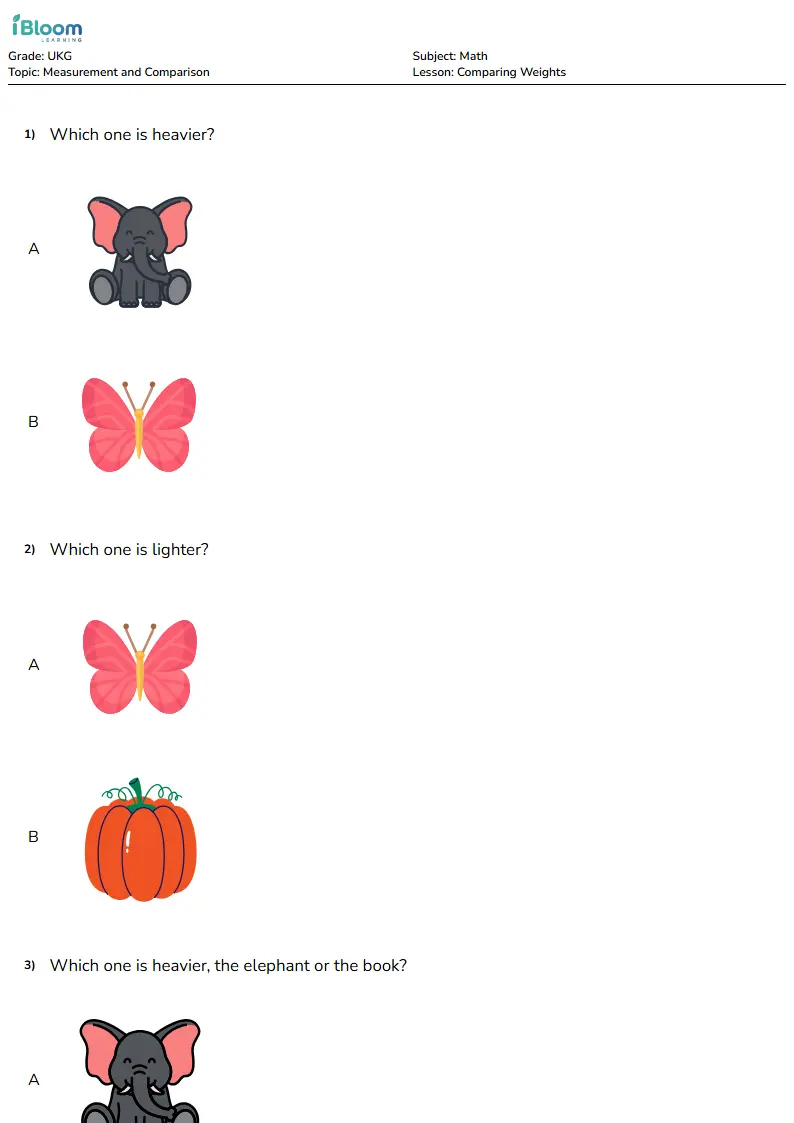
Free Comparing Weights Worksheets for Ukg
Looking for ukg math help? Download free, interactive comparing weights worksheets. AI-personalized and Common Core-aligned. Practice math with iBloom.
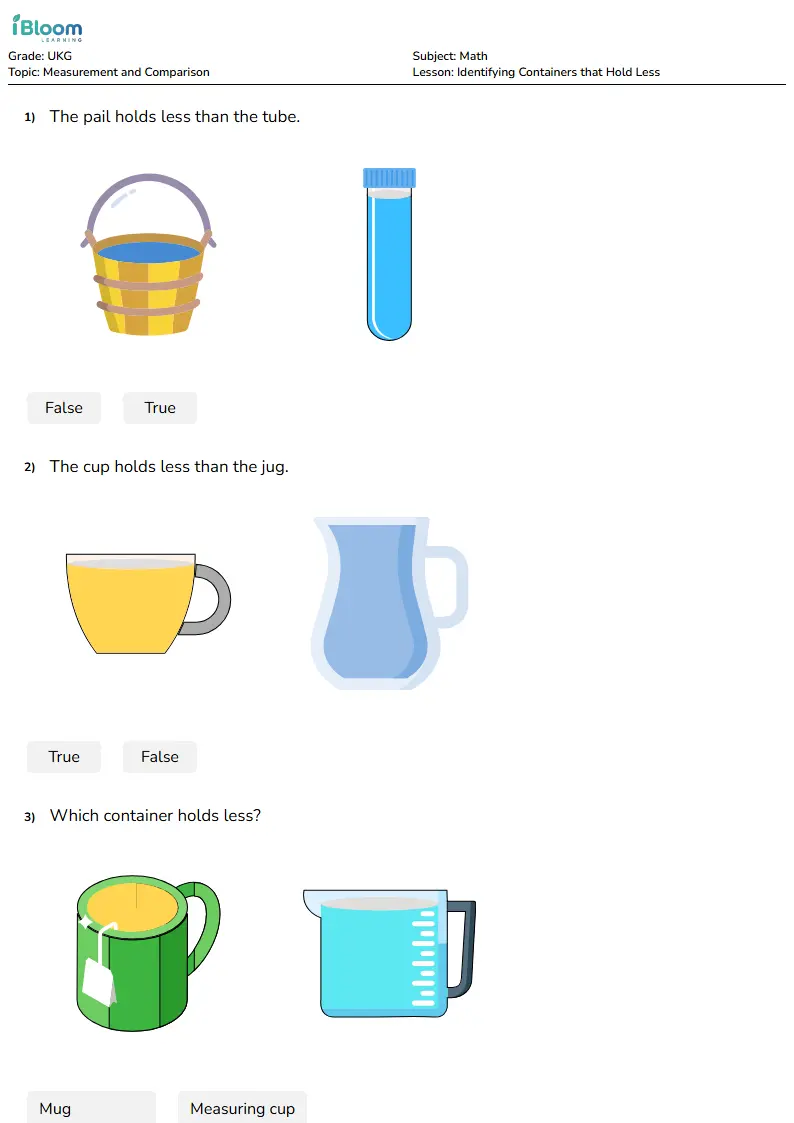
Free Identifying Containers that Hold Less Worksheets for Ukg
Looking for ukg math help? Download free, interactive identifying containers that hold less worksheets. AI-personalized and Common Core-aligned. Practice math with iBloom.
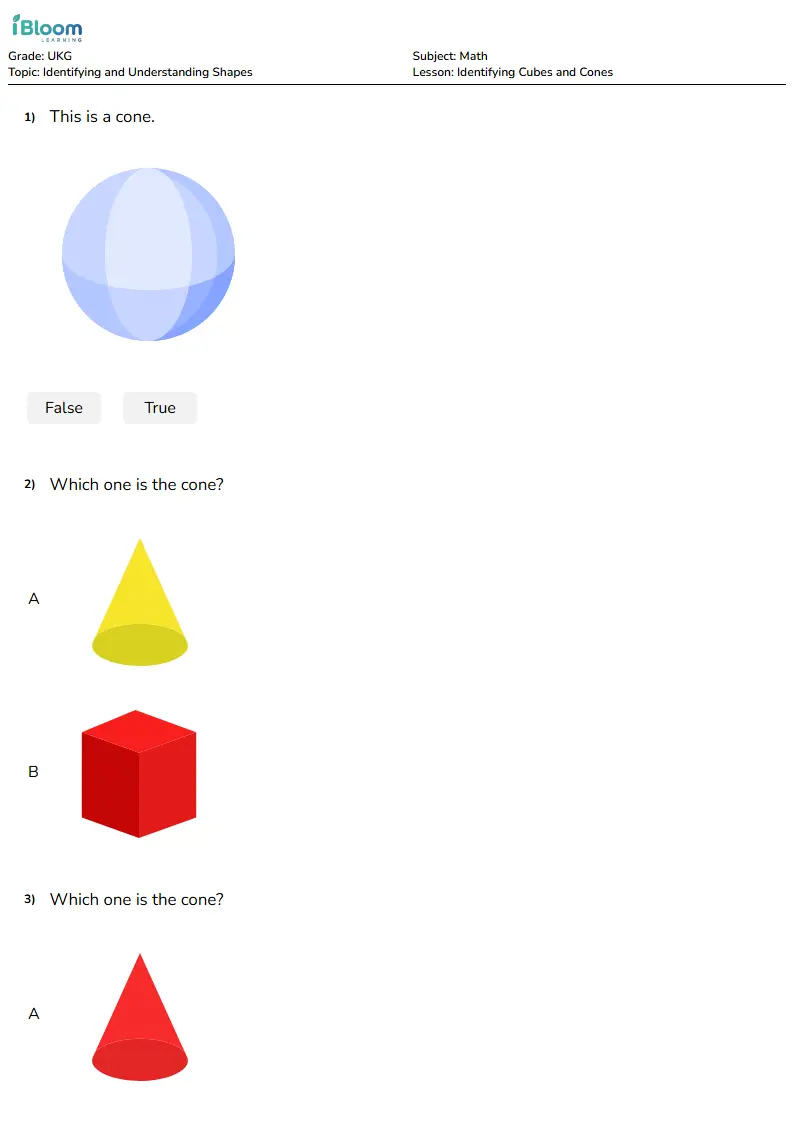
Free Identifying Cubes and Cones Worksheets for Ukg
Looking for ukg math help? Download free, interactive identifying cubes and cones worksheets. AI-personalized and Common Core-aligned. Practice math with iBloom.
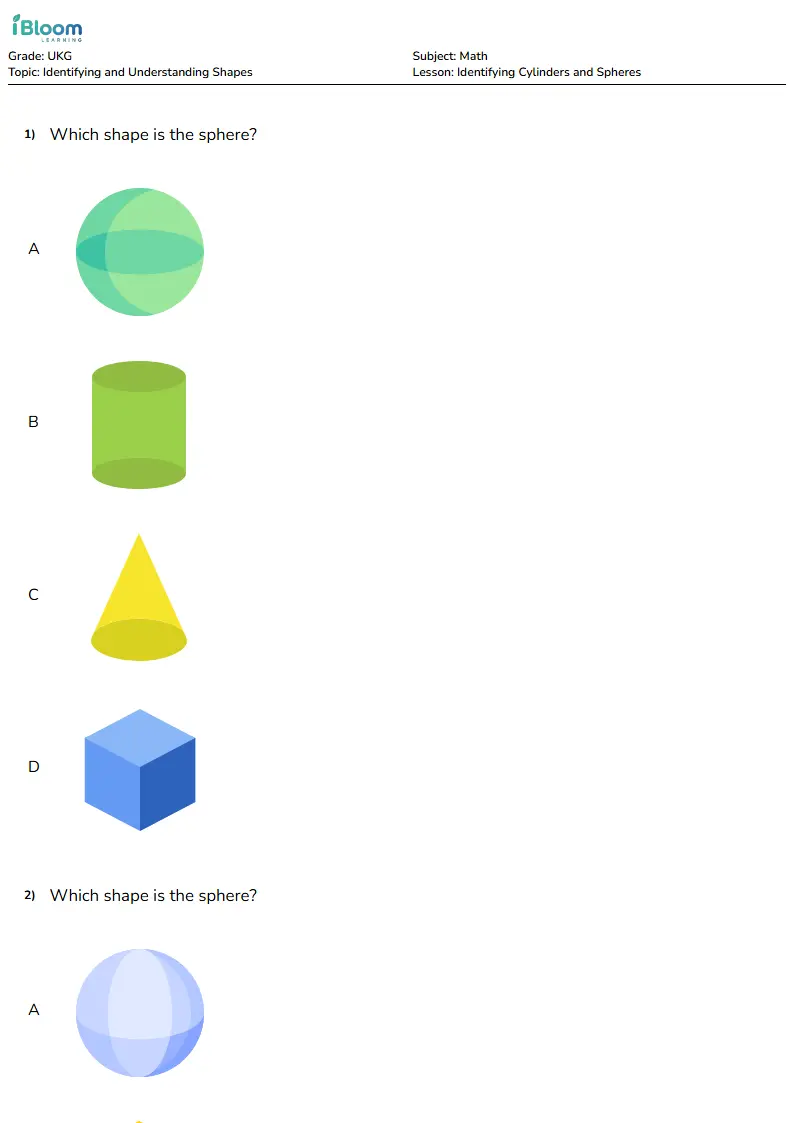
Free Identifying Cylinders and Spheres Worksheets for Ukg
Looking for ukg math help? Download free, interactive identifying cylinders and spheres worksheets. AI-personalized and Common Core-aligned. Practice math with iBloom.
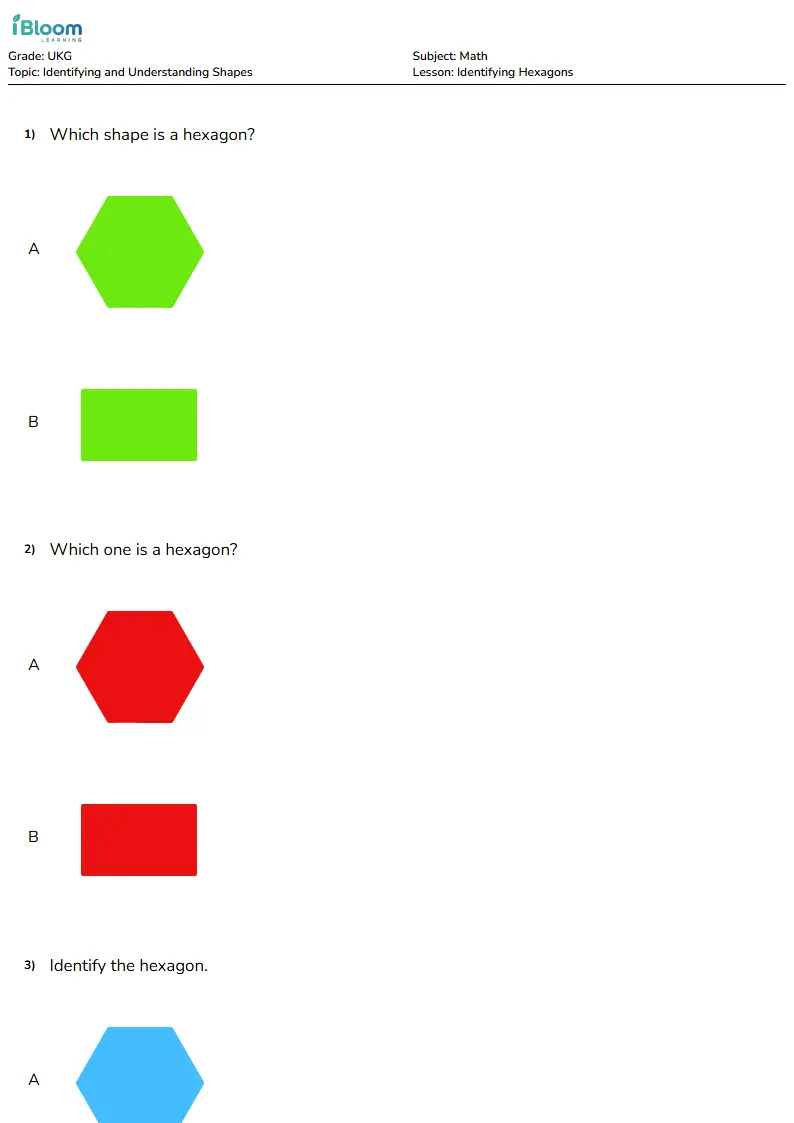
Free Identifying Hexagons Worksheets for Ukg
Looking for ukg math help? Download free, interactive identifying hexagons worksheets. AI-personalized and Common Core-aligned. Practice math with iBloom.
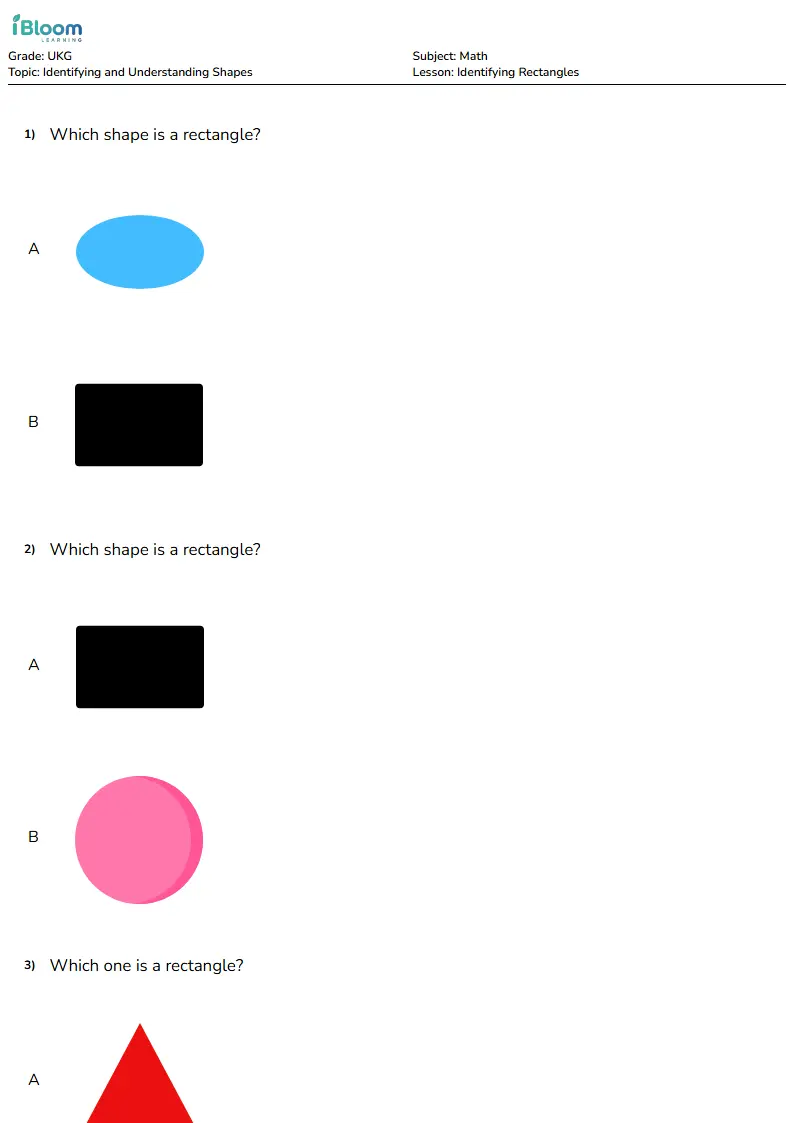
Free Identifying Rectangles Worksheets for Ukg
Looking for ukg math help? Download free, interactive identifying rectangles worksheets. AI-personalized and Common Core-aligned. Practice math with iBloom.
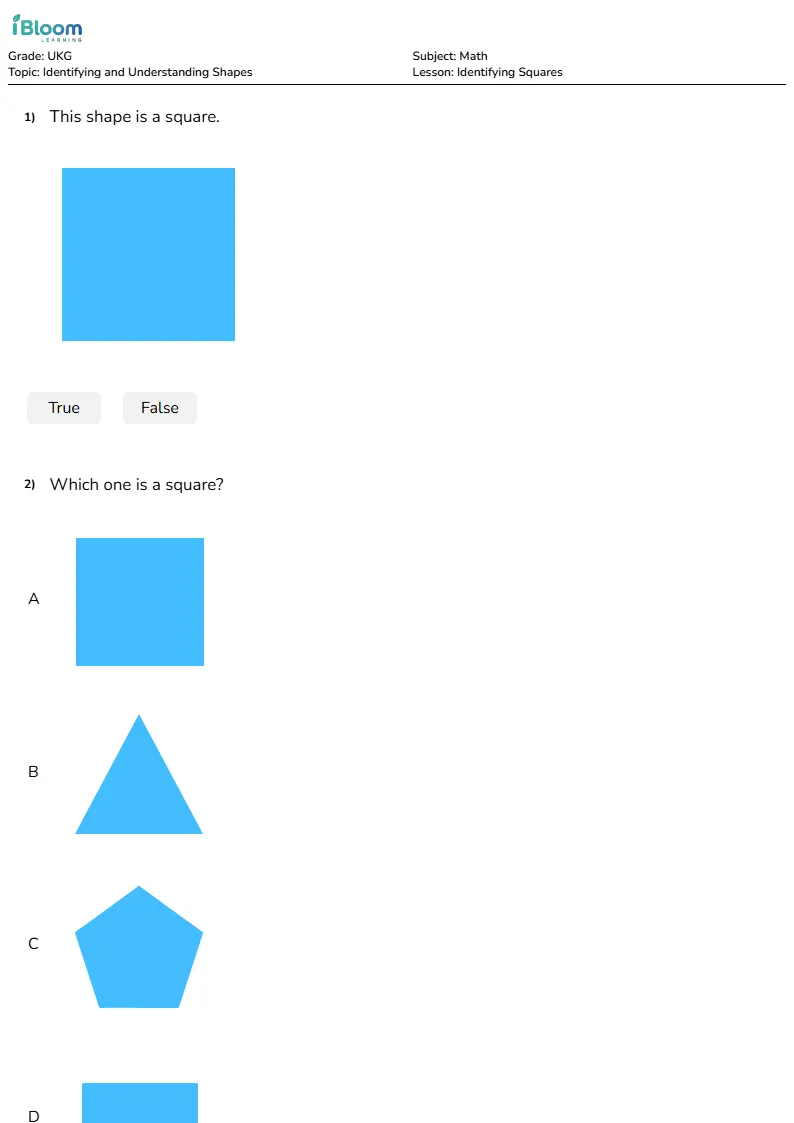
Free Identifying Squares Worksheets for Ukg
Looking for ukg math help? Download free, interactive identifying squares worksheets. AI-personalized and Common Core-aligned. Practice math with iBloom.
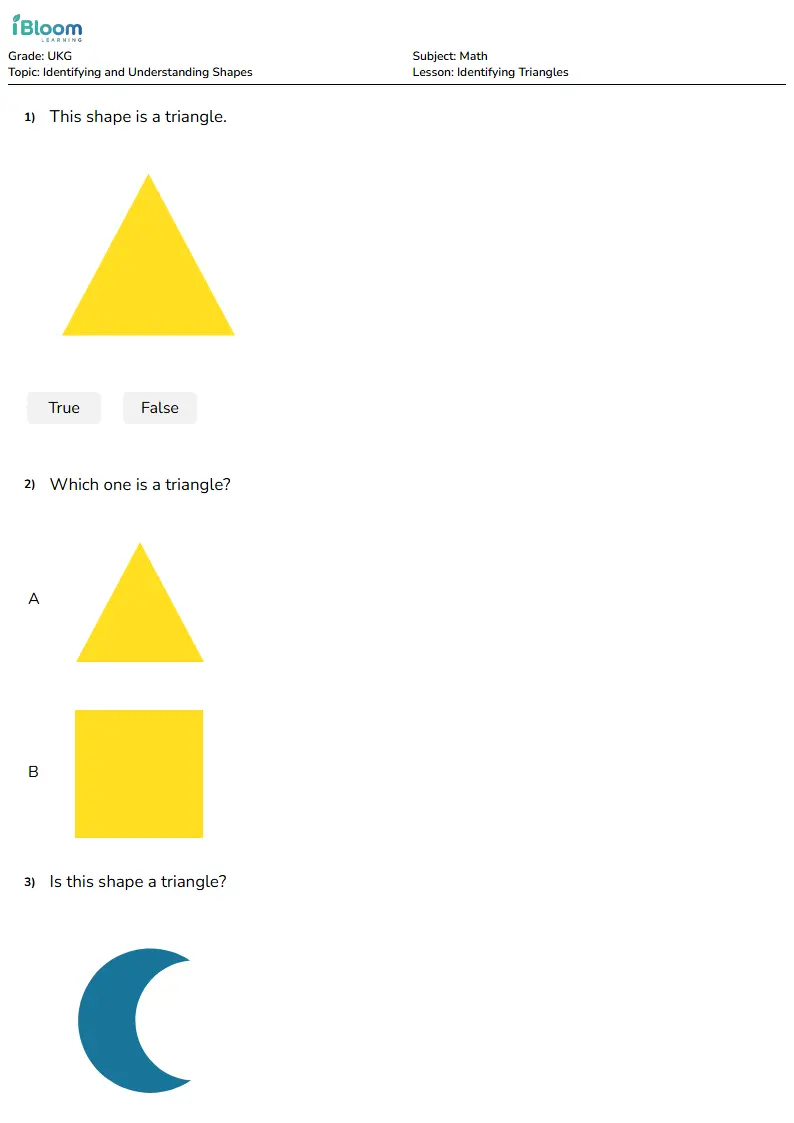
Free Identifying Triangles Worksheets for Ukg
Looking for ukg math help? Download free, interactive identifying triangles worksheets. AI-personalized and Common Core-aligned. Practice math with iBloom.
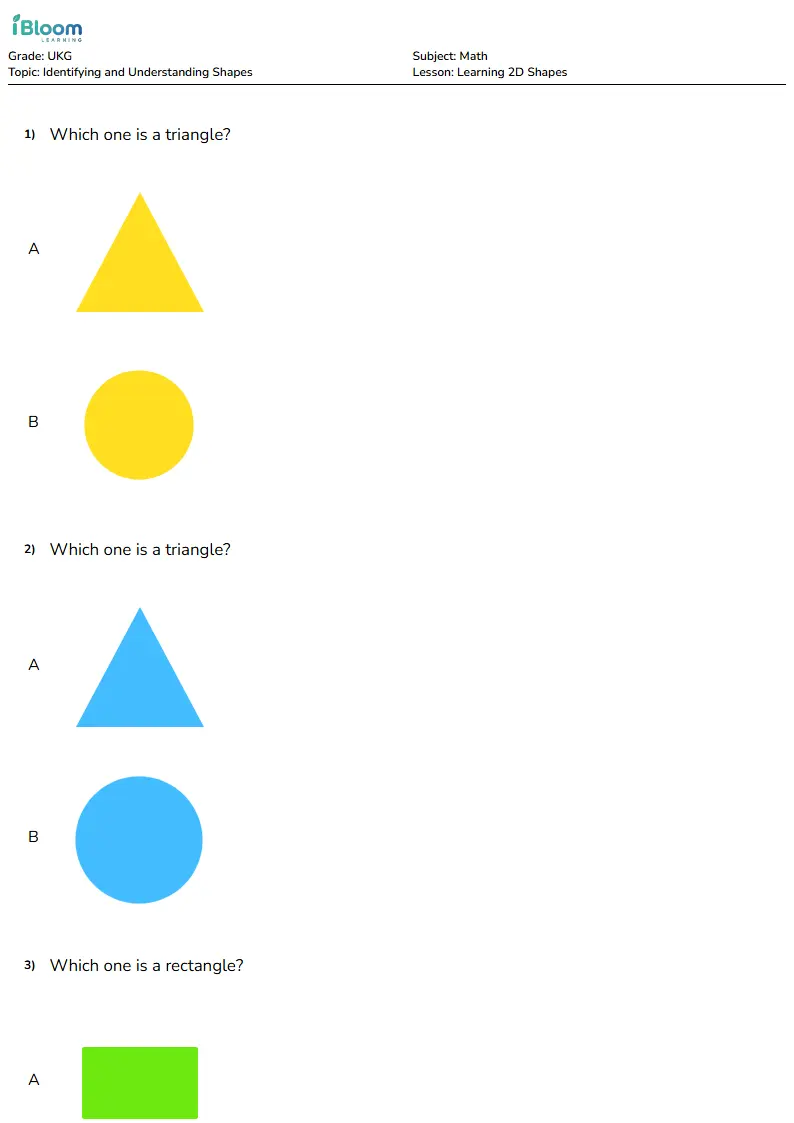
Free Learning 2D Shapes Worksheets for Ukg
Looking for ukg math help? Download free, interactive learning 2d shapes worksheets. AI-personalized and Common Core-aligned. Practice math with iBloom.
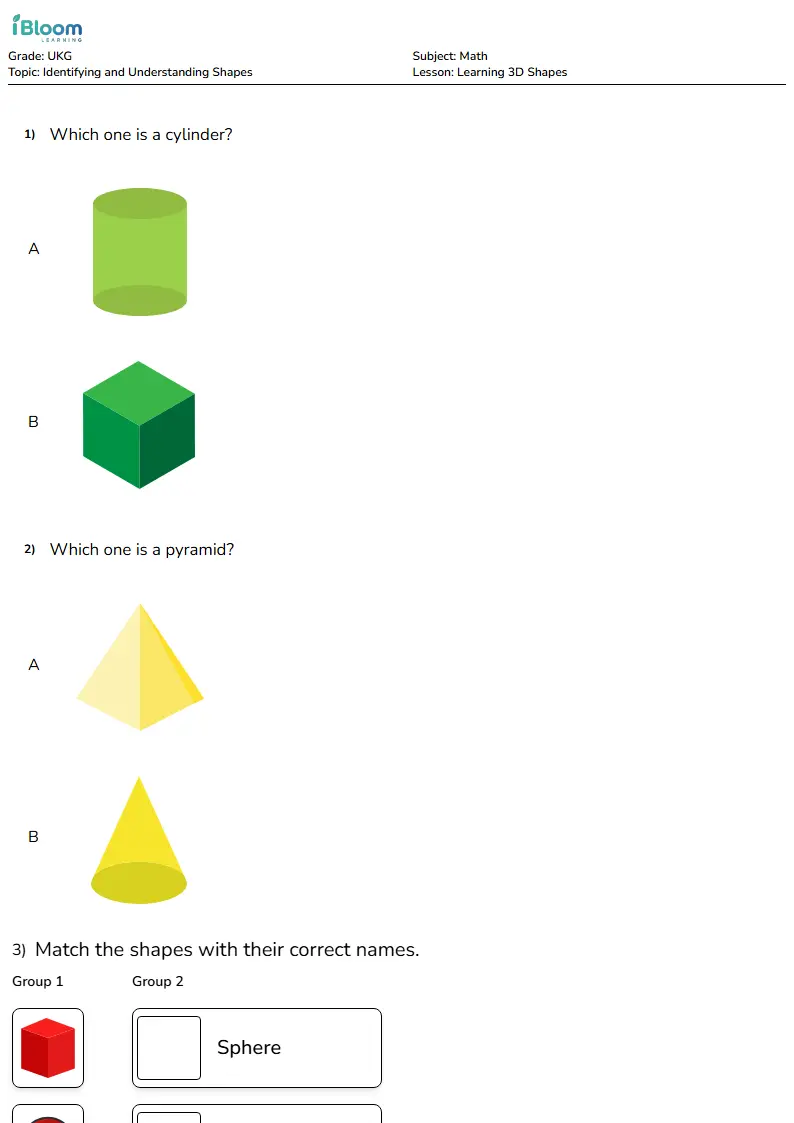
Learning 3D Shapes Worksheet for UKG
Help UKG children name cube, cuboid, sphere, cylinder and cone shapes, match them to real objects, and compare how each solid moves in practice.
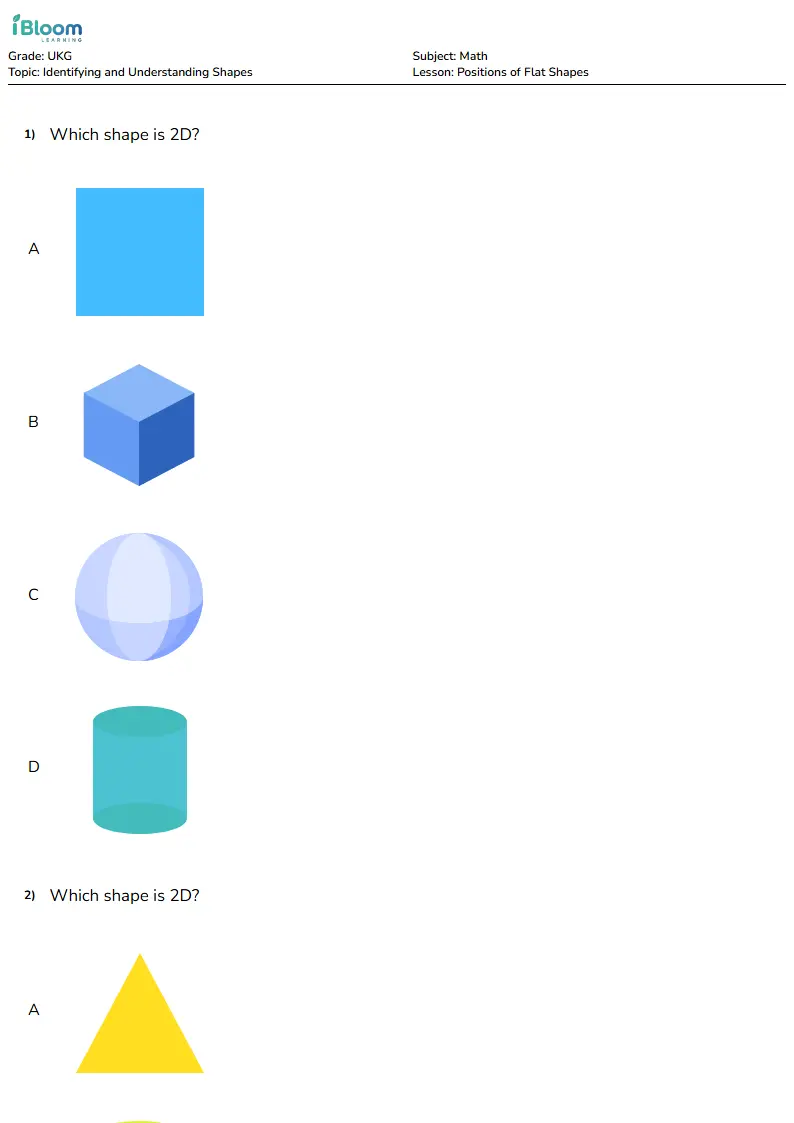
Free Positions of Flat Shapes Worksheets for Ukg
Looking for ukg math help? Download free, interactive positions of flat shapes worksheets. AI-personalized and Common Core-aligned. Practice math with iBloom.
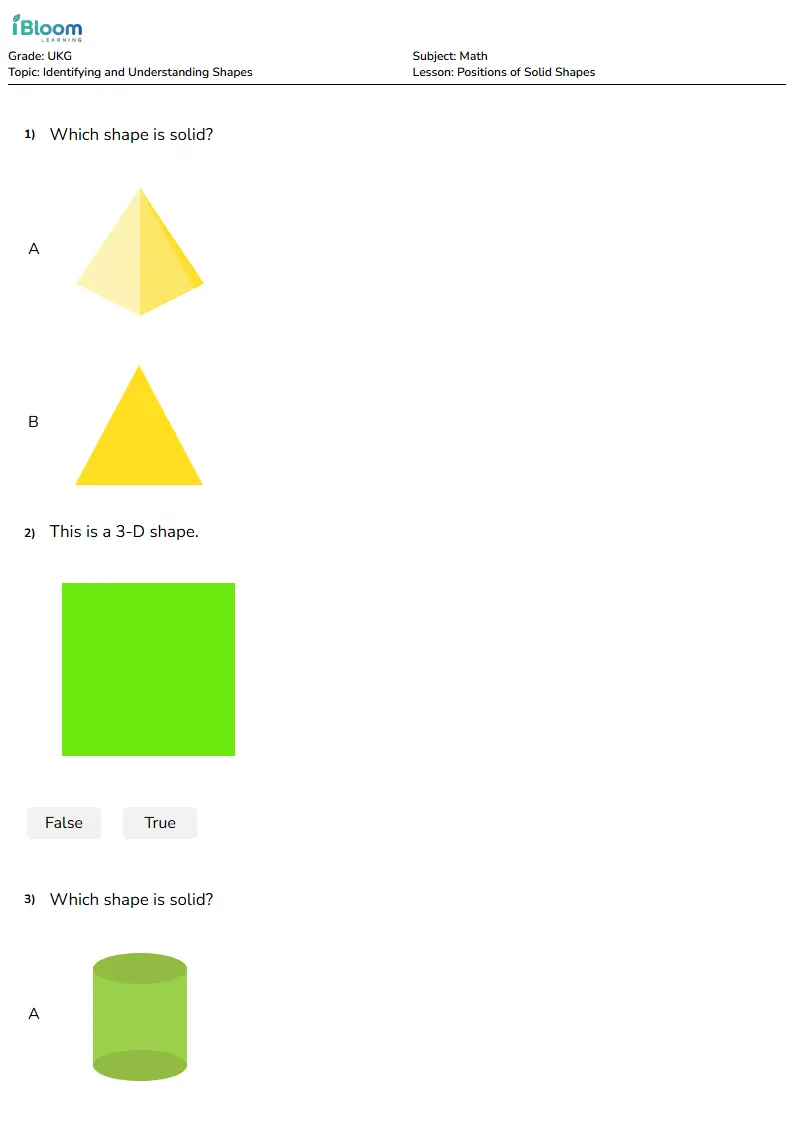
Free Positions of Solid Shapes Worksheets for Ukg
Looking for ukg math help? Download free, interactive positions of solid shapes worksheets. AI-personalized and Common Core-aligned. Practice math with iBloom.
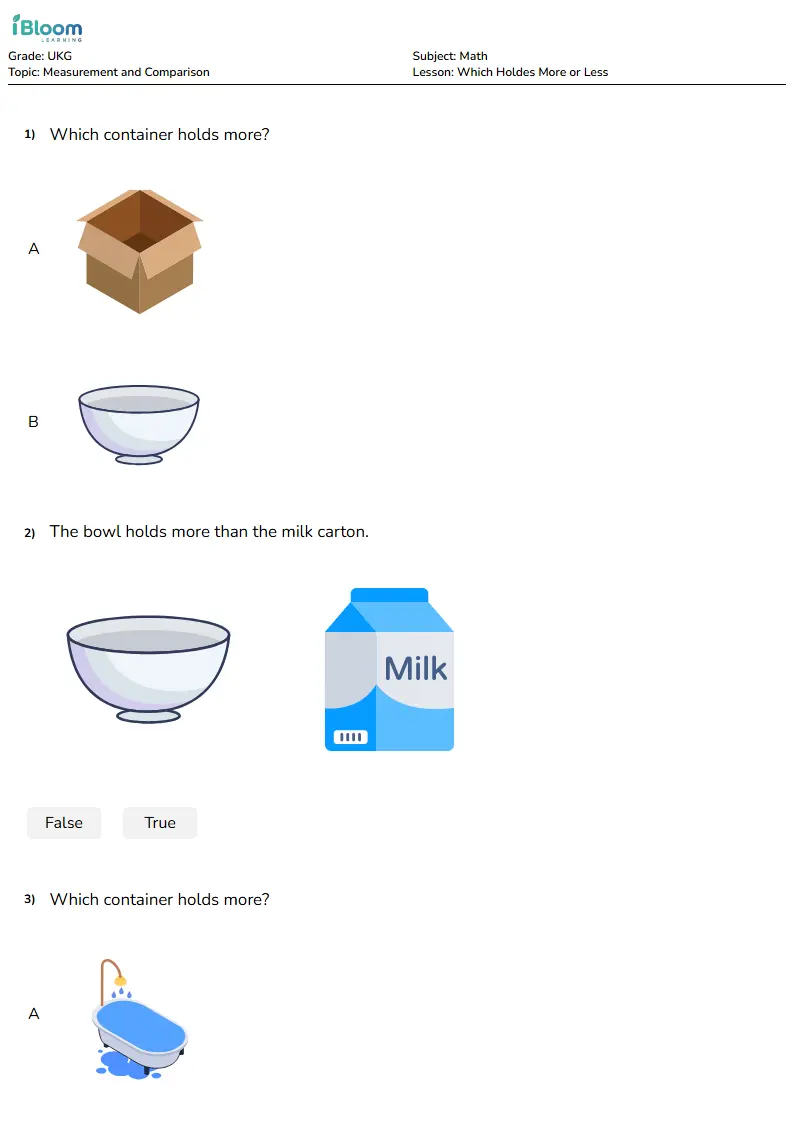
Free Which Holdes More or Less Worksheets for Ukg
Looking for ukg math help? Download free, interactive which holdes more or less worksheets. AI-personalized and Common Core-aligned. Practice math with iBloom.