Summarizing Stories Lesson for Class 4
Preparing your worksheet
Summarizing Stories Lesson for Class 4: english language arts practice for Class 4
Summarizing Stories Lesson for Class 4 helps children practise focused practice and one clear explanation. Start with Summarizing Stories Lesson for Class 4, then use the paired worksheet for Summarizing Stories Lesson for Class 4 when the child needs the same idea taught in another format.
This page is for parents, teachers, tutors, homeschool families, and children who need a calm way to try a small set and explain one answer. In India, this page can support CBSE, ICSE, state-board, Class 1, Class 2, Delhi, Mumbai, Bengaluru, Chennai, Hyderabad, Pune, Kolkata, Ahmedabad, Jaipur, Kerala, Tamil Nadu, Karnataka, Maharashtra, Telangana, Gujarat, Rajasthan, and West Bengal. In the United States, it can support kindergarten, first grade, second grade, homeschool, intervention, California, Texas, Florida, New York, Illinois, Pennsylvania, Ohio, Georgia, North Carolina, Michigan, Los Angeles, Houston, Chicago, Dallas, Austin, Seattle, Boston, Denver, Atlanta, and Miami. In the UAE, it can support Dubai, Abu Dhabi, Sharjah, Ajman, Al Ain, Ras Al Khaimah, Fujairah, Umm Al Quwain, British curriculum, American curriculum, IB, and Indian curriculum classrooms.
What the child is learning
The child is learning to connect a math situation with a model, an answer, and a short explanation. In addition, that usually means seeing two parts, joining them, counting on or filling a frame, and naming the total. In related math pages, the same routine helps the learner slow down and show the reasoning before marking an answer.
A correct answer is useful, but the explanation is the real check. If the child can say, "I started with 3, added 4 more, and got 7," the adult can hear the operation, the model, and the total.
Parent practice routine
Use this page for ten to fifteen minutes. Read the direction aloud, model one item, and let the child try a small set. Ask the child to point, move, draw, fill a frame, jump on a number line, or explain before writing the final answer.
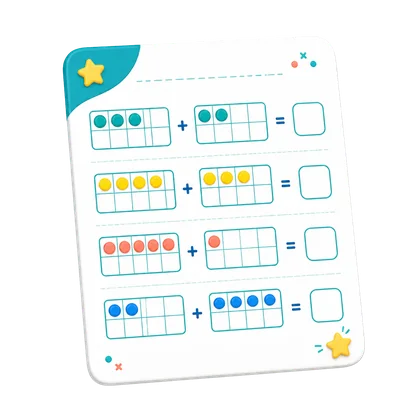
- Make a quick example with 3 counters and 4 more counters.
- Ask what is being joined and what the total is.
- Let the child solve one item from Summarizing Stories Lesson for Class 4.
- End by asking the child to create one similar problem for an adult.
If the child needs a broader explanation, use iBloom Math Worksheets and then return to the child-facing page. The article gives adults language; the worksheet or lesson gives children practice.
Teacher and tutor routine
Teachers can use this page as a warm-up, center activity, small-group reteach, homework review, intervention check, or exit ticket. Tutors can use it to find whether the child needs help with directions, number sense, model use, counting on, fact fluency, or explanation.
A useful classroom routine is: model one item, let children solve two items, then ask partners to compare explanations. The explanation should name the starting amount, the added part, and the total. This keeps the work simple for children while still building mathematical communication.
Examples to try before the page
- Show 3 objects, add 4 objects, and ask the child to count the total.
- Draw two groups of dots and write the addition sentence that matches.
- Use a ten-frame, number line, picture, or object model before writing the answer.
- Change one number in the example and ask how the total changes.
For more practice, connect this page to Addition Worksheets for Grade 1, Addition Worksheets for Grade 2, and Picture Addition Worksheets. When the child is ready to compare operations, use Subtraction Worksheets for Grade 1.
How to support different learners
If the task feels hard, reduce the numbers, cover part of a busy page, read the direction aloud, or return to real objects. If the task feels easy, ask the child to write a new problem, explain a wrong answer, or solve the same question with a different model.
In a mixed classroom, one worksheet can support three levels. One group solves fewer items with counters. Another completes the main set and explains one answer. A third creates a new example or checks a partner's model.
Common mistakes to watch for
- The child guesses from the bigger number instead of joining the parts.
- The child counts the first group twice instead of counting on.
- The child fills a ten-frame or jumps on a number line too quickly and loses track.
- The child writes the answer but cannot explain what changed.
- The page is completed once and never revisited.
When a mistake appears, pause and model one item. The adult planning reference can help adults think about models and practice, but the child should return to iBloom for direct work.
India, US, and UAE classroom notes
Curriculum language changes by region. Indian schools may say Class 1 addition sums or addition worksheets. US classrooms may say Grade 1 addition, first grade facts, number bonds, or addition models. UAE schools may mix British, American, IB, Indian, and home-language routines.
Let multilingual children describe the situation in the strongest language first if needed. Then repeat the key English words: add, join, altogether, total, plus, equation, frame, counter, number line, and answer.
Connected iBloom practice
Choose the next page based on what the child needs: a lesson for modelling, a worksheet for independent practice, or an article for adult planning.
- Summarizing Stories Lesson for Class 4
- paired worksheet for Summarizing Stories Lesson for Class 4
- iBloom Math Worksheets
- Addition Worksheets for Grade 1
- Addition Worksheets for Grade 2
- Picture Addition Worksheets
- iBloom Math Worksheets
- Summarize key information Lesson for Fourth Grade
- Determine the theme and summarize Lesson for Fifth Grade
- Summarizing Important Information Lesson for Class 4
Frequently asked questions
Who should use this page?
Use it when a Class 4 child needs focused english language arts practice connected to summarizing stories.
How long should practice take?
Most children do well with 10 to 15 minutes and one clear explanation.
Should children memorize facts first?
No. Fast recall is useful later, but children should first understand the meaning with objects, pictures, frames, or number lines.
What should we do next?
Use one connected iBloom link above so the child sees the same skill again in a new format.
More practice for this grade
More English Language Arts lessons
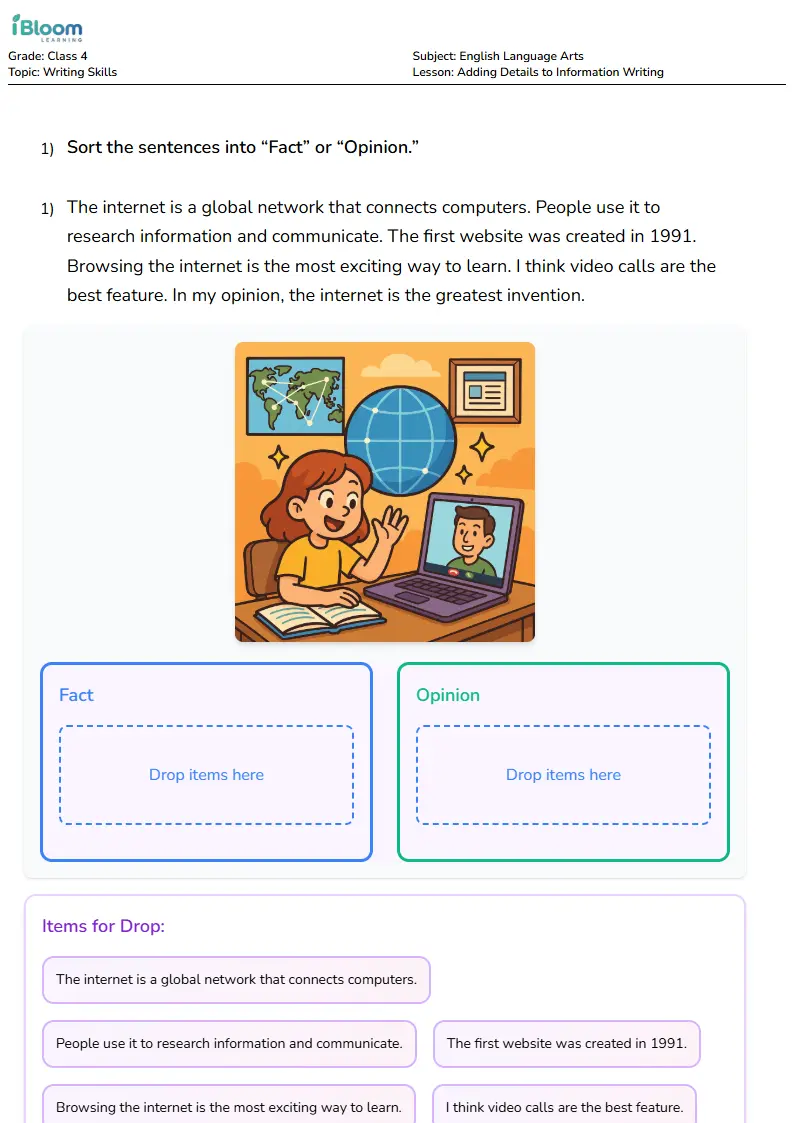
Adding Details to Information Writing Lesson for Class 4
Explore a free interactive english language arts lesson for class 4: Adding Details to Information Writing. AI-personalized, Common Core-aligned, and built for kids.
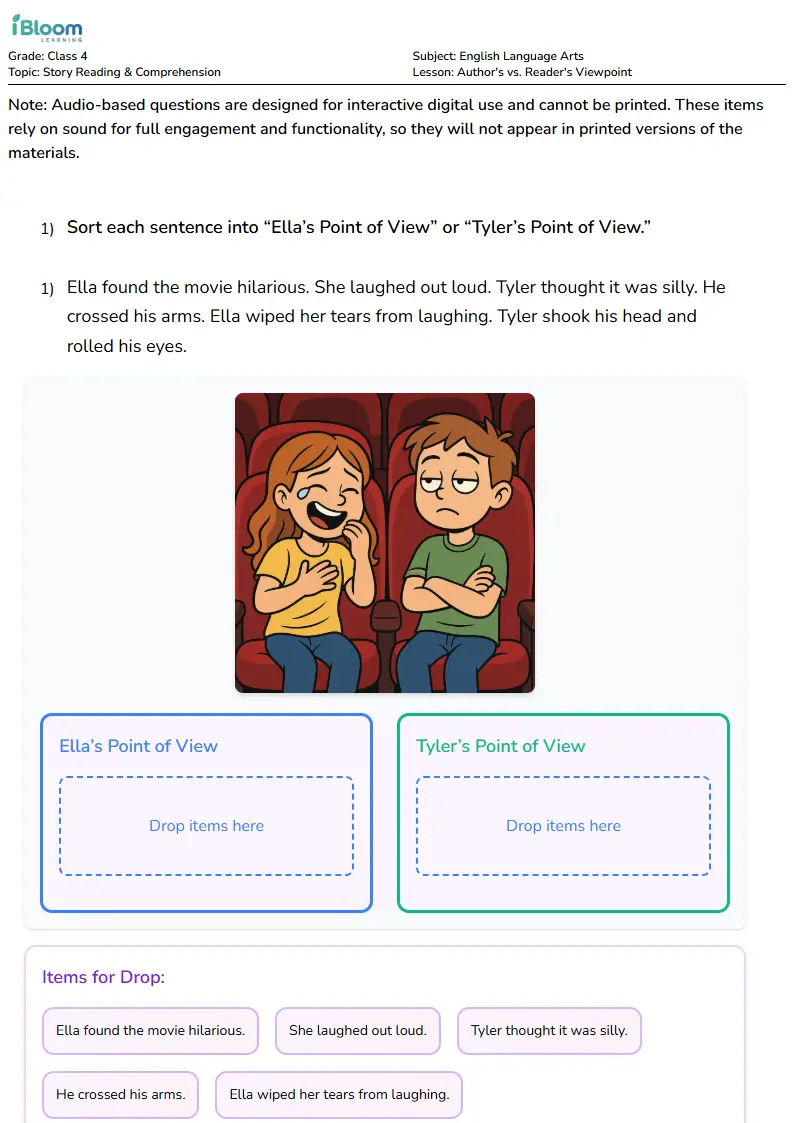
Author's vs. Reader's Viewpoint Lesson for Class 4
Explore a free interactive english language arts lesson for class 4: Author's vs. Reader's Viewpoint. AI-personalized, Common Core-aligned, and built for kids.
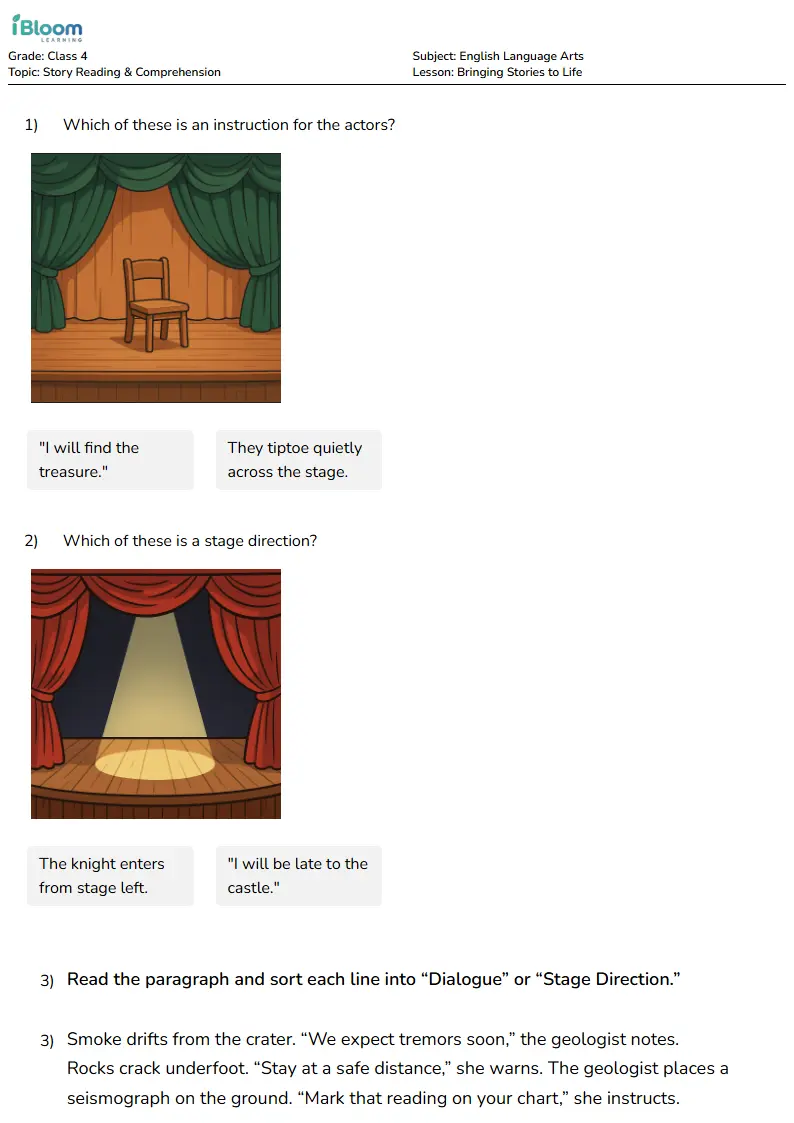
Bringing Stories to Life Lesson for Class 4
Explore a free interactive english language arts lesson for class 4: Bringing Stories to Life. AI-personalized, Common Core-aligned, and built for kids.
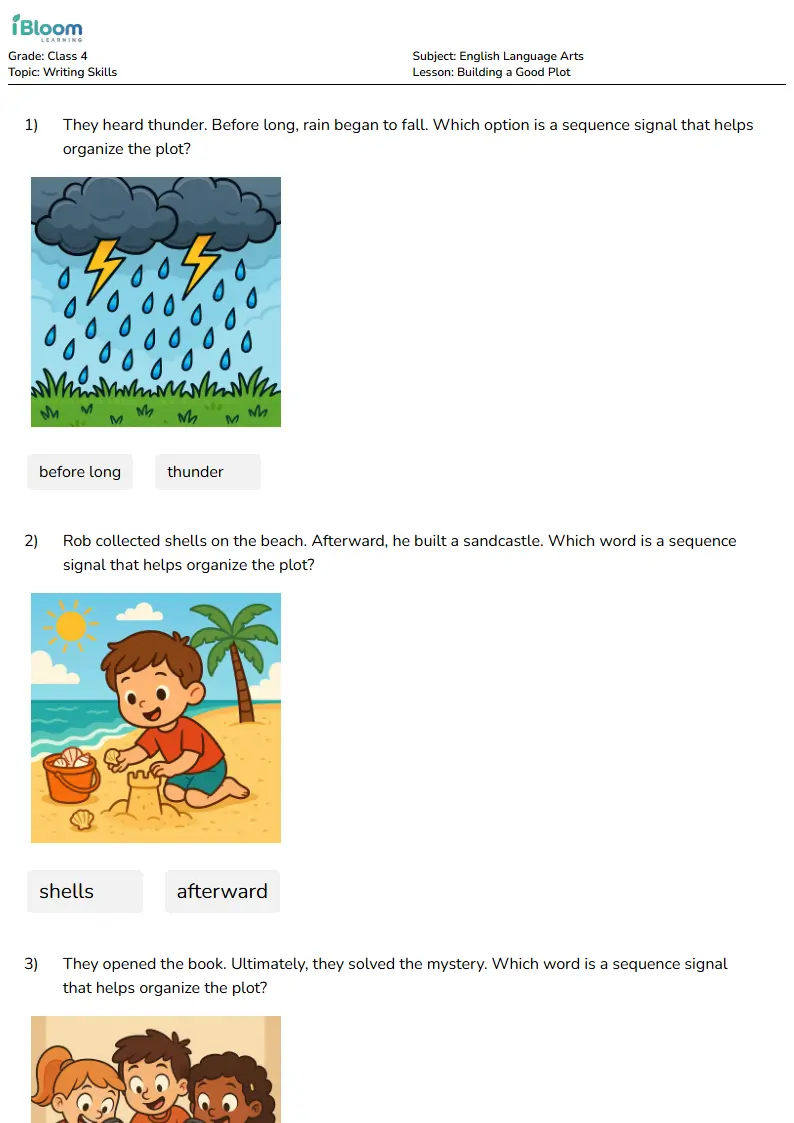
Building a Good Plot Lesson for Class 4
Explore a free interactive english language arts lesson for class 4: Building a Good Plot. AI-personalized, Common Core-aligned, and built for kids.
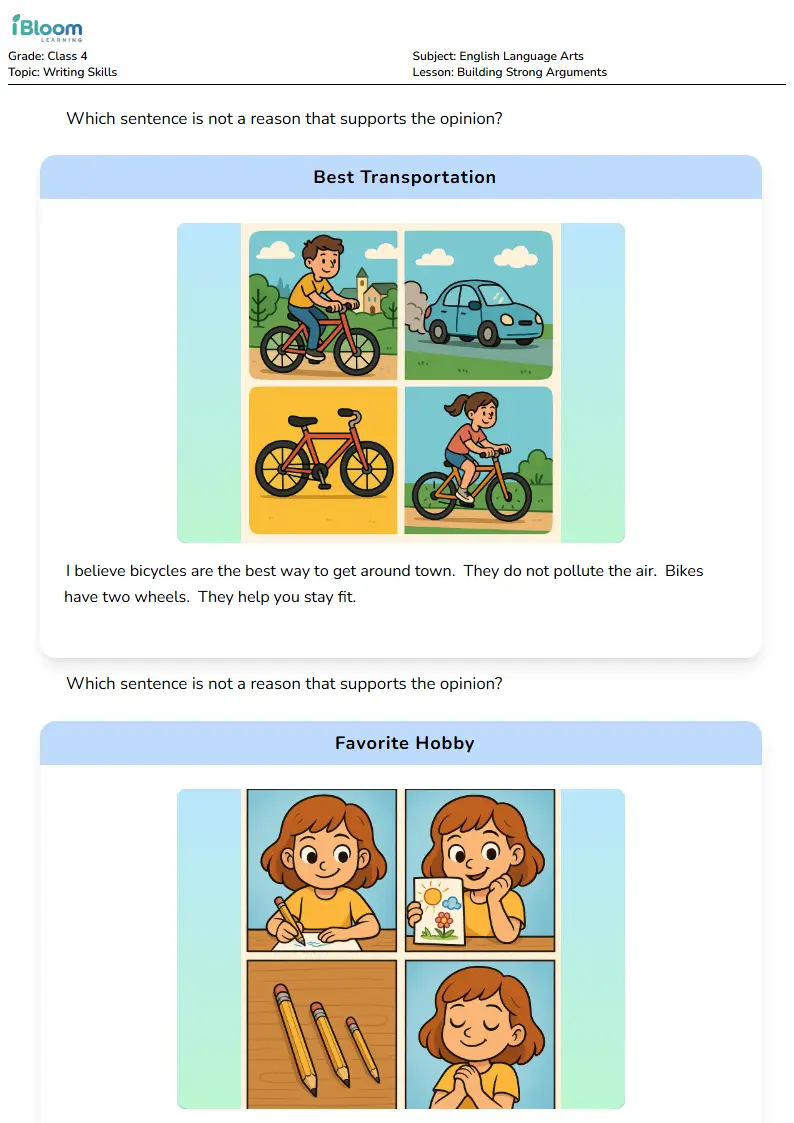
Building Strong Arguments Lesson for Class 4
Explore a free interactive english language arts lesson for class 4: Building Strong Arguments. AI-personalized, Common Core-aligned, and built for kids.
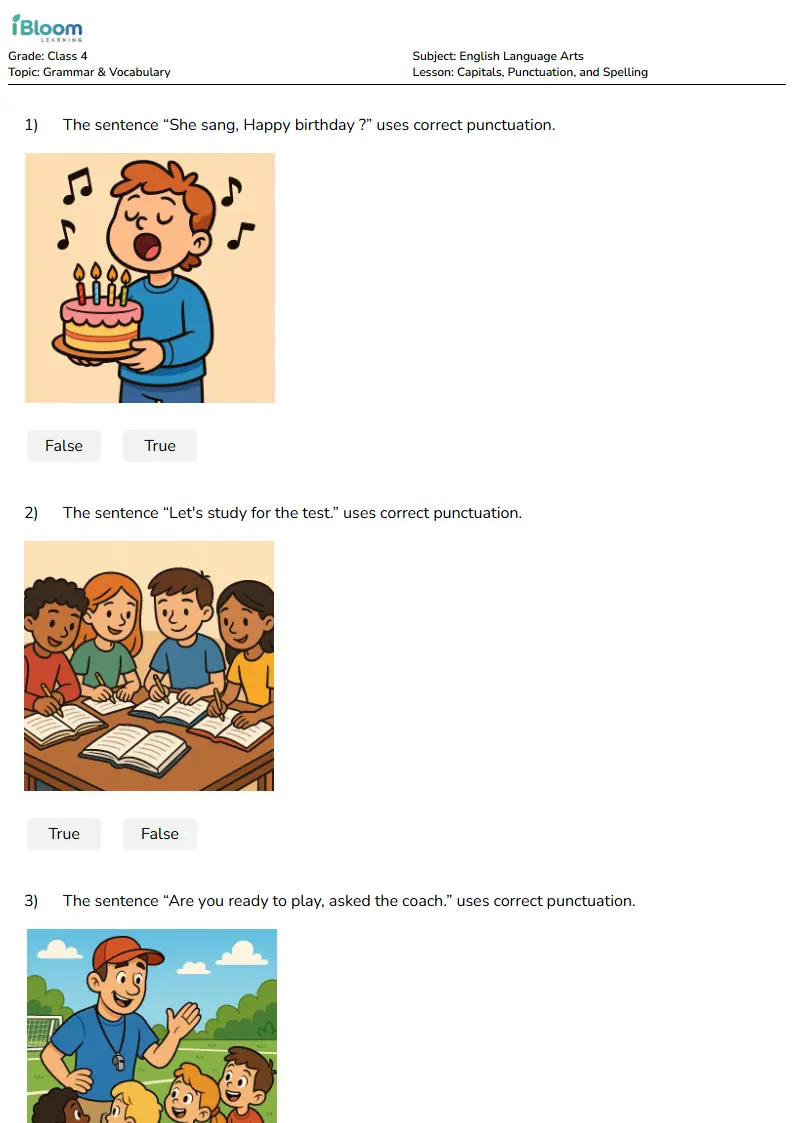
Capitals, Punctuation, and Spelling Lesson for Class 4
Explore a free interactive english language arts lesson for class 4: Capitals, Punctuation, and Spelling. AI-personalized, Common Core-aligned, and built for kids.
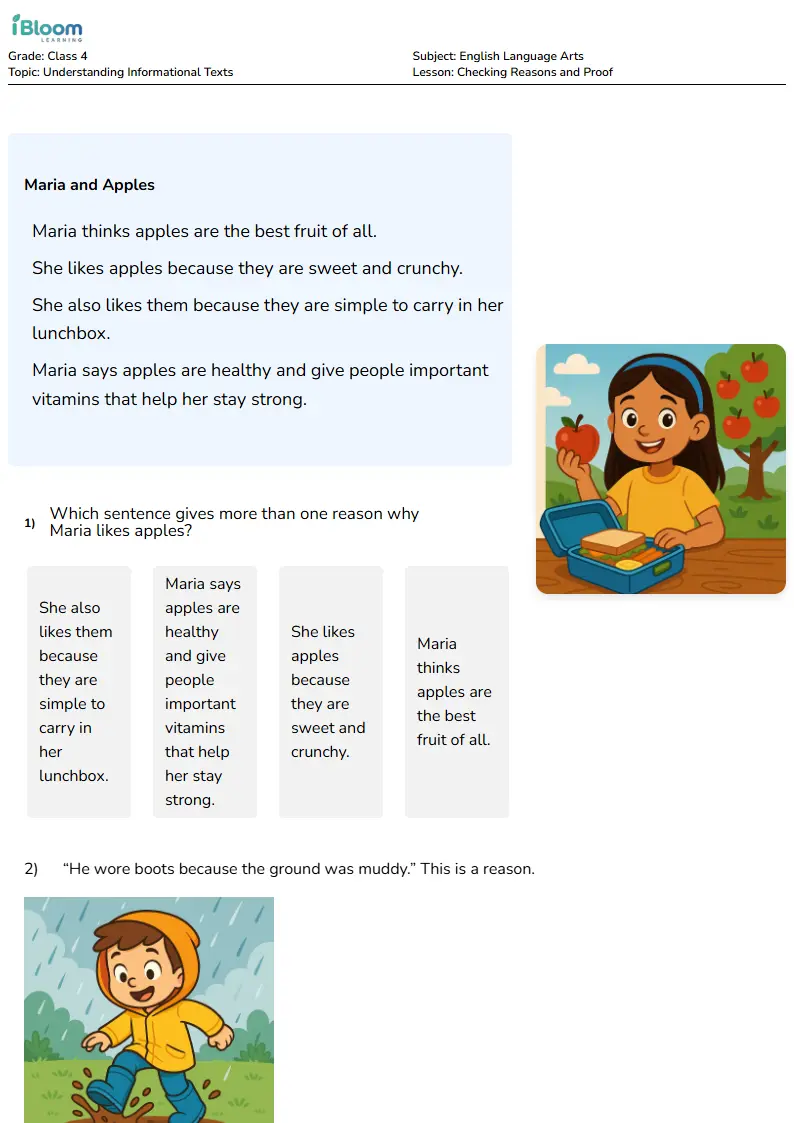
Checking Reasons and Proof Lesson for Class 4
Explore a free interactive english language arts lesson for class 4: Checking Reasons and Proof. AI-personalized, Common Core-aligned, and built for kids.
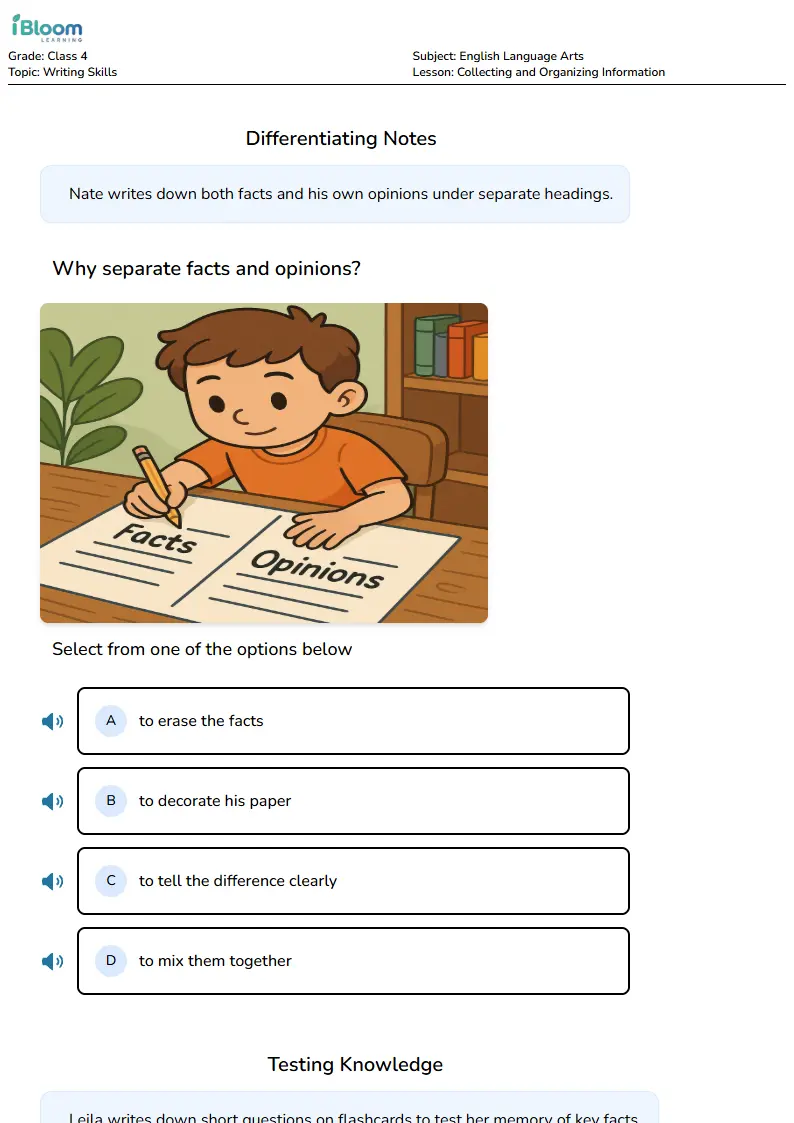
Collecting and Organizing Information Lesson for Class 4
Explore a free interactive english language arts lesson for class 4: Collecting and Organizing Information. AI-personalized, Common Core-aligned, and built for kids.
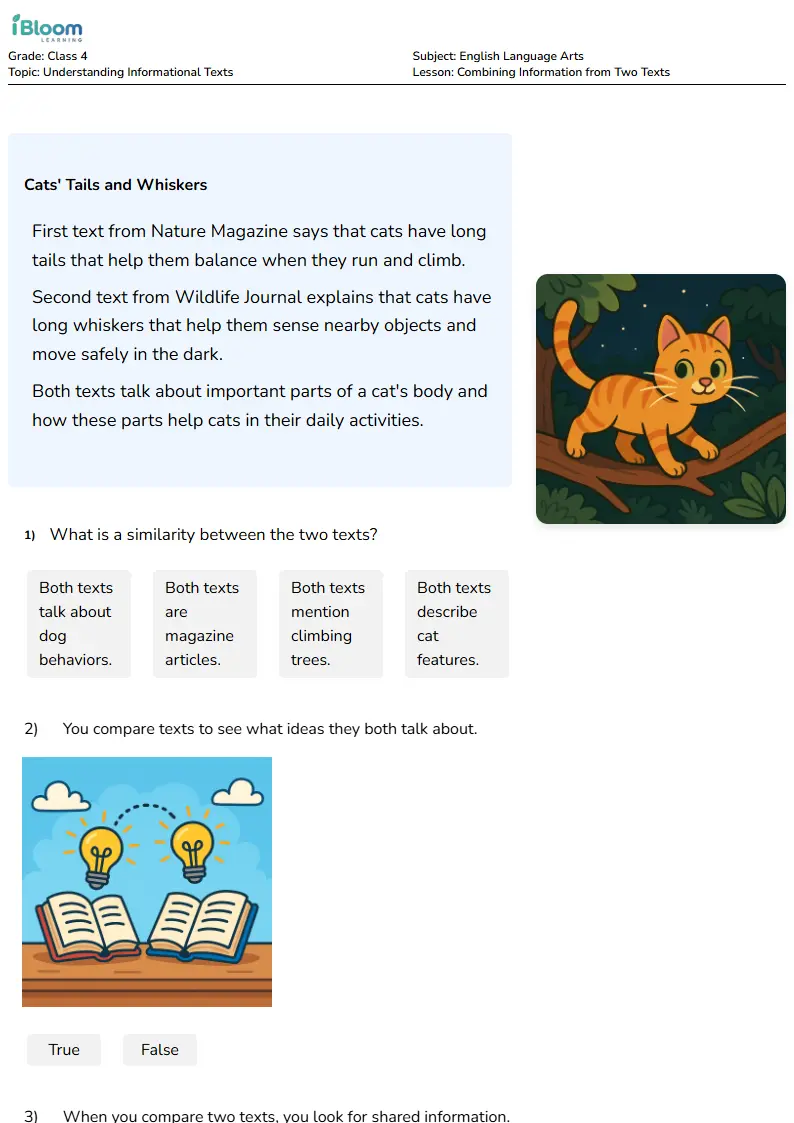
Combining Information from Two Texts Lesson for Class 4
Explore a free interactive english language arts lesson for class 4: Combining Information from Two Texts. AI-personalized, Common Core-aligned, and built for kids.
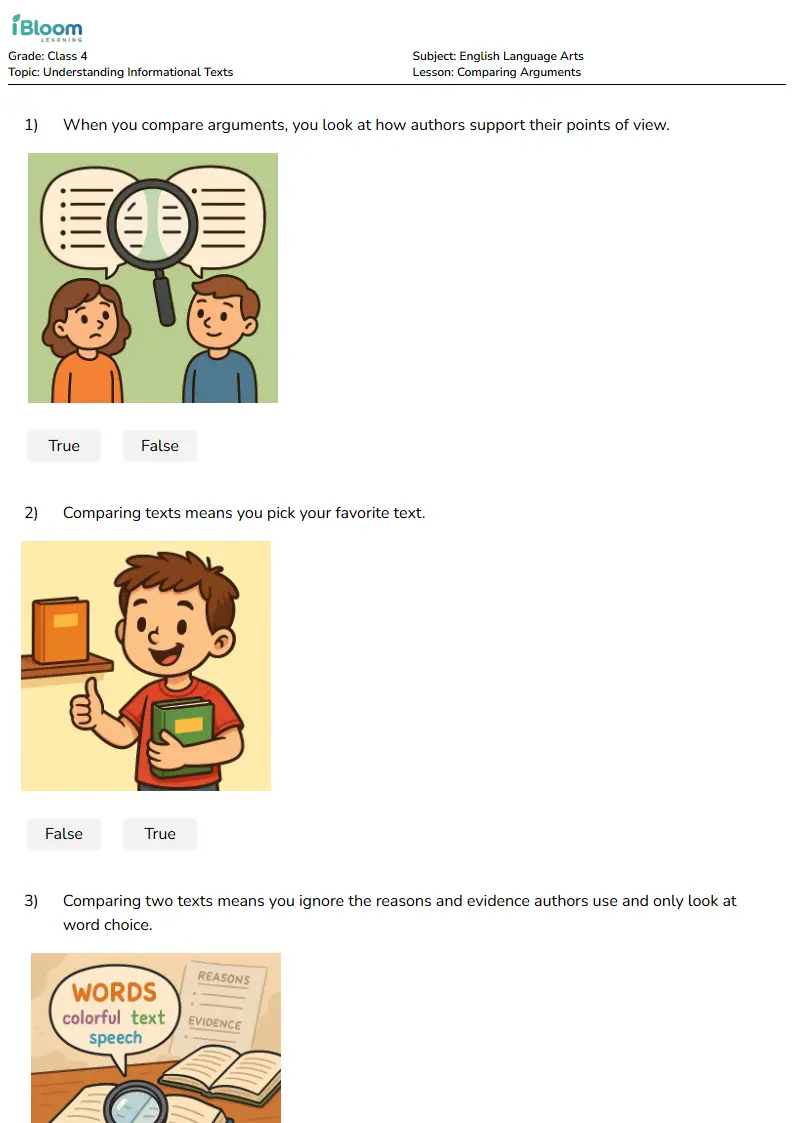
Comparing Arguments Lesson for Class 4
Explore a free interactive english language arts lesson for class 4: Comparing Arguments. AI-personalized, Common Core-aligned, and built for kids.
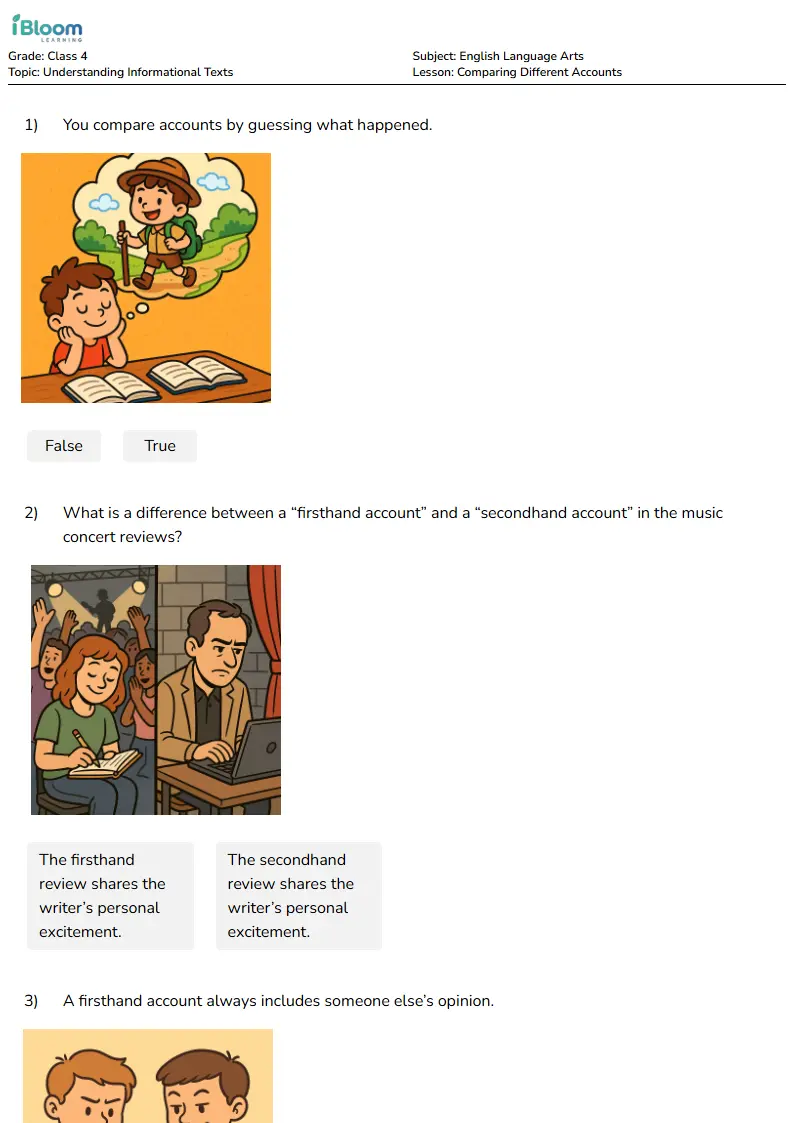
Comparing Different Accounts Lesson for Class 4
Explore a free interactive english language arts lesson for class 4: Comparing Different Accounts. AI-personalized, Common Core-aligned, and built for kids.
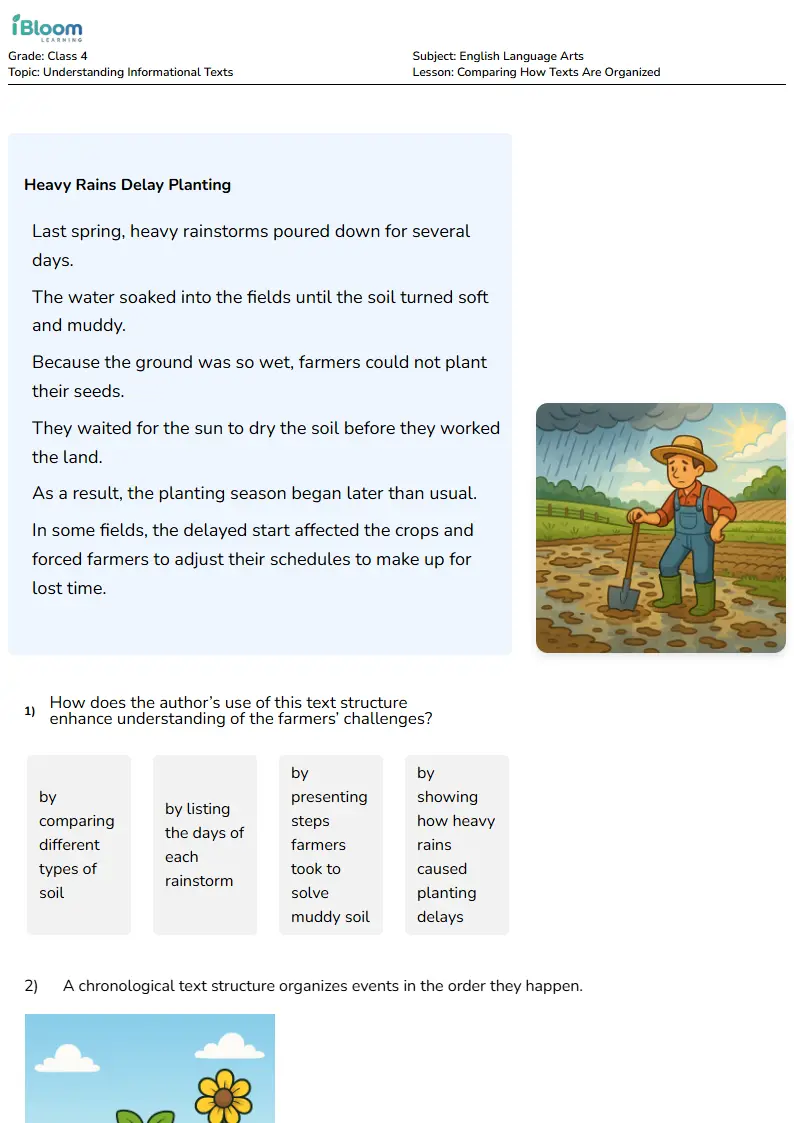
Comparing How Texts Are Organized Lesson for Class 4
Explore a free interactive english language arts lesson for class 4: Comparing How Texts Are Organized. AI-personalized, Common Core-aligned, and built for kids.
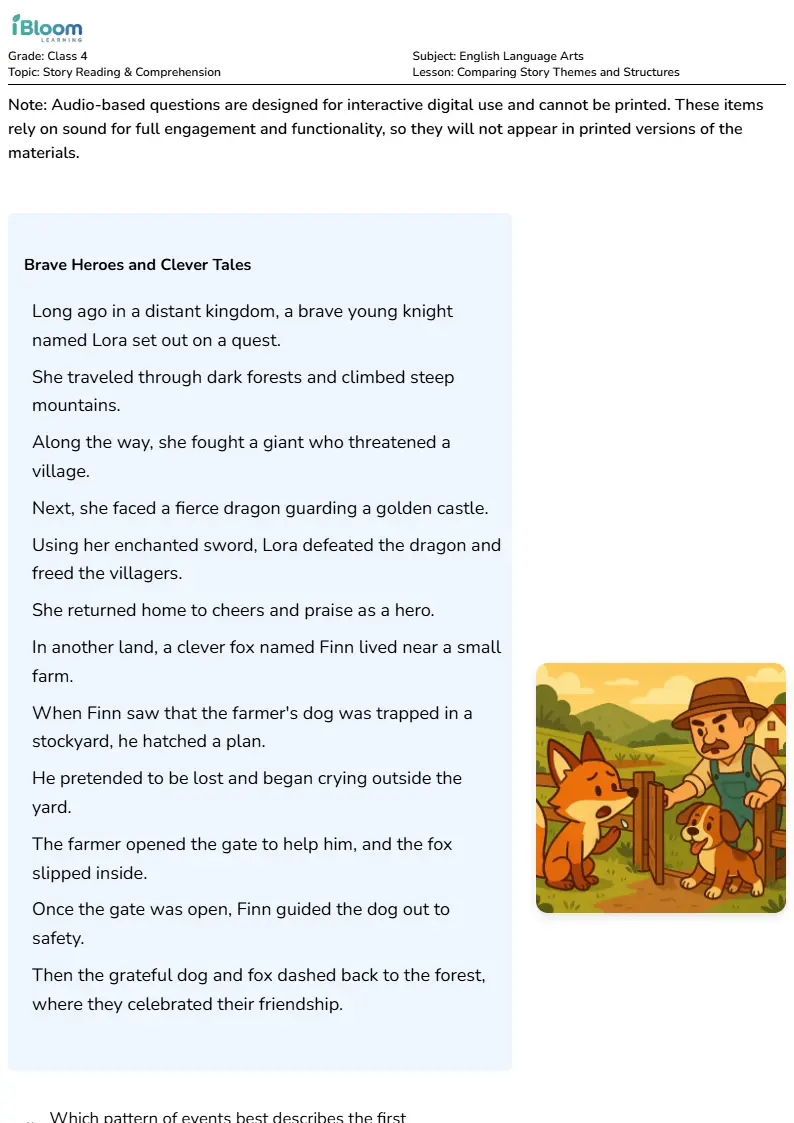
Comparing Story Themes and Structures Lesson for Class 4
Explore a free interactive english language arts lesson for class 4: Comparing Story Themes and Structures. AI-personalized, Common Core-aligned, and built for kids.
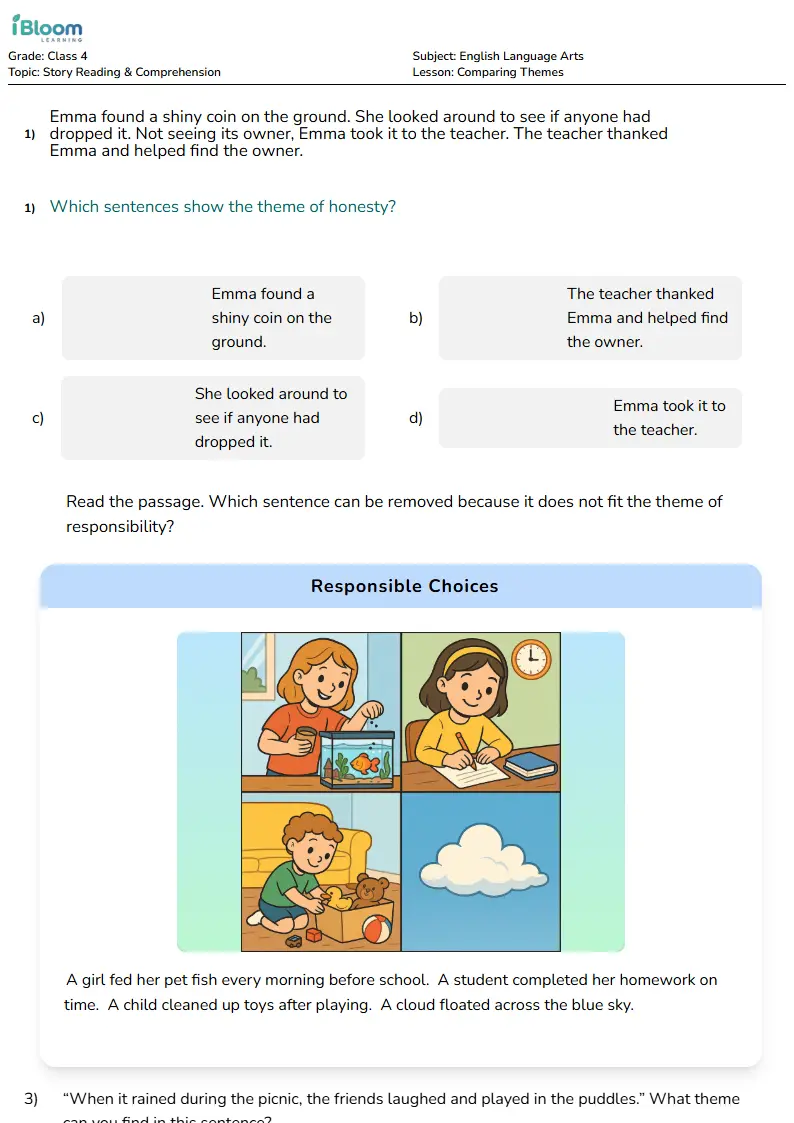
Comparing Themes Lesson for Class 4
Explore a free interactive english language arts lesson for class 4: Comparing Themes. AI-personalized, Common Core-aligned, and built for kids.
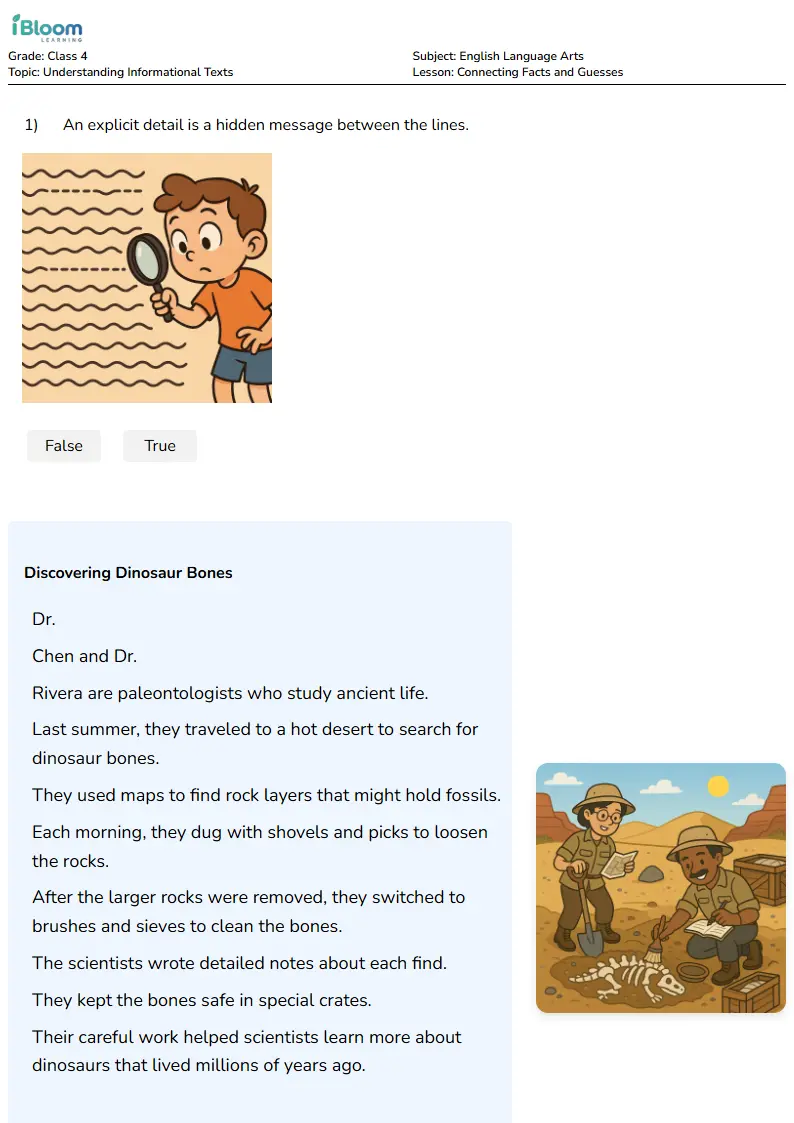
Connecting Facts and Guesses Lesson for Class 4
Explore a free interactive english language arts lesson for class 4: Connecting Facts and Guesses. AI-personalized, Common Core-aligned, and built for kids.
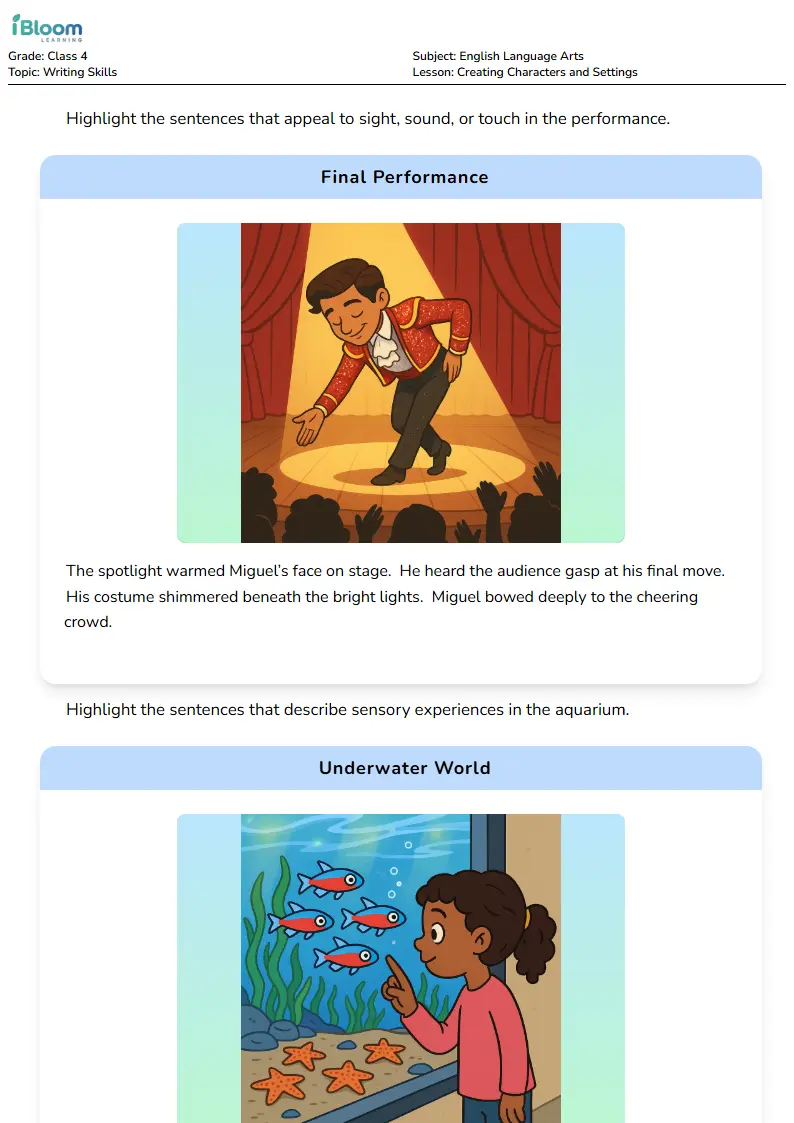
Creating Characters and Settings Lesson for Class 4
Explore a free interactive english language arts lesson for class 4: Creating Characters and Settings. AI-personalized, Common Core-aligned, and built for kids.
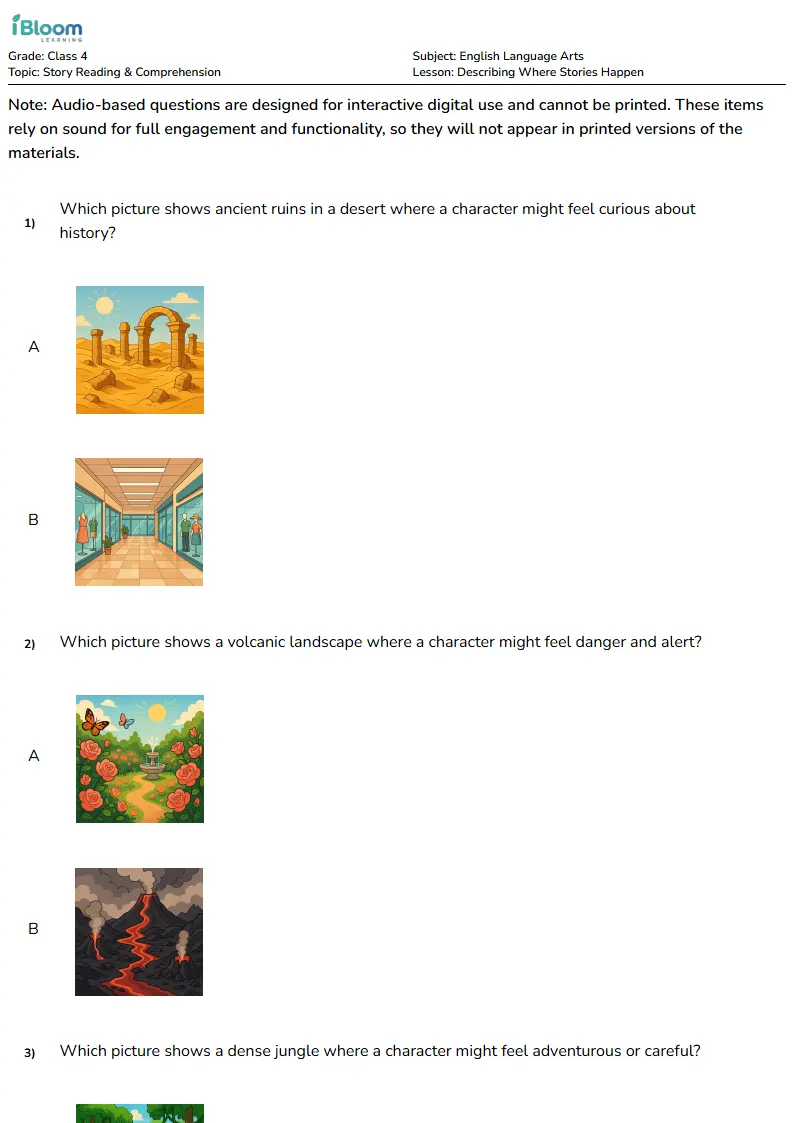
Describing Where Stories Happen Lesson for Class 4
Explore a free interactive english language arts lesson for class 4: Describing Where Stories Happen. AI-personalized, Common Core-aligned, and built for kids.
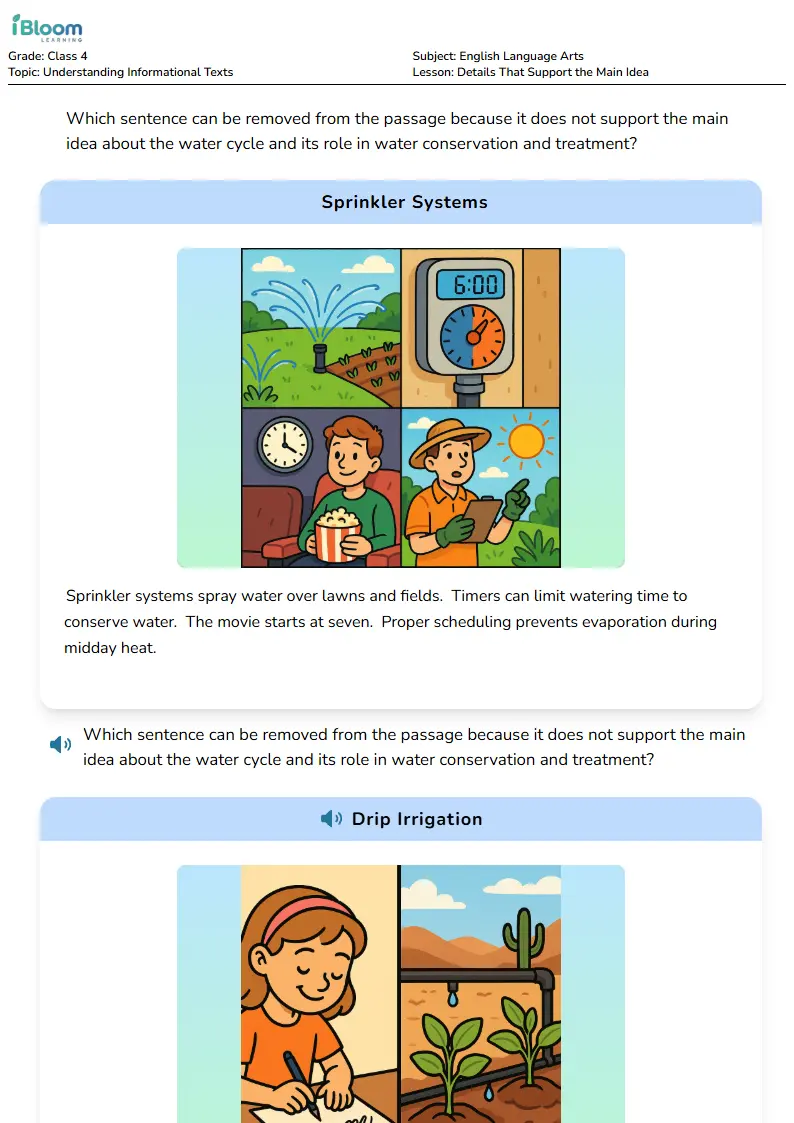
Details That Support the Main Idea Lesson for Class 4
Explore a free interactive english language arts lesson for class 4: Details That Support the Main Idea. AI-personalized, Common Core-aligned, and built for kids.
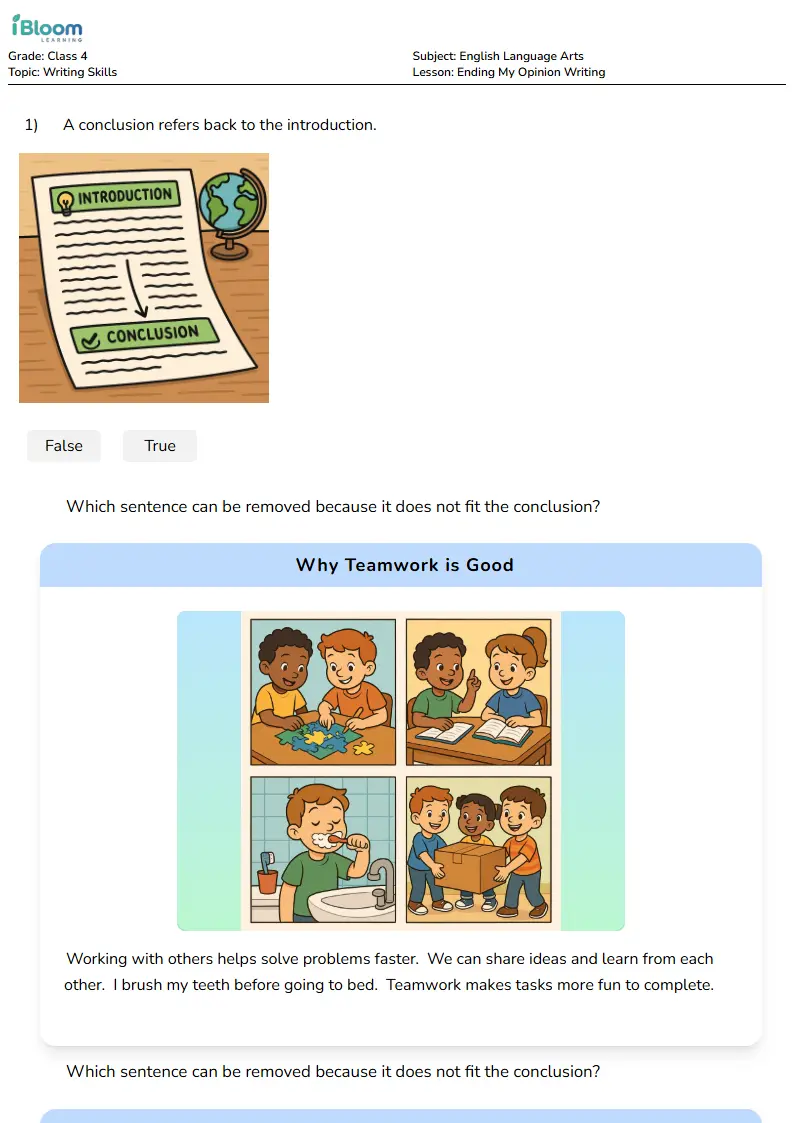
Ending My Opinion Writing Lesson for Class 4
Explore a free interactive english language arts lesson for class 4: Ending My Opinion Writing. AI-personalized, Common Core-aligned, and built for kids.
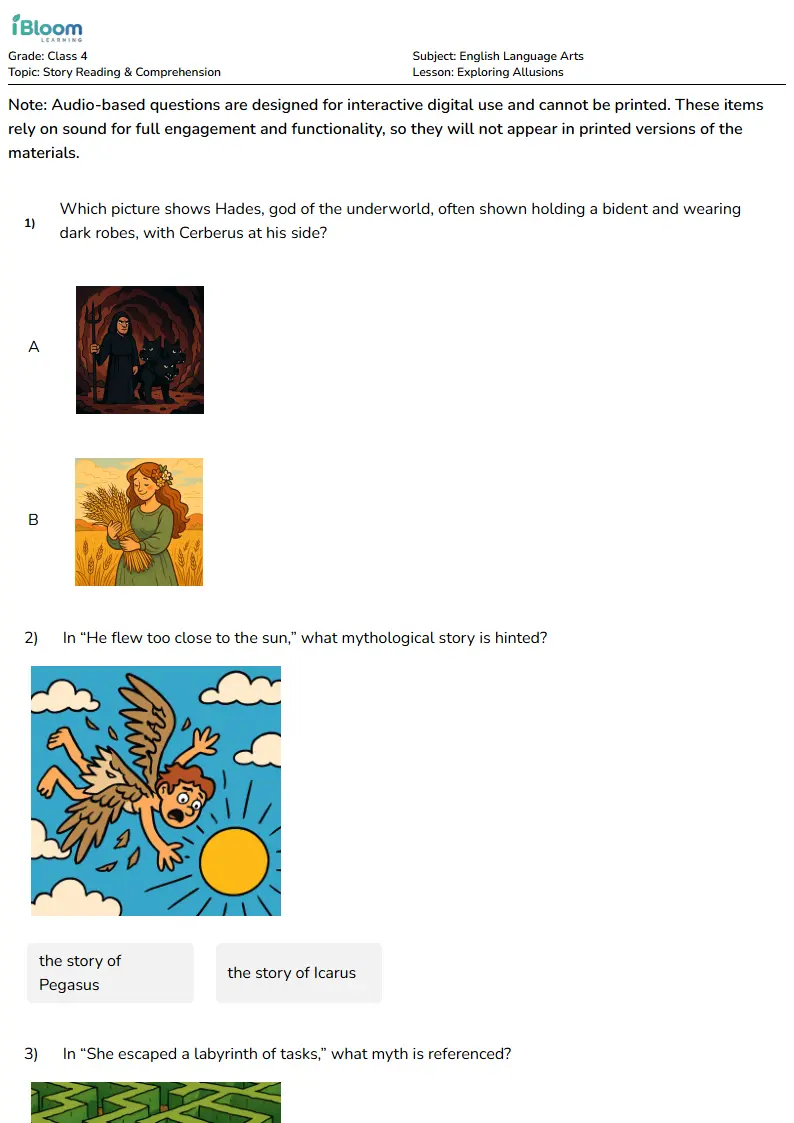
Exploring Allusions Lesson for Class 4
Explore a free interactive english language arts lesson for class 4: Exploring Allusions. AI-personalized, Common Core-aligned, and built for kids.
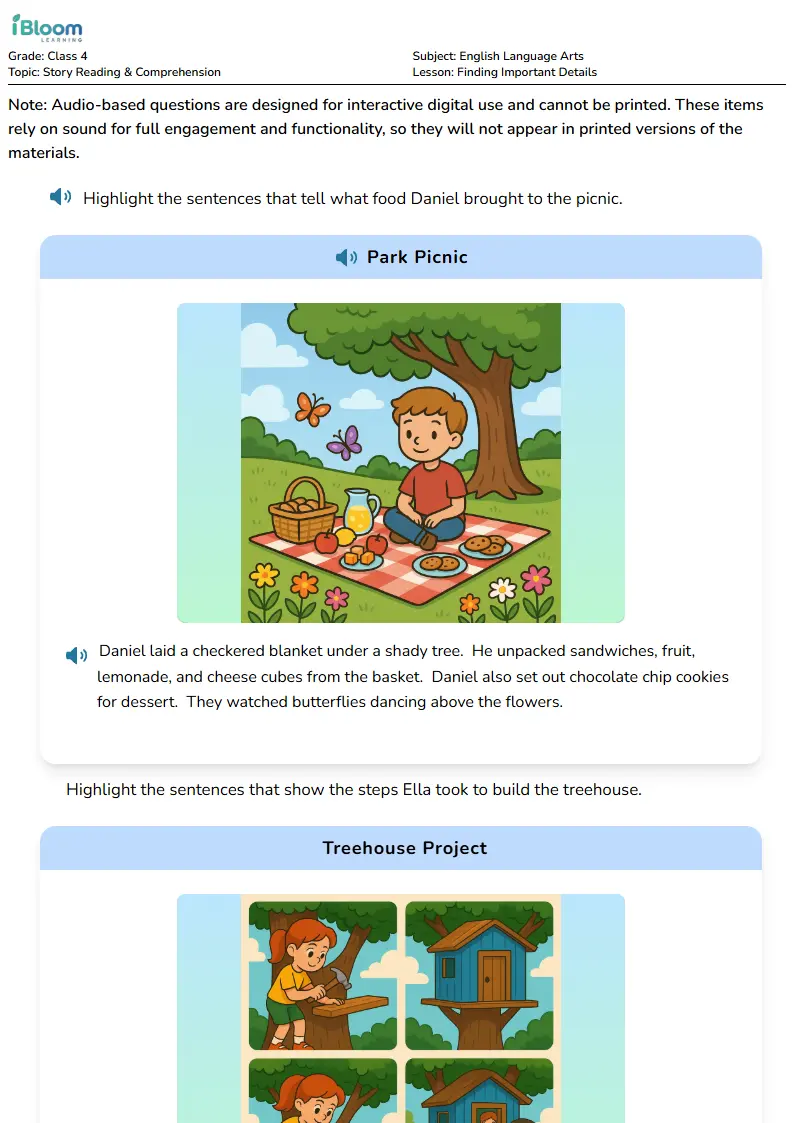
Finding Important Details Lesson for Class 4
Explore a free interactive english language arts lesson for class 4: Finding Important Details. AI-personalized, Common Core-aligned, and built for kids.
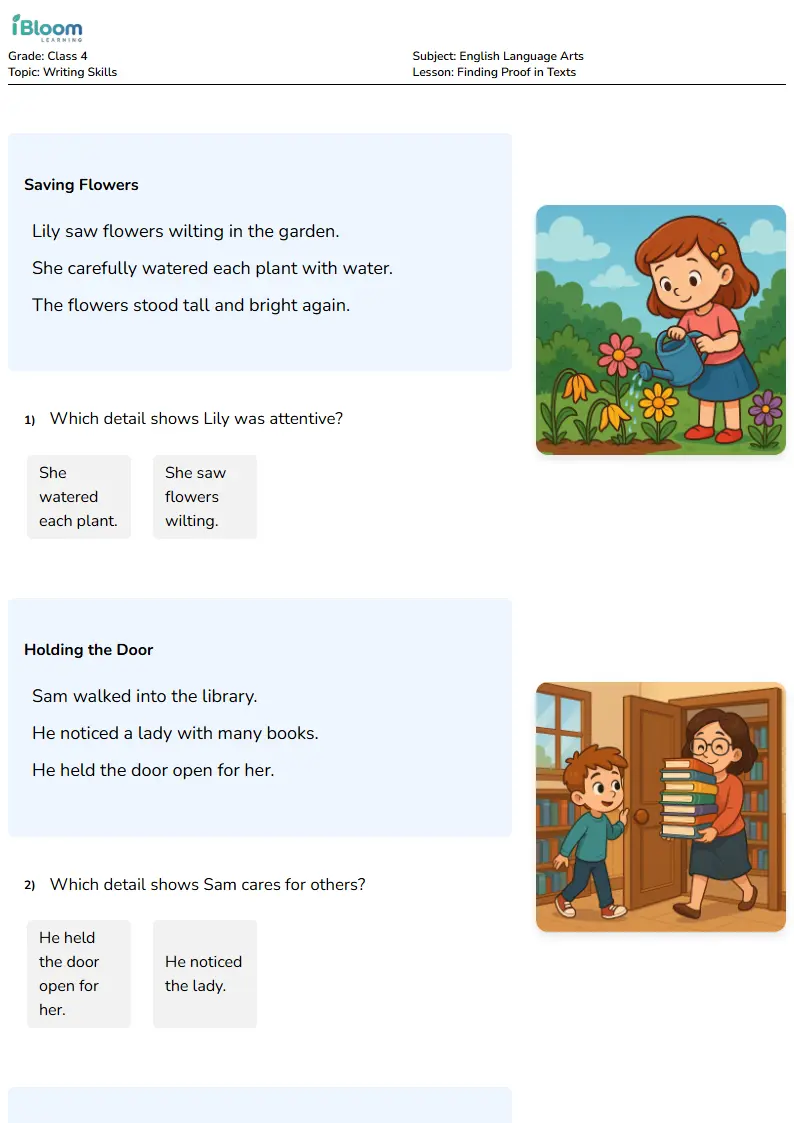
Finding Proof in Texts Lesson for Class 4
Explore a free interactive english language arts lesson for class 4: Finding Proof in Texts. AI-personalized, Common Core-aligned, and built for kids.
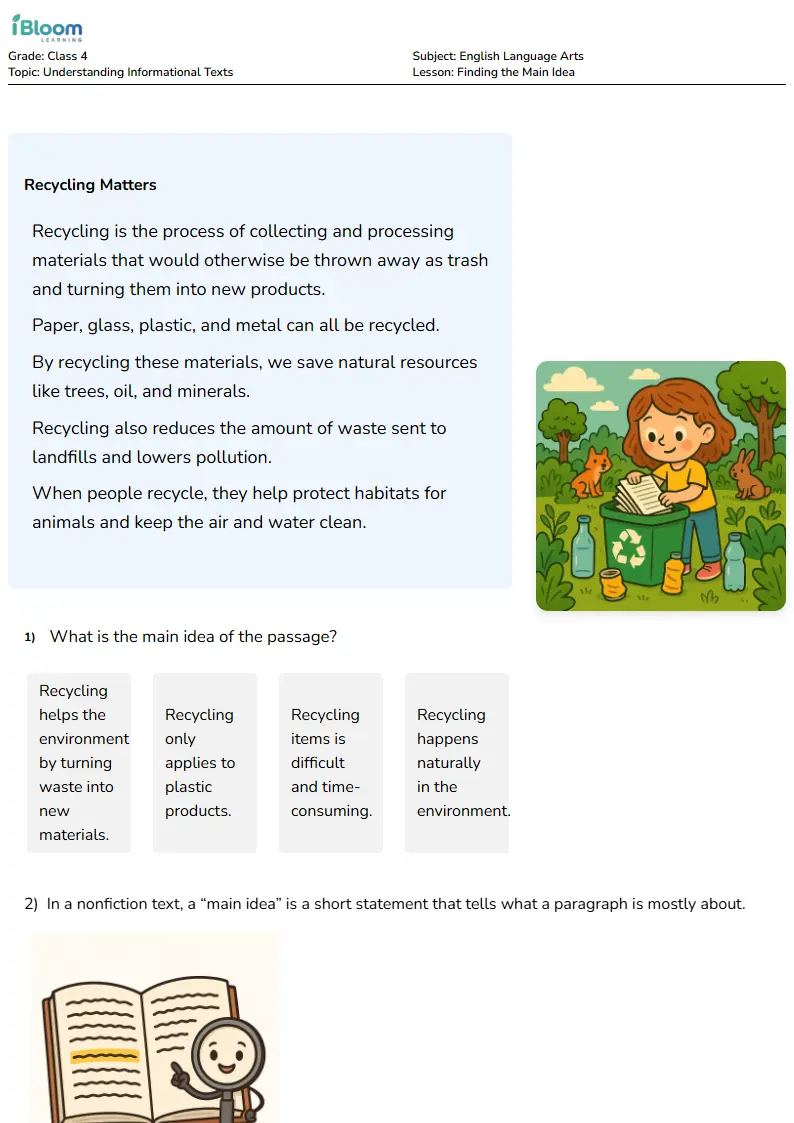
Finding the Main Idea Lesson for Class 4
Explore a free interactive english language arts lesson for class 4: Finding the Main Idea. AI-personalized, Common Core-aligned, and built for kids.
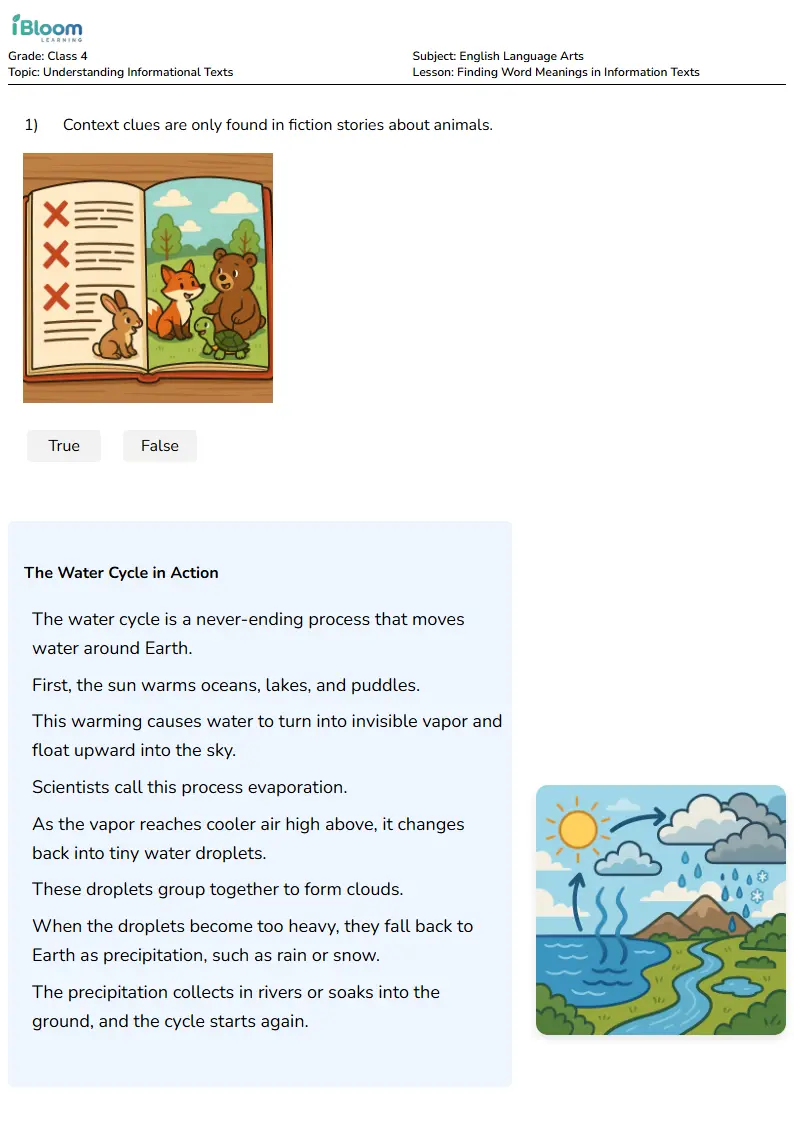
Finding Word Meanings in Information Texts Lesson for Class 4
Explore a free interactive english language arts lesson for class 4: Finding Word Meanings in Information Texts. AI-personalized, Common Core-aligned, and built for kids.