Second Grade Reading Comprehension Worksheets
Second Grade Reading Comprehension Worksheets help parents and teachers choose focused practice for second grade children in United States. This guide is visible, practical, and written for real families and classrooms: it explains what to
Free printable worksheet
Free reading comprehension worksheet for second grade
This two-page printable has a short story, The Lost Kite, with 12 multiple-choice questions on details, word meaning, order of events and the main idea. Page 2 is the answer key.
- Free PDF download
- Answer key included
- Ready to print
Free to print and use at home or in class. How to use this worksheet

Overview
Second Grade Reading Comprehension Worksheets help parents and teachers choose focused practice for second grade children in United States. This guide is visible, practical, and written for real families and classrooms: it explains what to practise, how to use short worksheet routines, and where to continue inside iBloom.

Free reading comprehension worksheet for second grade
This two-page printable has a short story, The Lost Kite, with 12 multiple-choice questions on details, word meaning, order of events and the main idea. Page 2 is the answer key.
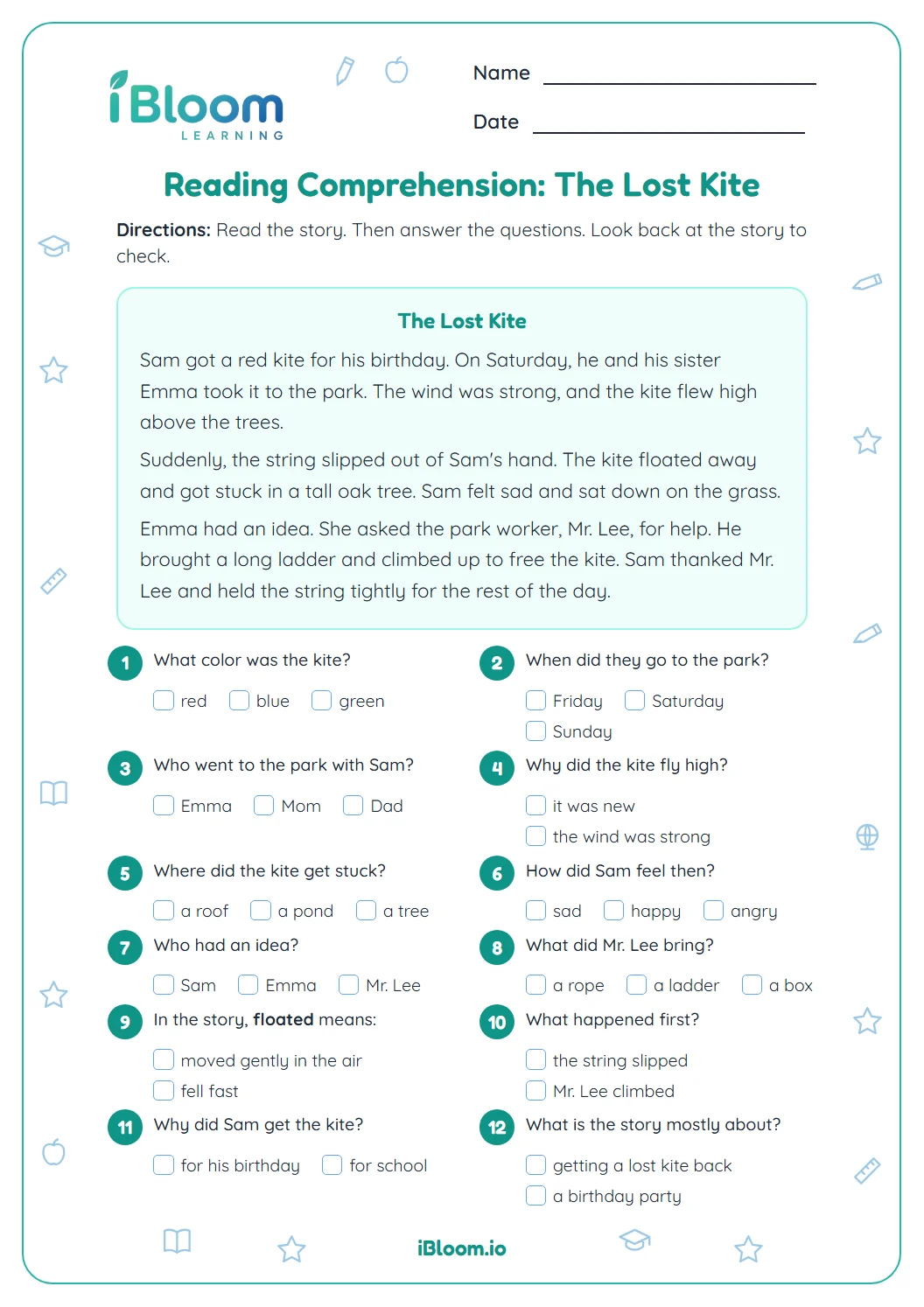
Download the free Second grade reading comprehension worksheet PDF
Answer key preview
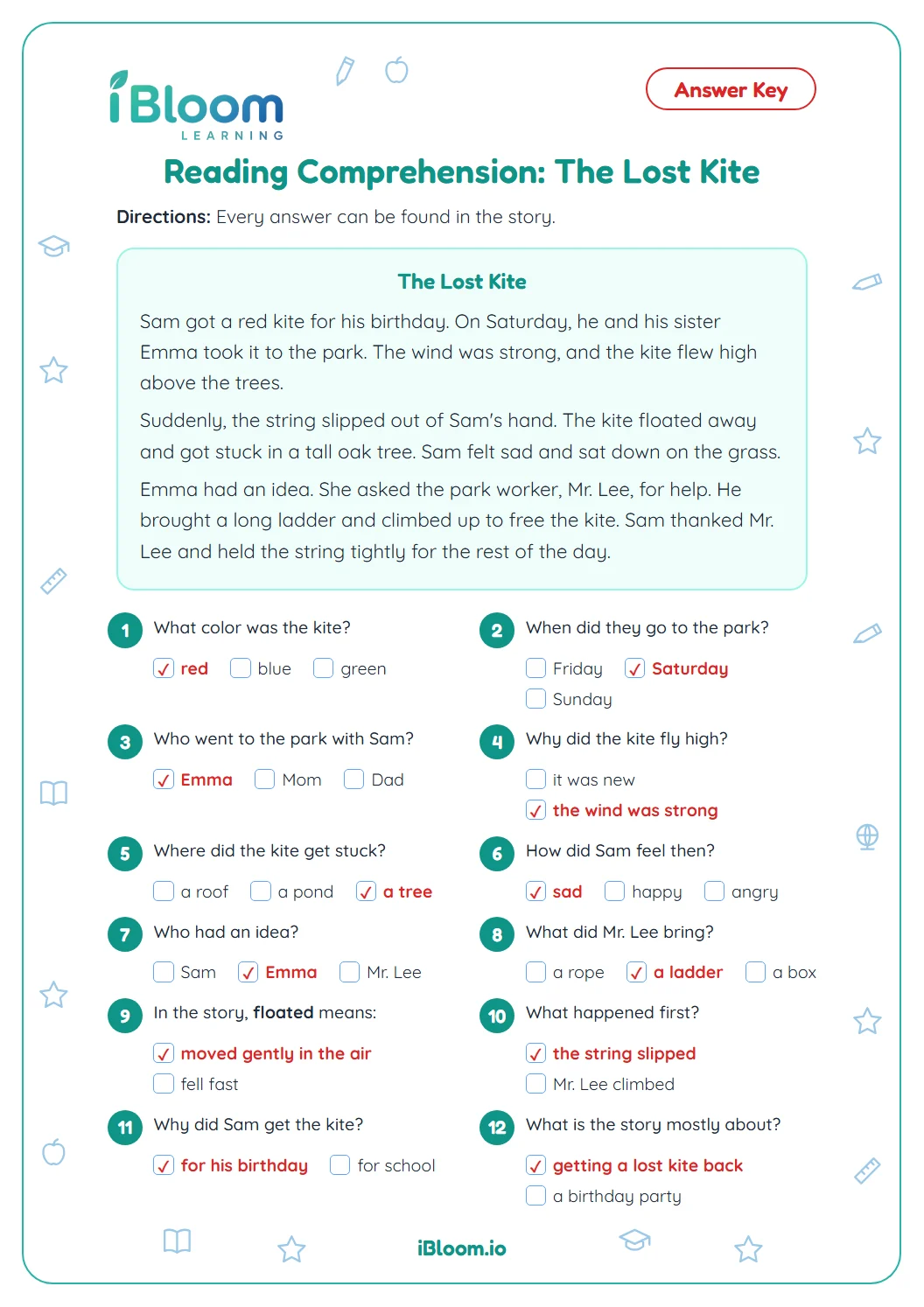
Ask your child to point to the sentence in the story that proves each answer before checking the box.


Quick Takeaways
- Second Grade Reading Comprehension Worksheets should focus on main idea, supporting details, context clues, character response, story sequence, evidence, and short written answers.
- Children learn more from a short explained routine than from a long packet.
- Adults should ask for one explanation after each small practice set.
- Regional context matters, but the page should still teach the skill clearly.
- Use iBloom links throughout the article to move from guide reading into actual child practice.
Why this regional worksheet guide matters
In the United States, skill practice often happens through classroom centers, small groups, intervention blocks, homework folders, and homeschool routines. The page has to help adults choose a skill, not just download a random worksheet.
The best worksheet routine has four parts: preview, try, explain, and repeat. Preview means the adult names the skill. Try means the child completes a small number of items. Explain means the child tells how they knew. Repeat means the skill returns in a new page, lesson, or oral example a few days later.
This matters for US second grade classrooms, homeschool families, intervention groups, and literacy centers in California, Texas, Florida, New York, Illinois, Georgia, Washington, Massachusetts, and North Carolina. A child may know the answer during a lesson and still forget it during homework. A parent may know the child needs practice but not know whether to start with oral language, number sense, phonics, reading, writing, or problem solving. A teacher may need one page for a center and another page for reteaching. This guide helps adults choose the right next step.

Core skills to practise
Start with main idea, supporting details, context clues, character response, story sequence, evidence, and short written answers. Do not practise every skill on the same day. When adults choose one skill, children can notice the pattern and explain the answer.
Useful practice types include:
- Letter-sound or word-reading checks.
- Picture reading and oral sentence practice.
- Short passage questions with evidence.
- Grammar and punctuation corrections.
- Sentence building with nouns, verbs, describing words, and reasons.
- Vocabulary practice using context clues.
- Spelling or phonics review before independent writing.
For children who need reading support, connect this guide with phonics worksheets, context clues for kids, and kindergarten reading assessment. For children who need writing support, use building sentences with nouns and verbs and punctuation worksheets.
Parent routine
Parents can use Second Grade Reading Comprehension Worksheets in 10 to 15 minutes. Start with one shared example. Let the child try three to five items. Ask the child to explain one answer. Stop after a useful correction instead of pushing through a long page.
If the child is multilingual, let the child explain the idea in the home language first, then repeat the important school-language word, number sentence, sound, or explanation. This works well for families across India, the US, and UAE because the goal is understanding first and written accuracy next.
Use this sequence:
- Say the skill: "Today we are practising main idea."
- Model one item.
- Let the child try a small set.
- Ask, "How did you know?"
- Choose one related iBloom page for the next session.

Teacher routine
Teachers can use this guide for lesson planning, small groups, literacy centers, homework review, and parent support. The same page can become a warm-up, an exit ticket, or a reteaching tool depending on the child's response.
For a center, choose one worksheet and one oral explanation task. For a small group, model the thinking aloud. For homework, tell parents which answer the child should explain, not only how many questions to finish.
The strongest teacher move is to connect a worksheet to a follow-up lesson. If a child misses a context clue question, move to a context clue guide. If a child misses punctuation, move to sentence correction. If a child guesses during phonics, move back to sound work.
Common mistakes
Watch for these issues:
- The child finishes the page but cannot explain any answer.
- The adult gives too many hints and the child stops thinking.
- The page mixes too many skills at once.
- Regional labels such as CBSE, kindergarten, or KG2 are used, but the actual skill is unclear.
- The child copies a polished sentence without understanding the word order.
Fix one mistake at a time. Ask the child to point, say, count, underline, draw, or reread. A small correction repeated over several days is stronger than a long correction once.
Explore related iBloom practice
Use these visible links to continue the learning path:
- Continue with this iBloom resource
- Continue with this iBloom resource
- Continue with this iBloom resource
- Continue with this iBloom resource
- Continue with this iBloom resource
- Continue with this iBloom resource
Adults who want background reading can use these external resources:
Frequently Asked Questions
Who should use Second Grade Reading Comprehension Worksheets?
Parents, teachers, tutors, and homeschool families can use it when a second grade child needs focused practice connected to United States school expectations.
Should children complete a full worksheet every day?
No. A short set with one clear explanation is usually better than a long page completed quickly.
How do I choose the right worksheet?
Start with the skill that caused the most recent mistake: sound, word meaning, reading detail, punctuation, grammar, or sentence writing.
Can this work for multilingual families?
Yes. Let the child explain the idea in a home language first if needed, then practise the target word, sound, number, sentence, model, or answer.
What should we do after finishing the worksheet?
Choose one related iBloom lesson, worksheet, or blog guide so the skill appears again in a new context.