Free printable practice
W Z Practice Activities
Printable cursive W-Z worksheets help children practise the final letters of the alphabet with correct joins, loops, slants and spacing.
Free printable worksheet PDFs
Preview every available page, then download the free worksheet PDF for home, homeschool, tutoring, or classroom practice.
Preview the exact activity before downloading it.
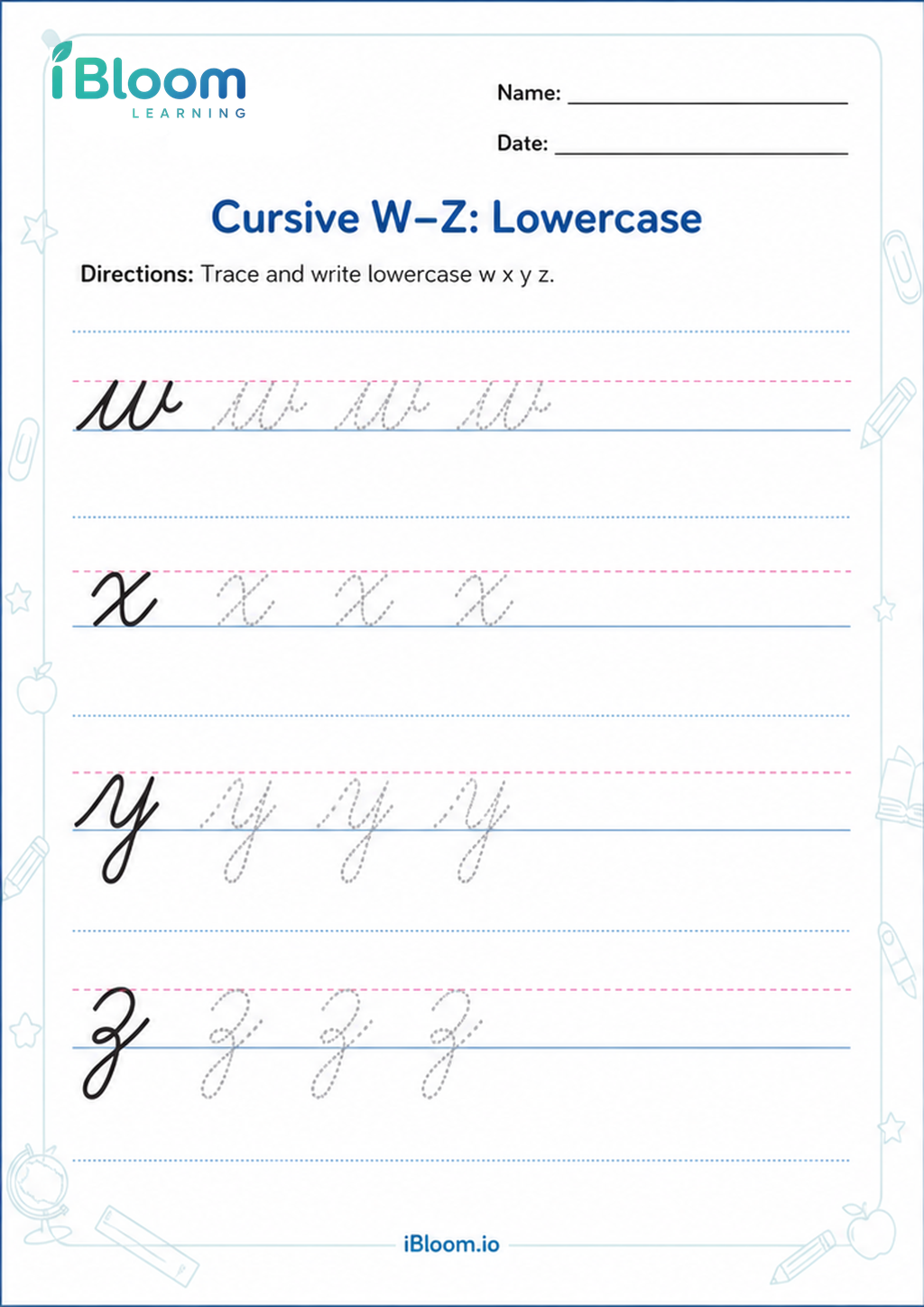 Cursive W–Z: LowercaseClass 2 printable practice for Cursive Letters W–Z.Class 2Free PDF preview
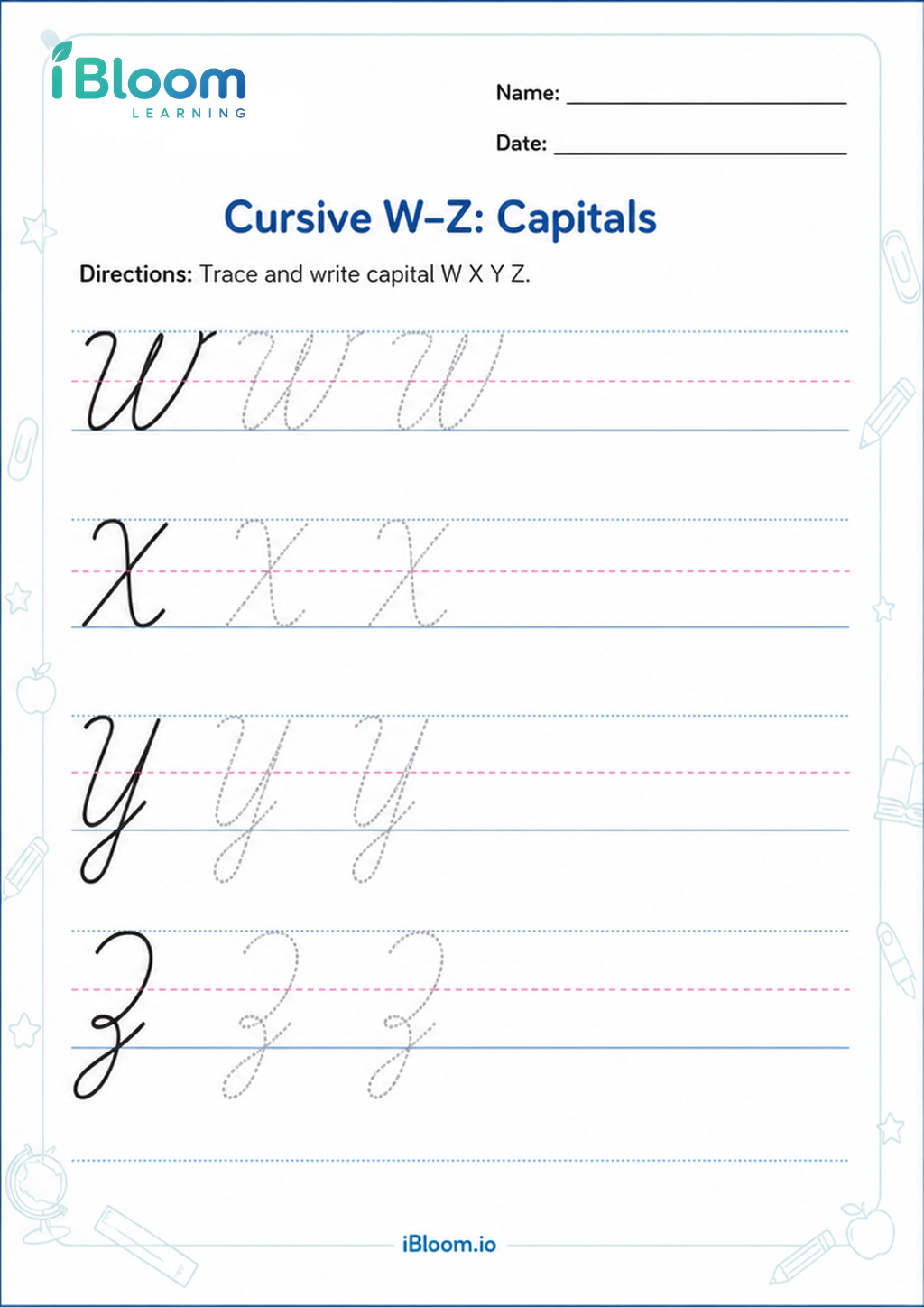 Cursive W–Z: CapitalsClass 2 printable practice for Cursive Letters W–Z.Class 2Free PDF preview
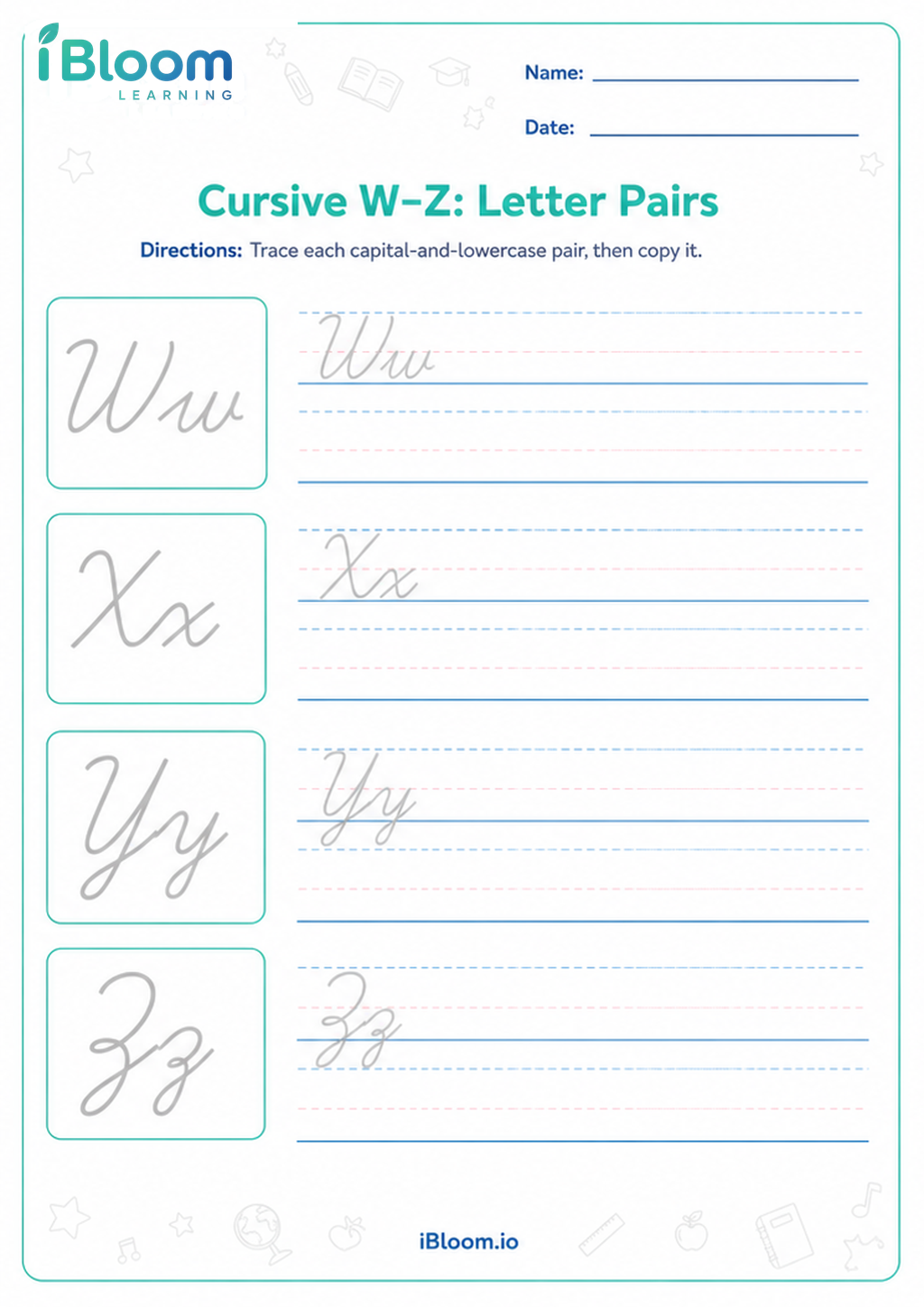 Cursive W–Z: Letter PairsClass 2 printable practice for Cursive Letters W–Z.Class 2Free PDF preview
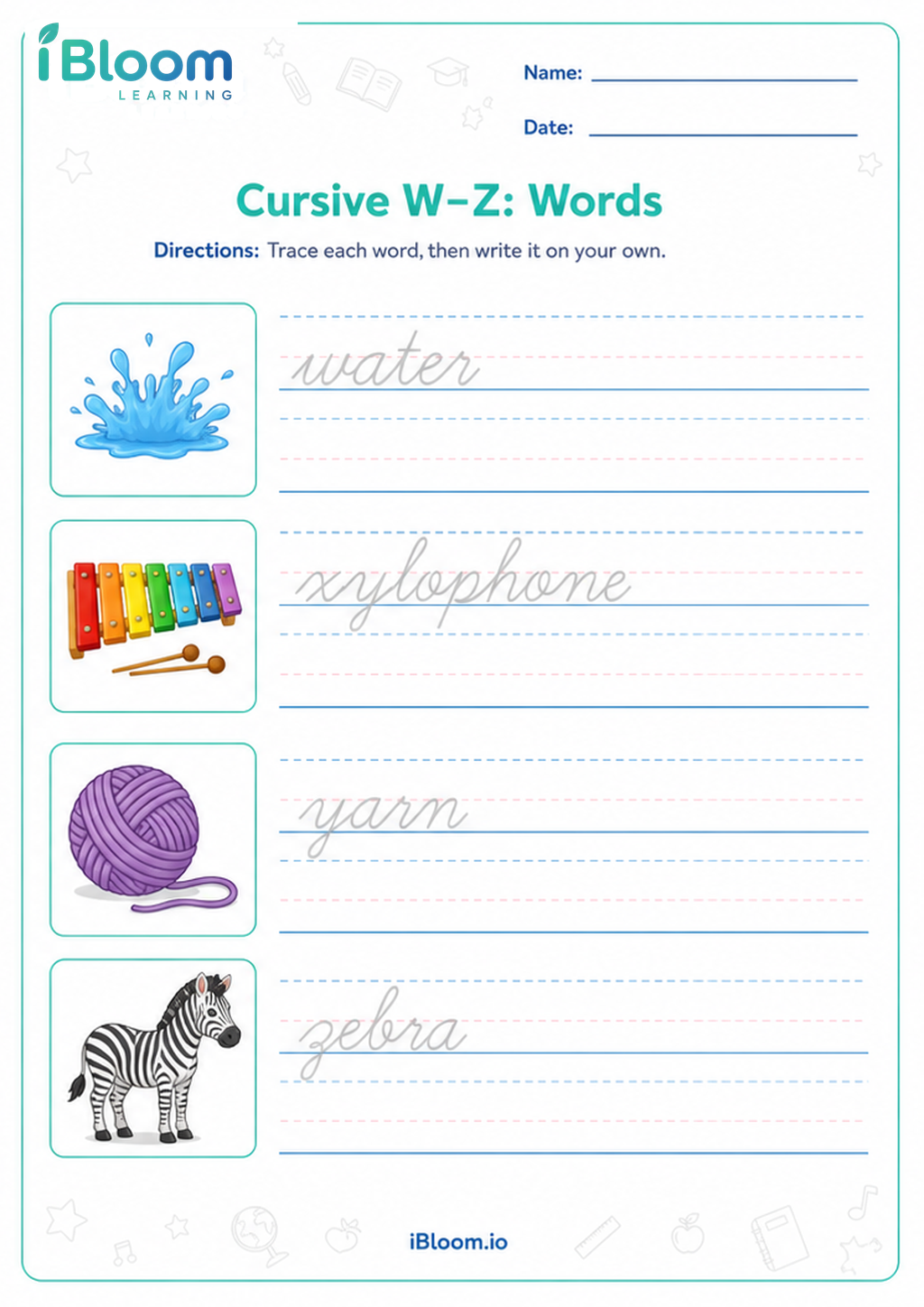 Cursive W–Z: WordsClass 2 printable practice for Cursive Letters W–Z.Class 2Free PDF preview
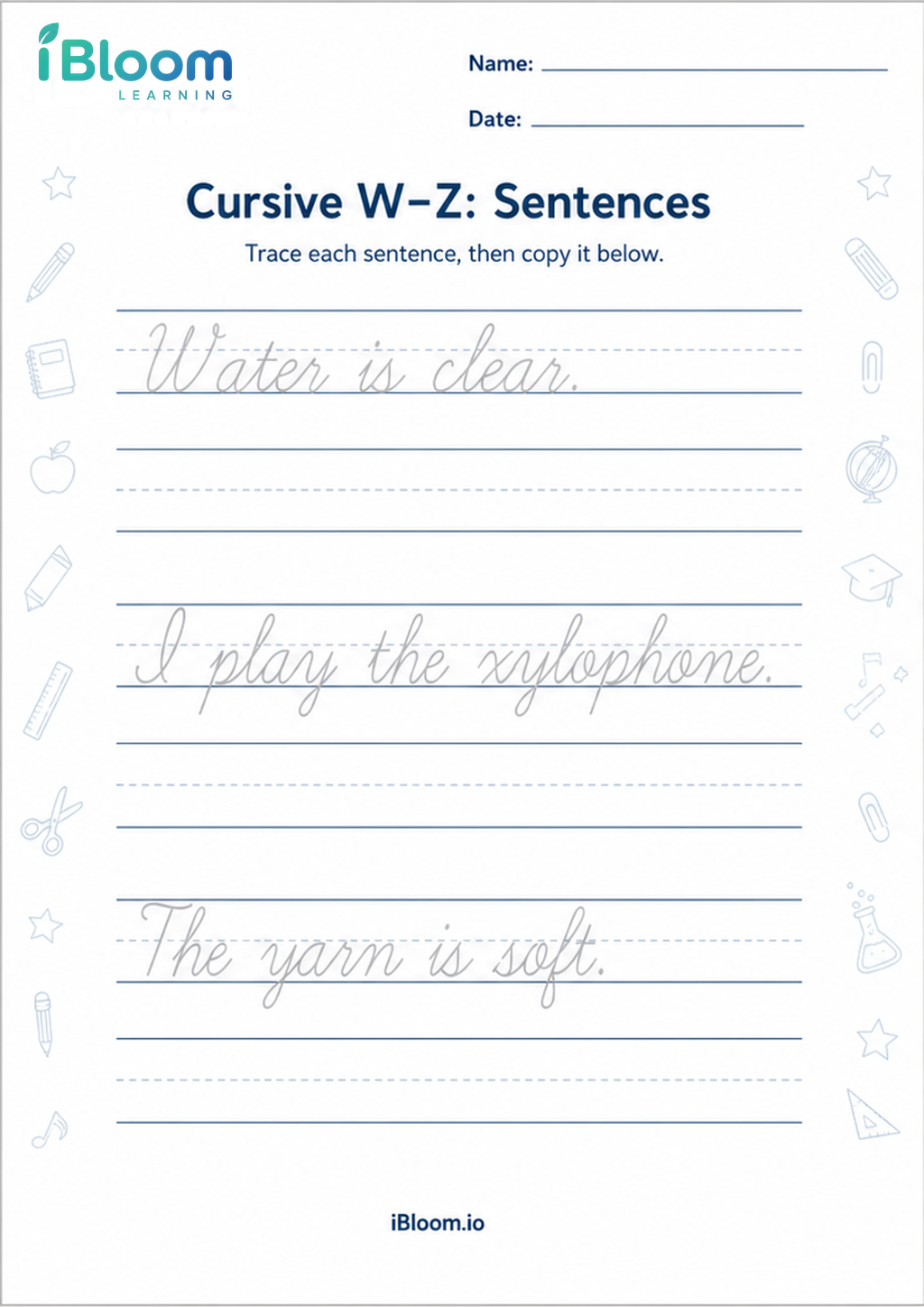 Cursive W–Z: SentencesClass 2 printable practice for Cursive Letters W–Z.Class 2Free PDF preview
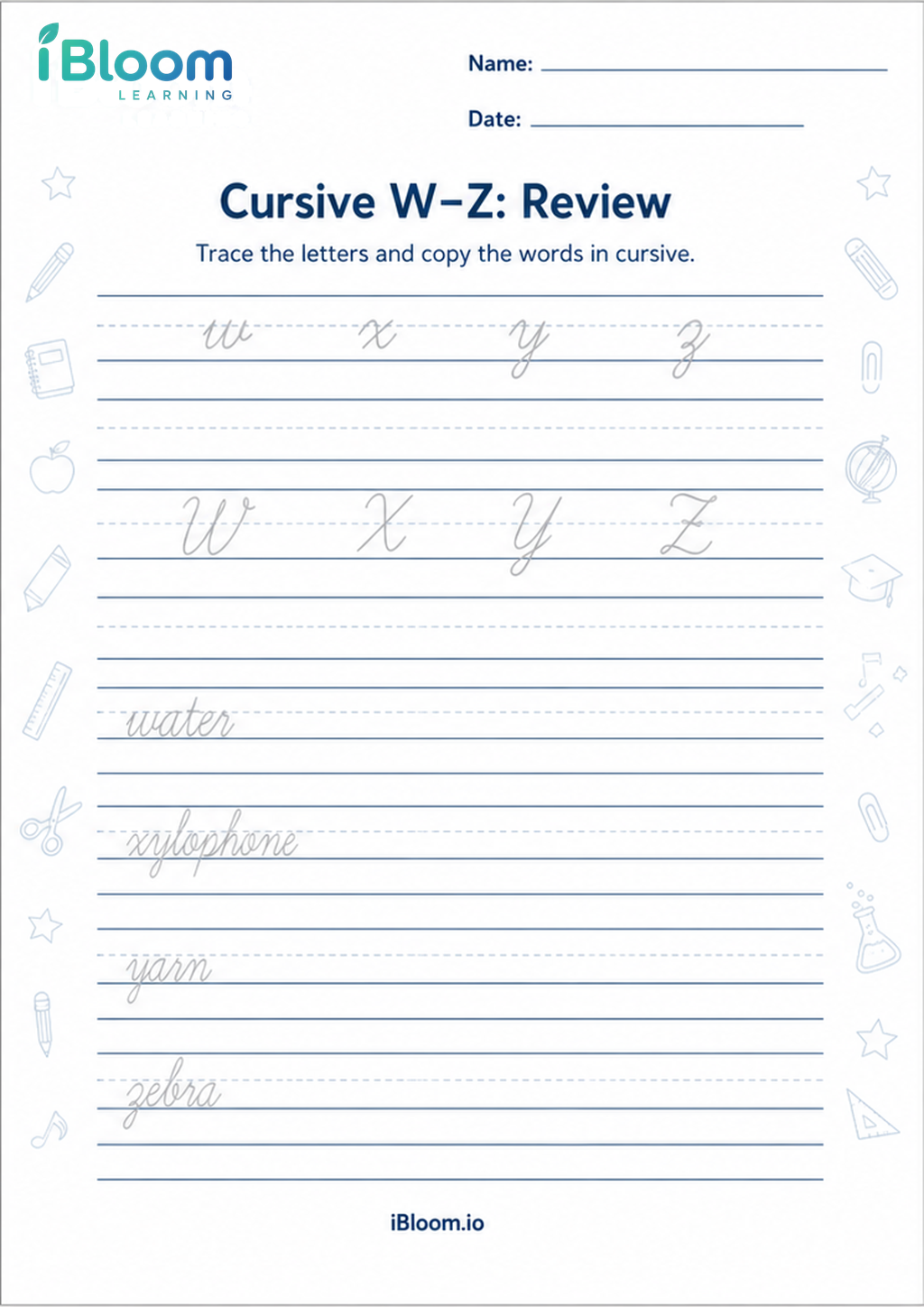 Cursive W–Z: ReviewClass 2 printable practice for Cursive Letters W–Z.Class 2Free PDF preview
Practice that builds confidence
What children practise
These Cursive Writing > Cursive Letters > W Z practice activities help children build control over the final cursive letters: w, x, y and z. Learners trace, copy and write the letters while noticing entry strokes, exit strokes, height, slant and spacing.
The printable worksheets include guided letter practice, repeated formation lines and simple word-level writing where suitable. Children get focused practice with tricky movements such as the pointed turns in w, the crossing movement in x, the descender in y and the angular flow of z.
This collection focuses on the W-Z section of cursive letters, a group that needs careful hand control because the shapes are not all formed in the same way. Children practise starting on the line, moving smoothly through the stroke, and ending with a clear exit stroke so the next letter can join. They also compare letter height: w, x and z sit mainly between the baseline and midline, while y drops below the baseline.

Building letter formation step by step
The activities move from tracing to independent writing. Tracing helps children feel the direction of each stroke before they copy it on their own. For w, they practise even pointed dips. For x, they learn that the crossing stroke should be neat, not oversized. For y, they control the lower loop or tail so it does not collide with the next line. For z, they keep the shape clear while maintaining cursive flow.
A simple parent routine
At home, ask your child to warm up with finger tracing on the page before using a pencil. Say the movement aloud: “start, dip, rise, dip, rise” for w or “down and curve, then cross” for x. Let your child complete one short line carefully, then circle the best-formed letter. This keeps the focus on improvement rather than filling the page quickly.

Classroom uses for teachers
Teachers can use these printables for handwriting practice, early finisher work, small-group support or literacy centres. They are also useful after introducing cursive joins because w, x, y and z give children practice with different ending strokes. Displaying a model letter on the board before worksheet practice helps children match size and slant.

Common errors to watch for
Children may make w look like u, write x as two straight printed lines, forget the descender in y or make z too angular to join smoothly. Spacing can also become uneven when children concentrate on shape. Encourage them to pause, check the baseline and keep each letter within the guide lines.
Free printable PDF download
Use this cursive W-Z practice worksheet page to preview the activity, print it, or download it as a PDF for quick practice. It works well for homework, homeschool lessons, tutoring, morning work, revision, and classroom centers.
Answers and answer key support
After the child completes the worksheet independently, parents and teachers can use the answer support or answer key information to check the work, review mistakes, and choose the next practice step.
Why iBloom worksheets help
The iBloom W-Z cursive worksheets give repeated, focused practice without overloading children with too many letters at once. A child-friendly strategy is: trace slowly, copy once, compare with the model, then write again. This habit builds neatness, confidence and better muscle memory.
Helpful answers
Frequently asked questions
Which letters are practised in the W-Z cursive worksheets?
These worksheets focus on the final cursive letters of the alphabet: w, x, y and z. They help children practise each letter’s shape, size, stroke direction and joining movement.
Why is cursive y harder than the other W-Z letters?
Cursive y includes a descender, which means part of the letter goes below the baseline. Children need to control the tail or loop so it stays neat and does not touch the writing line below.
How can I help my child if cursive w looks like u?
Ask your child to count the two clear dips in w and make both rises tall enough. Slow tracing and saying the movement aloud can help separate w from u.
Should children trace every line before writing independently?
Tracing is useful at the start, but children should also copy and write independently. A good routine is to trace a few examples, copy a short line and then compare their letters with the model.
Can these worksheets be used in class literacy centres?
Yes. Teachers can place the W-Z sheets in handwriting or literacy centres for focused practice, revision, early finisher work or small-group support after demonstrating the letters.
Is this cursive W-Z practice worksheet free?
Yes. You can preview it for free and use the printable worksheet for home or classroom practice.
Can I download this cursive W-Z practice worksheet as a PDF?
Yes. Use the worksheet download option to save a printable PDF, or print the worksheet directly from the page.
Does this cursive W-Z practice worksheet include answers or an answer key?
When the activity has fixed answers, iBloom includes answer support so parents and teachers can check the completed worksheet.