







About this worksheet
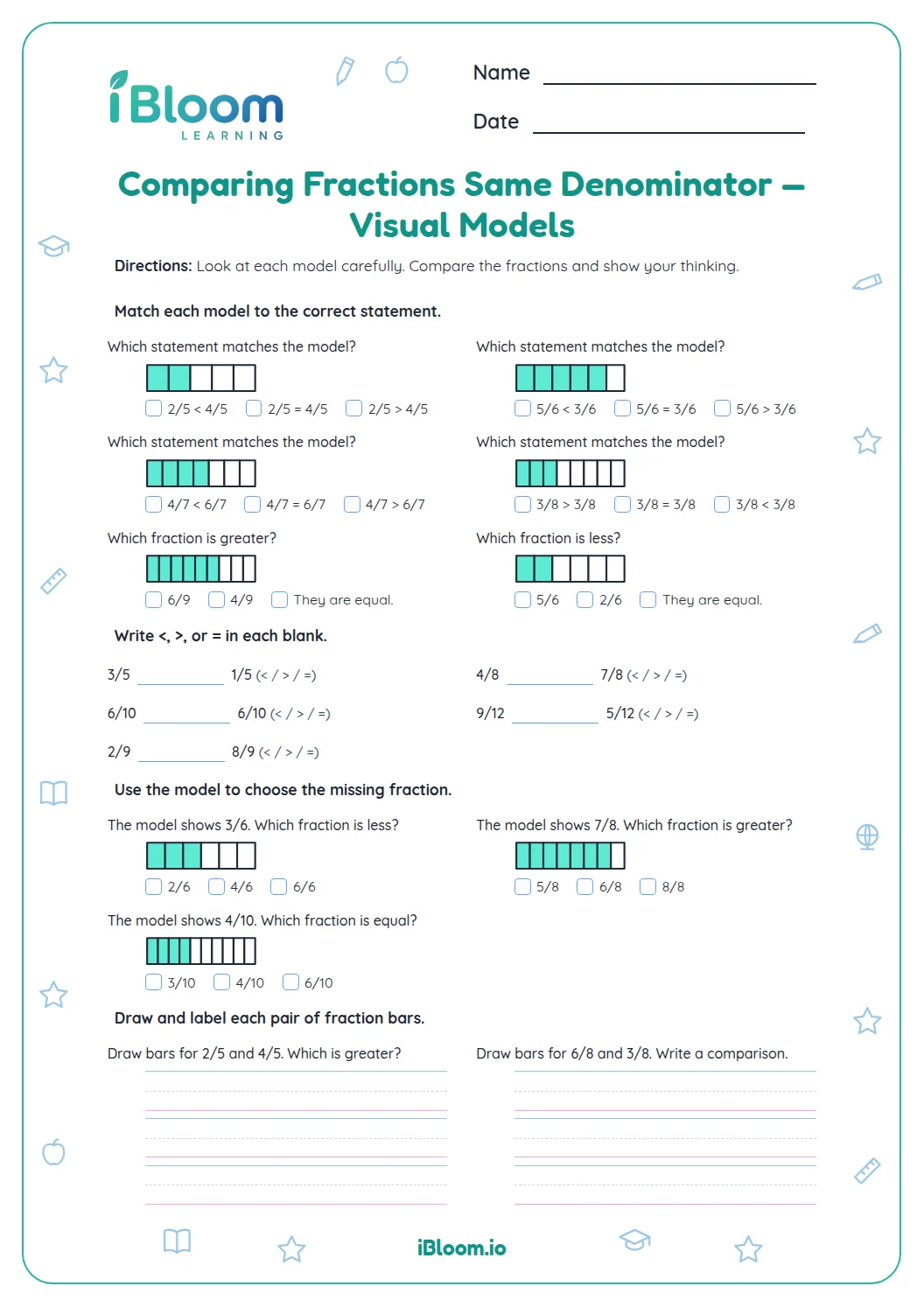
This Grade 3 worksheet makes same-denominator comparisons concrete. Children compare fractions with symbols, read shaded bar models, order three fractions and check a common misconception. The 15 questions progress from direct comparisons to short applications, and the separate key supports quick review.
How do matching denominators help?
When fractions have the same denominator, each piece is the same size. Compare the numerators: 5/8 is greater than 3/8 because five eighth-size pieces cover more than three. In question 2, both fractions are sixths, so 4/6 is greater than 2/6.
- 12/6 and 4/6
- 2Both fractions name sixths.
- 34 pieces are more than 2 pieces.
- 4So 2/6 < 4/6.
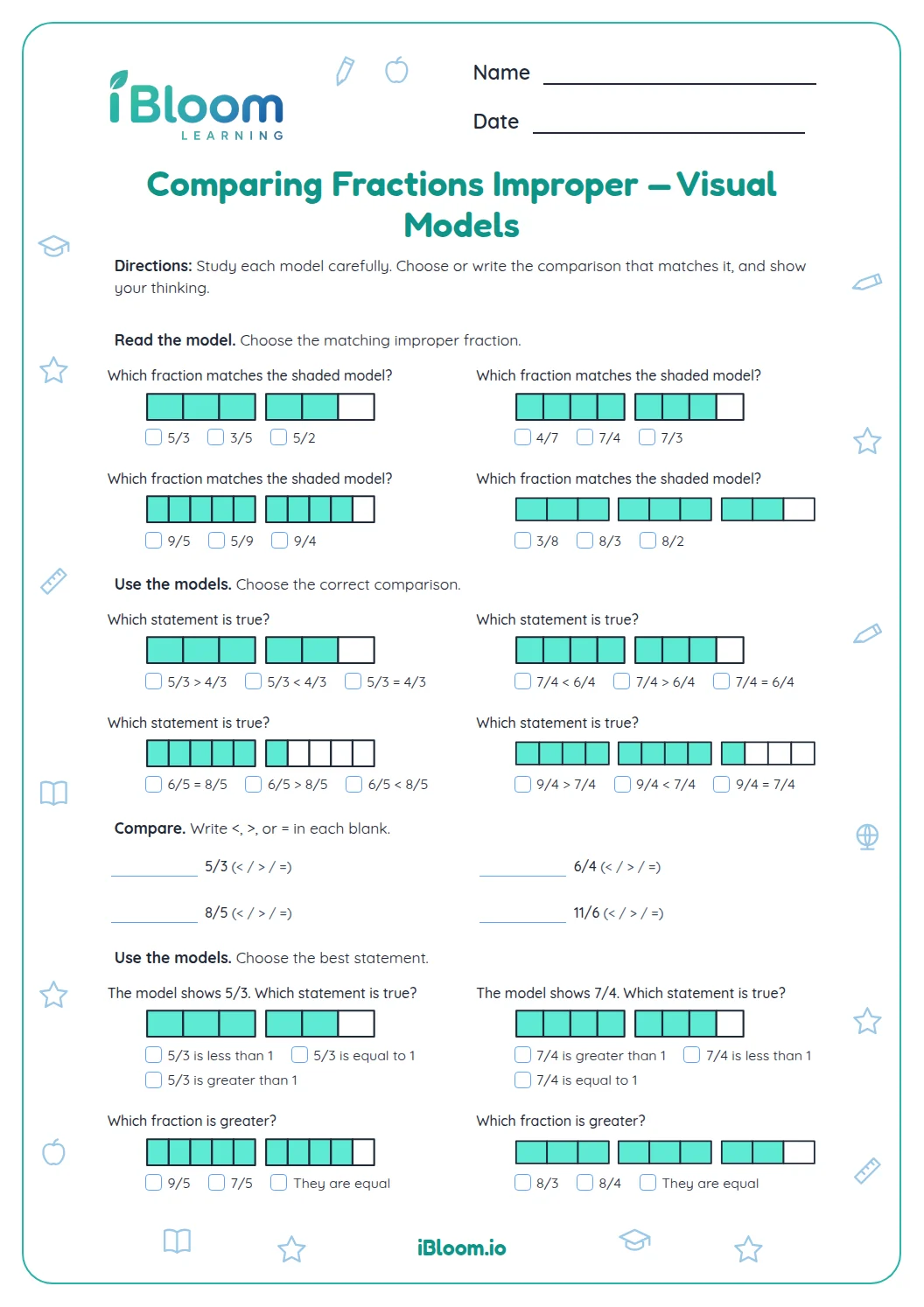
What changes in the model questions?
The bars show the shaded amount as well as the equal partitions. Count the shaded pieces and total pieces, then compare the matching-denominator fractions. The final part asks children to use that reasoning without relying only on a picture.
How to work through the fraction models
- 1Read the denominator first and confirm both fractions use the same-sized parts.
- 2Compare the numerators to see how many parts are shaded or named.
- 3For a symbol blank, decide which side is greater before writing >, < or =.
- 4For ordering, compare all three numerators and keep the common denominator.
- 5Use the bar drawing to check that a larger numerator means more shaded same-size parts.
Common fraction mistakes and quick fixes
The mistake
Choosing the fraction with the larger denominator as larger.
The fix
Check whether the denominators match. Here they do, so the numerator tells how many same-size parts.
The mistake
Reversing > and < after finding the larger fraction.
The fix
Read the symbol as an open mouth pointing toward the greater amount: 4/6 > 2/6.
The mistake
Comparing only numerators when denominators differ.
The fix
Use this shortcut only when the denominators match; otherwise compare the size of the pieces too.
What to practice next
Make more practice
Further reading
Questions parents and teachers ask
Why can I compare the numerators here?
Every pair in the comparison practice uses the same denominator, so each fraction is made of same-size parts. The numerator counts those parts. More same-size parts means a greater fraction, which is why 5/8 is greater than 3/8. Have the student name the total equal parts first, then the selected parts, and connect each count to its
What do the shaded bars represent?
Each bar is split into equal parts, and the filled parts show the numerator. For example, a bar divided into six parts with two shaded represents 2/6. Count all equal sections for the denominator and shaded sections for the numerator. Have the student name the total equal parts first, then the selected parts, and connect each count
How do I order fractions with the same denominator?
Keep the shared denominator in mind and order the numerators from smallest to largest. In question 14, the numerators 1, 3 and 5 give 1/6, 3/6, 5/6 from least to greatest. Have the student name the total equal parts first, then the selected parts, and connect each count to its place in the fraction.
What does the answer key include?
The separate answer key gives the comparison signs, selected fractions, model readings, the ordered list and the multiple-choice responses. Students can first explain why the numerator decides each same-denominator comparison, then check the key. Have the student name the total equal parts first, then the selected parts, and connect each count to its place in the fraction.
How long does this worksheet take?
Plan for about 20 minutes, depending on whether students explain their reasoning aloud. The first questions are quick comparisons; the model reading, ordering and misconception item take longer because they ask students to check how the fractions represent amounts. Have the student name the total equal parts first, then the selected parts, and connect each count to